
SOCOM MK 24 MRGG-A: LMT Mid-Range Gas Gun Guide
Written by John Wren|
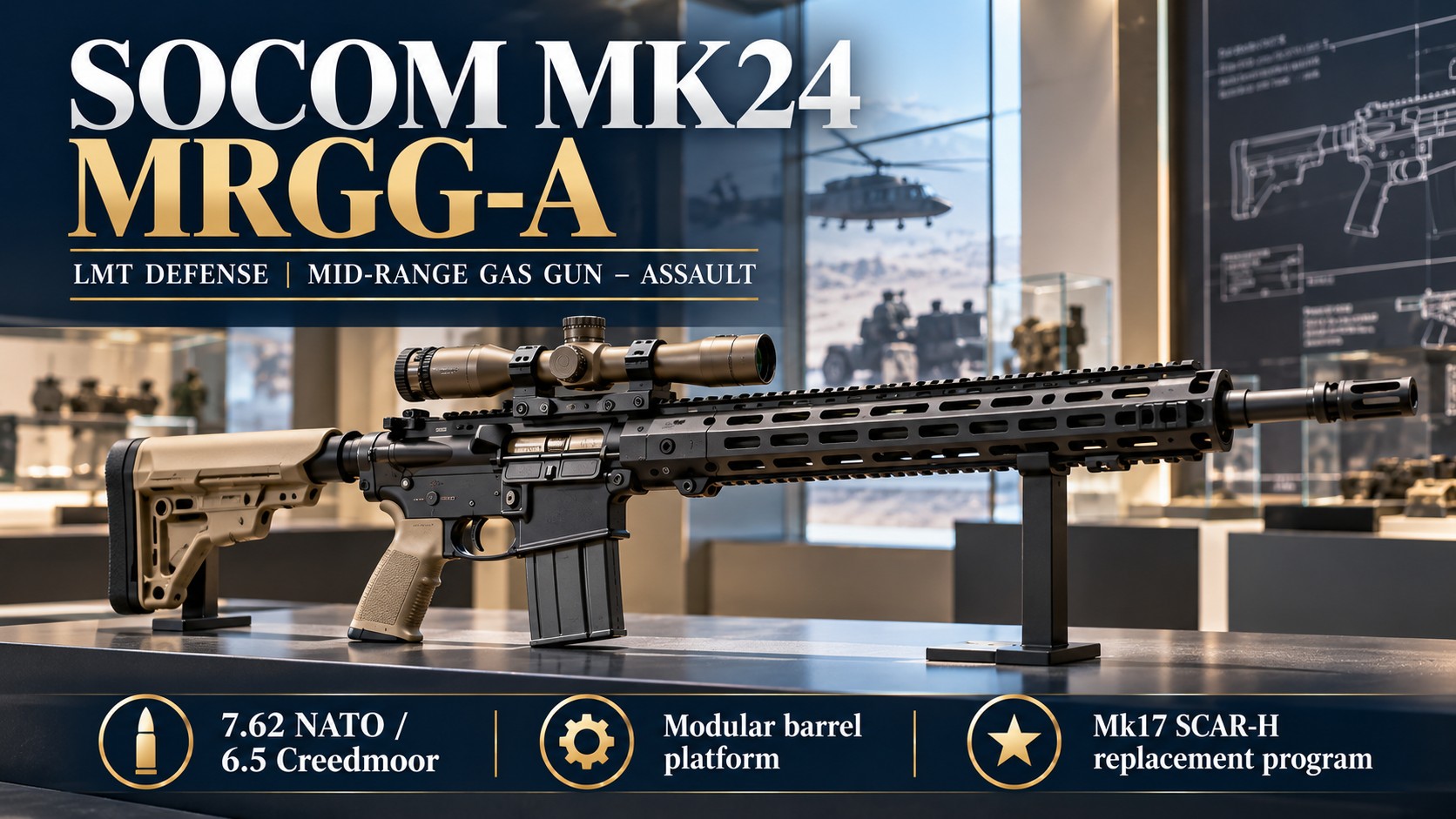
The SOCOM MK 24 MRGG-A is LMT Defense’s Mid-Range Gas Gun – Assault for U.S. Special Operations Command: a modular AR-pattern gas gun with quick-change barrels for 7.62×51mm NATO and 6.5 Creedmoor, built to replace the Mk 17 SCAR-H in the mid-range lane. A common assault-length module is about 14.5 inches. It is not the MRGG-S sniper sibling and it is not a bolt gun. The rifle and the ammunition stay at a licensed dealer or FFL.
Key takeaways
- MK 24 MRGG-A is LMT’s Mid-Range Gas Gun – Assault for SOCOM.
- Dual-caliber modules: 7.62 NATO and 6.5 Creedmoor; about a 14.5-inch assault barrel class.
- Program purpose: replace the Mk 17 SCAR-H in the mid-range / DMR lane.
- The rifle and the ammunition stay at a licensed dealer. No firearm or ammo Amazon button here.
Buy time with a SOCOM MK 24 MRGG-A only if the job is LMT Defense’s Mid-Range Gas Gun – Assault: a modular, dual-caliber gas gun for U.S. Special Operations Command meant to replace the Mk 17 SCAR-H in the medium-range and designated-marksman lane, not a hunting AR-15 you already own. Public reporting and LMT’s own MRGG language put 7.62×51mm NATO and 6.5 Creedmoor on quick-change barrel modules, with a 14.5-inch class barrel as the assault-length starting point. It is not a bolt gun. It is not the MRGG-S sniper sibling. The rifle and the ammunition stay at a licensed dealer or FFL.
Short version. An AR-10 pattern versus DPMS LR-308 pattern is the large-frame receiver family most people mean when they say “.308 AR.” A direct-impingement versus piston AR-15 is the small-frame gas conversation. An AR-15 versus AK-47 is a different caliber and a different magazine. AR pistol, carbine, and rifle sizes are a barrel-and-stock map. A .308 bolt gun versus 6.5 Creedmoor is the bolt-side cartridge split that still matters when the MK 24’s Creedmoor module is on the table. Bolt, semi-automatic, and lever rifles are the action primer. Rated hearing protection and rated shooting glasses go on before a case opens. A gun safe is where a rifle lives between range days.
This magazine does not ship a MK 24, an LMT MRGG-A, or a box of 7.62 NATO or 6.5 Creedmoor. There is no firearm listing here, no ammunition listing here, and no Amazon button for either one. The hero at the top is the SOCOM MK24 MRGG-A poster: LMT Defense mid-range gas gun assault — 7.62 NATO / 6.5 Creedmoor, modular barrel, Mk17 SCAR-H replacement. It is not an Amazon product card.
What is the SOCOM MK 24 MRGG-A?
MK 24 is the Mark designation people use for SOCOM’s Mid-Range Gas Gun – Assault. MRGG-A is LMT Defense’s contract name for that assault / mid-range rifle. The sibling lane is MRGG-S, the sniper-oriented Mid-Range Gas Gun. This page is the -A. Public coverage from outlets that cover SOCOM small arms describes the rifle as the replacement path for the Mk 17 SCAR-H in the medium-range fight: an AR-style large-frame gas gun instead of the SCAR’s reciprocal charging-handle layout, with modular barrels so a unit can swing between 7.62×51mm NATO and 6.5 Creedmoor without buying a second receiver family.
LMT’s civilian MWS / large-frame work is the commercial cousin most shooters already recognize. A contract MRGG-A is not automatically the same SKU as every MWS on a dealer wall. Serial markings, barrel markings, and the bill of sale matter. If the dealer cannot show you whether the sample is a contract-representative rifle, a reference barrel, or a commercial MWS configured to look the part, you are not done shopping. The AR-10 versus DPMS pattern page is still the warning label for large-frame parts mixing. LMT’s monolithic and quick-change ideas do not erase that warning for a random parts cart.
Purpose language in public briefs is consistent: replace the Mk 17 in the mid-range and designated-marksman role with a modular gas gun that keeps AR ergonomics. That is a unit procurement sentence. It is not a promise that every civilian can buy a “SOCOM MK 24” off a web form. Where a commercial LMT large-frame rifle is transferable, it transfers through a licensed dealer like any other rifle. Where a configuration is NFA — short barrel without the right paperwork, or a suppressor on the muzzle — the FFL and the forms are the law.
Who should care about the MRGG-A, and who should not?
Care about it if you follow SOCOM rifle programs, if you shoot LMT large-frame guns, or if you are trying to understand why 6.5 Creedmoor and 7.62 NATO show up on the same assault-length gas gun. Care about it if you are comparing a SCAR-H to an AR-pattern 7.62 for training familiarity. Do not care about it as a first deer rifle slogan. A hunting bolt gun in one cartridge is still the cleaner fall shopping trip for most camps.
Walk past a listing that says “MK 24” without a maker, a model string, and a caliber stamp you can photograph. Walk past a parts kit that claims “MRGG-A clone” if the seller will not put the receiver manufacturer on the invoice. Walk past a barrel swap story if you have not confirmed headspace, gas setting, and the magazine that feeds that chambering. Quick-change marketing is not a substitute for a gunsmith or a factory procedure.
Leave it if you wanted a bolt-action precision rifle. The rifle primer and the .308 versus Creedmoor bolt page are that desk. Leave it if you wanted a 5.56 carbine. The small-frame size and caliber map is that desk. Leave it if your state limits magazine capacity and you have not asked which magazine can leave with the gun.
What do public specs and the attached poster actually print?
The attached editorial poster and public reporting agree on the broad outline. Use the table. Do not invent a street price. Do not treat a suppressed configuration weight as the naked rifle weight.
| Line | SOCOM MK 24 MRGG-A (public / poster) |
|---|---|
| Designation | MK 24; MRGG-A — Mid-Range Gas Gun – Assault |
| Maker | LMT Defense |
| Program | U.S. Special Operations Command (SOCOM) |
| Purpose | Replace the Mk 17 SCAR-H in medium-range and designated-marksman roles |
| Type | Modular dual-caliber assault / designated-marksman gas gun |
| Calibers | 7.62×51mm NATO and 6.5 Creedmoor on quick-change barrel modules |
| Barrel | About 14.5 in as the common assault-length module; interchangeable system |
| Feed | Detachable box magazine; 10-round and 20-round class magazines depending on configuration and law |
| Weight class | Public figures cluster near 9 lb empty for some configs; poster text cites about 4.6–5.4 kg (about 10.1–11.9 lb) depending on configuration |
| Overall length | Poster text cites about 33–40 in depending on stock and barrel |
| Sights | Picatinny rail for optics; low-to-mid power variables and thermal packages appear in kit talk |
| Sibling | MRGG-S is the sniper-oriented Mid-Range Gas Gun, not this page |
Figures from public SOCOM / LMT reporting and the attached editorial poster. Configuration changes with barrel, optic, suppressor, and stock. The rifle and the ammunition stay at a licensed dealer.
When two weight numbers disagree, say both and weigh the serial. Task & Purpose’s public note on the program cited about 9.2 lb empty with a 14.5-inch barrel in one briefing. The attached poster prints a kilogram range that converts higher once optic and configuration stack on. Neither number is a price. Neither number replaces a scale.
How does the MRGG-A run as a gas gun?
The manual of arms is a semi-automatic rifle with a detachable magazine, a charging handle, and a safety you confirm on an unloaded gun. AR-pattern ergonomics are the point of the program story versus the SCAR-H. That does not mean every control is identical to a 5.56 carbine you already own. Magazine geometry for 7.62 NATO is not STANAG 5.56. A 6.5 Creedmoor module needs ammunition and magazines matched to that chambering. Mixing a Creedmoor barrel with a 7.62 magazine full of the wrong cases is how expensive mistakes start.
Gas guns get dirty. A mid-length or rifle-length gas talk from a 5.56 carbine does not automatically map onto a 14.5-inch 7.62 barrel. Follow the maker’s lubrication and cleaning notes for the serial you hold. Direct impingement versus piston is still the small-frame essay; do not paste it onto an LMT large-frame without reading LMT’s own system description for that upper. After a range day, unload, magazine out, chamber checked, then clean. Hoppe’s No. 9 and Break-Free CLP are solvents and oils, not ammunition.
Optics live on the rail. A low-power variable is a common mid-range choice; a higher magnification is a designated-marksman choice. AR optics and a red-dot comparison are accessory desks, not firearm sales. Mount height, eye relief, and a confirmed zero matter more than a program nickname. Confirm a zero before you trust a hold. Accuracy work is still a sight picture and a press.
What about 7.62 NATO, 6.5 Creedmoor, and barrel modules?
Two chamberings on one receiver family is the headline. 7.62×51mm NATO is the legacy battle-rifle cartridge the SCAR-H already used. 6.5 Creedmoor is the flatter, lower-recoil module units want for mid-range hits when the barrel and the load are matched. The bolt-gun Creedmoor page explains the cartridge trade in hunting weight. On a gas gun with a 14.5-inch class barrel, velocity and gas behavior are not the same as a 24-inch bolt gun. Do not copy a bolt-gun drop chart onto this barrel.
This magazine does not sell ammunition. The dealer matches the box to the stamp on the barrel module that is installed. If the rifle in the case has a 7.62 barrel, buy 7.62 / .308 ammunition the maker allows. If the Creedmoor module is installed, buy 6.5 Creedmoor. Do not “try a few” of the other cartridge because the magazine seated. Headspace and chamber are not suggestions.
Barrel swaps follow the maker’s procedure. Torque, gas settings, and a function check with the magazine you will actually use are part of the swap. If you cannot do that at the dealer or with a qualified smith, you do not have a dual-caliber rifle. You have a single-caliber rifle and a spare barrel in a box.
What do you confirm before it leaves the counter?
Name the model out loud: LMT, MRGG-A or the commercial model string on the receiver, not just “MK 24.” Read the caliber stamp on the installed barrel. Ask which magazines are in the case and which capacity your state allows to leave. Ask whether a suppressor on the sample is included, demilled, or a photo prop. Ask whether the stock length and the optic are part of the tagged price.
Run the action empty. Lock the bolt open. Look into the chamber. Confirm the safety on and off with the muzzle in a safe direction. Seat an empty magazine and remove it. If the dealer will not do those steps with you, you are not done. Responsible ownership is that habit, not a caption.
Hearing protection and glasses before the first round. Impact Sport and Walker’s Razor if you want a muff model name. A two-point sling is a strap. A range bag holds the kit. A gun safe at home is the next stop. Unload before the case. Magazine out. Chamber visible. Ammunition stored separately.
What does the clip on this page show?
The clip is a public YouTube video from 9-Hole Reviews titled “LMT MRGG-A [SOCOM Battle Rifle] to 1,000yds: Practical Accuracy.” The title names the LMT MRGG-A and the SOCOM battle-rifle role, and it frames a practical-accuracy string. This magazine has not timed the video, has not treated on-camera groups as a guarantee for your serial, and has not imported any price spoken in the clip. The hero at the top is the SOCOM MK24 MRGG-A — LMT Defense mid-range gas gun assault poster. The play image is YouTube’s thumbnail.
So should you buy a MK 24 MRGG-A pattern rifle?
Buy into this conversation if you want LMT’s Mid-Range Gas Gun – Assault story clear: SOCOM mid-range replacement for the Mk 17 lane, AR-pattern gas gun, 7.62 NATO and 6.5 Creedmoor modules, assault-length barrel class, and a dealer who will put the real model string on the transfer. Buy a commercial LMT large-frame only when the invoice matches the receiver. Buy a hunting bolt gun if the job is one animal and one cartridge. Buy nothing that skips an FFL.
The price is the tag at the licensed counter on the day you are there. This magazine does not print a price. The rifle stays at a licensed dealer. The ammunition stays there too. The program coverage, the attached poster, and the serial in the case are the facts. The dealer is the transfer.
Frequently asked questions
What is the SOCOM MK 24 MRGG-A?
It is LMT Defense’s Mid-Range Gas Gun – Assault for SOCOM: a modular gas gun meant to replace the Mk 17 SCAR-H in the medium-range and designated-marksman role. MK 24 is the Mark name; MRGG-A is the contract name.
What calibers does the MRGG-A use?
Public program language and the attached poster put 7.62×51mm NATO and 6.5 Creedmoor on quick-change barrel modules. Match the box to the installed barrel stamp at a licensed dealer.
Can I buy the MK 24 or the ammunition from this magazine?
No. There is no firearm listing and no ammunition listing here, and no Amazon button for either one. The rifle and the ammunition stay at a licensed dealer or FFL.
Is the MRGG-A the same as the MRGG-S?
No. MRGG-A is the assault / mid-range gun. MRGG-S is the sniper-oriented Mid-Range Gas Gun sibling. This page is the -A.
What barrel length do public notes describe?
A common assault-length module is about 14.5 inches, with an interchangeable barrel system. Overall length and weight change with stock, optic, and suppressor. Confirm the serial.
What does the video on this page show?
A public 9-Hole Reviews clip titled LMT MRGG-A [SOCOM Battle Rifle] to 1,000yds: Practical Accuracy. The title names the MRGG-A. This magazine has not timed it. The play button uses YouTube’s thumbnail.