
XM2010 Enhanced Sniper Rifle: .300 Win Mag Buyer's Guide
Written by John Wren|
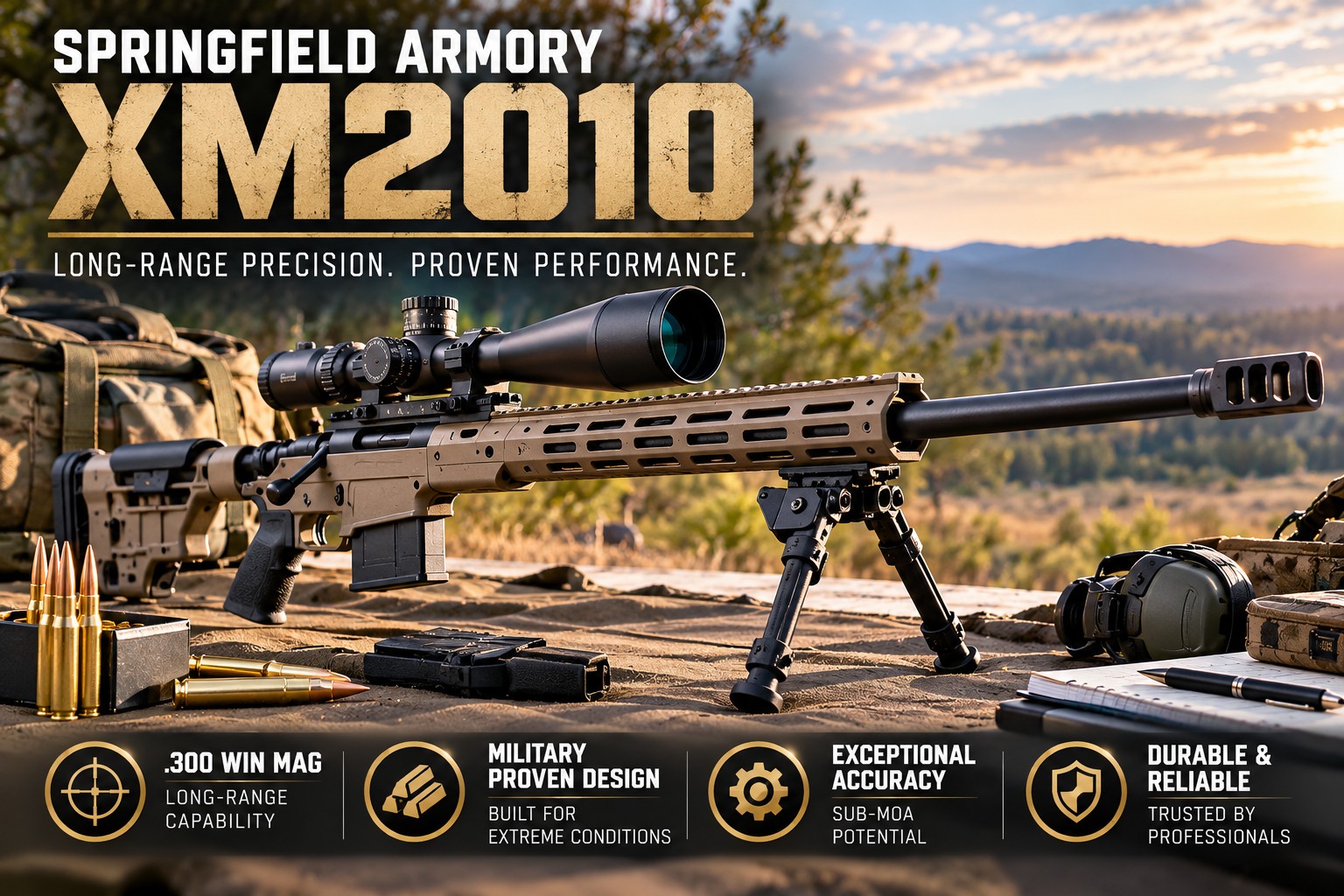
The XM2010 is the developmental name for Remington’s Enhanced Sniper Rifle that the Army fielded as the M2010 ESR: a Remington 700-pattern bolt gun in .300 Winchester Magnum with a modular chassis, a long fluted barrel class, and a suppressor path. It replaced the M24 in the longer sniper lane. It is not a semi-automatic and it is not a 6.5 Creedmoor shopping trip. The rifle and the ammunition stay at a licensed dealer or FFL.
Key takeaways
- XM2010 is the developmental tag for the M2010 Enhanced Sniper Rifle in .300 Winchester Magnum.
- Remington-pattern bolt action in a modular chassis; about a 24-inch barrel class in public sheets.
- It replaced the M24 7.62 NATO sniper rifle in the longer-range lane.
- The rifle and the ammunition stay at a licensed dealer. No firearm or ammo Amazon button here.
Buy time with an XM2010 Enhanced Sniper Rifle only if the job is a Remington-pattern bolt gun chambered in .300 Winchester Magnum from the Army’s M2010 Enhanced Sniper Rifle program, not a hunting .308 you already zeroed. The XM2010 name is the developmental tag for the rifle that entered service as the M2010 ESR: a chassis bolt gun with a long fluted barrel, a rail for a day optic, and a suppressor path the old M24 7.62 kit did not carry as a system. It is not a semi-automatic. It is not a 6.5 Creedmoor shopping trip. The rifle and the ammunition stay at a licensed dealer or FFL.
Short version. A bolt-action rifle is the action family. A Remington 700 5R is the civilian Remington-pattern bolt many people already know. A .308 bolt gun versus 6.5 Creedmoor is a hunting-cartridge choice in a different weight class. Bolt-action elk rifles are the sporting list. A long-range scope and a rifle-scope review are the glass conversation after the stamp on the barrel is clear. Rated hearing protection and rated shooting glasses go on before a case opens. A gun safe is where a rifle lives between range days.
This magazine does not ship an XM2010, an M2010, or a box of .300 Winchester Magnum. There is no firearm listing here, no ammunition listing here, and no Amazon button for either one. The hero at the top is the Springfield Armory XM2010 poster: long-range precision, proven performance, in a mountain golden-hour scene. It is not an Amazon product card.
What is the XM2010 Enhanced Sniper Rifle?
The XM2010 is the developmental designation for Remington’s Enhanced Sniper Rifle work that the U.S. Army fielded as the M2010 ESR. In plain speech, people still say XM2010, M2010, and Enhanced Sniper Rifle for the same program family. The chambering that defines the system is .300 Winchester Magnum. The parent rifle it replaced in the long-range lane was the M24, a Remington 700-pattern bolt gun in 7.62×51mm NATO. The upgrade was not a new toy for its own sake. It was more reach, a modular chassis, and a kit built around a day optic and a suppressor path that the older 7.62 sniper package did not treat as one system.
Remington’s military work sat on the same bolt-action DNA as the Remington 700 family that civilian counters still stock. That is why a 700 5R review is useful background for the action, even though a 5R on a hunting rack is not an M2010 kit and does not share the Army’s optic, chassis, or ammunition contract. The action lifts and pulls. The magazine is a detachable box in the chassis, not a floorplate you dump into your palm for every string. The stock is a modular chassis with an adjustable comb and length of pull, not a one-piece hunting stock you bed once and forget.
Public program writing and Remington-era product sheets for the ESR family describe a 24-inch barrel class, often fluted, with a threaded muzzle for a suppressor. Overall length and weight move with the stock setting, the optic, and whether a suppressor is mounted. Do not quote a single “empty weight” from a forum post as if it were a stamped plate. Weigh the serial in front of you, or read the sheet the dealer hands you for that configuration. The .300 Winchester Magnum stamp is the hard line. A .308 Win or 7.62 NATO box does not belong in that chamber because the case looks familiar.
Who is this rifle for, and who should walk past it?
This guide is for a reader who wants to understand the XM2010 / M2010 program rifle as a system: bolt action, .300 Win Mag, Remington lineage, chassis, optic rail, suppressor path. It is for someone comparing a precision bolt gun to a hunting Remington, or comparing a magnum sniper cartridge to the 7.62 NATO M24 it replaced. It is not a shopping cart for a first deer rifle, and it is not a mail-order checklist.
Walk past a civilian transfer that is marketed as “just like an XM2010” if the dealer cannot show you the actual model name, the caliber stamp, the barrel length, and the chassis maker on the serial you are holding. Military surplus language is not a model number. A Remington 700 in .300 Win Mag with aftermarket glass is still a Remington 700 until the tag says otherwise. A chassis kit you bolt on at home is not an Army ESR. If the job is a western hunting rifle in .308 or 6.5 Creedmoor, read the cartridge comparison and leave the sniper-program vocabulary on the shelf.
Leave it if you wanted a semi-automatic. An AR-15 or an AK-47 is a different manual of arms. An AR-10 or LR-308 pattern is a large-frame gas gun, not a bolt. Leave it if your state or your range will not allow the magazine or the suppressor path you were picturing. A threaded muzzle is not a promise that a can leaves the shop with you. The FFL and the stamp on the tax form are the law, not a caption on a poster.
What do the program sheets and public specs actually say?
Use the table as a map of the program rifle, not as a price list and not as a guarantee for every civilian look-alike. Where public Army and Remington-era descriptions agree, the cells are short. Where configurations differ, the cell says so.
| Line | XM2010 / M2010 ESR program rifle |
|---|---|
| Program names | XM2010 (developmental), M2010 Enhanced Sniper Rifle (fielded) |
| Maker lineage | Remington Arms for the Army ESR effort; Remington 700-pattern bolt action |
| Type | Bolt-action sniper rifle in a modular chassis |
| Chambering | .300 Winchester Magnum |
| Predecessor role | Replaced the M24 sniper rifle in 7.62×51mm NATO for the longer shot |
| Barrel class | About 24 in / 610 mm in public program descriptions; often fluted; threaded muzzle |
| Feed | Detachable box magazine in the chassis |
| Optic interface | Full-length rail for a day optic; kit optics vary by contract year |
| Stock | Adjustable chassis; folding-stock variants appear in kit photos and sheets |
| Suppressor | System path for a muzzle can; confirm the thread and the NFA rules before you plan one |
Program figures from public Army and Remington-era descriptions. Configuration changes with optic, stock, and suppressor. The rifle and the ammunition stay at a licensed dealer.
Do not average a suppressor-on weight with a suppressor-off weight. Do not copy a “max effective range” from a highlight reel as if it were a ballistic table for the load in your box. Confirm a zero on the rifle you will shoot, with the ammunition the dealer matched to the stamp, from a rest you trust. Accuracy work is a sight picture and a trigger press, not a program nickname.
How does the XM2010 run as a bolt gun?
The manual of arms is still a bolt-action rifle. Safety on. Magazine seated. Bolt lifted, pulled, pushed, and locked. The difference from a sporter Remington is the chassis and the magazine: you are not swinging a hinged floorplate under a walnut stock. You are locking a modular stock to a length and a comb height that fit the optic height, then running a short-action or long-action feel that depends on the receiver the kit actually uses. Ask the dealer to show the bolt throw on an unloaded gun. Magnum bolt faces and magnum magazine geometry are not the same as a .308 hunting 700 you borrowed last season.
Empty cases leave through the ejection port when you run the bolt. Hot brass is still hot. The barrel and the suppressor, if mounted, get hot enough to burn skin after a string. Gloves are not a fashion choice on a magnum sniper barrel. The optic’s elevation and windage are the optic’s clicks, not the iron-sight MOA note from a different rifle. If the kit optic has a reticle with holds, learn that reticle on paper before you trust a hold in the field. The scope review desk is where glass shopping lives. This page does not name a mail-order scope as part of a firearm sale.
A bipod on the rail or the chassis is common on the program look. A bipod is an accessory. It is not the rifle. A sling is an accessory. A two-point sling comparison is a strap conversation, not a bolt-gun transfer. Keep the accessories on separate receipts from the firearm if your dealer runs it that way, and keep the ammunition on its own stop at the same counter.
What about .300 Win Mag, suppressors, and the transfer?
.300 Winchester Magnum is the chambering the program rifle is known for. The ammunition has to match the stamp, including the case. This magazine does not sell ammunition and does not name a mail-order load. The dealer matches the box to the barrel. Magnum recoil is real. A brake or a can changes the blast and the feel. Neither one is a free gift that appears because a poster showed a long muzzle device. A suppressor is an NFA item in the United States when the law treats it that way. The FFL walks the form. This page does not.
Civilian ownership of a Remington-pattern .300 Win Mag bolt gun is a normal FFL transfer where state law allows it. Ownership of a rifle that was actually an Army M2010 kit is a different story: demilitarized sales, contractor leftovers, and “clone” builds are not one product. Read the serial, the receiver markings, and the bill of sale. If the seller cannot put the model in writing, you are not buying a program rifle. You are buying a story.
Carry and transport rules are local. A locked case, a separate ammunition container, and a route that does not cross a prohibited place are statutes, not vibes. Responsible ownership starts at the counter and continues in the safe. Unload before the case. Magazine out. Bolt open. Chamber visible.
What optic and kit questions should you ask?
Ask what day optic is on the sample, what rings or mount it uses, and whether that optic is included in the price on the tag. Program kits have used more than one glass over the years. A Leupold on one photo and a different variable on another photo are not a contradiction you solve by averaging. They are different kits. Long-range scope shopping is its own desk. Do not let a salesman bundle a random 6-24 onto a Remington and call the package an XM2010 because the barrel is long.
Ask about the chassis maker, the magazine brand and capacity, whether the stock folds, and whether the muzzle is threaded. Ask for the thread pitch in writing before you plan a brake or a can. Ask whether the barrel is the 24-inch class the program is known for, or a different length on that serial. Measure if the sheet is vague. A tape measure at the counter is cheaper than a wrong assumption.
Hearing protection rated for a magnum, and shooting glasses, go on before the first round. Impact Sport and Walker’s Razor are one muff comparison if you want a model name. A range bag holds them. Hoppe’s No. 9 and Break-Free CLP are cleaning products, not ammunition. Solvents stay away from primers. Clean after the session with the gun unloaded and the ammunition in another room.
What does the clip on this page show?
The clip is a public YouTube video from Military Mechanics titled “The M2010: Long-Range Sniper Rifle.” The title names the M2010 Enhanced Sniper Rifle and frames it as a long-range sniper system. This magazine has not timed the video, has not counted the rounds in it, and has not treated the narration as a ballistic table. The hero at the top is the Springfield Armory XM2010 mountain golden-hour poster. The play image is YouTube’s thumbnail for that clip, not a photograph this magazine made.
So should you buy an XM2010-pattern rifle?
Buy into this conversation if you want a Remington-pattern bolt gun in .300 Winchester Magnum with the Enhanced Sniper Rifle story clear in your head: chassis, rail, long barrel class, suppressor path, and a dealer who will put the real model name on the transfer. Buy a sporting Remington or another bolt gun if the job is hunting weight and a cartridge your camp already stocks. Buy nothing from a mailbox that will not complete an FFL transfer.
The price is the tag at the licensed counter on the day you are there. This magazine does not print a price. The rifle stays at a licensed dealer. The ammunition stays there too. The program sheets and the serial in the case are the facts. The dealer is the transfer.
Frequently asked questions
What is the XM2010 Enhanced Sniper Rifle?
It is Remington’s Enhanced Sniper Rifle for the Army, fielded as the M2010 ESR: a bolt-action chassis rifle chambered in .300 Winchester Magnum. XM2010 is the developmental name people still use for the same program family.
What caliber does the XM2010 / M2010 use?
.300 Winchester Magnum. It is not a 7.62 NATO M24 chambering and it is not 6.5 Creedmoor. Match the box to the stamp at a licensed dealer.
Can I buy the XM2010 or the ammunition from this magazine?
No. There is no firearm listing and no ammunition listing here, and no Amazon button for either one. The rifle and the ammunition stay at a licensed dealer or FFL.
Is the XM2010 the same as a Remington 700 5R?
No. Both sit on Remington bolt-action DNA, but a 5R on a hunting rack is not an M2010 kit. Chassis, optic, barrel class, and ammunition contract are different.
What barrel length do public sheets describe?
Public Army and Remington-era descriptions put the ESR in about a 24-inch / 610 mm barrel class, often fluted, with a threaded muzzle. Confirm the serial in front of you.
What does the video on this page show?
A public Military Mechanics clip titled The M2010: Long-Range Sniper Rifle. The title names the M2010. This magazine has not timed it. The play button uses YouTube’s thumbnail.