
Kel-Tec P50: A 5.7x28 Buyer's Guide
Written by John Wren|
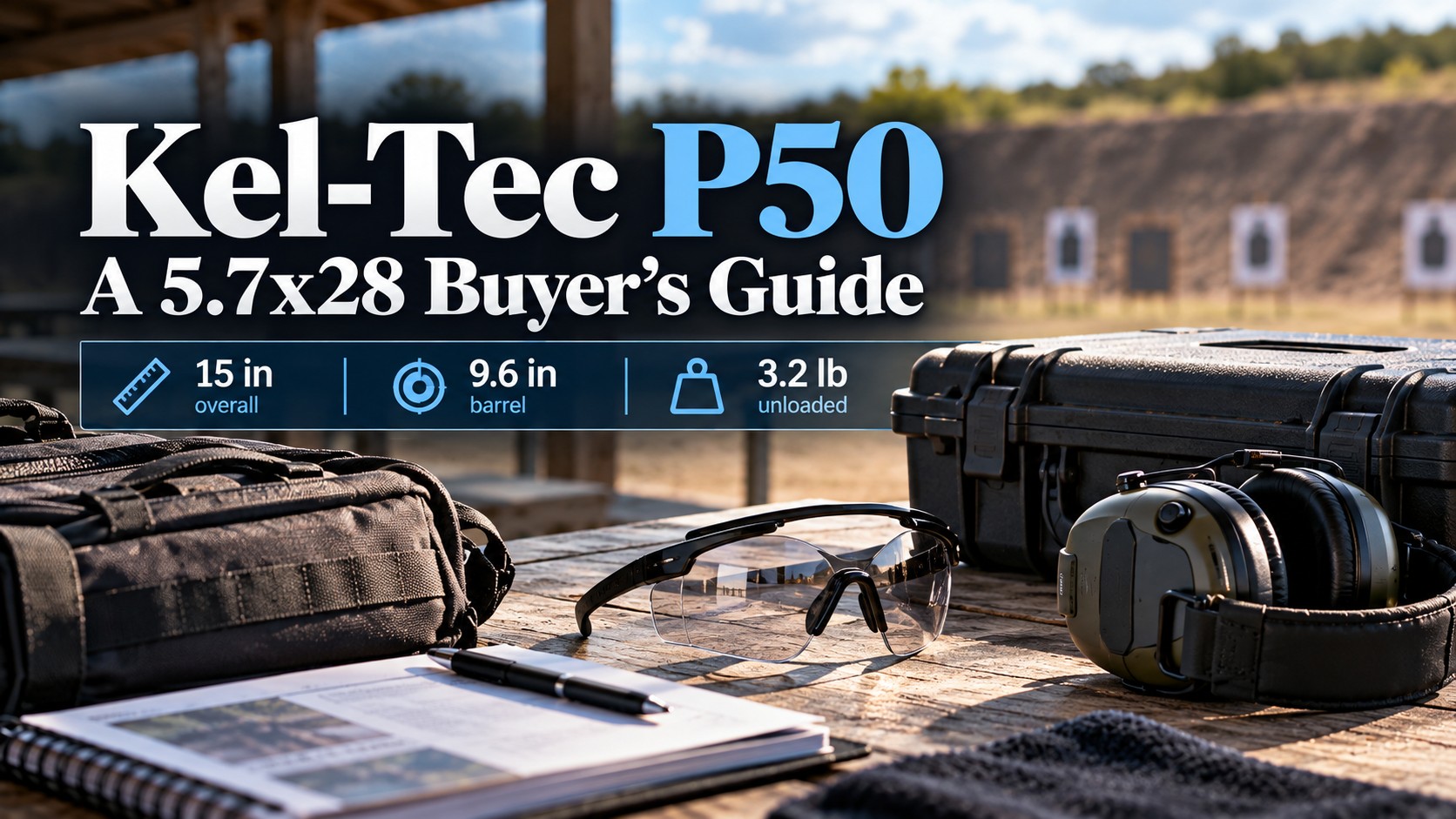
Buy the Kel-Tec P50 if you want the 5.7x28 pistol in Kel-Tec's January 2021 manual: a top-mounted FN PS90-style magazine of up to 50 rounds, a 9.6-inch barrel, 15 inches overall, and 3.2 pounds without the magazine. The 2025 guide prints the same length, barrel, and unloaded weight. It is not a concealed-carry 9mm and it is not the R50 rifle. The pistol and the ammunition stay at a licensed dealer.
Key takeaways
- The P50 is a 5.7x28 pistol with a top-mounted PS90-style magazine. The manual lists 50 rounds.
- Both sheets print a 9.6-inch barrel, 15 inches overall, and 3.2 pounds without a magazine. The manual's overview also says 3.5 pounds.
- The bolt does not lock back. The safety will not engage unless the hammer is cocked.
- The pistol and the ammunition stay at a licensed dealer. This page does not sell either one.
Buy the Kel-Tec P50 if you want the 5.7x28 pistol in Kel-Tec's January 2021 manual: a top-mounted FN PS90-style magazine of up to 50 rounds, a 9.6-inch barrel, 15 inches overall, 2 inches wide, 6.7 inches tall, and 3.2 pounds without the magazine. The 2025 product guide prints that same length, barrel, width, height, and unloaded weight, and a trigger of 5 pounds. It is straight blowback, hammer-fired, and single-action. It is not a 9mm you hide in a waistband, and it is not a rifle with a stock. The pistol and the ammunition stay at a licensed dealer.
Short version. A revolver or a semi-automatic pistol is a grip, not a shoulder stock. The P50 is the odd pistol in that family because the magazine does not sit in the grip. The 9mm showdown is a SIG Sauer P365, a Glock 19 Gen5, and a CZ Shadow 2, three grip magazines in one caliber. The .45 ACP showdown is an M&P45 Shield, an FN FNX-45, and a Springfield Garrison. An AR-15 and an AK-47 are shoulder rifles. AR pistol, carbine, and rifle sizes are a barrel-and-stock question this pistol does not answer by being long. Rated hearing protection and rated shooting glasses go on before a case opens. A gun safe is where it lives between range days.
This page will not ship a P50 or a box of 5.7x28. Kel-Tec sells through licensed dealers. There is no firearm listing here, no ammunition listing here, and no Amazon button for either one. The card at the top is a range bench under the headline Kel-Tec P50, with no firearm in the frame. It does not depict a pistol, a rifle, or a cartridge. The other picture is muffs, glasses, and a closed case.
What is the Kel-Tec P50?
The January 2021 manual, marked REV2021JAN, calls the P50 a semi-automatic pistol with a top-mounted magazine for 5.7x28 ammunition. Kel-Tec designed it to be holstered, carried in a backpack, or carried on a sling from integrated quick-disconnect ports. The magazine is a double stack. The description says it holds 50 rounds, and that one more round can sit in the chamber. Rounds leave that magazine rotated 90 degrees and are fed by the bolt. The operation line says straight blowback. The trigger-system line says hammer-fired, single-action. An aluminum receiver houses the bolt and the barrel. The grip and the handle are the exterior parts the manual calls impact-resistant glass-reinforced nylon. Most of the rest, the manual says, is steel and aluminum. The grip uses the pattern Kel-Tec calls gator grip.
That layout is the reason the gun is its own shopping trip. A conventional pistol puts the magazine in the grip, under the barrel, and a slide runs on top. The P50 puts an FN PS90-style magazine on top of the receiver. The manual says the pistol accepts that style of magazine, up to 50 rounds. You open the gun to get the magazine in and out. A release lever under the charging handle lets the receiver pivot on a hinge near the muzzle, and the magazine then sits between the receiver and the grip. If the magazine is not seated, the manual warns that closing the upper can damage the magazine or the pistol. This is not a magazine you drop out of a grip with your thumb while the gun stays closed.
The charging handle, the manual says, takes a twelve-pound pull to chamber the first round. After that the gun cycles itself. The bolt does not lock back when you chamber a round, and it does not lock back when the last round fires. You count rounds if you want to avoid a click on an empty chamber. If you stop before the magazine is empty, a live round can still be in the chamber. That is a different empty check from a pistol whose slide locks open on an empty magazine. The handgun primer describes the common semi-automatic, the one with the magazine in the grip and a slide that locks back. Read that page for the ordinary pistol. Read this page when the magazine is on top.
Who should buy a P50, and who should leave it on the rack?
Buy it if the job is a range pistol or a pack gun in 5.7x28, you want the capacity and the barrel the sheets print, and you will learn a magazine that loads on top. Fifteen inches overall and 6.7 inches tall is a large pistol. Two inches wide is not a micro. A concealed-carry handgun is a different shopping trip. The 9mm and .45 pages are the grip guns people hide or carry on a belt. The P50's own manual says the pistol can be holstered. A holster molded for a P365 or a Glock 19 will not be this gun. If the dealer does not have a holster that fits this serial, do not invent one from a different pistol.
Leave it if you wanted a revolver, a duty 9mm, a steel range .45, or a rifle you put in your shoulder. Leave it if your state limits magazine capacity and you have not asked the dealer which magazine can leave with the gun. The manual says to check federal and local law before you choose a capacity, and it says some states require reduced-capacity magazines. A 50-round line on a spec sheet is not a promise that 50 rounds can go home with you. Leave it if you wanted a stock. The manual tells you to check the law before you attach a stock, a brace, or anything that extends to the back of the pistol.
Kel-Tec's 2025 product guide prints two other guns on the same magazine idea. One block is 16.1 inches of barrel, 4.54 pounds unloaded, 30.5 inches overall, and 21.5 inches collapsed. Kel-Tec's rifle list calls that gun the R50. Another block is 9.6 inches of barrel, 4.3 pounds, 25.2 inches overall, and 16.4 inches collapsed. The rifle list calls that one the R50 Defender and tags it NFA. Those are different models. This page is the pistol, the gun with no stock in the P50 specification. A stock is not an accessory this page sells, and it is not a part you add because the rifle exists. If the gun in the case has a stock, read the model name before you call it a P50.
What do the manual and the 2025 guide actually print?
Use the table. Do not average the cells that disagree. The January 2021 manual is the handling document. The 2025 product guide is the later spec block for the pistol. Where they match, you can say the number twice. Where they do not, say which sheet you are reading.
| Line | January 2021 manual | 2025 product guide, P50 block |
|---|---|---|
| Caliber | 5.7x28mm | 5.7x28mm |
| Operation | Straight blowback, semi-automatic, hammer-fired single-action | The P50 block does not repeat the operation line |
| Capacity | 50 rounds on the included line. The description also says one round can sit in the chamber. | 50 |
| Weight | 3.2 lb without a magazine. A loaded 50-round magazine is 1.1 lb. The overview sentence also says 3.5 lb. | 3.2 lb unloaded |
| Length | 15 in overall. Barrel 9.6 in. Width 2 in. Height 6.7 in. | The same four figures |
| Trigger | The trigger line prints 5.0 lb and 1.8 kg, which are not the same force. | 5 lb / 22 N, which do match |
| Rifling | The line prints 1 in 7 in and 1 in 356 mm, which are not the same twist. | The P50 block does not print a twist |
Maker figures. A state may not allow the magazine the sheet prints. The pistol and the ammunition stay at a licensed dealer.
The overview sentence in the manual says the total weight of the pistol is 3.5 pounds. The measurement table says 3.2 pounds without a magazine, and 1.1 pounds for a magazine loaded with 50 rounds. The 2025 guide says 3.2 pounds unloaded. Three point two plus 1.1 is 4.3 pounds with a loaded magazine, which is not 3.5. Do not publish 3.5 as the unloaded weight, and do not publish 3.2 as the weight of the gun with a full magazine. Weigh the pistol you are holding if the number matters to a pack. The cells stay the cells.
The trigger line in the manual prints 5.0 pounds and also 1.8 kilograms. Those are not the same force. Five pounds is about 2.3 kilograms. One point eight kilograms is about 4 pounds. The 2025 guide prints 5 pounds and 22 newtons, and those two agree with each other. Cite 5 pounds as the figure the later guide repeats. If you are reading the manual out loud, cite both numbers on that line and say they disagree. Do not invent a pull you felt on a sample this page did not measure.
The rifling line in the manual prints "1 in 7 in" and "1 in 356 mm" in the same specification. Seven inches is about 178 millimeters. Three hundred fifty-six millimeters is about 14 inches. They are not one twist. The 2025 P50 block does not print a twist. The same guide prints 1:7 inch and 1:178 mm on the R50 and on the R50 Defender. Do not move that rifle line onto the pistol because the numbers look cleaner. Read the barrel, or ask Kel-Tec, before you quote a twist for the serial in the case.
The 2021 product guide prints barrel threads of 1/2-28. The manual's nomenclature includes a thread protector. The 2025 P50 block does not repeat the thread. Look at the muzzle. A thread you have not read is not a plan for a muzzle device. The sheets linked here are the January 2021 manual, the 2021 product guide, and the 2025 product guide. Current dealer information is on Kel-Tec's site.
How do you load a magazine that sits on top?
The manual's loading sequence is not a grip-magazine reload. You start with the safety up, which is safe, and the hammer has to be cocked or the safety will not engage. Lever up shows a circle and means safe. Lever down shows a triangle and means fire. The safety sits in front of the release lever at the rear of the grip, and it is ambidextrous. It disconnects the trigger and blocks the sear so the hammer cannot drop. If you stop the lever halfway, the manual says you may still be able to pull the trigger. The safety is not a substitute for the muzzle and the finger.
You open the receiver to about 90 degrees on the hinge near the muzzle. You set the loaded magazine into the cutout so the magazine's own cutout meets the barrel trunnion and the front tabs meet the hinge. Your hand covers the receiver and the magazine when you close it, and your fingers stay off the underside of the magazine. The manual says the bolt has to compress the top round before you close the receiver onto the grip. You close it until you hear a click, and you press the release lever up to confirm the hooks are locked. The manual warns that a latch that is not fully closed can still let the pistol fire. A full magazine, it says, does not always close easily.
To chamber, the safety stays up, the muzzle stays in a safe direction, and the finger stays outside the guard. You pull the operating handle all the way back and let the bolt go on its own spring. Guiding it closed slowly can cause a malfunction. A round is then in the chamber. The bolt will not lock open to show you that. The manual's own good practice, when you are only trying to put the gun on safe, is to do that handle stroke with the magazine out, so you are not chambering a round by accident.
The magazine itself loads from the top of the magazine body. The manual says to set a cartridge with the rim against the back wall of the recessed area, press it down in the center, and slide it all the way back before the next round. Each round rotates and feeds into the stack below. That is slower than thumbing rounds into a single-stack carry magazine. It is the work that comes with the 50-round body. The manual does not say a partial magazine is forbidden. It does say not every magazine closes easily once it is full. Seat and close it at the counter, unloaded of any argument about who is right, and see whether the hooks click on the magazine you will actually take home.
What ammunition does the manual allow?
5.7x28, and only the ammunition the manual names. Standard 5.7x28 cartridges. Made in the United States. SAAMI specification. Commercially manufactured. Clean, dry, high quality, and in good condition. Brass cases. The manual says never to use non-standard, reloaded, or damaged cartridges, and that any other ammunition is non-standard, can cause function problems, and can void the warranty. It also says Kel-Tec does not recommend handloads, reloads, remanufactured ammunition, or foreign or military surplus of unknown or questionable quality. A box the dealer did not hand you for that stamp is not a box this page will point you toward.
The manual has a specific warning about this cartridge. 5.7x28 cartridges have a dry coating and can stick in the chamber if the chamber is not lubricated. Lubricate the chamber before use. If you do not, you may have to clear a round by hand. After firing, a failure to extract can leave a case, or a fractured piece of a case, stuck in the chamber. A partial case, the manual says, should come out by a certified gunsmith so the chamber is not damaged. That is a maintenance fact. It is not a reason to skip the oil, and it is not a reason to experiment with a cartridge the manual did not list.
This page does not sell ammunition and does not name a mail-order load. The dealer matches the box to the stamp on the barrel. A state rule about the cartridge is the dealer's question too. Do not treat a velocity you remember from a shorter pistol, or from a 16-inch carbine, as the velocity this 9.6-inch barrel will print. The manual does not print a velocity, and this page will not invent one. The 9mm pistols and the .45 pistols are different stamps. A box for one of them does not belong in this chamber because the grip felt familiar on a different day.
How do the sights, the safety, and the rails work?
The sights ship with what the manual calls a general alignment. You still zero them. The front sight post is threaded into the receiver and adjusts elevation with a flat-head screwdriver. The manual says an eighth of a clockwise turn moves the group up by about 1 MOA, and the opposite direction moves it down. The rear sight is a windage pair of set screws. To move the group left, turn the left screw counterclockwise and the right screw clockwise. A quarter turn of each screw is about an inch at 30 yards. That is the manual's sight math. It is not a click value from a red dot you have not mounted.
A Picatinny-style rail runs along the receiver forward of the ejection port. A second rail sits forward of the trigger guard for a light or a laser. The manual says to check federal and local law before you put any extra grip on that bottom rail. An optic is a rail accessory you confirm does not block the charging handle, the ejection port, or the magazine. The manual does not name an optic, and it does not say one is in the box. The front post and the rear notch are the sights the manual describes. A slower sight picture is how you learn those sights. The manual's MOA note is a starting adjustment, not a zero you can copy from a different pistol.
Empty cases eject upward, to the right side of the receiver. They are hot. The exterior metal gets hot enough, the manual says, to burn you after several rounds. The gun is short for the amount of gun it is. Keep a firm grip, and keep fingers out of the line of the muzzle and out of the path of the bolt and the charging handle. Anyone watching, the manual says, stays at least six feet behind you, not beside you. That rule is about the case coming out to the right and about the muzzle, and it applies on a square range the same way it applies in a backyard the range officer would not approve.
Is the P50 a carry pistol or a carbine?
It is a pistol in the manual. The specification has no stock. It has a grip, a 15-inch overall length, and a 9.6-inch barrel. It is long for a pistol and short for a carbine. People will call it a personal-defense weapon because of the cartridge and the P90 magazine. The transfer is still the handgun transfer the dealer runs, unless you are looking at a different model. The R50 is the rifle in the 2025 guide: 16.1 inches of barrel, a collapsed length, and a stock. The R50 Defender is the other model on that spread, with a 9.6-inch barrel and a stock, and Kel-Tec's rifle list tags it NFA. If the sample in front of you has a stock, you are not holding the pistol this page is about.
A carry pistol is the other mistake. Fifteen inches and a magazine on top do not disappear under a T-shirt. Concealed-carry handguns on this magazine are guns built to hide. Use that page for that job. Use this page when the job is the 5.7x28 pistol with the top magazine. An AR pistol is a different receiver, a different magazine, and usually a different caliber. The size primer separates an AR pistol from a carbine and a rifle by barrel and stock. Do not file the P50 in that family only because the barrel is under 16 inches.
An AR-15 and an AK-47 do not share this magazine. Bolt, semi-automatic, and lever-action rifles are the shoulder-stock conversation. Pump, semi-automatic, and break-action shotguns are a smoothbore. An older 9mm roundup is a longer list of a different cartridge. None of those pages feeds a PS90-style magazine, and none of them is a substitute for sitting on this pistol.
What do you confirm before it leaves the counter?
Name the model out loud. P50, not R50, and not the Defender. Read the caliber stamp and the end of the ammunition box the dealer is handing you. Count the magazines in the case. The manual's included line says 50 rounds, which is the capacity it lists, not a count of how many magazines are in the carton. The 2021 product guide's P50 copy says the pistol comes with two 50-round magazines. That sentence is from 2021. The 2025 P50 block prints a capacity of 50 and does not say two magazines are in the box. Count what is actually there.
Ask which magazine your state allows to leave. Ask whether that serial's muzzle is threaded, and read the thread, before you plan a device. Ask the dealer to show the safety on an unloaded gun: lever up, circle, safe; lever down, triangle, fire; and the fact that the safety will not go on unless the hammer is cocked. Open the receiver the way the manual describes and look at the chamber. The manual says not to trust the extractor to clear a round. Look, and then look again. A round left in the chamber because the bolt did not lock back is the mistake this design makes easy.
Then the manual of arms, still unloaded, muzzle in a safe direction. Where the release lever is. How the magazine seats. That the bolt does not lock back. That cases come out up and to the right. That the charging handle wants a full stroke and a free return, not a ride forward. If you cannot repeat those steps, you are not done shopping. Responsible ownership starts at that counter.
Hearing protection rated for the range, and shooting glasses, go on before the case opens. A range bag holds them. Impact Sport muffs and Walker's Razor are one electronic-muff comparison if you want a model name, and Peltor and Howard Leight are another. ESS Crossbow and Wiley X Saber glasses are a glasses comparison, not a pistol. A two-point sling is a strap for the quick-disconnect ports the manual mentions. It is not the pistol. A gun safe at home is the next stop. The manual says not to store the firearm and the ammunition together, and to keep them locked away from children and from anyone who is not allowed to handle them. Unload before the case. Magazine out. Receiver open. Chamber visible.
Carry law is local. A permit, a vehicle rule, and a list of prohibited places are statutes. They change. This page does not clear you to carry a P50. A large pistol is not a legal category. It is a size. The dealer can point at the current rule where you live. You still have to read it.
What does the limited warranty actually say?
The January 2021 manual prints a limited lifetime warranty against defects in materials and workmanship for the lifetime of the original consumer purchaser. A claim needs the bill of sale in your name, or a copy of the Form 4473, showing you are that purchaser. Kel-Tec's remedy is repair or replacement, at Kel-Tec's discretion. The warranty is void if you do not follow the manual, if you alter parts from their original state, if damage comes from misuse, abuse, or poor maintenance, or if you disassemble past the breakdown in the manual. The manual stops field stripping at the bolt group. Further disassembly, it says, is for a certified gunsmith or for Kel-Tec, and doing it yourself can void the warranty.
Service, in that manual, is a prepaid shipment of an unloaded gun to Kel-Tec CNC Industries in Cocoa, Florida, with a letter that includes your name, your phone number, the serial number, and what you want done. The manual says some states require the gun to come back through a licensed dealer. The carrier's rules for shipping a firearm are the carrier's rules. This page is not those rules, and it is not a return authorization. The manual says no return number is required, and that Kel-Tec quotes charges before work that the warranty does not cover.
Cleaning, the manual says, comes after every shooting session, with the gun unloaded and with no ammunition in the cleaning area. Use a commercial gun solvent, gun oil, or a cleaner-lubricant-preservative. Put a light coat on the metal, then wipe it. Oil left in the bore is an obstruction, and the manual treats a bore obstruction as a reason the gun can come apart. Hoppe's No. 9 and Break-Free CLP are two products this magazine has compared. They are not a substitute for the chamber lubrication the manual wants before you shoot, and they are not ammunition. Solvents can affect a primer. Keep the ammunition out of the room where the solvent is.
The manual's malfunction notes are short, and they all start with the muzzle. A failure to fire means the round fed, the trigger was pulled, and the primer did not go. Keep the muzzle in a safe direction, engage the safety if the hammer will allow it, and wait at least a minute before you cycle the round out. A failure to feed, the manual says, is usually a dirty chamber, feed ramp, recoil spring, or magazine. A failure to eject leaves an empty case that has left the chamber but not the gun. A failure to extract leaves the fired case in the chamber, which is the failure the dry-coating warning is about. Past those four, the manual says to contact Kel-Tec service. This page is not a gunsmith, and it is not a place to practice a malfunction drill.
What does the clip on this page show?
The clip is a public YouTube review from Civilian Defense Concepts, LLC. The title is "Product review: Initial thoughts on the Kel-Tec P50 handgun 2024-06-23." The title names the pistol and calls the clip initial thoughts. This page has not timed the video, has not counted the rounds in it, and has not treated the title as a measurement. The poster at the top of this page is a range bench under the headline Kel-Tec P50, with no firearm in the frame. The bench photo is muffs, glasses, and a closed case. Neither file is a picture of a firearm or of ammunition. The play image is YouTube's thumbnail for that clip, not a photograph this magazine made.
So should you buy the Kel-Tec P50?
Buy it if you want this pistol. The cartridge is 5.7x28. The magazine is the PS90-style body on top of the receiver, 50 rounds on the capacity line, with one more in the chamber only if you chamber it. The barrel on both sheets is 9.6 inches. The overall length on both sheets is 15 inches. The unloaded weight the measurement table and the 2025 guide agree on is 3.2 pounds, and the manual's overview also says 3.5, so you do not pretend those are one number. You buy it from a dealer who will walk the hinge, the safety, the thread on the muzzle, and the open chamber with you. You buy the R50 only if you asked for the rifle. You buy a P365, a Glock 19, or a Garrison if the job is the job on those other pages.
Buy nothing from a mailbox. The price is the tag at the counter on the day you are there. This page does not print a price, because a price that is not on that tag is a fiction. The pistol stays at a licensed dealer. The ammunition stays there too. The manual and the 2025 product guide are the sheets. The dealer is the transfer.
Frequently asked questions
What is the Kel-Tec P50?
The Kel-Tec P50 is a semi-automatic pistol chambered in 5.7x28, with a top-mounted FN PS90-style magazine. Kel-Tec's January 2021 manual lists straight blowback, a hammer-fired single-action trigger, a 9.6-inch barrel, and 15 inches overall. The pistol stays at a licensed dealer.
What caliber and magazine does the P50 use?
The manual chambers it in 5.7x28 and says it accepts an FN PS90-style magazine of up to 50 rounds, plus one more round in the chamber if you chamber it. It calls for US-made, SAAMI-spec, commercially manufactured brass-cased ammunition, and it rejects reloads. Some states limit magazine capacity. Ask the dealer which magazine can leave.
Can I buy the P50 or the ammunition from this page?
No. Kel-Tec sells the pistol through licensed dealers. This page does not list a firearm or ammunition, and it does not add an Amazon button for either one.
Is the Kel-Tec P50 a concealed-carry pistol?
No. The sheets print 15 inches overall, 6.7 inches tall, and 2 inches wide, and the magazine sits on top. That is a large pistol, not a gun built to hide. Concealed-carry handguns are a different page. The R50 is a different model, a rifle.
What length and weight does Kel-Tec print for the P50?
The January 2021 measurement table and the 2025 product guide both print a 9.6-inch barrel, 15 inches overall, 2 inches wide, 6.7 inches tall, and 3.2 pounds without the magazine. The manual's overview also says 3.5 pounds, and a loaded 50-round magazine is listed at 1.1 pounds. Those are separate cells. Do not average them.
What does the video on this page show?
It is a public clip from Civilian Defense Concepts, LLC, titled Product review: Initial thoughts on the Kel-Tec P50 handgun 2024-06-23. The title names the pistol and calls the clip initial thoughts. This page has not timed it. The magazine's own images do not show a firearm. The play button uses YouTube's thumbnail.