
.45 ACP Showdown: Smith & Wesson M&P45 Shield M2.0 vs. FN FNX-45 vs. Springfield 1911 Garrison
Written by John Wren|
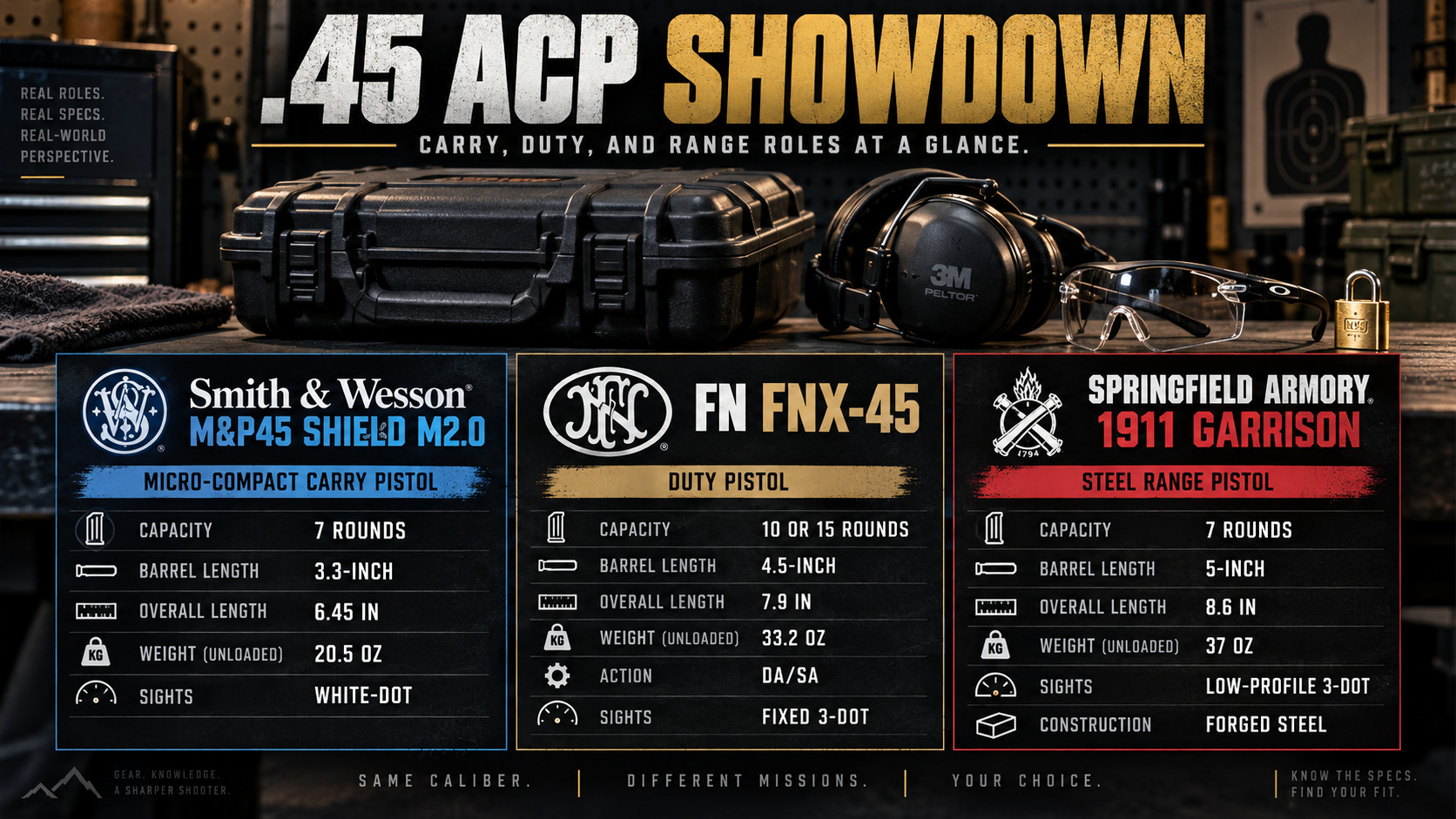
Conceal the Smith & Wesson M&P45 Shield M2.0 if the gun has to hide: 7 rounds, white-dot sights, 6.45 inches, 20.5 ounces. Choose the FN FNX-45 for a duty pistol: 10 or 15 rounds, 4.5-inch barrel, DA/SA, sights you confirm on the tag. Choose the Springfield 1911 Garrison for the square range: forged steel, 5-inch barrel, 37 ounces, low-profile 3-dot sights. The pistol and the ammunition stay at a licensed dealer.
Key takeaways
- The M&P45 Shield M2.0 is the micro carry gun: 7 rounds, white dots, 6.45 inches, 20.5 ounces.
- The FNX-45 is the duty gun: 4.5-inch barrel, 7.9 inches, 33.2 ounces. Read 10 rounds against 15.
- The 1911 Garrison is the steel range gun: 5-inch barrel, 8.6 inches, 37 ounces, one 7-round magazine on the PX9420 block.
- The pistol and the ammunition stay at a licensed dealer.
A .45 ACP you will still shoot is a size you can name, a magazine the maker printed, and a sight you can see — not a mailbox pistol and a capacity you remembered from a comment. The short answer: sit on a Smith & Wesson M&P45 Shield M2.0 if the gun has to hide, an FN FNX-45 if you want the duty pistol, and a Springfield Armory 1911 Garrison if the gun lives on a square range. All three are .45 ACP semi-automatic pistols. They are not the same length, the same weight, the same magazine, or the same sight. The pistol stays at a licensed dealer. The ammunition stays there too.
Short version. A handgun is a cylinder or a slide. This page is three slides you can tell apart before anyone talks about a price. Ears and glasses go on before a case opens. A safe is where the gun lives between range days. The 9mm showdown is a P365, a Glock 19 Gen5, and a Shadow 2. None of those is a .45, and none of those three is in this comparison. The crossbow showdown is a different desk and a different tool. An older 1911 roundup walks a longer list from a different year. This page is these three.
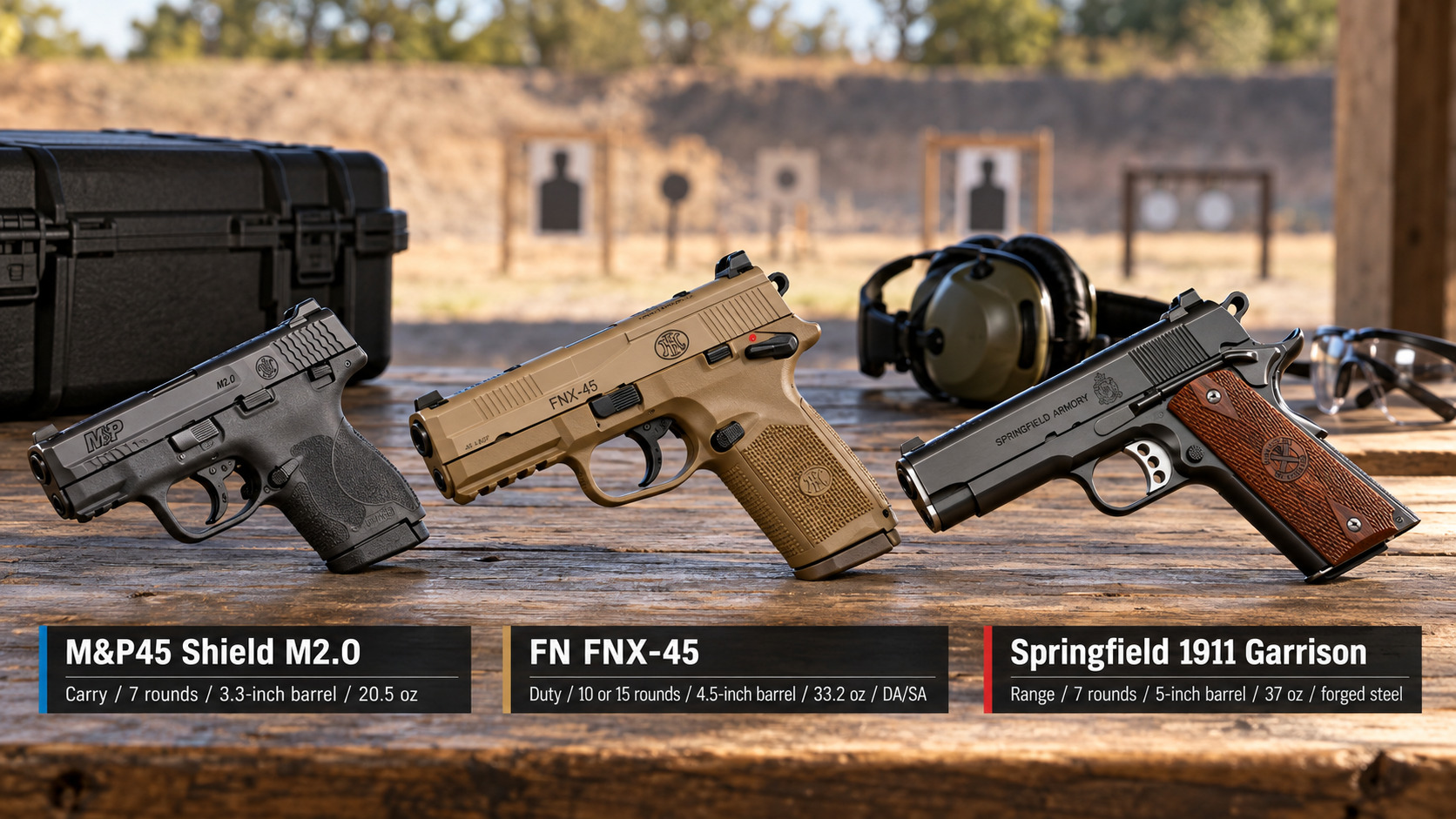
This page will not crate a Shield, an FNX-45, or a Garrison. Smith & Wesson, FN, and Springfield Armory sell through licensed dealers. There is no firearm listing here and no ammunition listing here. The card at the top is a spec poster with the three names, the job, and the figures the sheets print. The other picture is the three pistols on the bench.
Size, capacity, sights, and the job are the whole comparison
Write four facts before you write a favorite. Overall length. The weight or the width the sheet actually prints. The standard magazine, and whether that magazine is legal where you live. The sight that is on the gun, not the sight in a different SKU photo. Then name the job: carry, duty, or range. A pistol that wins all four does not exist in this trio. The Shield wins the hide. The FNX-45 wins the duty holster that was built for a .45 service pistol. The Garrison wins the square range, and it loses a waistband by being a steel 1911.
Do not line a 7-round flush magazine up against a 15-round duty magazine and call the gap a virtue you have measured on your belt. A state may not allow either number. The maker’s sheet and the statute are different documents. A dealer can hold both. This page cannot clear a magazine, a carry permit, or a prohibited place.
Do: read the caliber stamp, which on all three should say .45 Auto or .45 ACP, and still read it. Don’t: a box of 9mm, .40 S&W, or .45 Colt because the grip looked familiar. .45 ACP and .45 Colt are not the same cartridge. A rifle comparison is a different page. An AR pistol is a different transfer from these three. A rifle is a shoulder gun.
Smith & Wesson M&P45 Shield M2.0 — micro-compact, 7 rounds, white dots, the carry gun
Smith & Wesson’s current no-thumb-safety page, SKU 14659, calls the M&P45 Shield M2.0 a micro-compact chambered in 45 Auto. The same block prints a striker-fired action, a capacity of 7, a 3.3-inch barrel, white-dot sights, and no manual thumb safety. Overall dimensions on that page are 20.5 ounces, 1.05 inches wide, 6.45 inches long, and 5 inches high. The barrel line says a 3.3-inch, 1:15-twist stainless-steel barrel with an Armornite finish, and a stainless slide with the same finish. The page says the pistol ships with one 7-round magazine. Optic-ready is marked no. That is the carry gun in this trio, and it is the serial you have to confirm, because a thumb-safety sibling sits one click away.
SKU 14658 is the thumb-safety M&P45 Shield M2.0. Smith & Wesson’s comparison table prints the same caliber, the same capacity of 7, the same 3.3-inch barrel, the same 20.5-ounce weight, and the same 1.05-by-6.45-by-5-inch block. The safety cell is the difference: thumb safety, instead of none. A safety you did not know was there is a gun you will not fire when you mean to. A safety you expected and did not get is a different manual of arms. Ask which SKU is in the case before you build a habit around a lever that may not exist. The page does not print a trigger weight in pounds. The “10 lb trigger” cell is marked no, which is not a pull you can quote. Feel the striker pull. Do not borrow a number from a forum, and do not borrow one from the FNX line below.
Use is the waist. At 6.45 inches long, 1.05 inches wide, 5 inches high, and 20.5 ounces, this is the one of the three that disappears under a shirt you already own. It is also the shortest barrel and the lightest gun, which is the trade you feel on a target, not in a mirror. A small hand can run it. A large hand may cover the short grip. Smith & Wesson lists a 6-round Shield .45 magazine as a compatible accessory next to the 7-round magazine. The pistol still ships with one 7-round tube on the current page. A 6-round magazine is not a second gun, and it is not a promise that the height cell was measured with that tube. Sit on the gun with the magazine that will actually be in it.
White-dot sights are the standard sentence. You can see them in daylight. They are not night sights, and the page does not print a tritium option on this SKU. Do not assume the FNX in the next lane has the same dots, and do not assume a night sight because a different pistol in the safe has one. The grip is polymer, with the texture Smith & Wesson describes as the blend between traction and skin. That texture is the carry bargain: it has to hold the gun and it has to live against you. If it prints through a T-shirt or it chews a hip, the micro-compact measurement was not the whole decision.
Smith & Wesson — current M&P45 Shield M2.0 page and dealers
Do: a dealer who will still talk a transfer, and a holster molded to this serial. Don’t: an M&P45 that is actually a full-size M&P, a Shield in 9mm or .40 S&W, or a Shield Plus. Those are different sheets. The .40 Shield on the same series page prints a 3.1-inch barrel and a different weight. If the clerk says it is still a Shield, ask for 45 Auto on the stamp, 6.45 inches overall, and whether that serial has a thumb safety. A holster is the shell. The pistol stays at the counter.
FN FNX-45 — DA/SA, 10 or 15 rounds, the duty gun
FN’s FNX-45 page calls it a double-action/single-action hammer-driven pistol in .45 ACP, modeled on the FNP-45 service pistol FN introduced in 2007 for the Joint Combat Pistol program. That sentence is history on a product page. It is not a claim that the gun in the case is a military issue, and it is not a reason to skip the counter. The same page prints a magazine of 10 or 15 rounds, a weight of 33.2 ounces, a 4.5-inch barrel, an overall length of 7.9 inches, a height of 6.3 inches, a width of 1.58 inches, and a sight radius of 6.4 inches. The twist is 1:16 right-hand. The barrel is cold-hammer-forged stainless steel. The slide is stainless. The frame is polymer, with replaceable steel rails, two interchangeable backstraps, and a MIL-STD-1913 rail under the dust cover.
The trigger-pull line prints two ranges on the same spec: 8.8 to 12.1 pounds, or 3.96 to 5.06 pounds. FN does not label which range is the first shot. A DA/SA pistol is the reason there are two numbers. The long pull cocks and releases the hammer. The short pull comes after the hammer is already back. Sit on the gun, unloaded, and feel both. Do not average them into one pound figure, and do not paste either range onto the Shield or the Garrison. Those pages do not print it.
Sights on the standard page are fixed 3-dot. Fixed 3-dot green tritium night sights are listed as available, not as the gun in every box. Read the tag. A black frame and a flat-dark-earth frame are both on the page, and so is a stainless-slide option. The operating controls are fully ambidextrous: decocking/safety lever, slide stop, and magazine release. An external extractor carries a loaded-chamber indicator. That indicator is a glance, not a substitute for looking in the chamber when you unload.
What ships depends on the designation. FN’s table lists 66960 as the black-on-black pistol with two 15-round magazines, and it lists sibling designations that ship two 10-round magazines, including a stainless slide and a flat-dark-earth frame. The page says the pistol ships with two 15-round magazines with an extended base pad, or two 10-round magazines. Count the magazines in the box. A 15-round gun is not a 10-round gun just because the barrel length matches. A state may not allow the longer magazine to leave with you. Ask before you treat 15 as the number you will own.
Use is duty and the belt. Seven and nine-tenths inches long, 1.58 inches wide, and 6.3 inches tall is a service pistol, not a micro. It is heavier than the Shield by a wide margin, 33.2 ounces against 20.5, and it is lighter than a steel 1911 only if you are comparing the Garrison’s 37 ounces and ignoring how much wider the FNX grip is. Fifteen rounds, where that magazine is legal, is the duty argument. Ten rounds is the other box. Neither number makes the gun a carry micro. The rail is for a light you have confirmed fits that dust cover, bought at the same counter, not a reason this page will send you a light.
The FNX-45 Tactical is a different pistol. FN’s tactical page prints a 5.3-inch barrel, 33.3 ounces, an overall length of 8.6 inches, a height of 6.5 inches, a threaded muzzle, high-profile combat night sights, and mounting bases for a red dot. The standard gun in the table below is the 4.5-inch pistol with fixed 3-dot sights and no thread. If the muzzle wears a thread or a protector, you are not holding the duty gun this comparison measured. Magazines may look related. Confirm they lock into the gun you are actually buying. Do not let the shared FNX name do it.
FN — current FNX-45 page and dealers. The tactical page is the other gun.
Do: confirm DA/SA, confirm 10 or 15 on the box, and confirm tritium or plain 3-dot. Don’t: a story that every FNX-45 is the tactical model, or that the decocker is the same lever as a 1911 thumb safety. Ask the dealer to show hammer down, hammer cocked, and the safety, on an unloaded gun, muzzle in a safe direction. If you cannot repeat those three, you are not done shopping.
Springfield 1911 Garrison — forged steel, 5 inches, 7 rounds, the range gun
The range pistol in this trio is the Springfield Armory 1911 Garrison in .45 ACP, the blued gun Springfield lists as PX9420. The page calls it hot-salt-blued carbon steel and wood, on the classic 1911 design, with forged steel construction. The spec block prints a 5-inch forged stainless match-grade barrel with a 1:16 twist, a forged carbon-steel slide, a forged carbon-steel frame, low-profile combat 3-dot sights, a GI-style recoil system, thinline wood grips, one 7-round magazine, a weight of 37 ounces, a length of 8.6 inches, and a height of 5.5 inches. The grips are the checkered double-diamond pair with the crossed-cannon mark. That is the sheet. A price on a web page is not the tag in front of you, so this comparison does not print one.
The block does not print a width. Do not invent one. A 1911 is slimmer than the FNX’s 1.58 inches in the way a single-stack gun usually is, and “usually” is not a measurement. Sit on the gun and see where your hand lands on steel, a beavertail, and wood panels. The block also does not print a trigger weight. Leave the invented pound figure off. The barrel sentence says match grade. That is Springfield’s description of the barrel, not a group size this page measured.
It is a 1911. On the unloaded gun, confirm the hammer, the thumb safety, and the grip safety before you decide the manual of arms is the one you already know. The PX9420 block does not print a Series 70 or Series 80 sentence, so this page will not invent a firing-pin block. Ask. A grip safety you have never pressed is how a 1911 fails to fire for a person who only knows a striker. A thumb safety you swipe out of habit from a different pistol is how a muzzle wanders while you hunt for the lever. The dealer shows those controls. You repeat them.
Thirty-seven ounces is the point, and it is the problem. It is well above the Shield’s 20.5 ounces, and it is a different kind of weight from the FNX’s 33.2 ounces because the mass is steel, in a single-stack grip, with a 5-inch barrel and an 8.6-inch overall length. You feel it on a walk back to the truck. You also feel it as less muzzle movement on a slow bullseye, which is why a range gun is allowed to be heavy. An 8.6-inch steel pistol is a poor concealed-carry plan. The low-profile 3-dot sights are combat sights on a target-length slide. They are not the Shield’s white dots, and they are not the FNX tritium option you still have to confirm is installed.
The stainless Garrison, PX9420S, prints the same barrel, the same 37 ounces, the same 8.6-inch length, and the same 5.5-inch height, with a stainless slide and frame instead of the blued carbon steel. Count the magazines. The blued PX9420 block says one 7-round magazine. A Firstline stainless listing prints three. The gun in the case is the one whose finish and whose box count you can see. Springfield’s series page also describes a 4.25-inch Garrison. That is a different length. Do not let “Garrison” mean both.
A double-zipper case comes with the pistol, in Springfield’s sentence. That case is a shell for the ride to the range. It is not a holster, and it is not a safe. The GI-style recoil system is the spring and guide the page names. It is not a promise about how the gun will feel with a load the dealer did not hand you.
Springfield Armory — current 1911 Garrison .45 page and dealers
Do: name the SKU. Blued PX9420, stainless, 4.25-inch, and a different Springfield 1911 are not one pistol. Don’t: a 9mm 1911, an EMP, or a magazine from a different frame hung on this slide because both say Springfield. The older 1911 roundup is a longer list from another year. This page is the 5-inch .45 Garrison.
The sights do not interchange, and neither do the magazines
Three sight stories, and they do not collapse into “night sights.” The Shield M2.0 page includes white-dot sights in the standard sentence, and it does not print tritium on that SKU. The FNX-45 page publishes fixed 3-dot as standard and lists green tritium as available, which leaves the installed set to the tag on that pistol. The Garrison block names low-profile combat 3-dot sights. A sight you swap is a sight the maker or a gunsmith fits to that slide. A tritium set from the FNX page does not drop onto a Garrison, and a 1911 rear sight does not drop onto a Shield. If you cannot see the sight in the light you will actually shoot, that pistol is the wrong one, or the sight on it is the wrong configuration. Fix that at the counter, with the gun unloaded and the muzzle pointed at the berm.
Magazines are the same kind of mistake, and they are easier to make because all three say .45. A Shield magazine is a Smith & Wesson Shield .45 magazine, 7 rounds on the pistol page and a 6-round tube listed beside it as an accessory. An FNX-45 magazine is the FN magazine in the 10-round or 15-round length that designation ships. A Garrison magazine is a 1911 .45 magazine, one 7-round tube in the PX9420 block. They do not click into each other’s frames. A magazine that looks right and does not lock is a magazine for a different gun. Seat it and drop it once at the counter, slide locked open, chamber empty. Then buy the spare from the same dealer, for that serial, not from a bin labeled only “.45.”
A magazine is also not a permit. Smith & Wesson’s standard sentence is 7. FN’s page prints 10 or 15, and the box tells you which pair shipped. Springfield’s PX9420 block is one 7-round magazine. Some states limit what you can buy, own, or insert. Those rules change, and they are not printed as a substitute for the maker’s capacity line. Smith & Wesson also prints a state-compliance roster on the Shield page. A roster is not a carry permit, and the thumb-safety SKU’s roster is not identical to the no-safety SKU’s roster. Ask the dealer which magazines can leave with that pistol. Leave with magazines that are legal where you live. A longer FNX magazine that will not pass the counter is not a feature you add later from a mailbox.
Your hand is the fifth measurement
The sheets do not know your hand. A short Shield grip lets some shooters get the whole palm on the gun and leaves others with a finger hanging off. The pistol ships with one 7-round magazine. Try that magazine, unloaded, in the shirt you will wear. A number on a page cannot tell you whether 1.05 inches of width disappears under a T-shirt or prints at the belt. The texture that holds the gun on the range is the texture that sits against skin. Both matter. Only the counter can show you both.
The FNX-45 is the middle gun in length and the largest grip in this trio, and the backstraps are the adjustment FN actually ships. Two interchangeable backstraps change the distance from the back of the grip to the trigger. Install the one you will keep before you decide the double-action pull is “wrong.” A backstrap in the bag is not a backstrap on the gun. The ambidextrous magazine release and slide stop matter if you are left-handed. Ask the dealer to show them while the gun is empty. Do not discover the lever side on a timer. The decocker is part of that same pass: hammer down, then the long pull, then hammer cocked, then the short pull.
The Garrison’s steel grip and single-action pull are the other extreme. A reach that feels fine on the Shield’s striker can feel different when a grip safety has to be depressed before the thumb safety comes off and the hammer falls. That is the 1911 bargain. If you only ever intend to carry the Shield, say so, and still learn the Garrison only if the range gun is actually the one you will shoot. A 37-ounce pistol you will not practice is a safe ornament with wood grips. If the reach to the trigger is miserable with the grip safety pinned, this is not your range gun, no matter how steady the steel looks on a rest.
How we would pick among the three
Want the gun that hides, at 20.5 ounces and 6.45 inches long, 1.05 inches wide, with white-dot sights and a 7-round magazine? The M&P45 Shield M2.0. You are confirming whether that serial is SKU 14659, with no thumb safety, or SKU 14658, with one. Want the duty pistol with a 4.5-inch barrel, a 15-round or a 10-round magazine depending on the box, ambidextrous controls, and a DA/SA hammer? The FNX-45. You are confirming the sights, and you are confirming it is not the tactical model with the 5.3-inch threaded barrel. Want a forged-steel 1911 with a 5-inch barrel, 3-dot sights, and a weight that stays on the bench? The Garrison, PX9420 if you want the blued gun in this comparison. You are accepting 37 ounces and 8.6 inches, and you are accepting one 7-round magazine unless the box in front of you says otherwise.
Sit on all three if the shop has them. The one that fits the job you named, with a sight you can call, is the one you will still shoot in November. The one that wins a comment thread and loses your hand is a safe ornament. There is no single winner, because the jobs are not the same job.
| Pistol | Job | Magazine on the sheet | Sights | Where it stays |
|---|---|---|---|---|
| M&P45 Shield M2.0 | Carry | 7; ships one 7-round magazine. A 6-round tube is listed as an accessory. | White dot | Smith & Wesson / licensed dealer |
| FN FNX-45 | Duty | 10 or 15. Two magazines, the length the designation ships. | Fixed 3-dot; green tritium available | FN / licensed dealer |
| 1911 Garrison | Range | One 7-round on the PX9420 block | Low-profile combat 3-dot | Springfield / licensed dealer |
Maker figures. A state may not allow the magazine the sheet prints. The pistol and the ammunition stay at a licensed dealer.
| Pistol | Overall length | Barrel | Width or mass | Height |
|---|---|---|---|---|
| M&P45 Shield M2.0 | 6.45 in | 3.3 in, stainless, 1:15 | 1.05 in wide; 20.5 oz | 5 in |
| FN FNX-45 | 7.9 in | 4.5 in, cold hammer forged | 1.58 in wide; 33.2 oz | 6.3 in |
| 1911 Garrison | 8.6 in | 5 in, forged stainless, match grade, 1:16 | 37 oz; the PX9420 block does not print a width | 5.5 in |
The Shield thumb-safety sibling prints the same size block. The FNX-45 Tactical is a different weight, a different length, and a threaded muzzle. The Garrison single length in this table is the 5-inch gun. A 4.25-inch Garrison is a different pistol.
What you confirm before any of them leaves the counter
Name the model out loud. M&P45 Shield M2.0, and whether the thumb safety is on that serial. FNX-45, not the Tactical, with the magazine count that is in the box. 1911 Garrison, 5-inch .45, blued or stainless, with the magazine count you can see. Read the caliber stamp and the end of the ammunition box the dealer is handing you. A .45 ACP stamp is the start. The box still has to match. None of the three pages cited here prints a +P sentence in the block this comparison uses. Do not borrow a +P line from the 9mm showdown because that page was about a different cartridge and a different pistol. Ask, and do not experiment with a box the dealer did not hand you for that stamp.
Ask what the transfer is. A handgun from a licensed dealer is a dealer transfer, with the paperwork that dealer runs. A marketplace listing is not the counter. A private plan you invented in a parking lot is not a plan. The ammunition is part of the same stop. This page does not sell either one, and it does not link a cartridge.
Then the manual of arms, unloaded, muzzle in a safe direction. On the Shield: where the magazine release is, whether a thumb safety is on that serial, how the slide locks open, and that the sights are the white dots you can see. On the FNX-45: hammer down and hammer cocked, the ambidextrous decocker, the magazine that came in the box, the backstrap you will leave installed, and whether the sights are plain 3-dot or the tritium set. On the Garrison: hammer, thumb safety, grip safety, the 3-dot sights, and the single magazine if that is what PX9420 put in the box. If you cannot repeat those steps, you are not done shopping. Ownership starts at that counter, not after a story about what the gun might do.
Carry law is local. A permit, a state that does not require one, a vehicle rule, and a list of places you cannot take a pistol are statutes. They change. This page does not clear you to carry any of the three. The dealer can point at the current rule. You still have to read it. A micro pistol is not a legal category. It is a size. Ownership is the habit after the paperwork, not a slogan on the receipt.
Ears and eyes before a group. A group before a story.
A centerfire pistol is loud enough to damage hearing in a few shots, and a .45 is not the exception. A case fragment does not care which name is on the slide. Ears rated for the range, and glasses rated for shooting, go on before the case opens. A range bag holds those, plus a chamber flag if the line uses one. It does not hold a borrowed box that does not match the stamp. The picture on this page is the M&P45 Shield M2.0, the FNX-45, and the 1911 Garrison on the bench.
Accuracy work is a slow press and a sight that does not move when the shot breaks. The Shield’s 3.3-inch barrel and 20.5-ounce weight will show a flinch sooner than the Garrison’s 5-inch steel pistol, because the gun is lighter and the sight radius is shorter. That is information. It is not a reason to skip practice on the gun you will carry. The FNX prints two trigger ranges because it is DA/SA. Feel both. The Shield page and the Garrison block cited here do not print a trigger weight in pounds. Leave the invented number off.
A holster, if the job is carry or duty, is molded to that pistol. A Shield shell is not an FNX-45 shell, and neither is a 1911 shell. Retention you cannot hear click is a dropped gun. Retention you cannot defeat on purpose is a holster you will not train. Fit it at the shop, on the belt you wear, with the magazine you will actually carry. The Garrison rarely belongs in a concealment holster. If you are fitting one anyway, you have picked the range gun for a carry job. Reconsider the Shield or, if the job is duty and not hiding, the FNX-45, before you buy a steel 1911 a holster cannot hide.
Do: a few hundred dry repetitions, then live rounds on a square range, in the clothes and the holster you will use, before you trust a draw. Don’t: a first serious shot with a manual of arms you have not run unloaded. A safe at home is the next stop, not the truck for a week. Unload before the case. Lock the slide open. Look at the chamber. Then look again. Tell someone else in the house where the gun is if other people live there.
Three names that sound like cousins, and are not
M&P45 Shield M2.0, the thumb-safety Shield, the .40 Shield, the 9mm Shield, and a Shield Plus do not share one cartridge or one barrel. This page is the .45 micro: 6.45 inches overall, capacity 7, white dots, 1.05 inches wide, 20.5 ounces, optic-ready marked no. SKU 14659 has no thumb safety. SKU 14658 does, at the same size. A full-size M&P in .45 Auto is a different concealability problem and a different holster. Write “no thumb safety” or “thumb safety” on the receipt, in words, next to the SKU.
FNX-45 and FNX-45 Tactical are two pistols. The duty gun here is 4.5 inches, 33.2 ounces, 7.9 inches overall, 1.58 inches wide, 6.3 inches tall, fixed 3-dot unless the tag says tritium, and a magazine count of 10 or 15 that you read off the designation. The tactical gun is the 5.3-inch threaded pistol at 33.3 ounces and 8.6 inches, with optic bases and high-profile night sights. An FNX in 9mm is a different cartridge. An FNP-45 is the older service pistol FN cites as the model, not the gun in this table. A flat-dark-earth frame is still an FNX-45 if the barrel and the magazine match the standard page. Write the designation down.
Garrison, the 4.25-inch Garrison, the stainless PX9420S, and every other Springfield 1911 are a family. The range gun in this comparison is the 5-inch .45 at 37 ounces and 8.6 inches, with a forged stainless match-grade barrel, low-profile 3-dot sights, GI-style recoil, thinline wood grips, and one 7-round magazine on the blued PX9420 block. You still have to see the finish, and you still have to count the magazines. A 9mm 1911 from the same maker is a different barrel, a different magazine, and a different stamp. Do not let the shared 1911 name do the shopping.
Sit on the pistol that matches the job. Shoot the group you already planned.
Smith & Wesson, FN, Springfield — at a licensed dealer. The Shield is the carry micro: short, light, white dots, 7 rounds, and a thumb-safety question you answer on that serial. The FNX-45 is the duty pistol: 4.5-inch barrel, 10 or 15 on the box, DA/SA, sights you confirm on the tag, not the threaded tactical gun unless you asked for it. The Garrison is the steel range gun: 5 inches, 37 ounces, 8.6 inches, 3-dot sights, and a 7-round magazine you count in the box. Ears and glasses before the case. A safe after. A mailbox .45 was a flyer.
A price that is not on the tag in front of you is a fiction, so this comparison does not print one. A pistol and a box of ammunition are a dealer transfer, not a parcel. The card at the top is a spec poster. The other picture is the Shield, the FNX-45, and the Garrison on the bench.
The handgun primer is the action, revolver against semi-automatic. This page is three pistols inside that second action. The 9mm showdown is three different pistols in a different caliber. The older 9mm roundup is a longer list. The crossbow showdown is still a bow, a speed on a named arrow, and a shop that presses strings. None of those pages is a substitute for sitting on these three.
Also in the magazine
Keep going with the handgun primer, the 9mm showdown, rated glasses, rated ears, a safe, ownership, a holster fitted to the serial, the older 1911 roundup, and the crossbow showdown. The pistol stays at a licensed dealer.
Frequently asked questions
Which of these three .45 ACP pistols should I sit on?
Sit on the Smith & Wesson M&P45 Shield M2.0 if you will conceal it: 7 rounds, white-dot sights, 6.45 inches, 20.5 ounces. Sit on the FN FNX-45 if you want the duty pistol: 4.5-inch barrel, 10 or 15 rounds depending on the box, DA/SA. Sit on the Springfield 1911 Garrison if the gun lives at a range: forged steel, 5-inch barrel, 37 ounces, low-profile 3-dot sights. All three stay at a licensed dealer.
Can I buy these pistols or the ammunition on Amazon from this page?
No. Smith & Wesson, FN, and Springfield Armory sell through licensed dealers. This page does not list a firearm or ammunition, and it does not add an accessory card.
What capacity does each maker print?
The M&P45 Shield M2.0 page prints a capacity of 7 and one 7-round magazine in the box. A 6-round Shield .45 magazine is listed as an accessory. The FNX-45 page prints 10 or 15 rounds, two magazines, and the designation tells you which. The 1911 Garrison PX9420 block prints one 7-round magazine. A state may not allow the longer magazines. Ask the dealer.
Do the Shield, the FNX-45, and the Garrison share magazines or sights?
No. The magazines do not lock into one another's frames. White-dot sights, FN's fixed 3-dot or available tritium, and the Garrison's low-profile combat 3-dot sights are different sights on different slides.
Is the Springfield 1911 Garrison a carry gun?
No. At 37 ounces and 8.6 inches it is a steel range pistol. The M&P45 Shield M2.0 is the carry gun in this trio. The FNX-45 is the duty gun. Some people conceal a duty-size pistol. The Garrison is the one that stays a range gun.
What do I confirm before one of these leaves the counter?
The exact model, the caliber stamp, the magazine that locks into that frame, the sight that is actually installed, and whether that serial has a thumb safety or a decocker. The transfer is a licensed dealer. The ammunition matches the stamp. Ears and glasses go on before a group.