
What to Wear Deer Hunting in Cold Weather: Layer Guide
Written by Outdoors Magazine|
Outdoors Magazine is a participant in the Amazon Services LLC Associates Program. We may earn a commission if you buy through links on this page, at no extra cost to you. Affiliate disclosure.
For cold-weather deer hunting, wear a merino or synthetic base layer (no cotton), an insulating mid layer and a quiet, windproof outer shell. Add insulated waterproof boots with wool socks, mittens, a warm hat and neck gaiter. Walk to the stand lightly dressed, put on the warm layers once you arrive, and wear the blaze orange your state requires.
Key takeaways
- Wear merino or synthetic base layers; cotton loses warmth when wet.
- Walk in light and add insulation at the stand so sweat doesn't chill you.
- Mittens, a warm hat, neck gaiter and insulated boots protect the extremities.
- Blaze-orange rules vary by state; check your own agency's current regulations.
For what to wear deer hunting in cold weather, build three layers: a merino or synthetic base (never cotton), an insulating mid layer, and a quiet, windproof outer shell, plus insulated boots with wool socks, mitts, a warm hat and neck cover. Walk in light, add the warm layers at the stand, and wear the blaze orange your state requires.
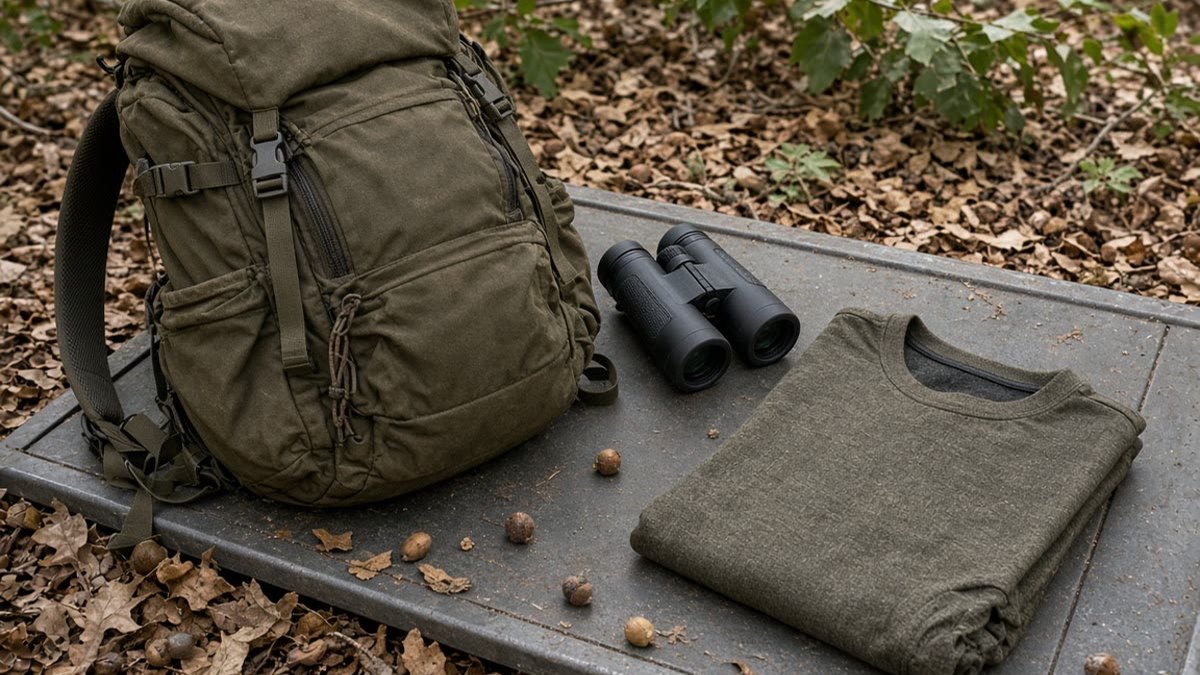
Most of the warmth goes up the tree in the pack, not on your back during the walk in. AI-generated editorial image of an olive backpack, binoculars and a folded olive wool sweater laid on a gray tree stand platform among fallen oak leaves and acorns.
Dressing for a cold deer hunt is a different problem than dressing for a cold hike. On the walk to the stand you are producing a lot of heat and probably some sweat. Then you sit nearly motionless for hours, often off the ground and exposed to wind, while the morning stays cold or gets colder. Sitka Gear puts it plainly in its layering guide: the stiller you have to be, the colder you're going to get.
This guide pulls together cold-weather advice from the CDC, CDC NIOSH and the National Weather Service, hunting-clothing guidance from Idaho Fish and Game, Sitka Gear and Minus33, and hunter-orange rules published by three state wildlife agencies. If you are new to the sport, pair it with our checklist for a successful first deer hunt.
Why do you get colder sitting in a deer stand than walking?
Walking makes heat, sitting still doesn't, and sweat from the walk keeps pulling heat out after you stop. A stand also puts you in the wind. The CDC says hypothermia can happen even above 40°F when a person is chilled by rain, sweat or cold water, so a damp, motionless hunter loses heat fast.
Sitka's guide sums up the activity side with two rules. When you are moving, "be bold, go cold" so you don't overheat. When you are sitting, add insulation, because stillness is what lets the cold in.
Moisture is the second problem. The CDC advises staying dry because wet clothing chills the body quickly, and it recommends taking off a layer as soon as you feel too warm and trying not to sweat. A shirt that soaked up sweat on a twenty-minute uphill walk stays wet against your skin for the whole sit.
Wind adds to both. The National Weather Service defines wind chill as how cold people and animals feel outside, based on how fast wind and cold pull heat from exposed skin. It is calculated only for temperatures at or below 50°F with wind above 3 mph. The NWS example: at 0°F with a 15 mph wind, the wind chill is -19°F and exposed skin can freeze in 30 minutes. A stand perched above the brush can leave you sitting in that wind with nothing to block it.
What base layer should you wear deer hunting in cold weather?
Wear a merino wool or synthetic base layer that wicks sweat away from your skin, and skip cotton entirely. Pick a weight that matches how cold it is and how still you'll be: a midweight top and bottom covers many late-fall sits, and a heavyweight set suits sits in deep cold.
The base layer sits against your skin and has one main job: keep it dry. Idaho Fish and Game recommends a wool or synthetic base layer that wicks sweat away from the body and warns hunters to avoid anything cotton, which saps warmth when it's wet. Sitka says it recommends not relying on cotton in winter and describes merino as naturally temperature-regulating, moisture-wicking and odor-resistant, with synthetic blends adding stretch and durability. The CDC's winter guidance makes the same point in general terms: start with a base layer that holds body heat and doesn't soak up moisture.
Weight matters more for stand hunters than for most people, because you need the layer to keep you warm while you are barely moving. Minus33 publishes approximate temperature ranges for its merino fabric weights by activity level:
- Lightweight (170 gsm): rated for 60°F and up at low activity, or roughly 60°F to 30°F at high activity.
- Midweight (245 gsm): about 60°F to 30°F at low activity, or 30°F to 0°F at high activity. Hunting is one of the uses Minus33 lists for it.
- Heavyweight, also called expedition weight (400 gsm): about 30°F to 0°F at low activity, or 0°F and below at high activity.
Minus33 says these ranges are approximate, and every hunter runs a little warmer or colder. For a stand hunter, the low-activity column is the one that describes the sit, and the high-activity column describes the walk in.
How should you layer the mid and outer layers for a cold stand?
Use a warm, packable insulating mid layer and a windproof outer shell, waterproof if rain or wet snow is forecast. Walk in with as little on as you can stand, carry the insulation, and put it on once you reach the stand and cool down, so sweat never soaks it.
Sitka describes the mid layer as the piece that traps the heat your base layer keeps close, and suggests choosing it for packability and a good balance of thickness and warmth. It notes that if you build enough warmth into the mid layer, you often won't need a bulky outer shell. For the outer layer, Sitka calls windproof the minimum and says waterproofing is essential when the forecast is wet.
Idaho Fish and Game warns against a single big, bulky parka because your only choices are to wear it or take it off. Several thinner layers let you fine-tune. CDC NIOSH recommends several layers of loose clothing for better insulation and notes that clothing that restricts movement can be dangerous, which matters when you're climbing into a stand.
The core habit is to walk in light and dress at the stand. One hunter quoted in Minus33’s hunting layering article says he layers lighter to start his trek even on cold mornings; another carries a few heavier expedition-weight layers in his pack in case he sits still and the temperature drops. Sitka's guide adds the reasoning: you will likely warm up on the walk, and once you start sweating, you need a layer that absorbs and wicks the moisture so you don't get cold later. The CDC's advice to remove a layer when you get too warm applies the whole way to the tree.
In practice that often looks like base layer plus a light shell or vest for the walk, with the insulated jacket, insulated bibs or pants, hat and mitts in a pack. Hoist the pack on a haul line rather than climbing with it; the Pennsylvania Game Commission recommends using a haul line to bring gear up and wearing a full-body safety harness whenever your feet leave the ground. Once you're clipped in and settled, dress in the warm layers before you start to feel chilled.
Quiet fabrics. Your outer layer is what brushes against branches, the stand and your own arms, so noise matters. Sitka notes that a streamlined system avoids the swishing of fabric that can spook game. The Minus33 article quotes a hunter who finds wool quieter than synthetics when moving through heavy vegetation. Before the season, put on your full outer layer and raise your arms as if lifting binoculars; if it rustles loudly in a quiet room, consider a softer outer piece before you sit in a silent woods.
For more on adjusting layers as conditions change through the day, see our general guide to layering tips to stay comfortable in any weather.
What boots and socks keep your feet warm in a deer stand?
Wear insulated, waterproof boots with enough room for thick socks, and use merino or synthetic socks, often a thin liner under a cushioned boot sock. Fit them with the socks you'll actually wear. Carry a spare dry pair of socks if the walk in makes your feet sweat.
Feet sit still longer than any other part of you on stand, and they rest on a cold metal or wood platform. CDC NIOSH says boots should be waterproof and insulated, and Sitka's cold-weather guidance calls for insulated, waterproof boots with proper fit and wool or synthetic socks instead of cotton. Fit means room for the socks you'll actually wear, so try boots on with your hunting socks.
Layering works for feet, too. Hunters quoted by Minus33 describe pairing a thin wool liner sock with a full-cushion wool boot sock to fill rubber boots, and moving up to an expedition-weight sock for very cold sits. The liner wicks sweat off your skin; the cushioned sock adds insulation. NIOSH also recommends carrying spare dry clothing, and a dry pair of socks is the lightest version of that advice: changing out of damp socks once you're settled can make the difference between a long sit and a short one.
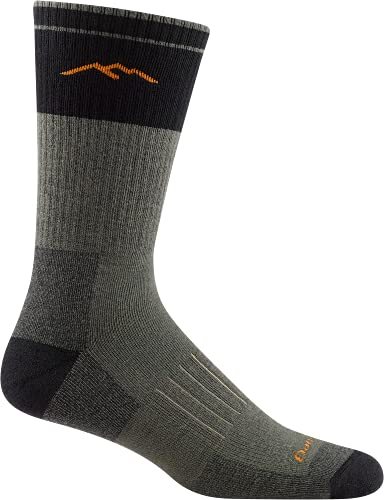
One widely sold example of a cushioned hunting boot sock is Darn Tough's style 2101. Darn Tough lists it as a heavyweight, full-cushion boot sock with terry loops running the length of the sock, about 11 inches from heel to cuff, made mostly of merino wool with nylon and elastane, in a forest color, and guaranteed for life. The maker suggests pairing it with hunting and field boots. Check the fit with your boots before opening day, because a thick sock in a snug boot defeats the purpose.
How do you keep your hands, head and neck warm while hunting?
Wear mittens or mitts for warmth while you wait, with thin liner gloves underneath for tasks that need your fingers. Add an insulated hat and a neck gaiter or balaclava, and keep chemical hand warmers in a pocket or mitt. Avoid touching cold metal stand parts with bare skin.
The CDC recommends mittens because they are warmer than gloves. The trade-off for hunters is dexterity, which is why many wear a thin liner glove inside a mitt or pocket muff and slip the mitt off only when they need their fingers. Sitka's cold-weather article recommends insulated, waterproof gloves and suggests hand and foot warmers and face protection for the coldest sits.
Chemical warmers are cheap insurance on a long sit, and NIOSH lists chemical hot packs among the items to keep in a cold-weather first-aid kit. How long a warmer lasts depends on the type and how you use it; our guide to how long hand warmers last covers run times, shelf life and safe use.
For your head, NIOSH notes that hats reduce body heat escaping from your head, and the CDC recommends a hat plus a scarf or knit mask over the face and mouth. Idaho Fish and Game points out that adding or removing a beanie is one of the easiest ways to adjust your warmth, which makes it a good piece to carry in a pocket on the walk in. A neck gaiter or balaclava, which Sitka recommends for added warmth, closes the gap between collar and hat where cold air gets in.
NIOSH also advises avoiding touching cold metal surfaces with bare skin. On a steel stand, ladder or rail on a frigid morning, that is a practical reason to keep at least liner gloves on while climbing and setting up.
How much blaze orange do you need for deer hunting?
It depends on your state, your season and sometimes your hunting method. Some states require a set number of square inches on the head, chest and back; others set a percentage of clothing above the waist or require one visible orange garment. Always read your own state's current regulations before you hunt.
Your outer layer may need to meet a legal visibility standard. Here is how three state agencies describe their rules, as published on their own pages. These are examples only, not a summary of every season or exception:
- Pennsylvania: The Pennsylvania Game Commission says that when orange is required, hunters must wear 250 square inches of fluorescent orange visible from 360 degrees on the head, chest and back, and that a hat and vest satisfy the requirement. During the firearms deer, bear or elk seasons, a minimum of 100 square inches of fluorescent orange must be displayed within 15 feet of a blind or enclosed stand. The commission strongly recommends orange even when it isn't required, especially while moving.
- Wisconsin: The Wisconsin DNR says that while a firearm deer season is in progress, hunting game other than waterfowl requires at least 50% of the hunter's outer clothing above the waist to be blaze orange or fluorescent pink, and any hat or head covering must also be at least 50% blaze orange or fluorescent pink. Camo-blaze is allowed if at least half the material is orange or pink, faded or stained garments may not meet the rule, and the DNR recommends 100% solid color.
- Michigan: In its November 4, 2026 firearm deer season safety release, the Michigan DNR says deer hunters, including archers, must wear hunter orange from Nov. 15 to 30. The orange (a cap, hat, vest, jacket or raincoat) must be the outermost layer, visible from all directions, including when hunting from inside a blind. Camouflage patterns count only if they are at least 50% hunter orange, and the DNR recommends wearing as much orange as possible, noting that it does not deter deer.
Rules differ between states and change from year to year. Check your own state wildlife agency's current hunting regulations for the exact season, method and land type you'll be hunting, and make sure your orange piece goes on over your insulated jacket, not under it.
What are the warning signs of hypothermia and frostbite?
The CDC lists shivering, exhaustion, confusion, fumbling hands, memory loss, slurred speech and drowsiness as hypothermia warning signs in adults. Redness or pain in any skin area may be the first sign of frostbite, followed by white or grayish-yellow skin, skin that feels unusually firm or waxy, and numbness.
The CDC calls hypothermia a medical emergency and says that if a person's temperature is below 95°F, get medical attention immediately. If help isn't available right away, the CDC advises getting the person into a warm room or shelter, removing wet clothing, and warming the center of the body first: the chest, neck, head and groin. Warm drinks can help, but never give anything to drink to an unconscious person.
Frostbite most often hits the nose, ears, cheeks, chin, fingers and toes, and the CDC recommends keeping those areas covered in warm, dry clothing. The NWS adds a useful distinction: you can get frostbite only when the actual air temperature near your skin is below freezing, but you can still become hypothermic when it's above freezing and the wind chill makes it feel colder. Our guide to preventing frostbite covers more prevention habits.
This is general safety information, not medical advice. If you suspect hypothermia or frostbite, follow the CDC's guidance and get medical care.
Putting the system together on a cold morning
Check the forecast temperature, wind and NWS wind chill the night before. At the truck, put on the base layer, a light outer piece, boots and your required orange, and start walking a little cool. Slow down on the climbs so you arrive dry. At the stand, clip in, haul up the pack, and dress before you get cold: mid layer, insulated outer layer, hat, neck gaiter and mitts, with warmers in your pockets and your orange garment on the outside. If you start shivering hard or your fingers stop working well, take that as your cue to climb down, move around and warm up.
Sources: CDC: Preventing Hypothermia, CDC: Safety During and After a Winter Storm, CDC NIOSH: Cold Stress and Workers, National Weather Service: Wind Chill, Pennsylvania Game Commission: Safe Hunting Tips, Wisconsin DNR: Highly Visible Clothing, Michigan DNR: 10 tips for a safe and successful firearm deer hunting season (Nov. 4, 2026), Idaho Fish and Game: Dress for the weather, Sitka Gear: How to Layer Hunting Clothes, Sitka Gear: Warmest Hunting Clothes, Minus33: Fabric Weights Overview, Minus33: Hunting Layering Tips, Darn Tough: Men's Boot Heavyweight Hunting Socks (style 2101), OpticsPlanet: Darn Tough Hunter Boot Heavyweight listing; Amazon B096M1HGRN.
Frequently asked questions
Why do you get colder sitting in a deer stand than walking?
Walking generates body heat, but sitting still in a stand does not, and sweat from the walk in keeps pulling heat away after you stop. Stands are also often exposed to wind. The CDC notes hypothermia can occur even above 40°F when someone is chilled by rain, sweat or cold water.
What base layer should you wear deer hunting in cold weather?
Choose a merino wool or synthetic base layer that wicks sweat away from your skin, and avoid cotton, which loses its warmth when wet. Match the weight to the sit rather than the walk: midweight suits many late-fall sits, and heavyweight or expedition weight suits very cold, still hunts.
How should you layer the mid and outer layers for a cold stand?
Pair a packable insulating mid layer with a windproof outer shell that is waterproof when rain or wet snow is likely. Walk in wearing as little as you comfortably can, carry the insulation in a pack, and put it on at the stand before you get chilled so it stays dry.
What boots and socks keep your feet warm in a deer stand?
Wear insulated, waterproof boots with enough room for your hunting socks, so try them on with those socks. Use merino or synthetic socks, often a thin liner under a cushioned boot sock, and carry a dry spare pair to change into if your feet sweat on the walk in.
How do you keep your hands, head and neck warm while hunting?
Mittens are warmer than gloves, so many hunters wear mitts or a hand muff over thin liner gloves and keep chemical hand warmers in a pocket. An insulated hat plus a neck gaiter or balaclava seals the gap at the collar, and liner gloves keep bare skin off cold metal stand parts.
How much blaze orange do you need for deer hunting?
It varies by state, season and method. Pennsylvania specifies 250 square inches on the head, chest and back when orange is required, Wisconsin requires at least 50% of outer clothing above the waist during firearm deer season, and Michigan requires an outermost orange garment visible from all directions. Always check your own state's current regulations.