
Canister Stove in Cold Weather: Why It Fades and Fixes
Written by Outdoors Magazine|
Outdoors Magazine is a participant in the Amazon Services LLC Associates Program. We may earn a commission if you buy through links on this page, at no extra cost to you. Affiliate disclosure.
A canister stove weakens in the cold because its fuel must vaporize inside the can, and cold slows that, while the canister also chills itself as it runs. Keep the canister warm in a jacket or sleeping bag, set it on a nonflammable pad off snow, carry a warm spare, and use a regulated, inverted-canister or liquid-fuel stove for real winter.
Key takeaways
- Cold slows fuel vaporization, and canisters chill themselves as they run.
- Keep canisters warm in a jacket or sleeping bag and set them off the snow.
- Never heat a canister with flame or hot water; no windscreen on upright stoves.
- Use inverted-feed or liquid-fuel stoves for real winter, and never cook in a tent.
A canister stove in cold weather loses power because its fuel has to boil into vapor inside the can, and cold slows that boiling. Keep the canister warm in a jacket or sleeping bag, set it on a nonflammable pad off snow, swap in a warm spare, and for real winter use a regulated, inverted-canister or liquid-fuel stove.
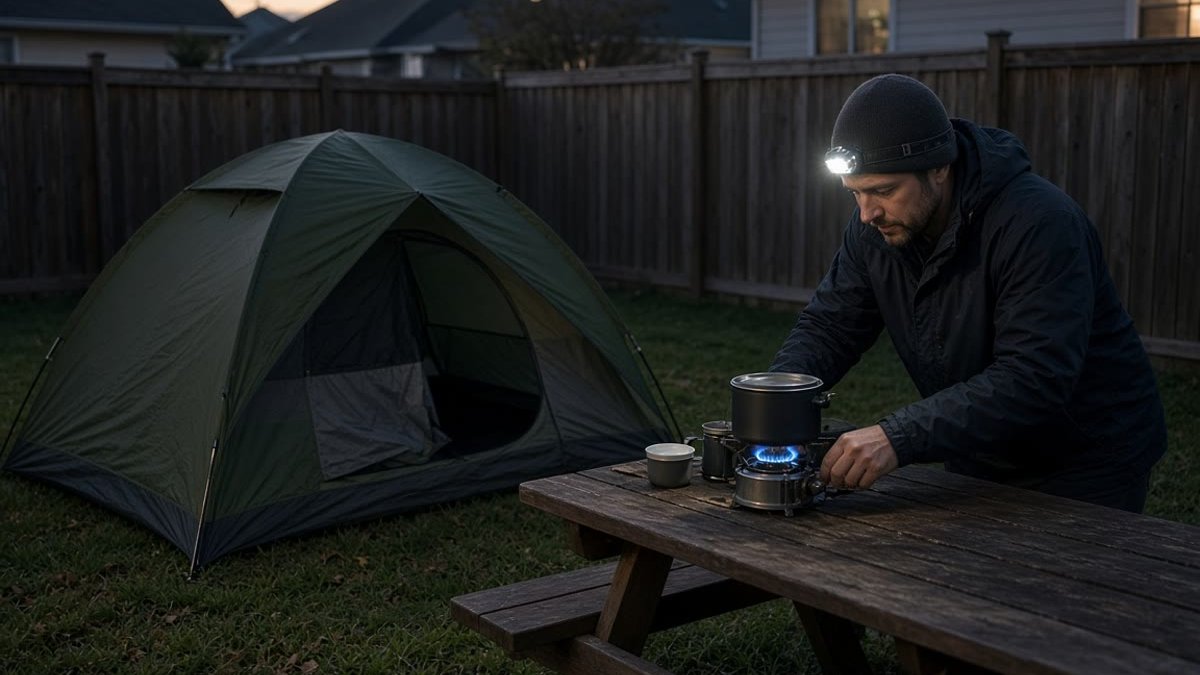
A backyard dry run shows how a stove behaves as the evening cools, long before a cold trailhead does. AI-generated editorial image of a man in a dark beanie wearing a lit headlamp bending over a small canister stove with a pot on a wooden picnic table at dusk, a green dome tent beside him in a fenced backyard with houses behind.
Most people discover the problem the same way: the stove that roared all summer gives a weak, lazy flame on a frosty morning, the pot takes forever, and a canister that felt half full seems to quit early. Nothing is broken. A canister stove is a small pressure system, and its pressure depends on temperature. Once you understand why, the fixes are simple, and most of them weigh nothing.
This guide draws on fuel and stove guidance from MSR (Cascade Designs), the instruction manuals for two MSR stoves, boiling-point data from the NIST Chemistry WebBook, an Appalachian Mountain Club explainer, and carbon monoxide guidance from the CDC and the U.S. Consumer Product Safety Commission. Your own stove's manual is the final word for your stove; where a maker says something different from the general advice here, follow the maker.
Why do canister stoves lose power in the cold?
A screw-on canister holds fuel that is mostly liquid under pressure. A small amount of that liquid boils into gas at the top of the can, and that gas is what flows through the valve to the burner. MSR explains that fuel only flows while the pressure inside the canister is higher than the pressure outside it. Cold lowers the internal pressure, and when the liquid stops vaporizing fast enough, the burner is starved.
Two things set the canister's temperature. The first is the air, snow or ground around it. The second catches people out: the canister cools itself as you use it. Turning liquid into gas takes heat, and that heat comes out of the fuel and the metal can. MSR notes plainly that canisters cool as you run your stove, and the AMC explainer points out that this self-cooling can shut a stove down even when the air is somewhat warmer than the fuel's boiling point. Anyone who has felt a canister turn icy to the touch during a long boil has felt this happen.
There is a third effect that explains the early quitting. Canister fuel is a blend, and the parts of the blend do not boil off at the same rate. The AMC notes that in freezing conditions the propane burns off faster, which leaves a canister richer in the butane-type fuels that handle cold poorly. A partly used canister can therefore perform worse in the cold than a fresh one of the same blend, even though there is still fuel sloshing inside.
Altitude complicates the picture rather than fixing it. MSR says the lower outside pressure up high helps keep the inside and outside pressures in a better balance, but the cold that usually comes with elevation can cancel out that advantage.
At what temperature does butane, isobutane or propane stop working?
The useful number for each fuel is its boiling point, the temperature below which it stays liquid at normal sea-level pressure and stops producing much vapor on its own. The NIST Chemistry WebBook lists these normal boiling points:
- n-butane: about 273 K, which is roughly 32°F (0°C) (NIST). MSR says butane canisters may struggle around 31°F, and the AMC uses the same 31°F figure.
- Isobutane: about 262 K, roughly 12°F (−11°C) (NIST). MSR gives 11°F (−12°C), and says isobutane canisters struggle around 11°F, adding that it holds pressure at temperatures about 20 degrees lower than butane.
- Propane: about 231 K, roughly −44°F (−42°C) (NIST). MSR gives the same −44°F/−42°C figure.
Propane is the cold-weather star, so why not fill canisters with it? MSR's fuel guide explains that propane's high vapor pressure needs heavy, burly canisters. Mixing in isobutane lets the blend live safely in a much lighter can. MSR's IsoPro, for example, is 80 percent isobutane and 20 percent propane. The PocketRocket Deluxe manual specifies an 80/20 isobutane/propane canister certified to EN 417, and the WindPro II manual allows that blend or a 70/30 butane/propane blend.
These boiling points are not the same as the temperature at which your stove becomes usable or useless. MSR warns that cooking efficiency can drop before you reach them, and its fuel-planning guide says upright canister stoves usually work down to about 20°F (−6.5°C), with fuel efficiency falling the further the temperature drops below that. Remember too that the canister can be colder than the air once it has been running for a while. When you read a fuel blend on a label, the practical takeaway is that more isobutane and propane, and less plain butane, means better cold-weather behavior.
How do you keep a fuel canister warm while winter camping?
Warmth in the canister is the cheapest performance upgrade there is. MSR's canister guidance and the AMC agree on the core habits:
- Sleep with it. Keep tomorrow's canister in your sleeping bag overnight, or inside an insulated jacket, so it starts the morning warm. If you are choosing a bag for cold nights, our guide to sleeping bag temperature ratings explains what those numbers really mean.
- Carry a warm spare. MSR suggests warming at least two canisters, so you can swap a cooling one for a warm one in the middle of a long session such as melting snow.
- Get it off the snow. MSR recommends a nonflammable barrier under the canister to keep it up off the cold ground, which helps it supply fuel longer. A canister sitting directly on snow is losing heat into a giant cold sink.
- Use a lukewarm water bath, carefully. MSR describes setting the canister in a bowl with an inch or so of lukewarm water while you cook, and the AMC describes a shallow dish with an inch or two of water. The word that matters is lukewarm.
The same overnight trick protects other gear. A water filter that freezes can be damaged, which is why our guide on how to keep a backpacking water filter from freezing recommends the same sleeping-bag habit.
What you must not do is overheat the can. Both MSR manuals reviewed here warn against storing canisters near heat sources or where temperatures exceed 120°F (49°C), because the canister can explode. The WindPro II manual tells you to keep the canister away from the stove burner and other heat sources. In practice that rules out the tempting shortcuts: never warm a canister over a flame or on a stove, never sit it in a pot of hot water, and never set it beside a fire to thaw. If your canister or stove maker gives a specific warming method or temperature limit, follow that and nothing warmer.
Cold also affects the stove itself. Both the PocketRocket Deluxe and WindPro II manuals warn that in freezing temperatures O-rings can stiffen and leak fuel, and tell you to check for leaks before and after lighting. The PocketRocket Deluxe manual says to check with soapy water, never with a flame. The PocketRocket Deluxe manual adds that the stove should not be operated or stored below 0°F (−18°C), a reminder that every stove has a floor worth reading in its own manual.
Can you use a windscreen with a canister stove?
It depends entirely on the stove design, and this is one place where general advice can be dangerous. Wind matters a great deal: MSR says even a 5 mph wind can cause as much as three times more fuel use over a cooking period. So the urge to wrap a screen around a struggling stove is understandable.
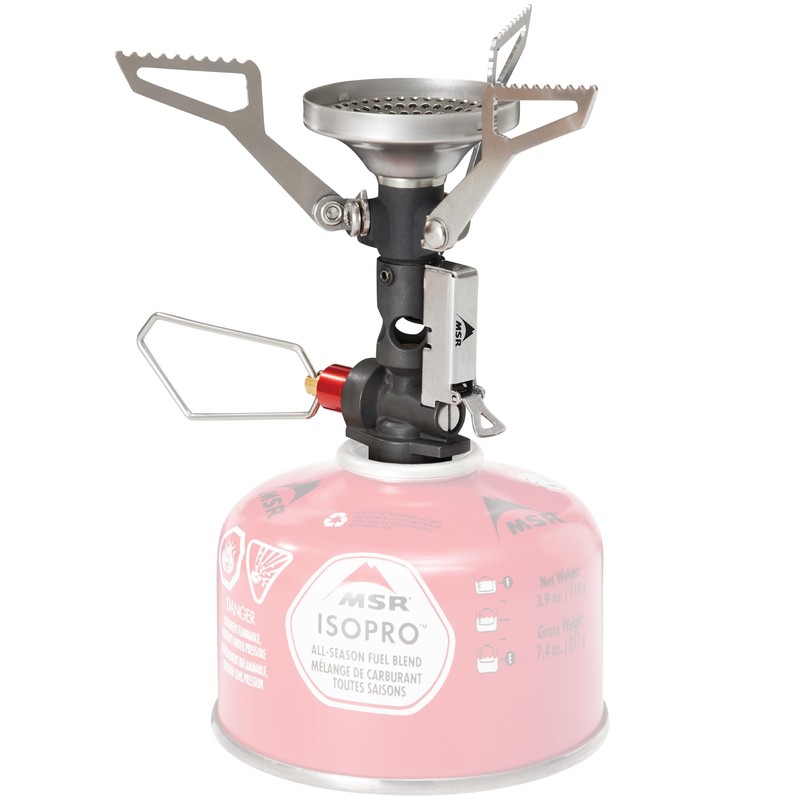
For a stove that screws directly on top of the canister, MSR says a metal windscreen is not recommended for propane-based canisters, because it can overheat the canister, build excess pressure and melt the gaskets. The PocketRocket Deluxe manual is blunter: never use any kind of windscreen, and never use a reflector or diffuser. Wrapping heat around the fuel is exactly the wrong thing to do with a pressurized can sitting under a flame. With an upright stove, look for natural shelter instead, such as the lee of a boulder or your pack, while keeping combustibles back; the PocketRocket Deluxe manual asks for at least 4 feet (1.2 meters) of clearance from combustible materials.
Remote-canister stoves are different. On those, the burner sits low on its own legs and a hose runs to a canister set off to the side. MSR's product page for the WindPro II says the remote burner allows the use of a windscreen, and one is included. The manual still sets rules: leave a 1-inch (2.5 cm) gap between the windscreen and the cookware, keep combustion and ventilation air unobstructed, and position the canister as far from the burner as possible. In other words, the screen goes around the burner, not around the fuel.
Do regulated or inverted-canister stoves work better in cold weather?
Yes, within limits, and they work in different ways. Neither changes the physics of a cold canister; they make better use of the pressure you have.
Pressure-regulated stoves are designed to hold a steadier output as canister pressure falls. MSR describes regulators as helping stoves perform with very low pressure. MSR's own figure for its WindBurner gives a sense of the limits: it says the regulator delivers consistent cooking down to a canister temperature of 32°F (0°C), and for use below freezing it recommends placing the canister in a bowl of water to keep it above freezing. A regulator can help on cool mornings, but it still needs a canister that is producing vapor. Our comparisons of the Soto WindMaster and MSR PocketRocket 2 and the Jetboil MiniMo and PocketRocket Deluxe look at regulated and unregulated designs side by side.
The PocketRocket Deluxe is one example of a regulated upright stove. Its instruction manual lists a pressure regulator and a piezo push-start igniter among its parts, and specifies an 80/20 isobutane/propane canister. It is an upright, top-mounted stove, so the no-windscreen and 0°F operating limits above apply to it.
Inverted-canister (liquid-feed) stoves attack the problem more directly. Turn a canister upside down and liquid fuel, not vapor, flows down the hose to the burner, where it is vaporized at the stove, which is why the stove must be primed first, instead of inside the cold can. MSR says this keeps a stove running without relying on vaporization in the canister, though it increases fuel consumption. Only invert a stove designed for it. MSR is explicit that you should make sure your stove has this feature before you try, and it warns that inverting its WindBurner can cause extremely dangerous flare-ups or liquid fuel build-up.
The MSR WindPro II is built for it. MSR's product page describes it as a remote-burner canister stove that can run upright for efficiency and flame control, or with the canister inverted on the included stand for improved cold-weather and low-fuel performance. MSR lists a minimum weight of 6.6 oz (0.19 kg), and the package includes a windscreen, heat reflector, canister stand and stuff sack. The manual lists output of 7,450 BTU/h in vapor mode and 10,000 BTU/h in liquid-feed mode, and describes liquid feed as the setting for very cold conditions or faster boiling.
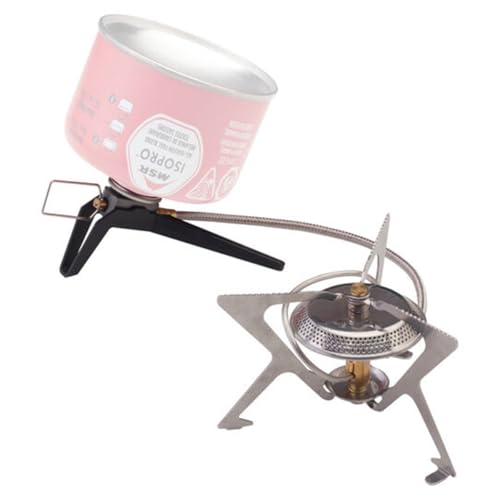
The manual's start-up sequence matters. Light the stove with the canister upright, let it burn for 30 seconds so it is properly primed, then invert the canister onto the stand. If you invert too early, the troubleshooting table warns, the stove can flare. Simmering is also harder in liquid-feed mode; MSR's fix is to turn the canister upright again when you need fine flame control.
Is it safe to cook in a tent or vestibule in winter?
No. This is the cold-weather mistake that kills people, and it is tempting precisely when the weather is worst. Canister stoves produce carbon monoxide, a gas you cannot see or smell. The WindPro II manual says the stove is for outdoor use only and should never be used in a tent, vestibule, car, house or any enclosed area, because it consumes oxygen and produces carbon monoxide. The PocketRocket Deluxe manual carries the same warning, naming campers, tents, cars and homes.
Public health agencies say the same. The CDC states that you should never use a portable gas camp stove indoors and lists headache, dizziness, weakness, upset stomach, vomiting, chest pain and confusion as the most common symptoms of carbon monoxide poisoning. The CPSC warns against using fuel-burning heaters and lanterns while sleeping in tents, campers and vehicles, notes that the risk is higher at high altitudes, and advises seeing a doctor if someone develops cold- or flu-like symptoms while camping.
Plan the cold-weather kitchen outdoors instead: a sheltered spot out of the wind, a stable base, the canister warm and off the snow, and enough light to see the flame. A headlamp and a small nonflammable pad cost far less than the alternative.
Liquid fuel and extra fuel: planning a cold trip
For regular winter camping, many people move to a liquid-fuel stove. MSR's case is straightforward: as temperatures drop, canister pressure falls and there is nothing you can do to offset it, whereas liquid-fuel stoves are kept pressurized by you, with a pump. MSR also notes that liquid-fuel stoves are more stable than most canister stoves on uneven or meltable ground like snow and ice, and that packing the right amount of fuel is more precise with bottles. MSR also notes that liquid-fuel stoves are fully field maintainable. It is a different, more hands-on system, so learn it before the trip, but for multi-day snow trips where you melt snow for water, a pumped stove removes most of the pressure guesswork described above.
Whatever you burn, bring more of it. MSR's fuel-planning guidance says low temperatures, melting snow and wind can require three to four times as much fuel as your baseline estimate. Snow melting adds both an extra step and extra burn time, and a canister that is running cold delivers less heat per minute. A practical approach is to work out your normal fuel needs, multiply for the conditions, and carry at least one extra warm canister you can swap in.
A short checklist before a cold outing:
- Check the blend on the label and choose isobutane/propane over plain butane.
- Start with a fresh canister and keep a second one warm in your jacket.
- Pack a small nonflammable barrier to keep the canister off snow and frozen ground.
- Read your stove manual's rules on windscreens, inverting and minimum temperature.
- Check the connection for leaks with soapy water before and after lighting.
- Cook outdoors, never in the tent or a closed vestibule.
Get those right and a canister stove is a dependable tool well into the cold season. Push it much below its comfortable range and the honest answer is to change the tool, not to heat the fuel.
Sources: MSR: Stoves 101, getting the most out of fuel canisters, MSR: The ultimate guide to MSR fuel, MSR: How much fuel should I carry?, MSR: 8 reasons a liquid fuel stove is better for winter camping, MSR: WindPro II stove, MSR WindPro II instruction manual, MSR PocketRocket Deluxe instruction manual, NIST Chemistry WebBook: butane, NIST Chemistry WebBook: isobutane, NIST Chemistry WebBook: propane, Appalachian Mountain Club: Why does my canister stove fail in cold weather?, CDC: Carbon monoxide poisoning basics, CPSC: Portable heaters and camping equipment; Amazon B005I6PNZS, B07L5S65HR.
Frequently asked questions
Why do canister stoves lose power in the cold?
Canister fuel has to boil from liquid into vapor inside the can, and cold lowers the pressure that pushes that vapor to the burner. The canister also chills itself as fuel vaporizes, and propane in the blend tends to burn off first, so a part-used canister can weaken even further.
At what temperature does butane, isobutane or propane stop working?
NIST lists normal boiling points of about 32°F (0°C) for n-butane, 12°F (−11°C) for isobutane and −44°F (−42°C) for propane. MSR says upright canister stoves usually work down to about 20°F (−6.5°C), with efficiency falling below that, and performance can drop before the boiling point is reached.
How do you keep a fuel canister warm while winter camping?
Keep the canister in your sleeping bag overnight or in an insulated jacket, carry a warm spare to swap in, and set it on a nonflammable barrier off the snow. MSR also describes a shallow bowl of lukewarm water while cooking; never warm a canister over a flame, in hot water or near a fire.
Can you use a windscreen with a canister stove?
Not around an upright stove that sits on the canister: MSR says a metal windscreen can overheat the canister, and the PocketRocket Deluxe manual says never to use any kind of windscreen. Remote-canister stoves such as the WindPro II are designed for a windscreen around the burner, with the canister kept as far from the burner as possible.
Do regulated or inverted-canister stoves work better in cold weather?
Yes, within limits. A pressure regulator helps hold output as canister pressure falls, while an inverted-canister stove feeds liquid fuel to the burner so it does not depend on vaporization inside the cold can. Only invert a stove the maker designed for it, such as the MSR WindPro II.
Is it safe to cook in a tent or vestibule in winter?
No. Stove makers and the CDC say never to use a gas camp stove in a tent, vestibule, vehicle or other enclosed space, because it produces odorless carbon monoxide that can kill. Cook outdoors in a sheltered spot, and see a doctor if anyone develops symptoms such as headache, dizziness or confusion while camping.