
Tire Pressure in Cold Weather: Why It Drops and What to Do
Written by Outdoors Magazine|
Outdoors Magazine is a participant in the Amazon Services LLC Associates Program. We may earn a commission if you buy through links on this page, at no extra cost to you. Affiliate disclosure.
Tire pressure drops about 1 psi for every 10°F the temperature falls, per Bridgestone, Michelin and AAA, with Goodyear and Firestone citing 1 to 2 psi. Check tires cold, before driving, and inflate to the pressure on the driver's door-jamb placard, not the sidewall maximum. Check at least monthly and before trips, including the spare, and don't overinflate for winter.
Key takeaways
- Pressure falls about 1 psi per 10°F drop; some makers say up to 2 psi.
- A cold-morning TPMS light usually means a tire is truly low, not leaking.
- Check cold, before driving, at the door-jamb placard number, not the sidewall.
- Check monthly and before trips, spare included; never overinflate for winter.
Tire pressure in cold weather drops about 1 psi for every 10°F the air temperature falls, according to Bridgestone, Michelin and AAA; Goodyear and Firestone say 1 to 2 psi. Check pressure cold, before driving, set it to the number on the driver's door-jamb placard rather than the sidewall maximum, and recheck at least monthly and before trips.
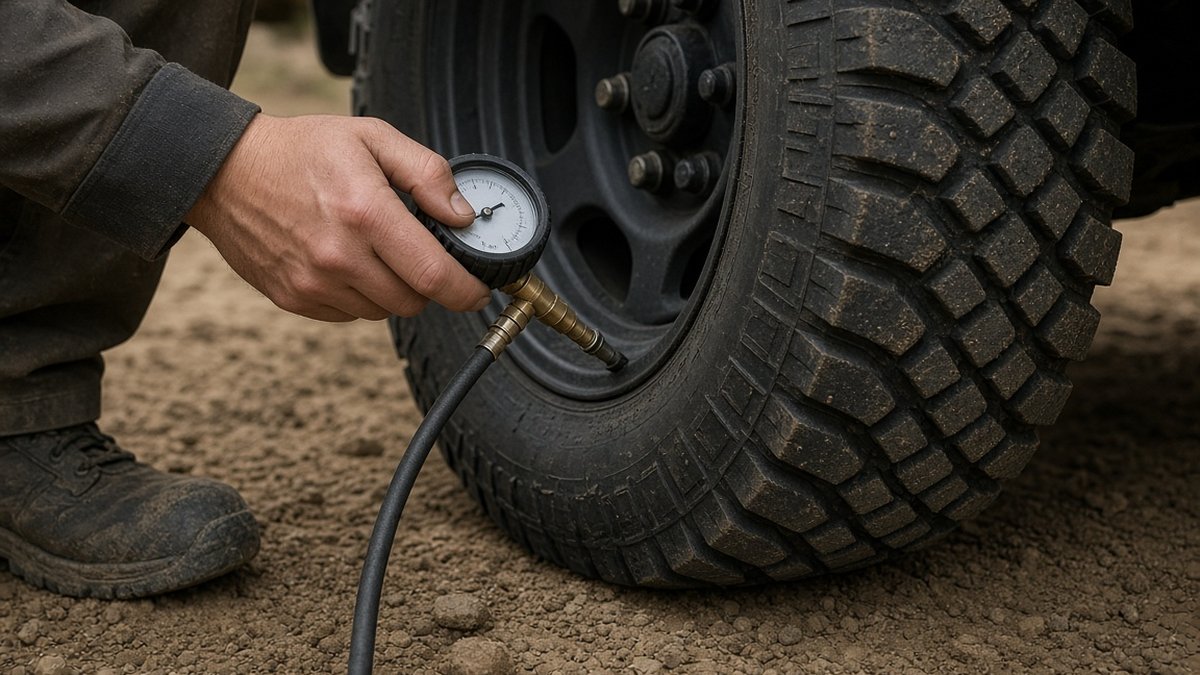
A ten-second gauge check is cheap insurance before a cold drive. AI-generated editorial image of a hand pressing a dial tire-pressure gauge with a hose onto the valve stem of a chunky off-road tire on a dirt surface.
The first hard frost of the season tends to come with a small orange light on the dashboard. It looks alarming, and on a dark morning before a holiday drive it is easy to either panic or ignore it. Neither is the right response. In most cases the tires have not sprung a leak; the air inside them has simply cooled and lost pressure overnight. But a tire that has dropped below its recommended pressure is a tire that is underinflated, whatever the reason, and that matters for braking, handling, wear and fuel use on exactly the kind of long, snowy, loaded-up trip that winter brings.
This guide pulls together what tire makers, AAA, the U.S. Department of Energy and the federal tire pressure monitoring rule say about cold-weather tire pressure, and how to fold a quick tire routine into holiday travel, mountain drives and early starts at the trailhead.
Why does tire pressure drop in cold weather?
Air contracts as it cools, so the same amount of air inside a tire pushes outward with less force on a cold morning. Bridgestone puts the change at approximately 1 psi for every 10°F change in ambient temperature, and Michelin and AAA use the same rule of thumb. Goodyear and Firestone give a wider range of 1 to 2 psi per 10°F.
Firestone explains it in plain terms: when the temperature drops, the molecules in the air slow down and crowd closer together, and when it warms up they spread out again. Its cold-weather guide gives an example that is easy to remember: a 20°F drop over a weekend could, in theory, cost a tire about 4 psi. AAA Club Alliance notes that a cold snap of 20 to 30 degrees can pull pressure below the recommended level overnight, and that pressure rises again at about the same rate when the weather warms.
Temperature is not the only thing at work. Tires also lose a little air over time; Les Schwab describes it as air escaping the wheel and tire assembly. Bridgestone says tires lose approximately 1 psi a month on average, and Les Schwab says the loss can be 1 to 2 psi a month. Over a season, slow seepage and falling temperatures stack on top of each other. That is why a car that was set correctly in October can be noticeably low by the first week of December even with no puncture at all.
Why does the tire pressure light come on on cold mornings?
The tire pressure monitoring system, or TPMS, is designed to warn you when a tire is significantly underinflated. Under the federal standard for these systems, FMVSS No. 138, the low-pressure warning must come on within 20 minutes once a tire falls to 25 percent below the vehicle maker's recommended cold inflation pressure (or a minimum pressure set in the rule for that tire type, whichever is higher). If your tires were already a few psi low in the fall, an overnight temperature drop can be enough to push one of them past that line.
Les Schwab describes the usual pattern: the light comes on during a cold snap, then shuts off on its own after some driving because the tires and the air inside warm up and the pressure rises. Goodyear likewise says a TPMS light in cold weather happens naturally and does not necessarily mean a tire is leaking. Still, a light that goes out after 15 minutes on the highway means the tires were low when you started, and they will be low again tomorrow morning.
The federal rule requires owner's manuals to say this directly: when the low-pressure light comes on, stop and check your tires as soon as possible and inflate them to the proper pressure. The same required text warns that TPMS is not a substitute for proper tire maintenance and that it remains the driver's job to keep pressure correct, even when a tire is not low enough to trigger the light. AAA makes the same point, noting that a typical system does not alert you until a tire is already about 25 percent below the recommended pressure. On a tire that should be at 35 psi, that is roughly 26 psi before the dashboard says anything.
One more thing to watch for: a light that flashes. On vehicles where the low-pressure light also serves as the malfunction indicator, the federal text says the light will flash for about a minute and then stay on when the system detects a fault, and it will repeat that sequence at each start-up until the fault is fixed. When that happens, the system may not be able to warn you about low pressure at all. The rule notes that malfunctions can come from things like installing replacement or alternate wheels or tires, which is worth remembering if you have just swapped onto a set of winter wheels.
How do you check cold tire pressure correctly?
"Cold" in tire terms means the tires have not been driven on recently, not that the weather is cold. Bridgestone and AAA define it as a vehicle that has not been driven for at least three hours, and Goodyear says several hours, long enough for the tires to cool down. Michelin UK treats tires as still cold if they have been driven less than 3 kilometers, or a little under 2 miles. Firestone's simplest advice is to measure before you drive, not after. Driving heats the tires and gives a falsely high reading.
Next, find the right target. The recommended pressure is on the vehicle placard, usually a sticker on the driver's door jamb, and in the owner's manual; FuelEconomy.gov adds that some vehicles put it in the glove box, and Firestone mentions the fuel door as another spot. Use that number. Do not use the figure molded into the tire sidewall. Bridgestone explains that the sidewall number is the tire's maximum inflation pressure, not the right pressure for your vehicle, and that running at the maximum can make tires wear faster and compromise traction and braking. The federal rule also notes that if your vehicle has tires of a different size than the placard lists, you need to determine the proper pressure for those tires.
Then work through each tire:
- Unscrew the valve cap and keep it somewhere it won't roll away.
- Press the gauge straight and firmly onto the valve stem. If you hear hissing, Firestone says the gauge probably isn't seated; adjust the angle until the hiss stops.
- Read the pressure and compare it with the placard. Write it down if you are tracking a slow leak.
- Add air in short bursts and recheck often, since compressors fill at different speeds. To let air out, Les Schwab says to press the center pin in the valve.
- Replace the valve cap, which helps keep dirt and moisture out of the valve.
A gauge of your own is worth having. Gas-station air hoses are convenient, but by the time you reach the station the tires have been driven and warmed, so the reading is no longer a cold one. Firestone notes that simple pencil gauges are inexpensive and that digital gauges cost a bit more but are very easy to read. A gauge that lives in the glovebox or door pocket lets you take a real cold reading in the driveway before you leave.
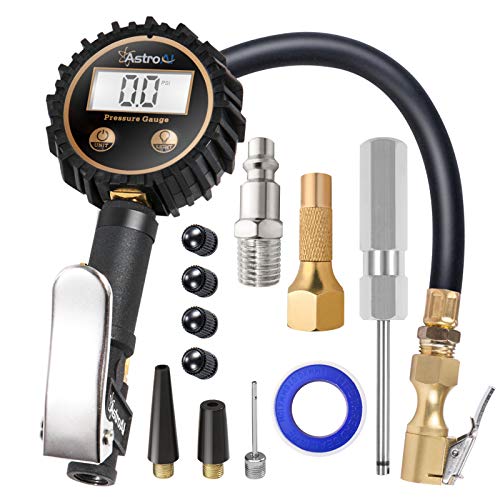
If you have a compressor at home, an inflator gun with a built-in gauge combines both jobs. The AstroAI ATG250 below has a digital gauge with a backlit screen, a range of 3 to 250 psi with 0.1 display resolution, a heavy-duty clip-on air chuck on a rubber hose, and a quick-connect coupler for a shop compressor, and it runs on two AAA batteries, which are included, according to the maker's product page. AstroAI's own FAQ says the gauge has an error of plus or minus 1.5 psi and that the reading fluctuates while air is flowing, so release the trigger and let the number settle before you read it. Note that it is not a stand-alone pump; it needs a compressor to supply air.
Should you add air in a warm garage or outside?
Set your pressure for the temperature the car will actually be driven in. Michelin UK recommends checking and adjusting tire pressure at the ambient outside temperature, and says that if you have to inflate indoors, you should then leave the vehicle outside to acclimatize. That matters most in winter, when a heated or attached garage can be far warmer than the driveway.
The reason follows from the same rule of thumb. If you set your tires to the placard number at 60°F inside a heated garage and then drive out into 20°F air, the tires will cool and lose pressure as they adjust to the outside temperature, by roughly 1 psi per 10°F according to Bridgestone's figure. You end up below the placard pressure on the road even though the gauge read perfectly in the garage.
The simplest fix is to check after the car has been sitting outside long enough to cool to the outdoor temperature, such as first thing in the morning on a car parked in the driveway, or after a few hours parked at work. If you only have air in the garage, fill there, roll the car outside, let it sit for a few hours, and then recheck and top up so the final reading matches the placard at outdoor temperature. Either way, the goal is the same number on the gauge in the conditions you will drive in, not a bigger one.
Should you overinflate your tires for winter?
No. Inflate to the vehicle maker's recommended pressure and keep it there; don't add extra air in advance to cover future cold snaps. Michelin warns that too much air reduces the tire's contact area, which decreases grip on icy roads. Les Schwab says overinflating in winter can cause a loss of traction, compromised handling and a bumpier ride, especially on snow-covered roads.
AAA adds that overinflated tires wear faster in the center of the tread, put less rubber on the road, ride harsher and are more vulnerable to potholes and road debris, all of which become bigger problems on frost-heaved winter pavement. And because pressure rises again when the weather warms, air you add to compensate for a cold morning can leave the tire over pressure on a sunny afternoon. The fix for cold weather is more frequent checks, not a higher target.
This is different from deliberately airing down for sand, rock or deep snow off pavement, which is a separate decision with its own risks and a need to air back up before returning to the highway. If that is your plan, our guide on how tire pressure impacts off-road adventures covers it. For regular winter road driving, the door-jamb number is the number.
How often should you check tire pressure in winter?
At least once a month and before any long trip. That is the advice from Bridgestone, Michelin and AAA, and the federal rule requires owner's manuals to say that each tire, including the spare if the vehicle has one, should be checked monthly when cold. AAA suggests checking more often during seasonal transitions, especially as fall turns to winter, and Les Schwab recommends a monthly check in the colder months. Firestone's habit is even simpler: check every other time you stop for fuel, and always when the TPMS light comes on.
Don't skip the spare. It is easy to forget a tire that lives under the cargo floor or beneath the bed of a truck, and it loses air like any other tire. Check its pressure against the placard or the spare's own label when you check the others, and confirm the jack and lug wrench are where they should be.
Some moments call for an extra check beyond the monthly routine: the first truly cold morning of the season, the night before a holiday drive, after you load the car with passengers, gear and gifts, and before heading up into the mountains or out to a remote trailhead where the nearest air hose could be an hour away. If one tire keeps reading lower than the others week after week, that is a slow leak, not the weather, and it is worth having a tire shop look at it.
What does driving on underinflated tires do?
The federal TPMS rule spells out the risks in the language it requires in owner's manuals: driving on a significantly underinflated tire causes the tire to overheat and can lead to tire failure, and underinflation also reduces fuel efficiency and tread life and may affect the vehicle's handling and stopping ability. Bridgestone adds that improper inflation can cause rapid or irregular wear and significant internal tire damage that can lead to sudden failure.
Heat is the hidden danger. AAA notes that driving on underinflated tires builds excess heat, which weakens the tire's internal structure and raises the risk of a blowout. That damage doesn't always show from the outside, which is one reason not to treat a cold-morning light casually before a long highway drive.
Handling and wear suffer too. AAA says underinflated tires tend to wear unevenly along the outer edges of the tread, which can affect handling and braking, and Firestone notes that underinflated tires can increase braking time and skid more easily on wet pavement. On winter roads, where grip is already reduced, those are not small effects.
Then there is fuel. FuelEconomy.gov says underinflated tires can lower gas mileage by about 0.2 percent for every 1 psi drop in the average pressure of all the tires, and that keeping tires properly inflated improves mileage by about 0.6 percent on average and up to 3 percent in some cases. Across a whole winter, the safety and tire-life costs of low pressure outweigh the fuel cost.
A simple tire routine for winter road trips
Holiday travel, ski weekends and winter hikes tend to start early, run late and cross a lot of temperature change. A few habits keep tires from being one more thing that goes wrong:
- Check the night before or first thing in the morning. Take a cold reading at home with your own gauge and top up to the placard number before you load up.
- Adjust at outdoor temperature. If you fill in a heated garage, let the car sit outside and recheck before you count it as done.
- Check the spare and tools. Pressure, jack and lug wrench, before you leave pavement or cell coverage behind.
- Expect the morning light. A TPMS warning at a cold trailhead or motel parking lot after a mild day of driving is common. Check the tires, add air if they are low, and don't assume it is nothing because it went out last time.
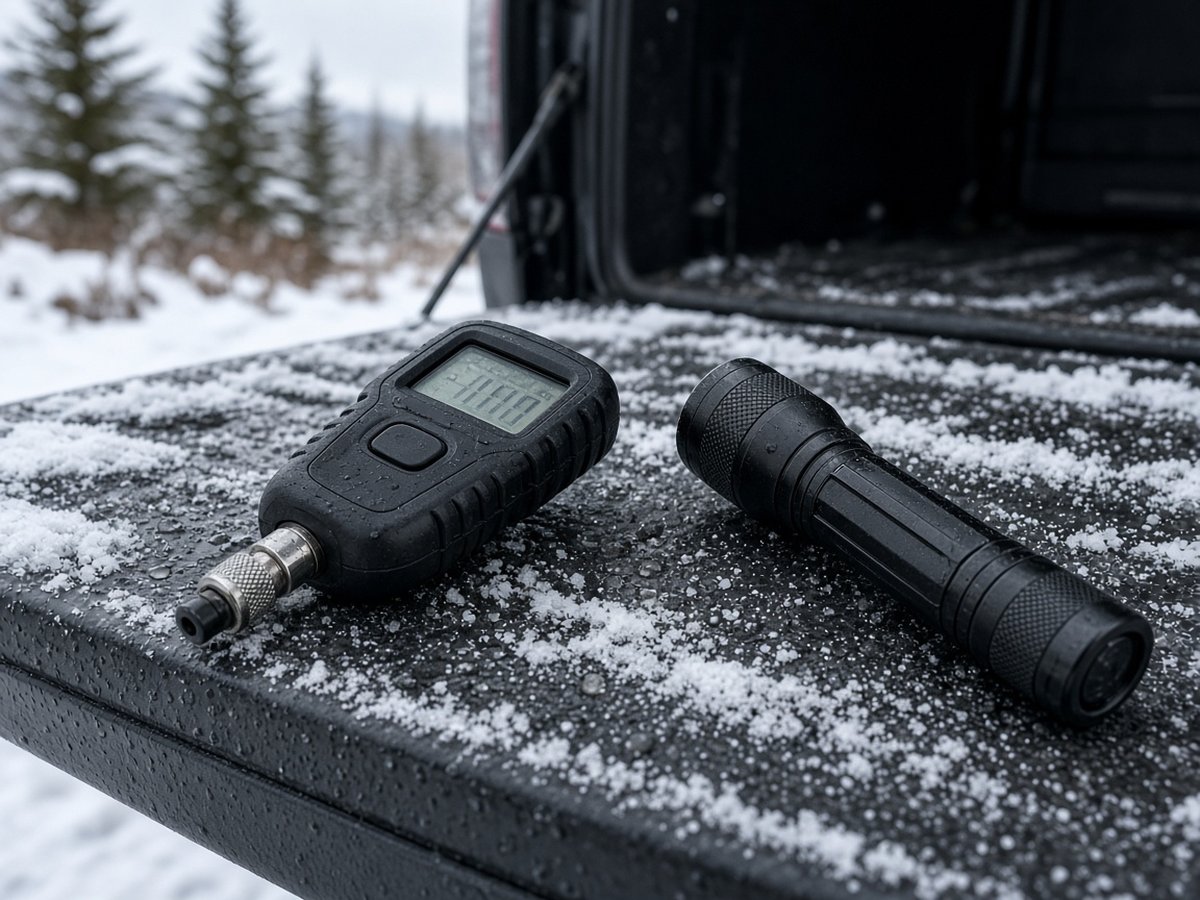
- Keep a gauge and a light in the vehicle. Valve stems are hard to find by feel in the dark with gloves on.
Mountain passes and trailhead lots can be colder than the valley town where you set your pressure, so a quick recheck after a cold night away from home is worth the minute it takes. Tires are only one part of winter readiness. Pair this routine with a well-stocked winter car emergency kit, read up on navigating snowy roads, and see our winter road trip hacks for staying warm and safe before you head out.
If a tire keeps losing air, shows bulges, cuts or exposed cords, or your TPMS light flashes or stays on after you have set the pressure correctly, have a tire shop inspect it before a long drive.
Sources: Bridgestone Americas, Michelin: preparing for winter, Michelin UK: winter tyre pressure, Goodyear/Cooper Tire, Firestone Complete Auto Care, Les Schwab: winter tire pressure, Les Schwab: TPMS light in cold weather, AAA Club Alliance, FuelEconomy.gov: Keeping Your Vehicle in Shape, 49 CFR 571.138 (FMVSS No. 138, tire pressure monitoring systems), AstroAI ATG250 product page; Amazon B07KY8RFKC.
Frequently asked questions
Why does tire pressure drop in cold weather?
Air contracts as it cools, so the air in a tire exerts less pressure on a cold morning. Bridgestone, Michelin and AAA put the change at about 1 psi for every 10°F drop, while Goodyear and Firestone say 1 to 2 psi. Tires also seep roughly 1 psi a month, so the losses add up over a season.
Why does the tire pressure light come on on cold mornings?
Under the federal TPMS standard, the warning must come on once a tire falls 25 percent below the recommended cold pressure, and an overnight temperature drop can push an already-low tire past that point. The light often goes out after driving warms the tires, but that means they were low, so check and add air.
How do you check cold tire pressure correctly?
Check before driving, after the vehicle has sat for at least three hours, using your own gauge. Compare each reading with the pressure on the driver's door-jamb placard or in the owner's manual, not the maximum on the tire sidewall, and add or release air to match.
Should you add air in a warm garage or outside?
Set pressure at the outdoor temperature you'll drive in. Michelin recommends adjusting tire pressure at ambient outside temperature and, if you inflate indoors, leaving the vehicle outside to acclimatize, then rechecking. Tires set in a warm garage lose pressure once they cool outside.
Should you overinflate your tires for winter?
No. Michelin says too much air reduces the tire's contact area and grip on icy roads, and Les Schwab says winter overinflation can cost traction and handling. Inflate to the vehicle maker's recommended pressure and check more often instead.
How often should you check tire pressure in winter?
At least once a month and before any long trip, including the spare. AAA suggests checking more often as fall turns to winter, and Firestone recommends checking every other fuel stop and whenever the TPMS light comes on.