
What to Keep in a Winter Car Emergency Kit
Written by Outdoors Magazine|
Outdoors Magazine is a participant in the Amazon Services LLC Associates Program. We may earn a commission if you buy through links on this page, at no extra cost to you. Affiliate disclosure.
A winter car emergency kit should cover four jobs: clearing snow, getting unstuck, staying warm and being found. National Weather Service and NHTSA lists include a shovel, a scraper with brush, sand or kitty litter, jumper cables, blankets, spare hats and mittens, a flashlight, a first-aid kit, water, high-calorie food, a phone charger, and flares or reflective triangles.
Key takeaways
- Cover four jobs: clear snow, get unstuck, stay warm and be seen.
- Keep blankets, layers, food, water and light in the cabin, not the trunk.
- If stranded, stay with the car and call 911 if you can.
- Run the engine about 10 minutes an hour with the exhaust clear and a window cracked.
A winter car emergency kit should cover four jobs: clearing snow, getting unstuck, staying warm and being found. National Weather Service and NHTSA lists include a shovel, a scraper with brush, sand or kitty litter, jumper cables, blankets, spare hats and mittens, a flashlight, a first-aid kit, water, high-calorie food, a phone charger, and flares or reflective triangles.
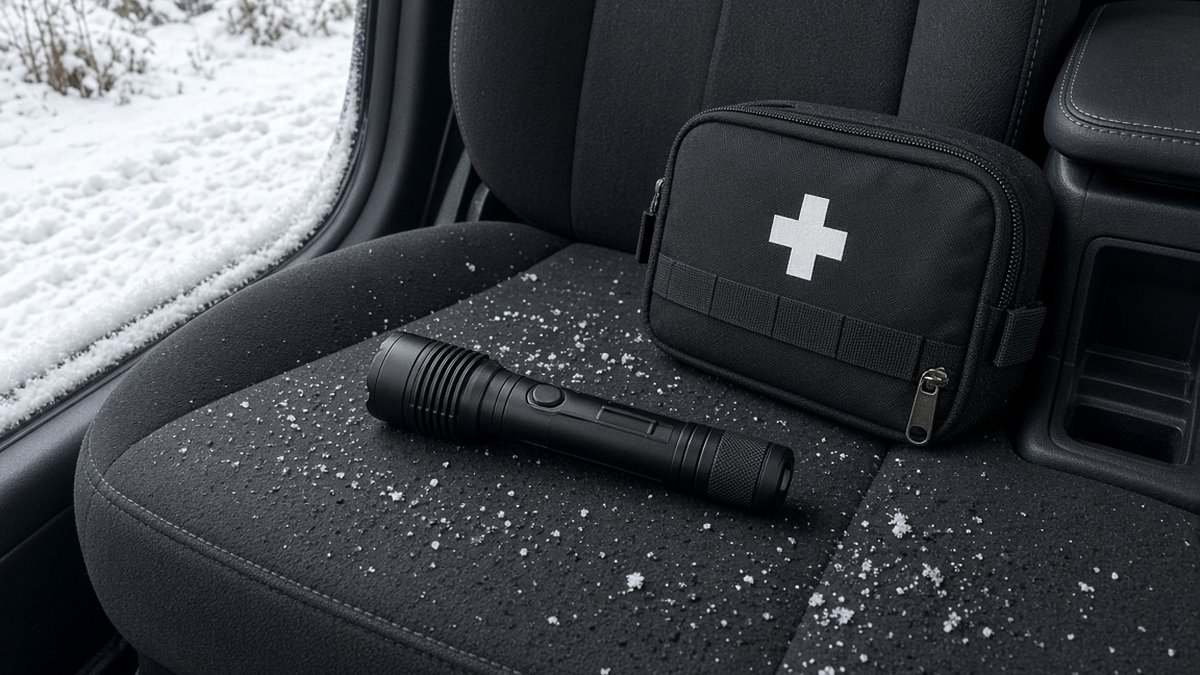
Pack the kit where you can reach it from the driver's seat. AI-generated editorial image of a black first-aid pouch with a white cross and a black flashlight on a dark car seat, with snow on the seat and a snowy roadside outside the window.
Most winter trips end the way they were planned. The kit is for the ones that don't: a slide into a ditch on a back road, a dead battery at a trailhead lot after dark, or a highway that closes behind a jackknifed truck while you sit in a line of stopped cars. In each case the car becomes your shelter, and what you packed in October decides how comfortable the next few hours are.
The good news is that the official lists agree with each other. The National Weather Service, the National Highway Traffic Safety Administration, Ready.gov, the CDC and state transportation departments all name the same core gear, then add a few extras. This guide pulls those lists together, explains what each item is for, and covers what to do with it if you are stuck. Road conditions, chain rules and travel advisories vary by state, so check your state's 511 service or DOT site before you leave.
What should be in a winter car emergency kit?
Start with the National Weather Service checklist: a flashlight with extra batteries, blankets or a sleeping bag, extra hats, mittens, parkas and boots, a first-aid kit, non-perishable food, bottled water, a phone and charger, sand or kitty litter, a snow shovel, an ice scraper with brush, booster cables, and flares or triangles. Add any medicine you take.
It helps to sort the list by job, because then it is easy to see a gap.
Clearing snow and getting unstuck. NHTSA's list starts with a snow shovel, broom and ice scraper, plus an abrasive material such as sand or kitty litter in case the car gets stuck. The sand or litter goes under the drive wheels for grip. Jumper cables belong here too: NHTSA notes that it takes more battery power to start a gas or diesel engine in cold weather, so a weak battery that survived fall may quit on the first hard freeze. South Dakota State University Extension lists a portable jump starter as an alternative to cables, which is useful if you often drive alone and can't count on a second car. The CDC and NWS lists also include a tow rope or tow chains, and the CDC adds tire chains and canned compressed air with sealant for emergency tire repair.
Staying warm. Blankets or a sleeping bag appear on every list. Add the clothing you would want if the heater were off: extra stocking caps, warm socks and gloves or mittens, which is how Wisconsin DOT puts it, and a parka and boots, per the NWS checklist. A dress coat and street shoes are fine for the drive and poor for a night in a cold car. SDSU Extension also suggests hand warmers.
Water, food and medicine. Pack bottled water and high-calorie, non-perishable food such as trail mix, granola or energy bars. NHTSA specifically mentions any necessary medicine for longer trips or drives through lightly populated areas, and the CDC lists a first-aid kit with any necessary medications and a pocket knife. The NWS goes further and suggests a small can and waterproof matches to melt snow for drinking water.
Light, power and communication. Carry a flashlight with extra batteries and a phone charger that works in your car, plus a battery pack if you have one. The CDC and SDSU Extension both add a battery-powered radio with spare batteries, which gives you weather and road news without draining the phone. The NWS recommends a compass and road maps, noting that you should not depend on mobile devices with limited battery life.
Being seen. NHTSA lists warning devices such as flares and emergency markers, and the NWS checklist names flares, triangles and other bright objects. The CDC suggests a bright colored flag or help signs. A red cloth works too: the NWS suggests tying one to the antenna or a door.
The longer NWS winter storm kit adds a few items people forget: a knife, a tool kit, extra clothing to keep dry, a water container, and a large empty can with tissues and toilet paper for use as an emergency toilet. It also lists a candle and matches for light and, in an emergency, heat. None of that takes much space, and all of it matters most on the rare night you are stuck for hours.
Where should you keep an emergency kit in your car in winter?
Keep the warmth and survival items inside the cabin, where you can reach them without getting out. Wisconsin DOT suggests the back seat, because a trunk can jam or freeze shut. Tools you use outside the car, such as the shovel and traction sand, can ride in the trunk or cargo area.
Think about the moment you will need each item. If you are sitting in a car in a blizzard, you want the blankets, hats, water, food, flashlight and phone charger within reach of the front seats. Stepping out into wind and drifting snow to dig through a trunk is exactly the kind of exposure the stranded-driver advice tries to avoid, and a trunk lid can be frozen or blocked by a snowbank after a slide.
A practical split looks like this. In the cabin: a duffel or bin behind a front seat with the warm layers, blankets, food, water, first-aid kit, flashlight, charger and radio. In the trunk or cargo area: the shovel, traction sand or litter, jumper cables or jump starter, tow strap, flares or triangles and any tire chains. Keep the ice scraper and brush in a door pocket or under a seat so you can clear glass before every drive. NHTSA's advice is to clean snow, ice or dirt from the windows, headlights, tail lights, backup camera and other sensors before driving.
Use bags you can find by feel in the dark. A bright pouch for the first-aid kit and a separate one for the flashlight and batteries save fumbling with cold hands. Water bottles can freeze in a parked car, so leave some headspace in each one and keep them in the cabin, which warms whenever the heater runs.
What should you do if you get stranded in your car in a snowstorm?
Stay in the vehicle. The National Weather Service warns that people who leave their cars can become disoriented quickly in wind-driven snow and cold. Call 911 if you can, describe where you are, make the car easy to spot, keep the exhaust pipe clear of snow, and avoid shoveling or pushing until help arrives.
The first decision is the most important one: stay with the car. It is shelter from wind, it is much easier for rescuers to find than a person on foot, and Wisconsin DOT points out that it also protects you if other vehicles lose control nearby. Walking along a highway is dangerous in any season. SDSU Extension puts it simply: if stranded, never leave your vehicle.
Next, call for help. Wisconsin DOT recommends calling 911 if you can, describing your location and situation, and following the dispatcher's instructions, which may be to stay where you are until help arrives. Note the highway, direction of travel, the last exit or mile marker you passed, and any landmark. Then save your phone battery.
Make the car visible. NHTSA says to put bright markers on the antenna or windows and keep the interior dome light on. The NWS adds a detail worth remembering: tie a bright colored cloth, preferably red, to your antenna or door, turn on the dome light at night when running the engine, and after the snow stops falling, raise the hood to show you need help. Flares or triangles behind the car warn other drivers, but place them only if you can do so without walking into traffic.
Resist the urge to dig your way out in a storm. Wisconsin DOT tells drivers not to get out to shovel or push the vehicle free, and the NWS warns against overexertion such as shoveling heavy snow, pushing a car or walking in deep snow if you are not in good health. Sweating is a problem too: the NWS notes that damp clothing can lead to a chill and hypothermia. Inside the car, the NWS suggests moving your arms, legs, fingers and toes vigorously from time to time to keep blood circulating.
Our guide to handling car trouble in the great outdoors covers breakdowns on remote roads more broadly, and much of it applies once the snow stops.
How long should you run your car to stay warm when stranded?
The National Weather Service says to run the motor about 10 minutes each hour for heat, with a window open slightly for fresh air. Clear snow from the exhaust pipe first. NHTSA gives the same idea in plain terms: run the engine only sporadically, just long enough to stay warm, to avoid carbon monoxide poisoning.
The danger is carbon monoxide. A running engine makes it, and snow packed around the tailpipe can push it back into the cabin. NHTSA's wording is to avoid running the car for long periods with the windows up or in an enclosed space, and if you must run it, to clear the exhaust pipe of snow and run it only sporadically. Wisconsin DOT gives the same advice, adds that you should make sure the exhaust is not blocked, and warns that using portable heaters inside vehicles or other enclosed spaces can be dangerous.
In practice, that means checking the tailpipe before every engine run, which is one of the few reasons to step outside, since falling or drifting snow can cover it again. Crack a window while the engine runs, as the NWS advises, and turn the engine off when the cabin is warm. Between runs, the blankets and extra layers do the work, which is why they are the most important part of the kit.
Fuel is the limit on all of this. NHTSA advises keeping the gas tank close to full, even in a hybrid, because if you get stuck in a traffic jam or in snow you may need more fuel than expected to get home or to keep warm. The NWS and the CDC add that a near-full tank helps avoid ice in the tank and fuel lines. In winter, refill well before the low-fuel warning comes on.
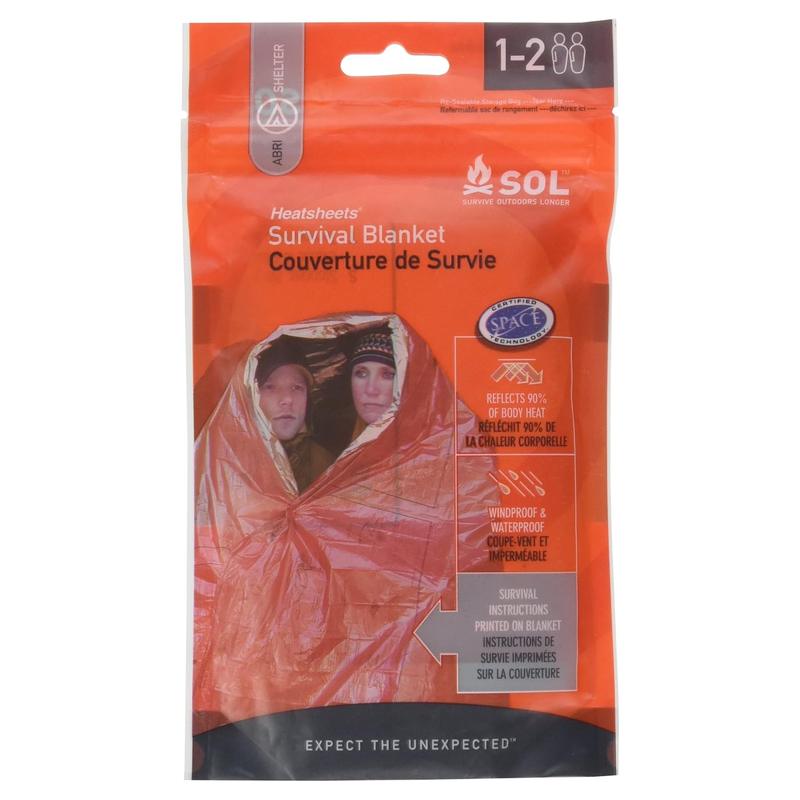
Blankets are where a little extra goes a long way. A regular wool or fleece blanket is the comfortable base layer, while a reflective emergency blanket packs small enough to leave one for every seat. The SOL Heatsheets Survival Blanket, for example, is a 60-by-96-inch sheet of vacuum-metalized polyethylene sized for two people, which the seller describes as windproof and waterproof, reflecting 90 percent of body heat, with survival instructions printed on it and a high-visibility orange exterior. Layer it with a regular blanket or sleeping bag rather than relying on it alone.
How do you prepare your car for winter driving?
Get the car serviced before the season and check the battery, cooling system, lights, wipers, defrosters and tires. NHTSA says to fill the washer reservoir with winter fluid, set tire pressure to the number on the driver's door placard, and replace tires with less than 2/32 inch of tread. Keep the gas tank close to full.
A kit helps after something goes wrong; maintenance keeps it from going wrong. NHTSA's winter checklist starts with a tune-up and a check for leaks and badly worn hoses, then works through the systems that cold weather punishes.
Battery. Have a mechanic check voltage, amperage and reserve capacity, inspect the charging system and belts, and tighten loose cable connections. Electric and hybrid drivers should know that NHTSA says driving range drops when the battery is cold. If an EV has a thermal heating pack for the battery, NHTSA suggests plugging it in whenever it's not in use and pre-heating the cabin before unplugging in the morning.
Cooling system. Make sure there is enough coolant and that it meets the manufacturer's specification, check for leaks, and have the coolant tested for the proper mix. The CDC notes you can check the antifreeze level yourself with an antifreeze tester.
Visibility. NHTSA points out that you can go through a lot of washer fluid in a single snowstorm. Fill the reservoir with winter fluid that has de-icer and carry extra. Replace worn wiper blades, consider heavy-duty winter blades if you drive in a lot of snow and ice, and confirm that front and rear defrosters work. Check every light, including brake lights, turn signals and emergency flashers.
Tires. NHTSA says tire pressure drops as the outside temperature drops. Inflate to the pressure on the placard on the driver's side door frame or in the owner's manual, not the number on the tire sidewall, and check when the tires are cold, meaning the car hasn't been driven for at least three hours. Tread should be at least 2/32 of an inch, and if you use snow tires, NHTSA suggests installing them in the fall and looking for the snowflake symbol. Don't forget the spare. Some states set their own rules on chains and studded tires, so check before mountain trips.
Before you go, check the weather and road conditions and tell someone your route and expected arrival time; the NWS adds alternate routes and suggests avoiding traveling alone. Our tips for navigating snowy roads and our winter road trip hacks cover the drive itself.
What are the signs of hypothermia and frostbite while waiting for help?
Ready.gov lists shivering, exhaustion, confusion, fumbling hands, memory loss, slurred speech and drowsiness as hypothermia signs, and says a body temperature below 95 degrees is an emergency. Frostbite shows up as numbness and white or grayish-yellow skin that feels firm or waxy. Get warm and dry, starting with the core.
Cold sneaks up on people who are sitting still. Watch each other, not just yourself, because confusion and drowsiness, two of the listed hypothermia signs, make it hard to notice your own decline. Pay extra attention to anyone who got wet while digging; the NWS warns that sweating can lead to a chill and hypothermia.
The kit is your first response, and Ready.gov's hypothermia advice maps onto it directly: warm the center of the body first, meaning the chest, neck, head and groin, and keep the person dry and wrapped in warm blankets, including the head and neck. For frostbite, Ready.gov says to use body heat to warm the area and not to massage it or use a heating pad. Run the engine on the NWS schedule, with the exhaust clear and a window cracked, and tell the 911 dispatcher if anyone shows these signs. Both conditions call for a warm room as soon as one is available.
Keep a few NHTSA child-safety points in mind if kids are along. Thick outerwear can interfere with a proper car-seat harness fit, so NHTSA recommends placing blankets or coats around a child after the harness is snug. That makes a couple of spare kid-sized blankets a smart addition to a family kit.
Packing the kit before the first storm
Build the kit in fall, while stores still have shovels and the weather is mild enough to work in the driveway. Use the NWS checklist as the base, add anything your own trips call for, and pack it in two parts: a cabin bag you can reach from the driver's seat and a trunk set for digging out. Swap in fresh batteries, water and food each season, and put back anything you used.
If your winter plans include trailheads, a kit in the car doubles as backup for the hike. Our guide to planning a short winter day hike covers the gear for the walk; the car kit covers what happens if the drive home doesn't go to plan.
Sources: National Weather Service: Prepare! Don't Let a Winter Storm Take You by Surprise, National Weather Service: What To Do If You're Caught in a Winter Storm, National Weather Service: Car Winter Survival Kit Checklist (PDF), NHTSA: Winter Driving Tips (PDF, hosted by NYC DCAS), Ready.gov: Winter Weather, CDC: Winter Weather Safety, Wisconsin DOT: Prepare an emergency kit for winter driving, Wisconsin DOT: If you become stranded, SDSU Extension: Winter car kits, and the SOL Survival Blanket listing at CampSaver; Amazon B006ZJFE06.
Frequently asked questions
What should be in a winter car emergency kit?
Start with the National Weather Service checklist: a flashlight with extra batteries, blankets or a sleeping bag, extra hats, mittens, parkas and boots, a first-aid kit, non-perishable food, bottled water, a phone and charger, sand or kitty litter, a snow shovel, an ice scraper with brush, booster cables, and flares or triangles. Add any medicine you take.
Where should you keep an emergency kit in your car in winter?
Keep the warmth and survival items inside the cabin, where you can reach them without getting out. Wisconsin DOT suggests the back seat, because a trunk can jam or freeze shut. Tools you use outside the car, such as the shovel and traction sand, can ride in the trunk or cargo area.
What should you do if you get stranded in your car in a snowstorm?
Stay in the vehicle. The National Weather Service warns that people who leave their cars can become disoriented quickly in wind-driven snow and cold. Call 911 if you can, describe where you are, make the car easy to spot, keep the exhaust pipe clear of snow, and avoid shoveling or pushing until help arrives.
How long should you run your car to stay warm when stranded?
The National Weather Service says to run the motor about 10 minutes each hour for heat, with a window open slightly for fresh air. Clear snow from the exhaust pipe first. NHTSA gives the same idea in plain terms: run the engine only sporadically, just long enough to stay warm, to avoid carbon monoxide poisoning.
How do you prepare your car for winter driving?
Get the car serviced before the season and check the battery, cooling system, lights, wipers, defrosters and tires. NHTSA says to fill the washer reservoir with winter fluid, set tire pressure to the number on the driver's door placard, and replace tires with less than 2/32 inch of tread. Keep the gas tank close to full.
What are the signs of hypothermia and frostbite while waiting for help?
Ready.gov lists shivering, exhaustion, confusion, fumbling hands, memory loss, slurred speech and drowsiness as hypothermia signs, and says a body temperature below 95 degrees is an emergency. Frostbite shows up as numbness and white or grayish-yellow skin that feels firm or waxy. Get warm and dry, starting with the core.