
How to Store a Boat Battery for Winter
Written by Outdoors Magazine|
Outdoors Magazine is a participant in the Amazon Services LLC Associates Program. We may earn a commission if you buy through links on this page, at no extra cost to you. Affiliate disclosure.
To store a boat battery for winter, charge it fully, disconnect it from the boat's wiring, clean the terminals and case top, and keep it somewhere cool, dry and above freezing. Then keep a lead-acid or AGM battery on a smart maintainer set for its chemistry, or check and recharge it on a schedule. Lithium needs no maintainer.
Key takeaways
- Charge fully and confirm resting voltage before storage.
- Disconnect the negative cable first and clean the terminals and case top.
- Store lead-acid cool, dry and above freezing; a drained battery can freeze.
- Maintain lead-acid or AGM with a smart charger; charge lithium full and disconnect it.
To store a boat battery for winter, charge it fully, disconnect it from the boat's wiring, clean the terminals and case top, and keep it somewhere cool, dry and above freezing. Then keep a lead-acid or AGM battery on a smart maintainer set for its chemistry, or check and recharge it on a schedule. Lithium needs no maintainer.
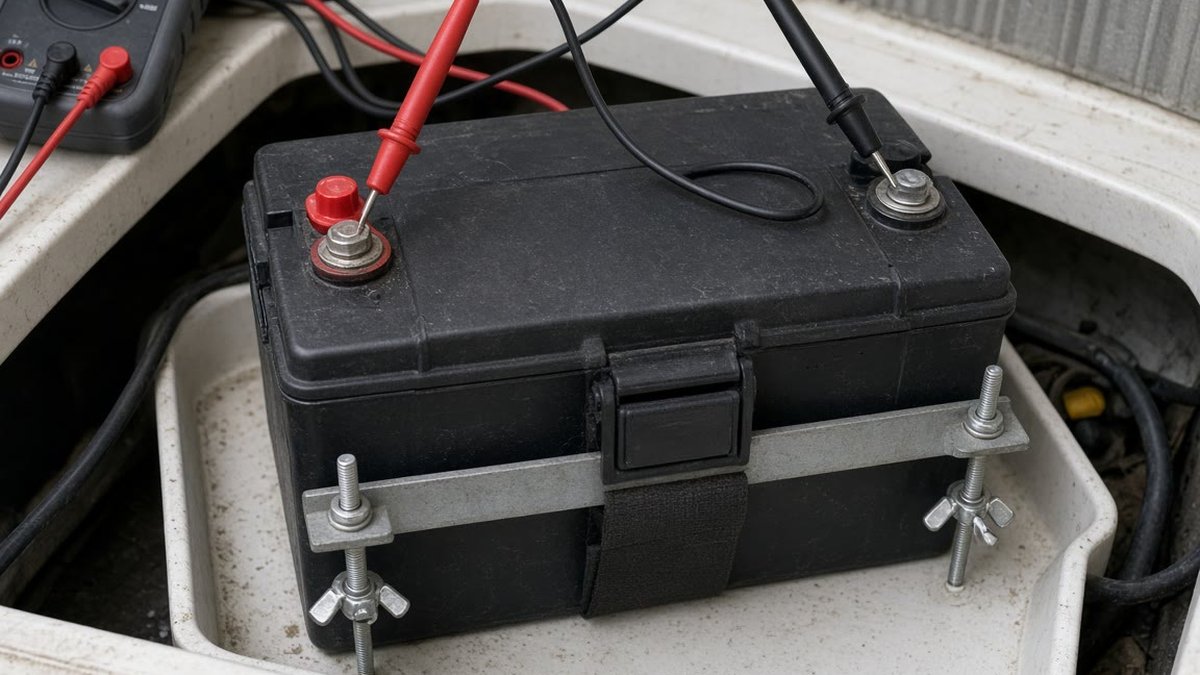
Read the resting voltage before the battery goes into storage. AI-generated editorial image of a black marine battery strapped into a white battery tray inside a boat, with red and black multimeter leads on the terminals and a meter at the edge of the frame.
A boat battery does most of its dying in the off-season. It sits for months with no alternator topping it up, small loads on the boat keep sipping current, and every week it loses a little charge on its own. By spring it can be flat, sulfated or, in a cold enough shed, cracked from frozen electrolyte. None of that is bad luck. It is the predictable result of a battery left partly charged and partly connected through a long winter.
The fix is a short routine in the fall and a few checks over the winter. The steps below draw on guidance from BoatUS and from battery and charger makers, including Trojan, Discover Battery, EnerSys, Odyssey, Battle Born and NOCO. Their numbers differ a little by brand and battery design, so treat the figures here as typical, and when your battery's own label or manual says something different, follow the label.
Start by knowing which kind of battery you have. Flooded lead-acid batteries have removable caps and liquid electrolyte. AGM and gel batteries are sealed lead-acid designs, with the electrolyte held in a glass mat or a gel. Lithium marine batteries, often lithium iron phosphate (LiFePO4), have a built-in battery management system and very different storage rules. BoatUS also advises sticking with one battery type on a boat, because mixing types can lead to over- or undercharging.
Should you take your boat battery out for the winter?
If the boat sits somewhere unheated and below freezing, taking the battery out is the simplest choice. EnerSys and Battle Born both advise keeping lead-acid batteries out of freezing temperatures, and a battery at home is easy to check and charge. If it stays aboard, disconnect the cables so nothing on the boat can drain it.
There is no single rule, because it depends on where the boat spends the winter. A boat in heated storage, or one with a properly installed onboard marine charger on shore power, can keep its batteries aboard. A boat on a trailer in an unheated barn in the northern half of the country is a different case. Battle Born's guidance on leaving marine batteries aboard over winter calls storing lead-acid batteries in freezing temperatures generally not recommended, and says to keep them somewhere that stays above freezing and is well ventilated, since lead-acid batteries can release gas even when disconnected.
If the battery comes out, do it in a set order. BoatUS says to always remove and reinstall the negative (black) cable first. Taking the negative off first means a wrench that touches the boat's metal while you loosen the positive won't make a short circuit. Before you pull anything, label the cables or take a phone photo of the terminals, especially if there are several accessory leads stacked on one post. BoatUS notes that connecting terminals the wrong way can damage electrical components on the boat.
If the battery stays aboard, a battery switch alone is not a complete disconnect. BoatUS points out that bilge pumps and carbon-monoxide alarms are often wired directly to the battery, so turning off the master switch won't stop them, and Battle Born makes the same point about CO alarms and emergency sensors. That is fine during the season, but over months of storage those small draws can flatten a battery. EnerSys recommends disconnecting the battery cables before storage to reduce parasitic loads. Weigh that against anything you want running; if your bilge pump must stay live on a boat stored in the water, plan on a maintainer or regular visits rather than a full disconnect. For the full lay-up list, see our guide to pulling the boat before the first hard frost.
Whether the battery comes out or stays in, clean it first. BoatUS says a dirty battery top can self-discharge to ground given enough dirt, and Odyssey makes the same point about grime on the case. Trojan's maintenance guide recommends cleaning the battery top with a cloth or brush and a solution of baking soda and water, and cleaning the terminals and the inside of the cable clamps with a post and clamp cleaner. BoatUS adds that a baking-soda solution neutralizes the white powder that builds up on terminals. BoatUS also recommends wearing gloves around batteries to protect your hands from acid. Let the top dry before the battery goes into storage. If corrosion keeps coming back, our boat battery troubleshooting guide covers terminals and finding a draw.
How full should a boat battery be before winter storage?
Charge a lead-acid or AGM battery completely before storage, then keep it near full. Trojan says to give a stored battery a boost charge when it shows 70% or less, and EnerSys warns against letting it fall below 50%. Battle Born also stores its lithium batteries fully charged.
Full matters because a lead-acid battery left partly discharged keeps forming lead sulfate on its plates. EnerSys says to fully charge the battery before storage to minimize sulfation, and Trojan's storage steps begin with completely charging the battery. Use a real charger for this rather than counting on the last trip of the season. BoatUS warns that cheap auto-parts-store chargers can overcharge and cook off electrolyte, and recommends a smart three-stage marine charger that moves through bulk, absorption and float.
Check the result with a digital multimeter set to DC volts. BoatUS gives these resting-voltage ranges for a 12-volt battery: 12.65 to 12.77 volts is fully charged, 12.45 to 12.54 is about 75%, 12.24 to 12.29 is about 50%, 11.99 to 12.06 is about 25%, and 11.75 to 11.89 means the battery is dead. Discover Battery's published chart lines up closely, listing 12.65 volts at 100% and 12.24 volts at 50%. Its figures assume a battery temperature of 80°F, and the reading shifts slightly in the cold.
Timing the reading matters. BoatUS says the most accurate test comes after the battery has rested for 12 hours with no load, because a battery that was just charged or just running carries a surface charge that reads high. If you're short on time, BoatUS suggests bleeding off the surface charge by running a 2- to 3-amp load, such as the running lights, for a couple of minutes, then letting the battery rest a couple more minutes before you read it. Our guide to boat battery life goes deeper on rest voltage.
Flooded batteries need one more step: check the electrolyte. Trojan says water should always be added after fully charging the battery, using distilled water, until the level sits 1/8 inch below the bottom of the fill well, and warns against overfilling. BoatUS also says to use distilled water because tap water carries too many impurities.
Once it's full, the battery starts losing charge on its own. BoatUS says a lead-acid battery may lose 5% of its charge per month, and Trojan says flooded batteries self-discharge up to 15% per month at 77°F, with the rate depending on storage temperature. Trojan's rule of thumb is to give a stored battery a boost charge when it shows a 70% charge or less, and to charge it completely again before putting it back into service. EnerSys sets the floor at 50%, below which it warns of internal damage. BoatUS notes that AGM and gel batteries have a low self-discharge rate, but Trojan still says VRLA batteries such as AGM should not be stored more than six months at 77°F without a recharge.
How cold does it have to be for a boat battery to freeze?
A charged lead-acid battery is very hard to freeze, but a discharged one is not. Discover Battery's chart puts electrolyte freezing near -75°F at full charge, -34°F at half charge and -10°F when discharged. Trojan warns that freezing does irreparable damage to plates and the case.
The reason is chemistry. As a lead-acid battery discharges, its electrolyte gets weaker and closer to plain water, so its freezing point climbs. Discover Battery's state-of-charge table gives the progression for a 12-volt battery: about -75°F at 100% charge, -55°F at 75%, -34°F at 50%, -16°F at 25% and -10°F when fully discharged. Exact figures vary by maker, but the direction does not: the lower the charge, the warmer the temperature at which the electrolyte can freeze.
Read that table as a warning about neglect rather than a license to leave the battery in the cold. A charged battery in an unheated shed is protected by its own charge; a battery that has been slowly drained by a forgotten radio memory or a dirty case top is not. Battle Born notes that lead-acid marine batteries can freeze completely under certain conditions, usually when nearly drained, and that frozen electrolyte can crack cells and the case. Trojan says freezing results in irreparable damage to a battery's plates and container, and that keeping a battery at a high state of charge also prevents freezing.
That is why charge and location work together. Keep the battery full, keep it somewhere that stays above freezing if you can, and check it during the winter. Inspect it before charging in spring: EnerSys advises replacing a battery whose terminals or case are damaged.
Should you leave a boat battery on a maintainer all winter?
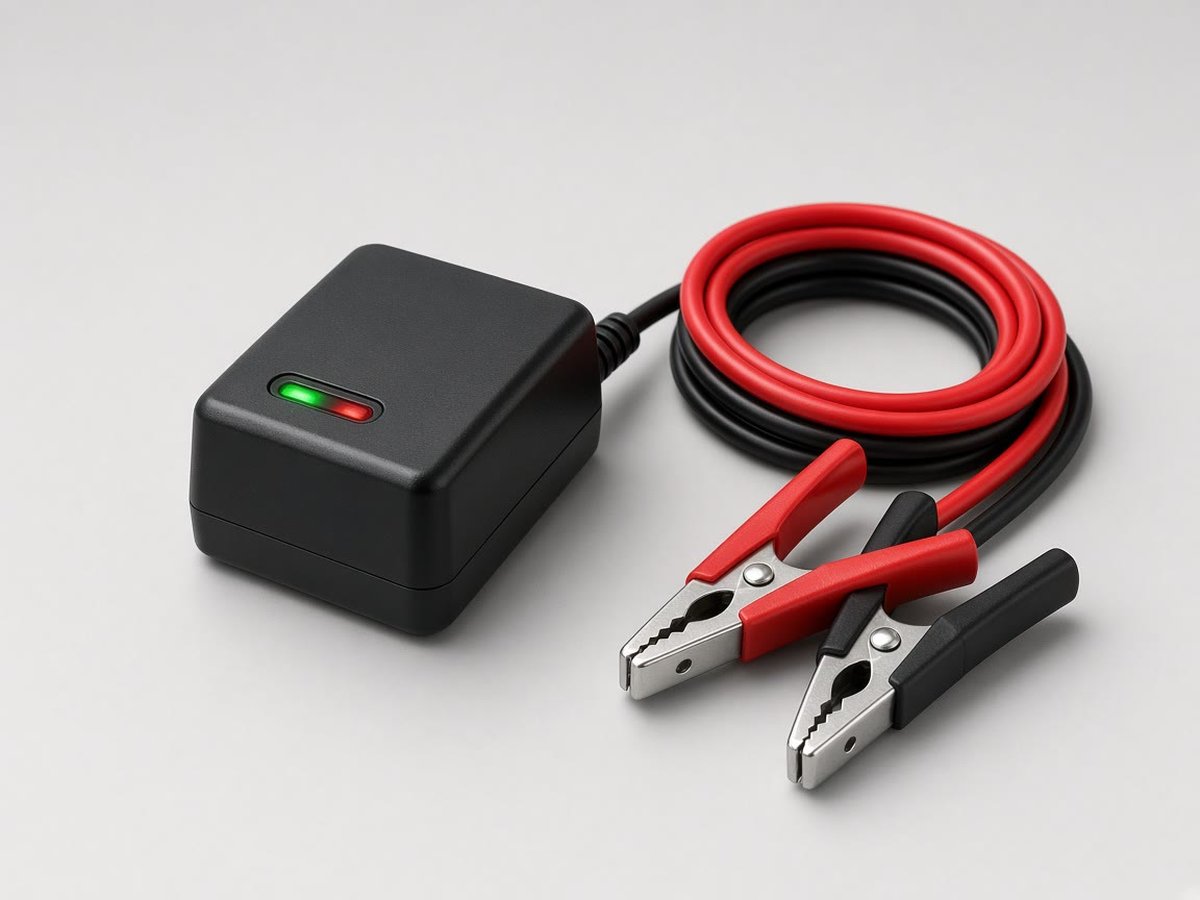
A smart, automatic maintainer can stay connected to a lead-acid or AGM battery all winter. BoatUS says a marine smart charger can safely be left connected and cuts back to avoid overcharging, unlike a basic auto-parts charger. Set it for the battery's chemistry and check that it is rated for the battery's size.
The difference between a smart maintainer and an old trickle charger is the important part. A basic trickle charger can keep pushing current into a full battery. BoatUS describes how better chargers move through bulk, absorption and float stages, finishing in a float mode that supplies just enough current to keep the battery full, and says a marine smart charger can safely be left connected. If your boat has a permanently installed marine charger and reliable shore power over the winter, that charger can do the job. Check its settings, since BoatUS warns that a charger set for the wrong battery type risks damaging the battery.
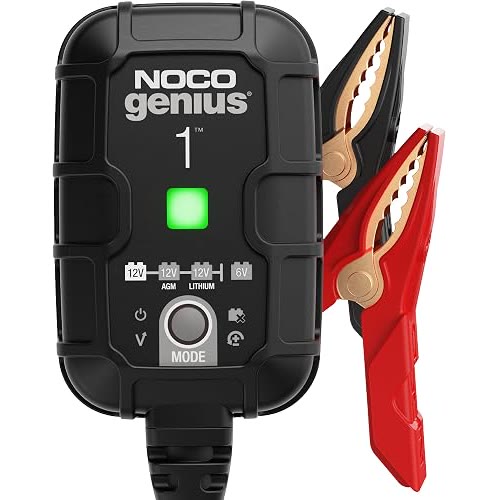
For a battery you carry home, a small plug-in maintainer is enough. NOCO's GENIUS1 is a compact 1-amp charger for 6-volt and 12-volt batteries, with modes for standard 12-volt lead-acid, 12-volt AGM and 12-volt lithium, plus a Force mode that lets you manually start charging a battery that has fallen below 1 volt. NOCO's specifications list a charging capacity of up to 30 amp-hours but maintenance for all battery sizes, a thermal sensor that adjusts charging to ambient temperature, an operating range of -4°F to 104°F and an IP60 rating. In practice that means it can hold a large marine battery at full, but at 1 amp it is slow to recharge one that is deeply drained, so bring the battery to full with a larger charger first.
Size matters with every maintainer. Battery Tender's Junior 021-0123, for example, is a 12-volt, 750-milliamp maintainer that its maker rates for lead-acid, AGM, gel and sealed batteries from 3 to 30 amp-hours, and Battery Tender directs owners of larger batteries to its bigger Plus model instead. Before you buy, check the amp-hour rating on your battery's label against the charger's spec sheet. Our NOCO GENIUS1 vs Battery Tender 021-0123 comparison lines up the two side by side.
If you'd rather not leave anything plugged in, periodic charging works too. Put a reminder on your calendar, check resting voltage, and recharge when the reading drops toward the 70% mark Trojan uses. Trojan suggests monitoring voltage or, for flooded batteries, specific gravity throughout storage. Either way, set up the maintainer or charger in a ventilated spot.
How do you store a lithium boat battery for winter?
Battle Born says to charge its LiFePO4 batteries fully, then disconnect them; they do not need a trickle charge. They lose about 2-3% of charge per month in storage and tolerate storage from -15°F to 140°F, but they will not accept a charge when their internal temperature is below 24°F.
Lithium iron phosphate batteries handle storage differently from lead-acid, and the battery's own manual is the authority. Battle Born's winterizing guide recommends storing its batteries fully charged in an environment above freezing if possible, and removing the main battery connections if the system has no disconnect switch. Because a disconnected Battle Born battery self-discharges only about 2-3% per month, the company says that after six months it should still hold about 75-80% of its charge. That is why it says its batteries do not need a trickle charge.
Cold affects charging more than storage. Battle Born says charging in extreme cold can cause lithium plating, which can lead to internal short circuits, and its batteries' protection will not allow a charge when the internal temperature is below 24°F. Its storage range is -15°F to 140°F, and its guidance on leaving batteries in a boat over winter says to remove them to a climate-controlled space if temperatures are expected to drop below -15°F. Warm a cold lithium battery above freezing before you charge it in spring.
Other lithium brands may set different storage charge levels and temperature limits, so check your maker's instructions. If you do use a charger on lithium, it needs a lithium-specific mode or profile. Never put a lithium battery on a charger set for lead-acid, or the reverse, and don't connect a basic trickle charger to a lithium battery.
Can you store a boat battery on a concrete floor?
Yes. Odyssey says it is perfectly fine to set a modern battery directly on concrete, because the old warning dates from hard-rubber cases. What actually drains a stored battery is time, heat, dirt on the case top and any load left connected, so control those instead.
The concrete-floor warning has been around for generations, and it once had some basis. Odyssey explains that the concern came from older hard-rubber battery cases, and that modern plastic cases don't have the same problem. Its guidance is direct: it is perfectly fine to place a battery directly on concrete.
Temperature deserves more attention than the floor. Odyssey says heat, not cold, speeds self-discharge, and that a battery stored at 95°F can self-discharge twice as fast as one at 75°F. Trojan says temperatures above 80°F accelerate self-discharge, and recommends a cool, dry location protected from the elements. A basement shelf, a heated garage or a frost-free workshop usually beats both a hot utility room and an unheated pole barn.
Pick a spot that is also safe. BoatUS notes that gases from lead-acid batteries, particularly overcharged ones, can be explosive, so a maintainer and a flooded battery belong in a ventilated space, not a closed cabinet, and BoatUS warns never to use a match or open flame to check electrolyte. BoatUS also recommends a battery box lid or terminal boots so a dropped tool can't short across the posts.
A fall checklist for the battery
Put these steps in order and the job is short. Charge the battery fully with a smart charger set for its chemistry. Let it rest and confirm the voltage. Top up a flooded battery with distilled water after charging. Label the leads and disconnect the negative cable first. Clean the case top and terminals. Store the battery somewhere cool, dry, ventilated and above freezing. Then either connect a maintainer that is rated for the battery or set a monthly reminder to check voltage and recharge.
In spring, reverse it. Charge the battery fully before reinstalling it, as Trojan advises before returning any stored battery to service, check the terminals once more, reconnect each cable to the correct post using your labels or photo, and secure the battery in its box or tray. Storage rules vary by battery maker and model, so keep the manual with the battery and let it settle any difference with the general guidance here.
Sources: BoatUS: Marine Battery Maintenance, Trojan Battery: Battery maintenance, Discover Battery: How can I measure my battery's state of charge?, EnerSys: Tips for off-season marine battery maintenance, Odyssey Battery: The truth about storing a battery on a concrete floor, Battle Born Batteries: How to winterize and store LiFePO4 batteries, Battle Born Batteries: Can you leave marine batteries in a boat over winter?, NOCO GENIUS1 specifications at Inverters R Us, and Battery Tender: Battery Tender Junior 021-0123; Amazon B07W46BX31.
Frequently asked questions
Should you take your boat battery out for the winter?
If the boat sits somewhere unheated and below freezing, taking the battery out is the simplest choice. EnerSys and Battle Born both advise keeping lead-acid batteries out of freezing temperatures, and a battery at home is easy to check and charge. If it stays aboard, disconnect the cables so nothing on the boat can drain it.
How full should a boat battery be before winter storage?
Charge a lead-acid or AGM battery completely before storage, then keep it near full. Trojan says to give a stored battery a boost charge when it shows 70% or less, and EnerSys warns against letting it fall below 50%. Battle Born also stores its lithium batteries fully charged.
How cold does it have to be for a boat battery to freeze?
A charged lead-acid battery is very hard to freeze, but a discharged one is not. Discover Battery's chart puts electrolyte freezing near -75°F at full charge, -34°F at half charge and -10°F when discharged. Trojan warns that freezing does irreparable damage to plates and the case.
Should you leave a boat battery on a maintainer all winter?
A smart, automatic maintainer can stay connected to a lead-acid or AGM battery all winter. BoatUS says a marine smart charger can safely be left connected and cuts back to avoid overcharging, unlike a basic auto-parts charger. Set it for the battery's chemistry and check that it is rated for the battery's size.
How do you store a lithium boat battery for winter?
Battle Born says to charge its LiFePO4 batteries fully, then disconnect them; they do not need a trickle charge. They lose about 2-3% of charge per month in storage and tolerate storage from -15°F to 140°F, but they will not accept a charge when their internal temperature is below 24°F.
Can you store a boat battery on a concrete floor?
Yes. Odyssey says it is perfectly fine to set a modern battery directly on concrete, because the old warning dates from hard-rubber cases. What actually drains a stored battery is time, heat, dirt on the case top and any load left connected, so control those instead.