
SOL Emergency Bivvy vs SOL Survival Blanket
Written by John Wren|
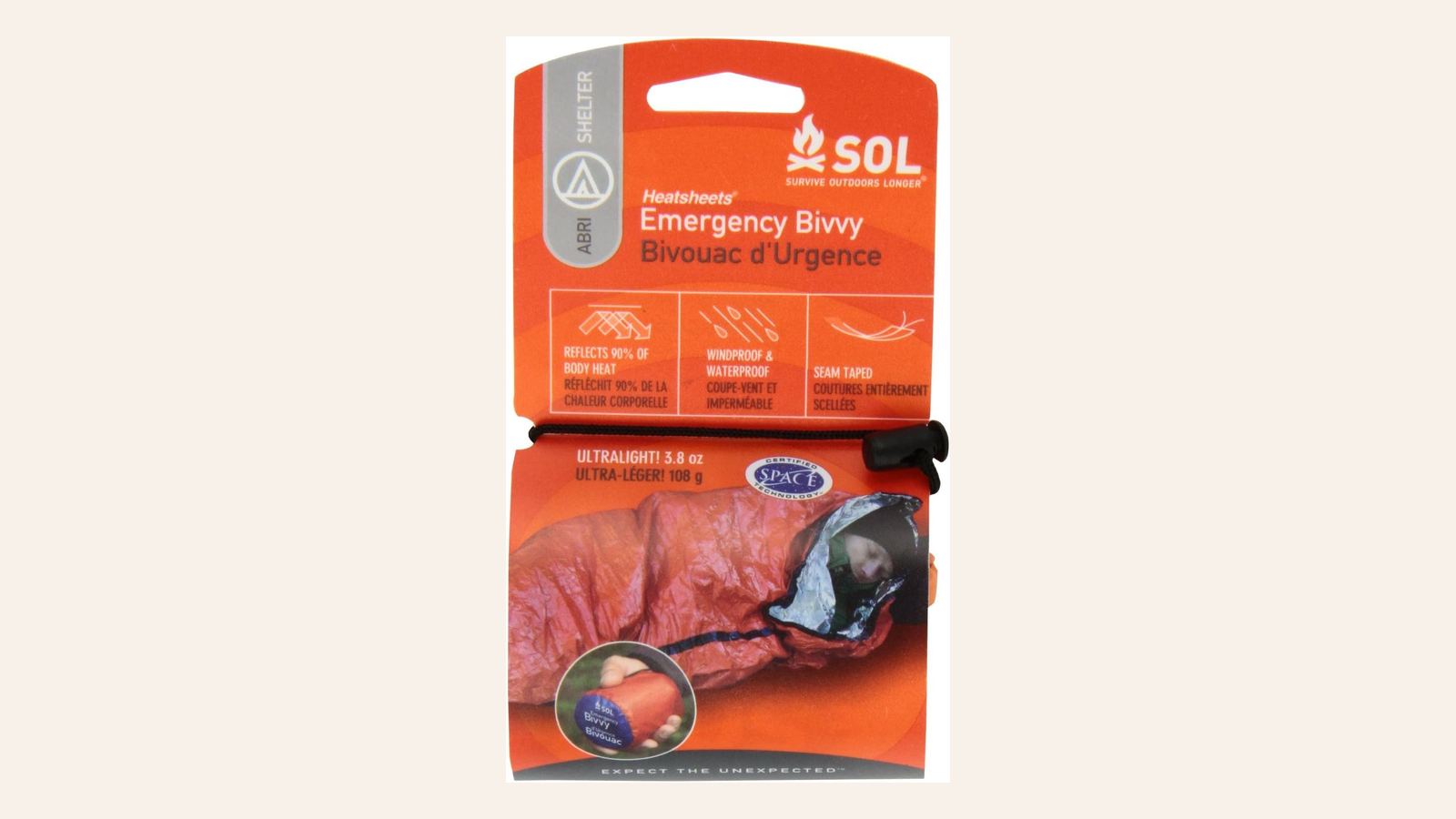
Choose the SOL emergency bivvy, about 84 by 36 inches and 3.8 ounces, when you may have to sleep in a sealed tube. Choose the SOL survival blanket, about 60 by 96 inches and 3.2 ounces, when you want an open sheet you can wrap or tie.
Key takeaways
- The bivvy is a sealed tube, about 84 by 36 inches and 3.8 ounces.
- The blanket is an open sheet, about 60 by 96 inches and 3.2 ounces.
- Neither is a temperature-rated sleeping bag.
- Put a pad or a pack under you. The ground steals heat.
Buy the SOL emergency bivvy when you may have to sleep in it: a sealed 84-by-36-inch tube, about 3.8 ounces, that reflects heat and blocks wind and rain. Buy the Adventure Medical SOL survival blanket when you need an open sheet, listed at 60 by 96 inches and 3.2 ounces, that you can wrap, hang, or lay on the ground. Both use a heat-reflective polyethylene, not a crinkly mylar party blanket. Neither is a sleeping bag with a rating, and neither is a tent. Confirm the inches on the pouch you open. A two-person sealed bivy, or a cheap mylar square, is a different product.
Short version. Water you can drink matters before a shiny sack does. A fire starter is how you add heat the sack cannot create. A compass is how you avoid spending the night in the sack at all. The bivvy or the blanket is the layer you hope stays in the lid of the pack. Check live prices. Read whether the pouch says blanket or bivy before you stuff it.
This comparison is two emergency shelters you can still carry every day. The bivvy on this card is the sealed SOL tube, about 84 inches by 36 inches. The blanket on this card is the open SOL survival blanket, model line 0140-1701, about 60 by 96 inches. One keeps weather off a person who is inside it. The other is a sheet you can use as a wrap, a groundsheet, a signal panel, or a roof if you already have something to tie it to. Buying the sheet and calling it a sleeping bag is how people spend a wet night holding a flap closed with their hands.
| Job | SOL emergency bivvy | SOL survival blanket | Buy |
|---|---|---|---|
| An unplanned night, wind and rain | Sealed tube, about 84 by 36 inches | Open sheet you must hold or tie | Bivvy |
| A wrap, a signal, a ground layer | Usable inside-out as a wrap, clumsier | 60 by 96 inch sheet, about 3.2 ounces | Blanket |
| Two people under one layer | This card is a one-person tube | Listed large enough to share as a wrap | Blanket, and it will still be tight |
| Weight in a pocket | About 3.8 ounces, stuff sack | About 3.2 ounces | Either is a pocket item |
| A rated winter bag | No temperature rating to trust | No temperature rating to trust | Neither |
The bivvy card is the sealed lightweight emergency bivvy. The blanket card is the open SOL survival blanket. A mylar disposable square is a different material.
Who should buy the bivvy, and who should buy the blanket?
Buy the bivvy if the failure you are planning for is "I am out, it is night, and I have to stop." A sealed tube blocks wind along the sides and gives rain somewhere to go besides your collar. You can slide in with your clothes on, pull the opening down around your face, and stop feeding the wind with every shiver. About 3.8 ounces is light enough for a hunting coat, a kayak hatch, or the lid of a day pack you always carry. The stuff sack is part of the product. A bivvy stuffed loose into a pocket tears at the folds and arrives as a wad you cannot open with cold hands.
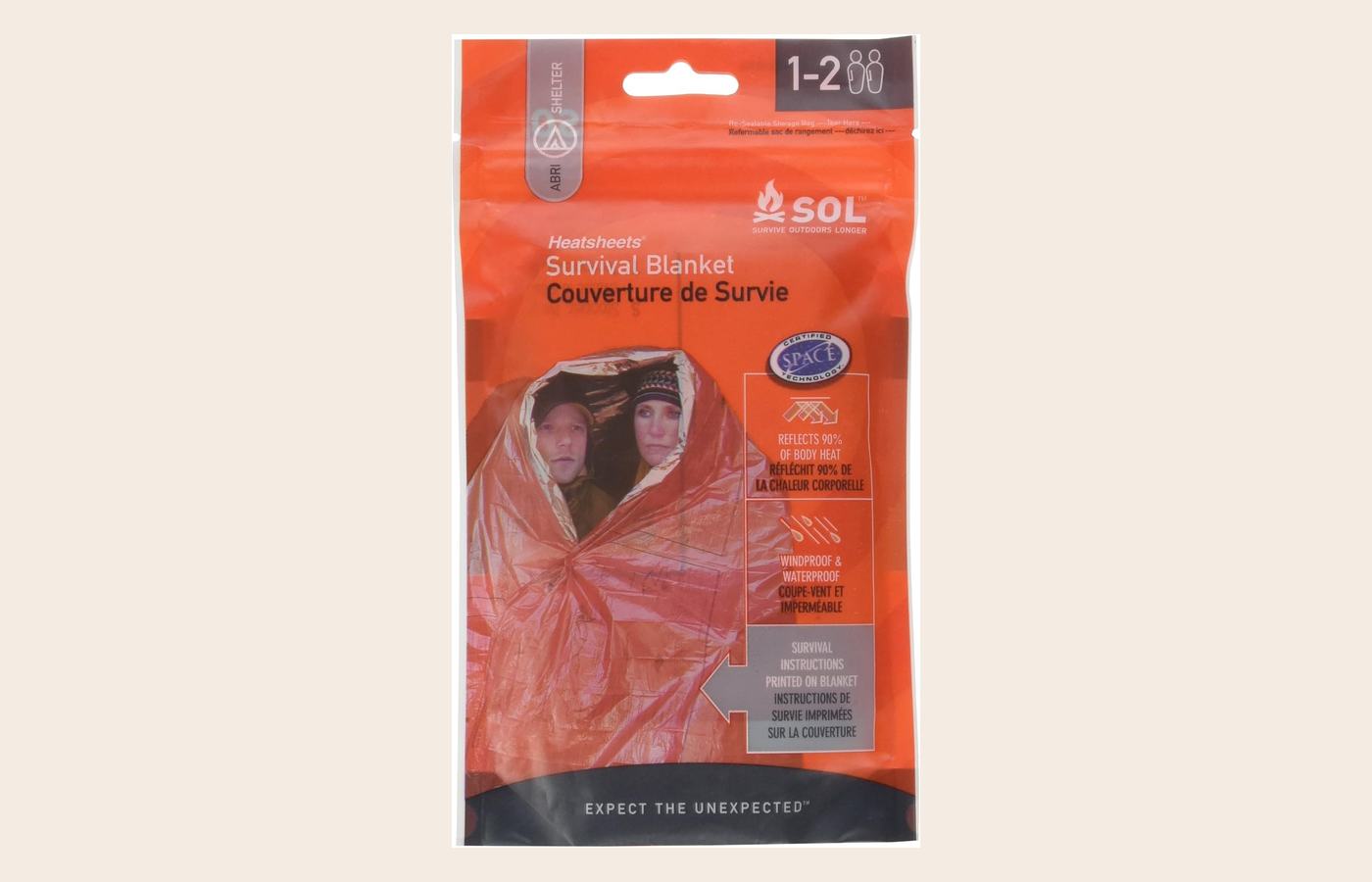
Buy the blanket if the job is more than lying down. A 60-by-96-inch sheet covers a person, covers two people who are willing to share, lines a damp bench, signals from a clearing, or becomes a roof over a branch if you can tie the corners. The maker prints survival notes on the sheet so the instructions are on the tool, not in a phone that just died. About 3.2 ounces is the listed weight. It is an open edge. Wind gets under an open edge unless you tuck it, sit on it, or tie it. That is the trade for a tool you can also see from the air because the outside is a bright emergency color.
Do not buy either one as your only plan for a trip you already know will go overnight. A multitool does not add warmth, and a reflective sack does not replace a pad under your back. The ground will steal heat faster than the air will. If you might sleep out, the bivvy plus a foam pad you already trust beats a blanket alone on wet dirt. If you might only need a wrap at a tailgate or a signal on a roadside, the blanket is the more honest tool.
What the SOL emergency bivvy is actually for
The SOL emergency bivvy on this card is a lightweight polyethylene sack, about 84 inches long and 36 inches wide, listed near 3.8 ounces, with a reflective face that the maker says returns about 90 percent of radiated body heat. The seams are sealed so wind, rain, and snow meet a tube instead of a slit. It is quieter and tougher than the old mylar squares that tear if you look at them. It is still a thin plastic. A coal, a spark, and a careless knife will hole it. A hole can be taped. A hole you sleep on becomes a wet back.
Use it when the day went long: a ridge that ate the daylight, a boat ramp you missed, a truck that will not start and a cab that will not hold heat. Get in before you are shaking so hard you cannot find the opening. Wear the dry layers you still have. A wet cotton shirt inside a reflective sack still cools you. If you can swap to a dry layer, do that first. Pull the bivvy up, leave your face in the air, and do not seal your mouth and nose inside a bag that was never meant to be airtight over your head. Condensation is normal. Waking up damp inside a windproof tube is still better than waking up in the wind.
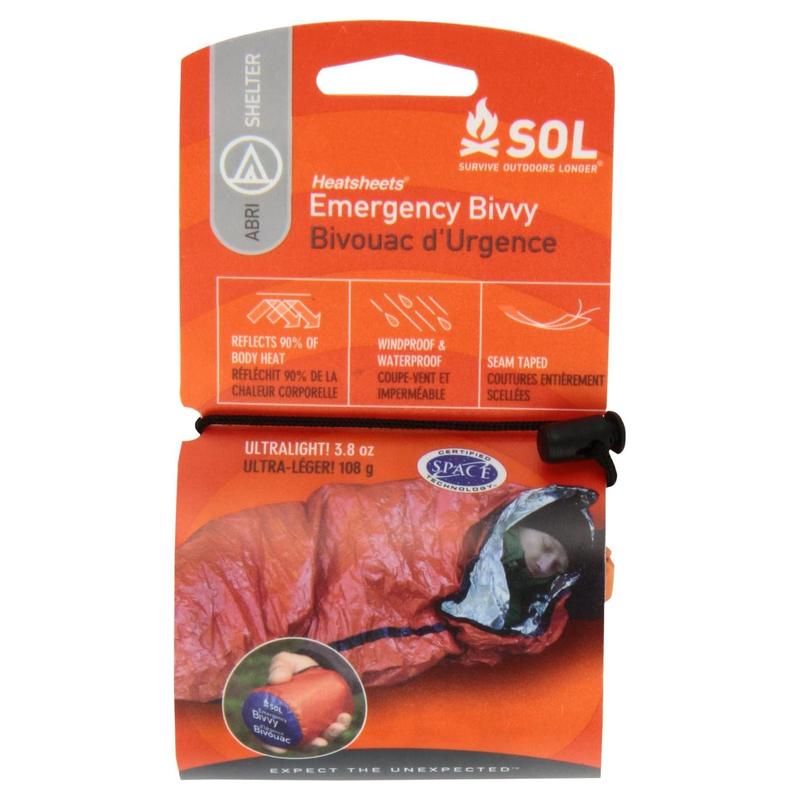
Do: put something under you if you have it. A sit pad, a pack, a dry log. Don't: lie in a drainage because the sack is waterproof. Waterproof from above still floods from a creek you rolled into. Don't: test it once, wad it wet, and forget it. Dry it at home, fold it back into the sack, and replace it if the reflective face is scuffed through.
What the SOL survival blanket is actually for
The Adventure Medical SOL survival blanket on this card is the open sheet, listed at 60 by 96 inches and 3.2 ounces, model family 0140-1701. The material is the same idea as the bivvy: vacuum-metalized polyethylene that reflects heat, resists the shredding mylar is famous for, and stays quiet enough that you can hear the woods. The bright face is for being found. The reflective face is for being warmer. Read which side the pouch tells you to put toward your body, and do that. A backward wrap still blocks some wind. It does not do the job the coating was aimed at.
Use it as a wrap while you build a better shelter, as a ground layer under a pad, as a cover over a pack, or as a panel you can tie. Two people can share it as a cape more honestly than they can share the one-person bivvy tube. It will not click shut. You sit on the edge, you tuck it under your boots, or you tie it. Survival notes printed on the sheet are there for the moment your hands are stupid and your memory is worse. Read them once at the kitchen table so they are not new information in the dark.
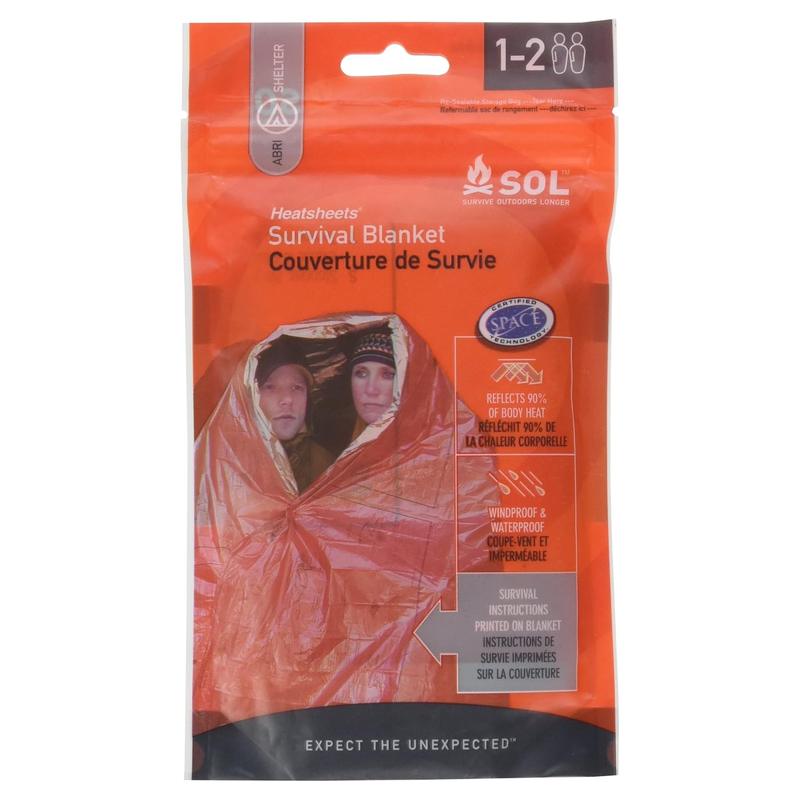
Do: practice opening it once, in daylight, with the same gloves you hike in. Don't: unfold it in a gale for the first time. The sheet becomes a sail. Crouch, open it low, and get it against your body before you stand up and donate it to a tree. Don't: cut it into a fashionable poncho unless you have tape and a plan. A cut sheet is a set of flaps. The uncut sheet is the tool.
How to spend a night in one without making it worse
Stop moving while you can still choose the spot. Wind, drainage, and widow-makers matter more than the logo on the sack. A reflective tube in a creek bed is a wet tube. A reflective tube under a dead limb is a bad bet the sack cannot fix. Get off the wet ground as much as you can. Eat something if you have it. Drink if the water is safe. A filter is the other pocket item that belongs next to this one. Heat you reflect still leaves if you are dehydrated and empty.
Change what you can. Wet socks come off if dry socks exist. A wet base layer stays on only if you have nothing dry, and then the sack is fighting a loss. A fire, if the place allows one and you can run it without burning the plastic, belongs upwind and farther away than your optimism. These materials melt and hole. They are not a welder's blanket. Sparks and the sack do not share a lap.
In the morning, dry the plastic before you pack it. A wet wad grows mildew and welds to itself. If you used the blanket as a signal, leave it where a searcher can still see it until you are actually found or you are walking out on a route you know. Stuffing the only bright panel back into a pouch at the trailhead of a walk-out is a choice. On a roadside, the bright side toward traffic is the point.
What actually fails on an emergency sack
Holes fail it. Brush, embers, and a kneel on a sharp rock are the usual causes. Carry a short strip of tape in the same pouch. A finger-sized hole in a bivvy is a leak you can live with for one night if you tape it and do not lie on it. A shredded mylar square is why these polyethylene versions exist. If you bought a foil blanket because it was cheaper and thinner, you bought a different tool. It may still reflect heat for an hour. It will not forgive a snag.
Condensation fails comfort, not the product. You will be damp. That is a person in a vapor barrier. Vent your face. Do not fight it by opening the whole tube to the wind every ten minutes. Ground cold fails the plan if you skipped a pad. The reflective layer slows radiant loss. It does not insulate you from the earth the way foam does. If the pack has room for a sit pad, the sit pad goes under the sack.
The other failure is the wrong shape with the right brand. SOL and Adventure Medical sell a one-person bivvy, a two-person bivvy, and an open blanket that share orange pouches. The sealed 84-by-36 tube is the bivvy card. The open 60-by-96 sheet is the blanket card. A photo of a person wrapped in a sheet, on a listing titled bivvy, is how you buy a flap when you needed a tube. Read the words sealed, blanket, and the inches.
What this fight is not
It is not a three-season tent, and it is not a sleeping bag with a number you can plan a January trip around. It is not a pad. It is not fire. A starter and a compass still answer different failures. It is not a group shelter for four. Two people and one blanket is already a compromise. Four people need more than one sheet or a real decision to walk out before dark.
It is not a souvenir. Open it once at home so the folds and the opening are familiar. Pack it back so the next open is fast. A tool you have never unfolded is a lump you will fight when your hands are cold.
So which one should you buy?
Buy the SOL emergency bivvy when the risk is a night in the weather and you want the sealed tube, about 84 by 36 inches. Buy the SOL survival blanket when you want the open 60-by-96-inch sheet for a wrap, a signal, or a ground layer. Carry one dry, know which side faces you, and put something between you and the dirt. Neither one has a winter rating. Both of them beat an empty pocket when the daylight runs out.
Frequently asked questions
SOL bivvy or SOL survival blanket?
Bivvy if you may have to sleep in wind and rain. The sealed tube is about 84 by 36 inches. Blanket if you want an open 60-by-96-inch sheet for a wrap, a signal, or a ground layer.
Is either one a winter sleeping bag?
No. Neither has a temperature rating you can plan a January trip around. They slow heat loss. A foam pad under you still matters, because the ground steals heat the sheet cannot stop.
How much do they weigh?
The bivvy is listed near 3.8 ounces. The blanket is listed at 3.2 ounces. Both belong in a pocket or a pack lid, not in a separate shelter bag.
Can two people share one?
The blanket is the one that can wrap two people, tightly. The bivvy on this card is a one-person tube. A two-person bivvy is a different product.
Which side faces my body?
The reflective side, the way the pouch describes it. Read it once at home. A backward wrap still blocks some wind and does less of the job the coating is for.
Can I use it next to a fire?
Keep sparks off it. The polyethylene holes and melts. It is not a fire blanket. Tape a small puncture. Retire a sheet that is shredded.