
How to Read Sleeping Bag Temperature Ratings
Written by Outdoors Magazine|
Outdoors Magazine is a participant in the Amazon Services LLC Associates Program. We may earn a commission if you buy through links on this page, at no extra cost to you. Affiliate disclosure.
Sleeping bag temperature ratings come from a lab test, now ISO 23537-1 and formerly EN 13537, that yields three numbers. Comfort is where a standard woman sleeps warm in a relaxed position, the limit is where a standard man sleeps curled up through the night, and extreme is survival only. Plan around comfort or limit, and use an insulated pad.
Key takeaways
- Comfort fits a relaxed standard woman; the limit fits a curled-up standard man.
- Extreme is a survival-only figure; never plan a trip around it.
- Ratings assume an insulating pad and a base layer; match both.
- Pick a comfort or limit rating 5 to 20 degrees below your expected low.
Sleeping bag temperature ratings come from a lab test, now ISO 23537-1 and formerly EN 13537, that yields three numbers. Comfort is where a standard woman sleeps warm in a relaxed position, the limit is where a standard man sleeps curled up through the night, and extreme is survival only. Plan around comfort or limit, and use an insulated pad.
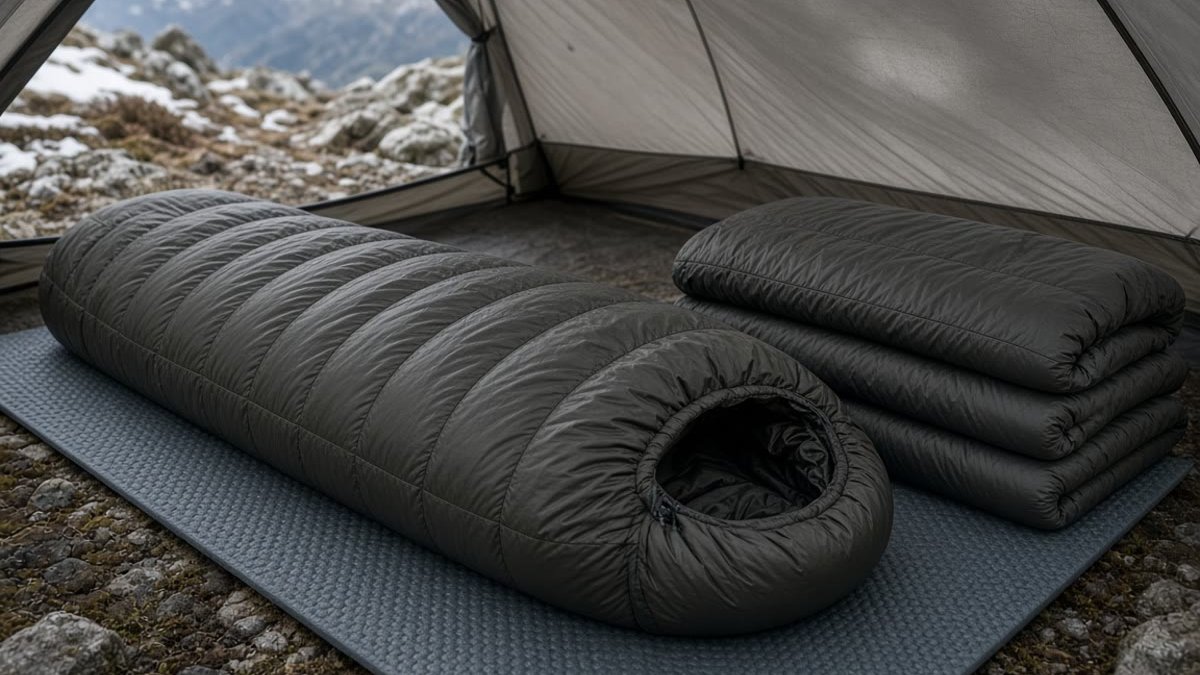
The rating on the label assumes a pad underneath you. AI-generated editorial image of a dark gray down mummy sleeping bag and a folded second bag on a gray pad inside a tent, with a snowy, rocky mountain visible through the open door.
Every sleeping bag on the shelf carries a temperature in its name, and those numbers look precise: a 20-degree bag, a 0-degree bag, a 40-degree summer bag. The trouble is that two bags with the same number can sleep very differently, because brands don't all put the same rating in the name. One may name a bag by its comfort figure, another by its lower limit, and another by a number set in-house from field use. Before you compare bags, you need to know which number you're looking at.
This guide explains where the numbers come from, what each one means, what the test assumes about the sleeper, and why the pad under the bag matters as much as the bag. The definitions below come from published summaries of the ISO standard and from manufacturer explainers at Therm-a-Rest, Rab and Western Mountaineering. The full standard itself is sold by ISO, so we've stuck to what those sources state publicly rather than guessing at test details.
What do sleeping bag temperature ratings mean?
They are the results of a standardized lab test, ISO 23537-1, in which a heated manikin lies in the bag in a cold chamber. The test produces a comfort rating, a lower limit rating and an extreme rating. They are guidelines for comparing bags, not guarantees of warmth.
The history is short. Before 2005, there was no common way to rate sleeping bags, and Therm-a-Rest notes that campers often had cold nights as a result. The European standard EN 13537 arrived in 2005 so that buyers could compare bags with the same rating directly. An international version, the ISO 23537 series, followed as an updated form of the EN method, and Therm-a-Rest says it switched its own ratings to ISO in 2017. The current document is ISO 23537-1:2022, which replaced the 2016 edition and its 2018 amendment.
The test itself works the same way across these versions. A manikin fitted with heaters and temperature sensors lies inside the bag in a cold, controlled chamber. The lab measures how much energy it takes to keep the manikin at a set temperature, which tells the lab how well the bag insulates. From that measurement, a set of temperature limits is calculated. Therm-a-Rest describes the results as ranges, with the published numbers taken from the bottom of each range.
Because every lab follows the same procedure, two bags tested to the standard can be compared fairly, even across brands. That is the real value of the ratings. They are less useful as a prediction of how you personally will sleep on a particular night. Western Mountaineering calls its ratings a guideline to help compare products rather than a guarantee of warmth, and a gear specialist quoted by the Washington Trails Association notes that the test can be inconsistent between labs and doesn't account for many factors that affect comfort.
What is the difference between comfort, limit and extreme ratings?
Comfort is the temperature at which a standard woman can sleep comfortably in a relaxed position. The lower limit is the temperature at which a standard man can sleep for eight hours curled up without waking. Extreme is a survival-only figure with a real risk of hypothermia, so never plan a trip around it.
The ISO summary published by Australian Hiker lays out four figures, and manufacturer explainers line up with it.
Upper limit. The temperature at which a standard man can sleep without excessive sweating. It exists in the standard, but it is typically not printed on commercial bags, so you will rarely see it.
Comfort. The temperature at which a standard woman can expect to sleep comfortably in a relaxed position. Therm-a-Rest puts it simply: the standard woman is not feeling cold. Rab describes comfort as the lowest temperature at which a person can sleep relaxed and get a good night's sleep, and it uses the comfort figure in its bag names for that reason.
Lower limit. The temperature at which a standard man can sleep for eight hours in a curled position without waking. Therm-a-Rest calls the zone between comfort and limit the transition range, where the standard man is fighting the cold but not shivering. It adds that the practical performance limit of a bag likely sits somewhere in that range.
Extreme. A survival-only figure for a standard woman. Below the lower limit, the summaries warn that a strong sensation of cold should be expected along with a risk of health damage from hypothermia. Rab describes the extreme figure as the minimum temperature at which a person can stay in the bag for up to six hours, curled up and fighting the cold, and warns that frostbite is very possible. Therm-a-Rest says a bag should be used in this range only in an emergency. Treat it as a margin of safety, never as a target for trip planning.
The useful window is between comfort and limit. If a bag lists a comfort of 32 degrees F and a limit of 22 degrees F, those two numbers frame where most people will sleep well, depending on how warm or cold they run. The bag's name might use either one, or a number in between.
Who is the "standard sleeper" in ISO sleeping bag tests?
The standard describes a standard man and a standard woman, both assumed to be 25 years old. The man is 1.73 m tall and weighs 73 kg; the woman is 1.60 m and 60 kg. The test manikin wears one layer of long underwear and lies on an insulating mat.
According to the Australian Hiker summary of the standard, the standard man is assumed to be 25 years old, 1.73 m tall and 73 kg, and the standard woman is assumed to be 25 years old, 1.60 m tall and 60 kg. These are statistical reference bodies, not a judgment about who should buy which bag. The comfort figure is defined around the standard woman sleeping relaxed, and the lower limit around the standard man sleeping curled up.
The clothing assumption is just as specific and just as easy to forget. The same summary says the manikin wears one layer of long underwear, and Therm-a-Rest describes it as a base layer similar to what a camper might wear. Therm-a-Rest and Rab both say the bag sits on a foam mat during the test, which Therm-a-Rest calls a basic foam mat and the Australian Hiker summary calls an insulating mat. None of the public sources we used gives an R-value for that mat, so we won't quote one.
What follows from all this is practical. If you are smaller, older, tired, underfed or simply someone who sleeps cold, the comfort number is the one to trust. If you are larger or naturally run warm, you may sleep well nearer the limit. If you go to bed in damp clothes, skip the base layer, or lay the bag on bare ground or a thin pad, you have moved away from the lab conditions, and the bag will feel colder than its label.
This matters when you compare women's and unisex bags. If one model is named by its comfort rating and another by its lower limit, the same headline number describes different amounts of warmth, and the bag named by comfort needs more insulation to earn it. Our roundup of cold-weather sleeping bags designed for women is a good place to compare cuts and fills. Whichever bag you look at, read the spec sheet for the labeled comfort and limit figures rather than relying on the number in the name.
Why does your sleeping pad's R-value affect a bag's rating?
The bag's insulation underneath you is crushed flat by your weight, so the pad does most of the work against the cold ground. Bag ratings are measured with the bag on an insulating mat, so a thin or uninsulated pad makes the same bag feel colder. Higher R-value means more resistance to heat loss.
Down and synthetic fill only insulate when they are lofted. Under your shoulders and hips, the bag's fill is pressed flat, so it does little to stop heat from flowing into the ground. The pad takes over that job. R-value measures a material's resistance to letting heat through, and a higher number means more thermal resistance. Western Mountaineering states outright that its bag ratings assume a properly insulated ground pad, around R 5.0 or higher for colder conditions, and suggests R 7 or higher for winter and snow camping.
Pad R-values used to be hard to compare because brands measured them differently. That changed with ASTM F3340-18, a common test method for sleeping pads. Therm-a-Rest says the standard was finalized and published in 2019 and lets campers make like-for-like comparisons between brands. The test places the pad between a heated top plate, which stands in for the body, and a cold plate underneath, and measures how much energy the top plate needs to stay at 35 degrees C. More energy means less insulation.
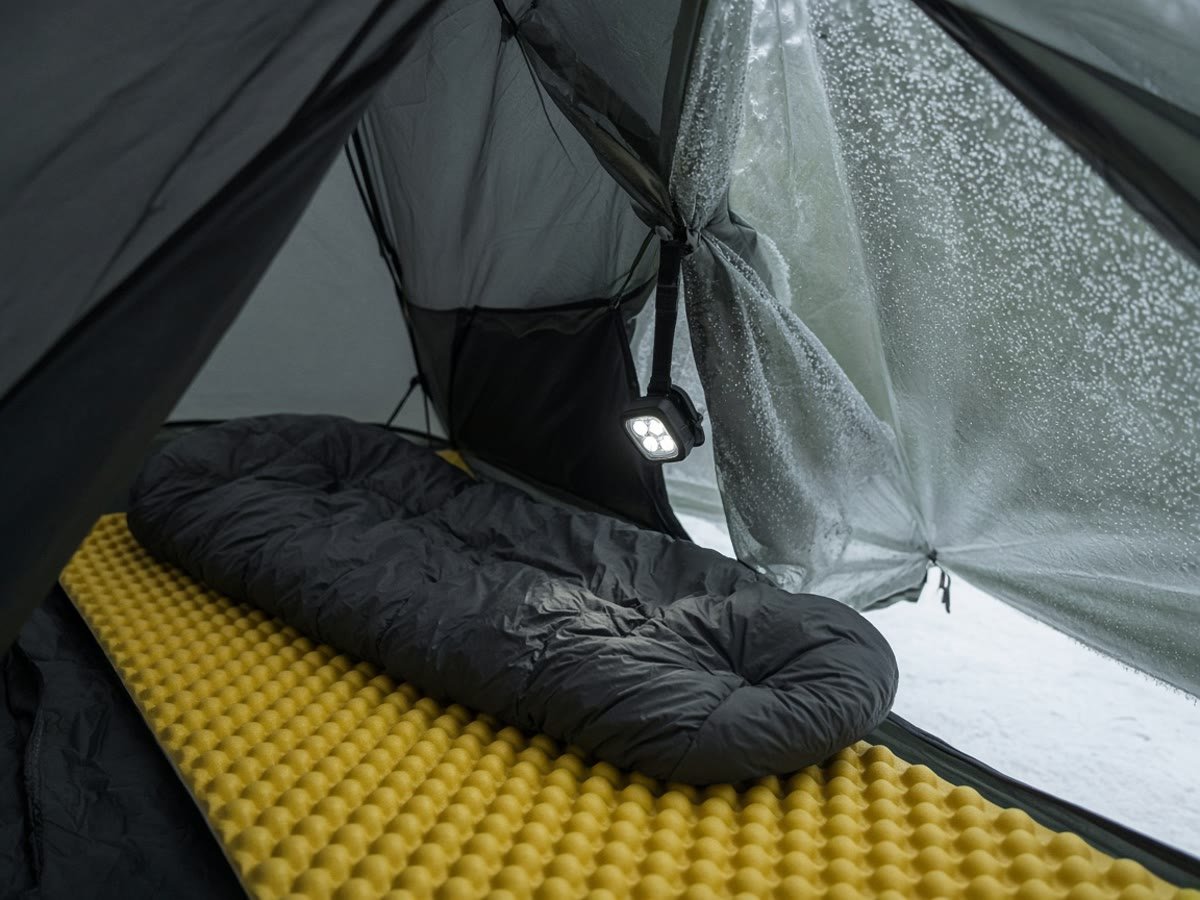
Pads also stack. R-values are cumulative, so two pads layered together give roughly the sum of their ratings. For example, Advnture notes that an R3 pad can be doubled with another R2 or R3 pad for winter instead of buying a single R5 or R6 pad. As a rough season guide from the same source, R 1 to 2.5 suits summer only, R 2.5 to 4 is recommended for three-season use, R 4 to 6 suits cold sleepers and winter camping, and R 6 and above suits more extreme environments. Our guide to choosing sleeping pad R-value for cold camping goes deeper on picking the right pad.
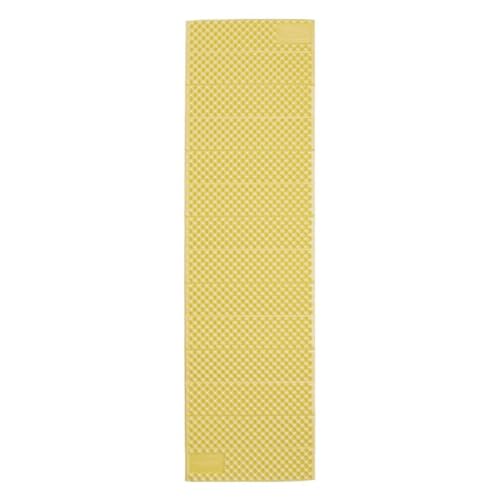
A closed-cell foam pad is the classic way to add R-value under an inflatable pad. The Therm-a-Rest Z Lite SOL is one example: a folding, egg-crate closed-cell foam pad with a reflective ThermaCapture coating that the maker lists at R-value 2.0. Therm-a-Rest describes it as suited to use on its own in warmer weather or layered under another pad for extra warmth in the cold, and it doubles as protection against punctures for an air pad. The regular size is 72 inches long, 20 inches wide and 0.75 inch thick, and weighs 14 ounces, according to the manufacturer.
The takeaway for reading bag ratings is simple. A bag tested on an insulating mat can't deliver its label rating on a thin summer pad over frozen ground. If you are buying a colder bag, budget for a warmer pad at the same time, or plan to stack a foam pad under the one you already own.
How do you choose a sleeping bag rating for the temperatures you expect?
Find the coldest low you realistically expect, then pick a bag whose comfort or limit rating sits below it. Western Mountaineering suggests a bag 5 to 10 degrees F colder than your expected low, and a Washington Trails Association guide suggests 10 to 20 degrees. Cold sleepers should lean on the comfort number.
Start with the forecast, then get honest about it. Look up the expected overnight lows for your destination and elevation at the time of year you're going, and use the coldest realistic number rather than the average. If you are unsure, plan for a colder night rather than a warmer one.
Next, decide which rating to read. Because comfort describes relaxed, undisturbed sleep and the limit describes curled-up sleep at the edge of the cold, cold sleepers should match the comfort number to their expected low, while warm sleepers can reasonably plan nearer the limit. If you don't know which you are, start with comfort. The extreme number should never enter the decision.
Then add margin. Western Mountaineering suggests choosing a bag 5 to 10 degrees F (3 to 5 degrees C) colder than your expected low, and treats its rating as a goal post for the lowest temperatures you realistically expect rather than a promise of comfort. A guide from the Washington Trails Association goes further, suggesting a bag rated 10 to 20 degrees colder than the coldest temperatures you expect. Those ranges overlap, and the right buffer for you depends on how you sleep and how far you are from your car.
Finally, build the rest of the system. Wear dry base layers to bed, which Western Mountaineering says can add warmth and keep the bag cleaner. Choose a bag that fits: one that is too roomy leaves air to heat, and one that is too narrow compresses the fill and creates cold spots. Don't overbuy, either. Therm-a-Rest warns that a bag that is too warm can make you sweat, and damp insulation leaves you colder later in the night. If you camp across a wide range of seasons, two bags, or one bag plus a liner and a warmer pad, often make more sense than one very warm bag. Store whichever bag you choose with its fill lofted between trips; our guide to storing a sleeping bag between trips covers how to do that.
Why do some sleeping bags not list comfort and limit ratings?
Not every bag falls under the standard. ISO 23537-1 covers adult bags with limit temperatures of -20 C and higher, and it excludes military, extreme-expedition, children's and babies' bags. Some makers also set their own ratings from field use. A single number with no label may not be an ISO result.
The scope of the standard explains most of the gaps. ISO 23537-1:2022 covers adult-sized sleeping bags for sports and leisure use with limit temperatures of -20 degrees C and higher. It does not apply to bags made for specific purposes such as military use and extreme climate zone expeditions, and it excludes bags for children and babies. The standard itself also notes that bags with uneven fill designed to add local insulation in certain areas raise problems for its calibration and test procedure.
That leaves several common cases without a standard rating. Rab says the standard does not cover quilt designs or measure performance below -20 degrees C, so it tests those products with the same methods and calculates an advisory limit figure instead. Western Mountaineering bases its own ratings on extensive field use and carefully calculated fill weights. It says it has EN/ISO test data for most models, and that its own rating usually falls between the comfort and limit figures from that protocol.
Other bags simply carry one number with no explanation. When that happens, look on the maker's spec page or the label for the words comfort and limit, or a reference to ISO 23537 or EN 13537. If none of those appear, treat the number as the brand's own estimate and give yourself a bigger margin, especially on budget bags and kids' bags, which the standard doesn't cover at all. For truly cold trips, such as those our guide to zero-degree sleeping bags covers, a clearly labeled rating is worth looking for.
Putting the numbers to work on your next cold night
Reading a temperature rating comes down to three questions. Which number is in the name? Which number fits how you sleep? And does the rest of your system, especially your pad and your sleep clothes, match what the lab assumed? Answer those three, and a 20-degree bag stops being a mystery and becomes a specific promise you can check against the forecast.
If you are shopping now, write your coldest expected low on a scrap of paper, add your margin, and compare only comfort and limit figures across the bags on your list. Then match the bag with a pad whose R-value suits the same nights. Ratings and forecasts both have limits, so carry an extra layer, and if a night turns colder than planned, add clothing and more insulation underneath you before you get chilled.
Sources: AFNOR: ISO 23537-1:2022 listing, BSI: BS EN ISO 23537-1:2022, Therm-a-Rest: Understanding EN/ISO sleeping bag temperature ratings, Rab: Sleeping bag temperature ratings explained, Australian Hiker: ISO 23537-1:2022 sleeping bag temperature rating, Western Mountaineering: Temperature ratings, Washington Trails Association: How do sleeping bag ratings work?, Therm-a-Rest: The ASTM R-value standard, Advnture: Sleeping pad R-values explained, and Therm-a-Rest: Z Lite SOL sleeping pad; Amazon B005I6R0WC.
Frequently asked questions
What do sleeping bag temperature ratings mean?
They are the results of a standardized lab test, ISO 23537-1, in which a heated manikin lies in the bag in a cold chamber. The test produces a comfort rating, a lower limit rating and an extreme rating. They are guidelines for comparing bags, not guarantees of warmth.
What is the difference between comfort, limit and extreme ratings?
Comfort is the temperature at which a standard woman can sleep comfortably in a relaxed position. The lower limit is the temperature at which a standard man can sleep for eight hours curled up without waking. Extreme is a survival-only figure with a real risk of hypothermia, so never plan a trip around it.
Who is the "standard sleeper" in ISO sleeping bag tests?
The standard describes a standard man and a standard woman, both assumed to be 25 years old. The man is 1.73 m tall and weighs 73 kg; the woman is 1.60 m and 60 kg. The test manikin wears one layer of long underwear and lies on an insulating mat.
Why does your sleeping pad's R-value affect a bag's rating?
The bag's insulation underneath you is crushed flat by your weight, so the pad does most of the work against the cold ground. Bag ratings are measured with the bag on an insulating mat, so a thin or uninsulated pad makes the same bag feel colder. Higher R-value means more resistance to heat loss.
How do you choose a sleeping bag rating for the temperatures you expect?
Find the coldest low you realistically expect, then pick a bag whose comfort or limit rating sits below it. Western Mountaineering suggests a bag 5 to 10 degrees F colder than your expected low, and a Washington Trails Association guide suggests 10 to 20 degrees. Cold sleepers should lean on the comfort number.
Why do some sleeping bags not list comfort and limit ratings?
Not every bag falls under the standard. ISO 23537-1 covers adult bags with limit temperatures of -20 C and higher, and it excludes military, extreme-expedition, children's and babies' bags. Some makers also set their own ratings from field use. A single number with no label may not be an ISO result.