
How to Avoid Hitting a Deer: Fall Driving Safety Tips
Written by Outdoors Magazine|
Outdoors Magazine is a participant in the Amazon Services LLC Associates Program. We may earn a commission if you buy through links on this page, at no extra cost to you. Affiliate disclosure.
To avoid hitting a deer, slow down and watch the road edges from dusk to dawn, especially October through December during the rut. Use high beams when no one is coming, watch for eye shine, and expect more deer after the first. If a crash is unavoidable, brake firmly and stay in your lane rather than swerving, and keep everyone belted.
Key takeaways
- October through December is peak deer-crash season; November is the worst month.
- Deer move most at dawn and dusk; slow down and use high beams when you can.
- Brake firmly and stay in your lane; swerving often causes the worse crash.
- Deer whistles lack scientific support; rules for keeping a hit deer vary by state.
Here is how to avoid hitting a deer: slow down and scan the road edges from dusk to dawn, especially October through December, when the rut keeps deer moving. Use high beams when you can and expect more deer behind the first. If a collision is unavoidable, brake firmly and stay in your lane instead of swerving.
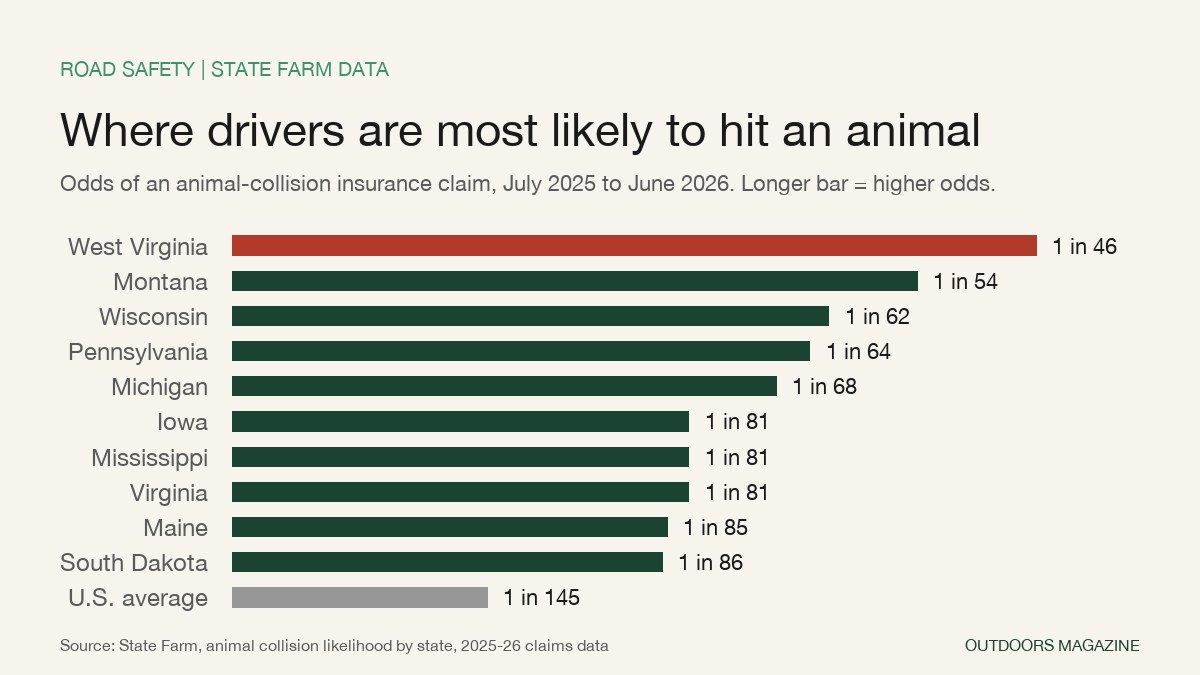
Odds of an animal-collision insurance claim in the ten highest-risk states and the U.S. average, July 1, 2025 to June 30, 2026. Source: State Farm animal collision data, released September 2026.
Late fall is when a lot of us spend the most time on dark two-lane roads. The drive to deer camp starts before first light, the trailhead parking lot empties after sunset, and the ride home from a late sit crosses the same farm-and-woodlot edges where deer cross. That timing puts outdoor people in exactly the place and hour where deer crashes happen most.
The numbers are large. State Farm estimates there were more than 1.6 million animal-vehicle collision claims in the United States between July 1, 2025 and June 30, 2026, and it calls deer "by far the most frequently struck animal." The AAA Foundation for Traffic Safety, counting only police-reported crashes, put the yearly toll from 2020 through 2024 at at least 353,800 crashes, 49,725 injuries and 277 deaths. This guide pulls together what State Farm, the AAA Foundation, the Insurance Institute for Highway Safety and several state agencies say about lowering your odds and handling a strike if it happens anyway.
Why are October through December the worst months for deer crashes?
Fall is breeding season, or the rut, when bucks roam after does and many yearling bucks leave the area where they were born. State Farm ranks November, October and December as the top months for large-animal collisions, and those three months accounted for about 41% of its animal-collision claims in 2024-25.
The Pennsylvania Game Commission explains the mechanics. As the rut approaches, many yearling bucks leave their birth areas looking for new territory, sometimes traveling dozens of miles, while adult bucks roam their home ranges chasing does. Deer that normally keep to a predictable pattern start crossing roads at odd places and odd times, and they pay little attention to traffic.
The insurance data reflects it. State Farm's 2024-25 report said October, November and December "continue to be the most dangerous" months for animal collisions, with about 650,000 incidents in those three months. Its current safety page ranks November first, then October, then December. The AAA Foundation found the same pattern in police reports: animal-related crashes were most common in the fall and peaked in November.
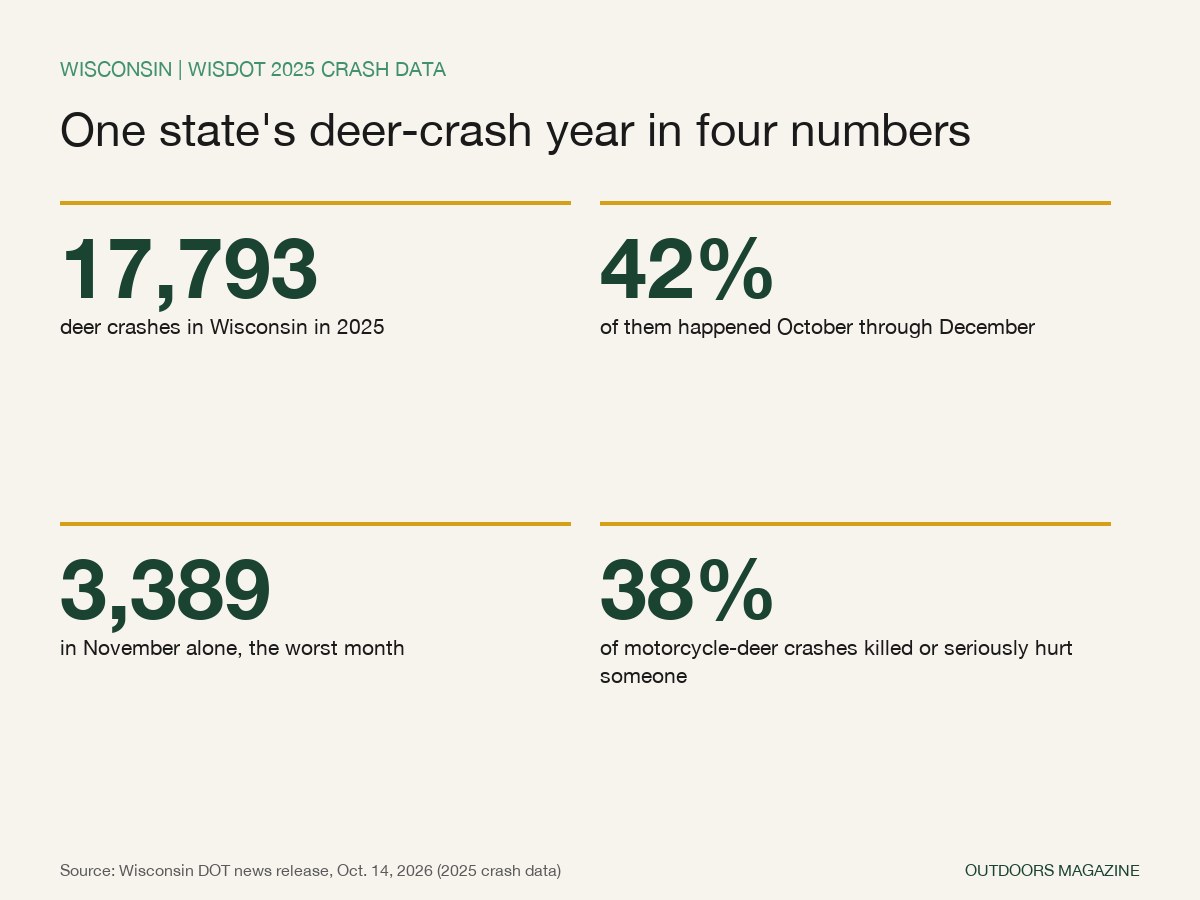
State data lines up too. Wisconsin DOT counted 17,793 deer crashes in 2025, and 42% of them happened from October through December. November alone had 3,389. In a May 2026 release, Wisconsin DOT also flagged a rise in May and June, when does look for places to give birth and young deer separate from their mothers, so fall is the peak, not the only season to pay attention.
One detail is worth knowing. The IIHS counts deaths from crashes where the first harmful event was hitting an animal, and in 2024 those deaths were highest in July through September (67), not October through December (53). More crashes in fall does not mean the rest of the year is safe, and the most dangerous single crash can happen in any month.
What time of day are you most likely to hit a deer?
Dusk through dawn is the high-risk window. Deer are most active early in the morning and in the evening, and Minnesota's Department of Public Safety singles out 6 to 9 p.m. In November, the end of daylight saving time puts the evening commute right in that window.
Wisconsin DOT says deer are most active in early morning and evening hours, and that shorter days make them harder to spot. Minnesota DPS tells drivers to be especially cautious from 6 to 9 p.m. The Pennsylvania Game Commission notes that daylight saving time ended on November 1 this year, which shifts more of the evening commute into the dusk hours when deer move. The AAA Foundation found that most animal-related crashes happen in rural areas, often in darkness, on roads with speed limits of 45 mph or higher.
For hunters and campers, that window is hard to avoid. Plan the drive with it in mind:
- Leave a cushion of time. A pre-dawn drive to a stand is exactly when you are tempted to push the speed. Leaving ten minutes earlier makes it easier to drive at a speed that lets you stop inside your headlights.
- Use high beams when you can. State Farm and Minnesota DPS both recommend high beams when appropriate.
- Watch the edges, not just the lane. Minnesota DPS tells drivers to watch for eyes reflecting in the headlights and for deer silhouettes on the shoulder, and to slow down if anything looks suspicious.
- Slow down at habitat edges. Minnesota DPS calls out roads that separate farm fields from forest and wooded areas between dusk and dawn. Deer crossing signs mark spots where crashes have happened before.
- Put the phone away. Wisconsin DOT lists avoiding distractions among its core tips, and Pennsylvania reminds drivers to follow the state's cell phone laws.
Which states have the highest odds of hitting a deer?
State Farm's claims data for July 2025 to June 2026 puts West Virginia first at 1 in 46, followed by Montana at 1 in 54, Wisconsin at 1 in 62, Pennsylvania at 1 in 64 and Michigan at 1 in 68. The national average was 1 in 145, an improvement on 1 in 139 the year before.
The rest of State Farm's top 10, listed on its animal-collision safety page, is Iowa, Mississippi and Virginia (each 1 in 81), Maine (1 in 85) and South Dakota (1 in 86). West Virginia has held the top spot for more than a decade, according to Carrier Management, and Pennsylvania had the most estimated claims of any state, about 141,000. These figures are insurance claim odds for the average driver in each state. They are not a forecast for any one road, and they include animals other than deer.
If your season takes you into one of these states, or across them on the way to a lease or a public-land unit, the odds are a reason to pay extra attention, not a reason to stay home. The habits below work everywhere. They also matter in states that are not on the list. In the IIHS ten-year count, Texas recorded the most deaths from collisions with animals from 2015 to 2024, with 197 of the 1,964 deaths nationwide.
Should you brake or swerve to avoid a deer?
Brake firmly and stay in your lane. State Farm, Wisconsin DOT and Minnesota DPS all advise against swerving, because a sudden swerve can cost you control and turn a deer strike into a crash with another vehicle, a tree or a rollover. The AAA Foundation found that sudden evasive action may be riskier than hitting the animal, though that may not hold for very large animals such as moose.
The advice is the same across sources. State Farm's 2026 release says "brake don't swerve," telling drivers to brake firmly and stay in their lane when possible. Wisconsin DOT warns that a sudden swerve can make you lose control. Minnesota DPS says plainly not to swerve to avoid a deer, and if a deer stays in the road, to stop rather than try to drive around it. State Farm's safety page adds that if a crash is unavoidable, you should keep control of the vehicle and stay on the road.
The reason is what happens next. IIHS notes that many animal collisions involve secondary impacts that are more severe, such as hitting another vehicle or a tree. Motor1, reporting New Jersey crash data compiled by AAA Northeast, said drivers who hit a deer directly were injured 4.5% of the time, while those who swerved and hit another vehicle or a fixed object were injured 27% of the time. The AAA Foundation concluded that sudden evasive action may be riskier than striking the animal, while cautioning that the finding may not apply to every situation, especially with much larger animals such as moose, elk or bison.
A few habits make braking work better:
- Expect a second deer. Wisconsin DOT says that if one deer crosses, others may follow, and the Pennsylvania Game Commission notes that deer often travel in groups and walk single file. Stay slow after the first one clears.
- Warn the driver behind you. If you can avoid the animal, State Farm suggests slowing down, honking and tapping your brakes to alert other drivers. If no one is behind you, it advises braking hard.
- Expect sudden moves. Wisconsin DOT says deer may freeze or change direction suddenly, so drive at a speed that gives you room to react.
- Buckle up everyone. State Farm, Wisconsin DOT and Minnesota DPS all list seat belts.
How should motorcyclists deal with deer?
Riders face far worse odds: in Wisconsin, 38% of motorcycle-deer crashes in 2025 ended in a death or serious injury. Wisconsin DOT advises controlled, straight-line braking and swerving only if you can stay in your lane, and Minnesota DPS adds using both brakes, avoiding night and low-light riding, and wearing a full-face helmet and protective gear.
The gap between cars and bikes is stark. Wisconsin DOT counted 223 deer crashes involving a motorcycle in 2025, with four deaths and 80 serious injuries. That 38% rate of death or serious injury compares with less than 0.1% for cars and light trucks. Nationally, the AAA Foundation found that motorcyclists accounted for nearly half of all animal-related crash deaths.
Fall riding brings those risks together. Riders heading to a trailhead or a late-season campsite should follow the state guidance closely:
- Brake in a straight line. Wisconsin DOT says riders should use controlled, straight-line braking and swerve only if they can safely stay in their lane. Minnesota DPS says to use both brakes for maximum braking.
- Keep your eyes and head up. Minnesota DPS lists this as part of the emergency technique.
- Avoid dawn, dusk and night riding. Minnesota DPS tells riders to avoid night and low-light periods, which is when deer are most active.
- Wear the gear. Minnesota DPS recommends a full-face helmet and full protective gear, and says high-visibility gear helps other drivers see you.
What should you do after hitting a deer?
Get the vehicle off the road if you can, turn on your hazard lights and call 911 if anyone is hurt or the deer or vehicle is blocking traffic. Stay buckled in rather than walking along the road, never try to move an injured deer, and photograph the damage for your insurer once it is safe.
Agency guidance follows the same order:
- Get to a safe spot. State Farm says to move your vehicle to a safe location when possible and turn on your hazard lights. Wisconsin DOT says to get off the road as soon as possible.
- Call for help when needed. Wisconsin DOT says to call 911 if someone is hurt or the deer is in an active traffic lane. If no one is hurt and the vehicle and deer are off the road, report the crash or contact local law enforcement. State Farm says to call police if the animal is blocking traffic or creating a hazard. Reporting rules vary by state, so check yours.
- Stay in the vehicle. Wisconsin DOT advises staying buckled in while you wait, because walking along a road is always dangerous.
- Leave the deer alone. Wisconsin DOT says never try to move an injured deer, and State Farm warns against approaching an injured or frightened animal. Pennsylvania and Minnesota both say to keep your distance from a deer that was hit but not killed, since it may recover and move on.
- Check the vehicle before you drive on. State Farm lists leaking fluids, damaged tires, broken lights and other hazards. Document the scene and damage once it is safe, then contact your insurer.
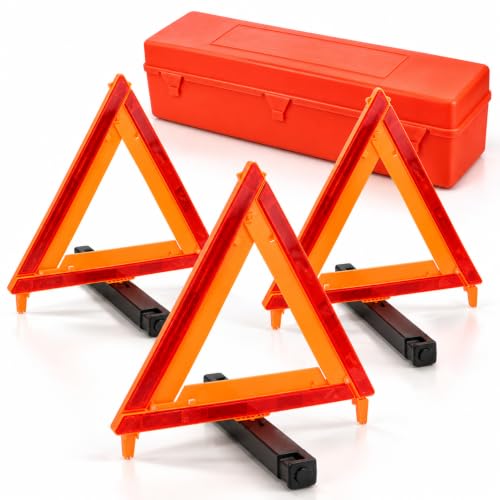
Being visible while you wait is part of staying safe. A set of reflective warning triangles set out behind the vehicle can give approaching drivers extra warning on a dark road. The Stark USA 57810 kit is a three-pack of red/orange triangles that the maker describes as DOT approved, with reflectors over a fluorescent infill and long, weighted metal legs on all four sides to resist wind gusts from passing traffic. It folds and comes with a storage case. Set triangles out only if you can do it without walking into traffic, and if conditions feel unsafe, stay in the vehicle as Wisconsin DOT advises. Our winter car emergency kit guide covers what else to carry, and if a strike leaves a tire low on a cold morning, our guide to tire pressure in cold weather explains how to check it.
Do deer whistles work?
The evidence says not to count on them. State Farm states that no scientific evidence supports that car-mounted deer whistles work, and Minnesota DPS tells drivers not to count on deer whistles or deer fences to keep deer from crossing roads.
The best-known test came from the University of Georgia, where researchers played sounds from a moving vehicle at the Berry College refuge and watched how wild deer reacted. They reported that wild deer were not deterred by any of the frequencies tested, including the ultrasonic range that whistle makers advertise. That work is from 2007, and we did not find a newer study that overturns it. A whistle is not likely to hurt anything, but it is not a substitute for slowing down, using your high beams and watching the shoulders.
Can you keep a deer you hit with your car?
It depends on the state, and the rules are specific. Some states let residents claim a road-killed deer with a permit, some restrict it, and chronic wasting disease rules can limit where the carcass and certain parts can go. Check with your state wildlife agency or a conservation officer before you load anything.
Two examples show how much the details vary. In Pennsylvania, the Game Commission says only state residents may claim a dead deer, and they must call 1-833-PGC-HUNT or 1-833-PGC-WILD within 24 hours of taking possession to get a free permit number. A passing Pennsylvania motorist may claim the deer if the driver who hit it does not want it, and CWD rules still apply. Drivers are not required to report hitting a deer to the Game Commission. In Minnesota, DPS says any resident may claim a road-killed animal by contacting a law enforcement officer, who issues a permit to possess it.
If you do not want the deer, Wisconsin DOT says to call the county highway department or the sheriff's non-emergency line for disposal, and Pennsylvania asks drivers to call PennDOT at 1-800-FIX-ROAD for dead deer on state roads. If you do keep it and it is still in good condition, our guide on how to field dress a deer covers cooling the carcass quickly and handling meat from CWD areas.
None of this guarantees a clean drive. Deer are unpredictable, and even careful drivers hit them. Slowing down at dusk and dawn, watching the shoulders, holding your lane and keeping everyone belted buys reaction time, keeps a deer strike from becoming a worse crash, and gets you through the stop safely if it happens.
Sources: State Farm: 20 years of animal collision data (2026), State Farm: Watch out for animals in the road, State Farm: Fewer animal collisions (2025), IIHS: Fatality Facts, collisions with fixed objects and animals, AAA Foundation for Traffic Safety: Animal-related crashes, injuries and deaths, 2020-2024, Motor1: AAA study on animal-related crashes, Wisconsin DOT: Drivers cautioned to watch for deer (2026), Wisconsin DOT: Late spring deer crashes (2026), Carrier Management: State Farm animal collision data (2026), Minnesota DPS: Deer-vehicle safety, Pennsylvania Game Commission: Drivers urged to stay alert (2026), University of Georgia Research: deer whistle study, Stark USA: 57810 warning triangle kit; Amazon B083G5WH32.
Frequently asked questions
Why are October through December the worst months for deer crashes?
Fall is breeding season, or the rut, when bucks roam after does and many yearling bucks leave the area where they were born. State Farm ranks November, October and December as the top months for large-animal collisions, and those three months accounted for about 41% of its animal-collision claims in 2024-25.
What time of day are you most likely to hit a deer?
Dusk through dawn is the high-risk window. Deer are most active early in the morning and in the evening, and Minnesota's Department of Public Safety singles out 6 to 9 p.m. In November, the end of daylight saving time puts the evening commute right in that window.
Which states have the highest odds of hitting a deer?
State Farm's claims data for July 2025 to June 2026 puts West Virginia first at 1 in 46, followed by Montana at 1 in 54, Wisconsin at 1 in 62, Pennsylvania at 1 in 64 and Michigan at 1 in 68. The national average was 1 in 145, an improvement on 1 in 139 the year before.
Should you brake or swerve to avoid a deer?
Brake firmly and stay in your lane. State Farm, Wisconsin DOT and Minnesota DPS all advise against swerving, because a sudden swerve can cost you control and turn a deer strike into a crash with another vehicle, a tree or a rollover. The AAA Foundation found that sudden evasive action may be riskier than hitting the animal, though that may not hold for very large animals such as moose.
How should motorcyclists deal with deer?
Riders face far worse odds: in Wisconsin, 38% of motorcycle-deer crashes in 2025 ended in a death or serious injury. Wisconsin DOT advises controlled, straight-line braking and swerving only if you can stay in your lane, and Minnesota DPS adds using both brakes, avoiding night and low-light riding, and wearing a full-face helmet and protective gear.
What should you do after hitting a deer?
Get the vehicle off the road if you can, turn on your hazard lights and call 911 if anyone is hurt or the deer or vehicle is blocking traffic. Stay buckled in rather than walking along the road, never try to move an injured deer, and photograph the damage for your insurer once it is safe.