
Batteries in Cold Weather: Why They Die and What to Do
Written by Outdoors Magazine|
Outdoors Magazine is a participant in the Amazon Services LLC Associates Program. We may earn a commission if you buy through links on this page, at no extra cost to you. Affiliate disclosure.
Batteries in cold weather lose power because cold slows their chemistry, so they deliver less and can quit early. On winter trips, use lithium AA cells instead of alkaline, keep phones, power banks and spares warm inside your jacket by day and in your sleeping bag at night, and never charge lithium-ion below freezing.
Key takeaways
- Cold hides energy rather than destroying it; warm batteries usually recover.
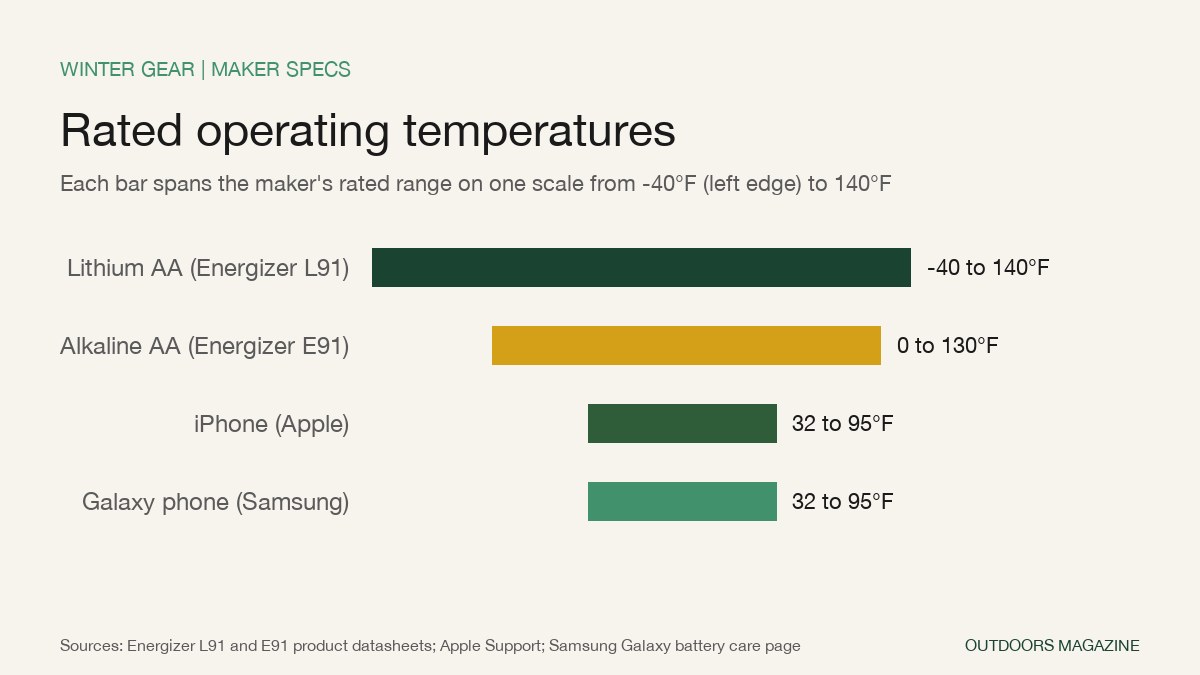
- Lithium AA cells are rated to -40°F; Energizer alkaline AAs are rated to 0°F.
- Phones are rated for 32 to 95°F; carry them inside your layers in winter.
- Never charge lithium-ion below freezing; warm the phone and power bank first.
Batteries in cold weather lose power because cold slows the chemistry inside them, so they deliver less and can quit early. For winter trips, use lithium AA cells instead of alkaline, keep phones, power banks and spares warm inside your jacket by day and in your sleeping bag at night, and never charge lithium-ion below freezing.
Rated operating temperature ranges for an Energizer lithium AA (-40 to 140°F), an Energizer alkaline AA (0 to 130°F), and iPhone and Samsung Galaxy phones (32 to 95°F). Source: Energizer L91 and E91 product datasheets, Apple Support, Samsung.
The first cold night of a winter trip tends to teach the same lesson. The headlamp that was bright at the trailhead is dim by dinner, the phone that showed 60 percent at sunset is dead when you reach for it at dawn, and the GPS that worked fine in October flashes a low-battery warning an hour out of camp. None of that means the gear is broken. In most cases the batteries are simply too cold to give up the energy they still hold.
This guide explains what cold does to the three kinds of batteries winter hikers and campers carry most often: disposable alkaline cells, disposable lithium cells, and the rechargeable lithium-ion packs inside phones, power banks and many newer headlamps. The figures come from manufacturer datasheets and support pages from Energizer, Apple, Samsung, Garmin and Petzl, plus Battery University. Your own device manual is the final word on the batteries it accepts and the temperatures it is rated for.
Why do batteries die faster in cold weather?
A battery makes electricity through chemical reactions, and those reactions slow down as the temperature drops. Energizer’s alkaline handbook explains that alkaline performance depends on how quickly water and hydroxyl ions can move and react inside the cell. As the temperature falls, that movement slows and the battery delivers less. Cold also raises the cell’s internal resistance, so a device that draws a lot of current sees a bigger voltage drop. Energizer notes that high-drain devices such as digital cameras are hit harder by cold than light-drain devices.
The important detail is what happens to the stored energy. Energizer says plainly that no capacity is actually lost to cold; it just becomes harder to access the battery’s full potential while the reactions are slowed. Its lithium handbook says the same thing about lithium iron disulfide cells. That is why a battery that seems dead on a frozen morning can come back to life after it warms up, a point covered in more detail below.
Lithium-ion packs behave the same way in broad terms. Battery University’s BU-410 article says the internal resistance of all batteries rises when they are cold, which noticeably affects discharge performance in lithium-ion. Apple says cold conditions might temporarily shorten an iPhone’s battery life and could cause the device to turn off, and Samsung warns that extended use or storage below 0°C (32°F) can lead to unexpected shutdowns and shorter battery life.
Put simply, the colder the battery and the harder you work it, the sooner it gives up.
Are lithium AA batteries better than alkaline in the cold?
Yes, by a wide margin on paper. The two chemistries share a size and a nominal 1.5-volt rating, but their rated temperature ranges are very different.
Alkaline AA. Energizer’s E91 datasheet rates its standard alkaline AA for operation from -18°C to 55°C, or 0°F to 130°F. The alkaline handbook adds that these cells can run as low as -20°C, but that performance there will be significantly lower. Part of the reason is the water-based electrolyte: Energizer says the lower temperature limit is set partly by the temperature at which the electrolyte freezes.
Lithium AA. Energizer’s Ultimate Lithium AA, model L91, is a lithium iron disulfide cell with a non-aqueous electrolyte. The L91 datasheet lists both operating and storage temperatures as -40°C to 60°C (-40°F to 140°F), and Energizer’s technical specification sheet gives the same operating range. The lithium handbook says these cells have a much lower sensitivity to temperature than other chemistries. Even at -40°C, it says, they perform well at a 200 mA drain, and they can deliver approximately full rated capacity at -40°C when discharged at 25 mA.
Lithium cells still slow down in the cold. The same handbook is clear that, as with all battery systems, service life is reduced as the discharge temperature drops below room temperature, and cold lowers the operating voltage. The advantage is in how much less they slow down, and in how much colder they keep working.
Gear makers point the same way. Garmin’s eTrex 22x/32x manual says alkaline batteries lose a significant amount of their capacity as the temperature decreases and tells owners to use lithium batteries when operating the device in below-freezing conditions. Petzl’s battery guidance says lithium batteries perform better than alkaline or NiMH batteries at extreme temperatures, and that most Petzl lamps that run on non-rechargeable batteries are compatible with lithium, with the instructions for use as the final check.
There is one disagreement worth knowing about. Petzl’s page gives lithium cells a working range of -20 to +50°C, a narrower span than the -40 to 60°C on Energizer’s own datasheets. Petzl’s figure is a general one for the category rather than a rating for a specific cell, so treat it as the more conservative number, and check the rating printed on whatever brand you buy.
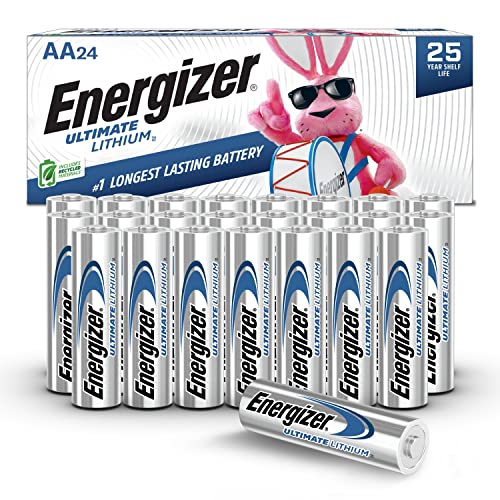
If your headlamp, GPS or avalanche-season gear takes AA cells, Energizer Ultimate Lithium is the widely sold example of this chemistry. Energizer’s product page says the AA cells perform from -40°F to 140°F, says they last up to 25 years in storage, and calls them 100 percent leak proof based on standard use. Check your device manual before you switch, since a few devices are not meant for lithium primary cells.
One practical note: do not judge a lithium AA with a voltmeter the way you would an alkaline. Energizer’s lithium handbook says a fresh lithium iron disulfide cell reads about 1.8 volts at rest, a good one generally reads above 1.74 volts, and one that reads below 1.70 volts after resting is completely discharged. A reading of 1.6 volts that looks healthy on an alkaline cell means a lithium cell is spent.
How cold is too cold for a phone?
Most phones are rated to be used at or above freezing. Apple’s support page says iPhone and iPad are designed for use where the ambient temperature is between 0°C and 35°C (32°F to 95°F). Samsung’s Galaxy battery care page gives the same optimal usage range, 0°C to 35°C.
That doesn’t mean a phone fails the instant the air hits 31°F. It means that below that range you are outside what the maker designed for, and both companies describe what to expect. Apple says that using a device in very cold conditions might temporarily shorten battery life and could cause the device to turn off. Samsung says extended use or storage below 0°C will worsen battery performance and may cause unexpected shutdowns, and it advises against storing a device in cold environments such as below-zero temperatures in winter.
Storage ranges are wider than use ranges. Apple says to store iPhone and iPad between -20°C and 45°C (-4°F to 113°F), and warns against leaving a device in a car, where temperatures can go beyond that range. On a below-zero night, even a phone switched off in a pack can fall outside that storage range.
The good news from both companies is that cold-related battery loss is usually temporary. Apple says battery life will return to normal when the device comes back to warmer temperatures. Samsung tells owners to let the device adjust to the optimal usage temperature before use. Apple notes that very hot conditions are the ones that can permanently shorten battery life.
Can you charge a phone or power bank below freezing?
Don’t. Battery University’s BU-410 lists the charge range for lithium-ion as 0°C to 45°C (32°F to 113°F) and states that no charge is permitted below freezing. It explains that charging a lithium-ion battery below freezing causes metallic lithium to plate onto the anode, which leads to a permanent loss of performance and safety, and that packs with plated lithium are more vulnerable to failure under vibration or other stress. The fix it gives is simple: bring the battery to a moderate temperature before charging.
Phone makers build some protection in. Apple says a device that gets too cold might not charge or could stop charging, and Samsung says charging will be limited to protect the battery if the temperature goes outside a certain range. Treat those as safety nets, not as permission. A power bank or charger may not know how cold the phone is, and the power bank itself is a lithium-ion pack with the same charging limits. If the power bank’s maker publishes a charging temperature range, follow it.
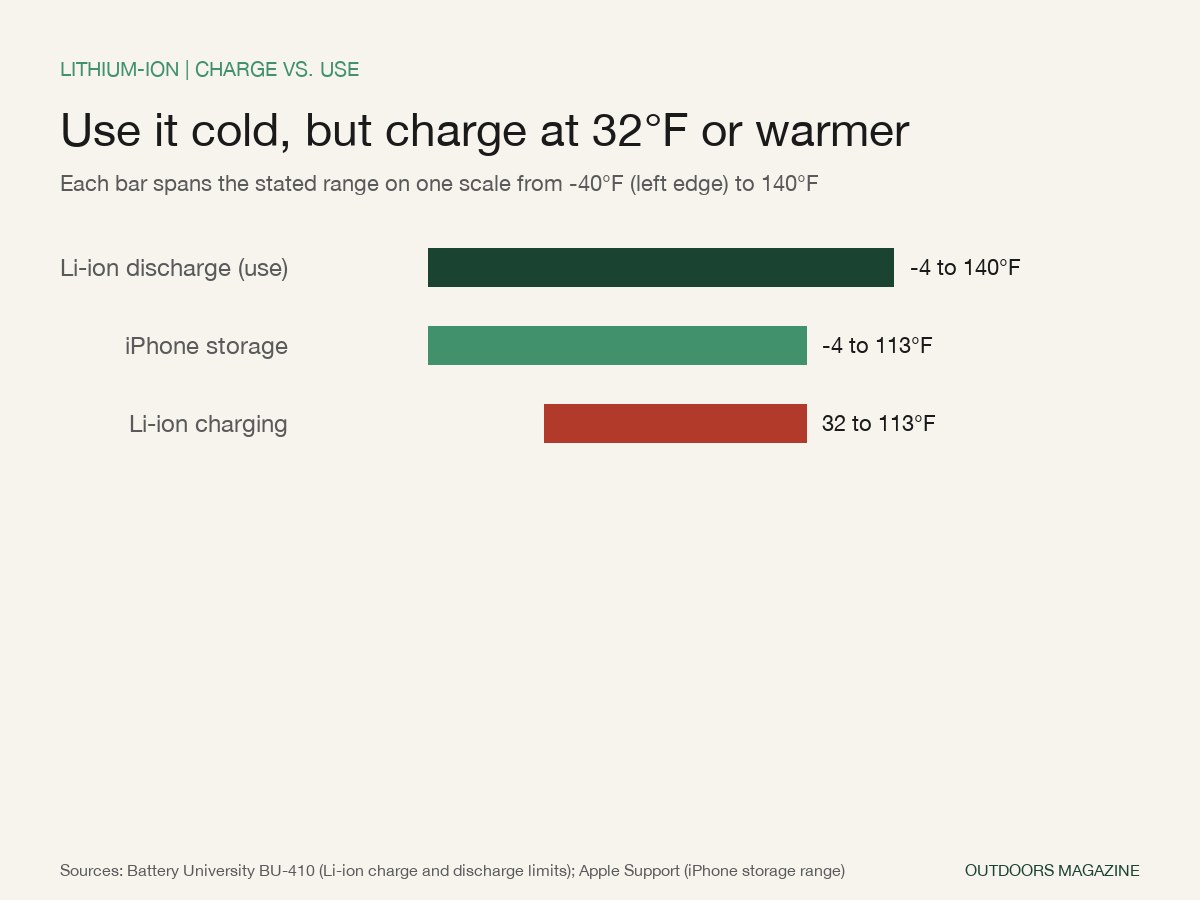
On a winter trip, that turns into a routine. Keep the power bank inside your jacket during the day so it stays warm. When you want to top up the phone, do it inside your sleeping bag or a warm pocket after both devices have had time to warm up, rather than plugging a cold phone into a cold power bank on the tent floor. The same goes for a headlamp or GPS with a built-in rechargeable battery.
Lithium-ion can be used below freezing even though it shouldn’t be charged there. Battery University lists the discharge range as -20°C to 60°C (-4°F to 140°F). Garmin says its inReach handhelds have rechargeable internal lithium batteries built for cold use, but it still recommends carrying the device inside your jacket, close to your body, because all electronics have reduced battery performance in the cold. Its winter tips also suggest considering a backup lithium battery pack.
How do you keep batteries warm on a winter trip?
Use your own body heat. It’s free, it’s always with you, and every maker in this guide points to it in one form or another.
By day, carry them inside your layers. Garmin’s winter inReach tips say to carry the device inside your jacket and close to your body. An inside chest pocket works well for a phone, a small power bank and a few spare AA cells. Pockets on the outside of a shell or on a hip belt sit right in the wind and stay much colder.
At night, take them into your sleeping bag. Backpacker suggests stowing electronics, batteries and anything else you don’t want to freeze in the foot of your sleeping bag, and choosing a bag with a little extra length for the purpose. A small stuff sack keeps the pile from wandering, and a phone in a zippered pocket near your chest is easier to find at 3 a.m. The same trick protects other cold-sensitive gear; our guides to keeping a backpacking water filter from freezing and using a canister stove in cold weather cover what else belongs in the bag with you.
Bring the right spares, and keep them warm too. Spare AA cells left in a pack lid all night are cold when you need them. Keep them in the same warm pocket as the device and swap a cold set for a warm set rather than carrying one set of cells until it quits.
Start full and cut the drain. Charge everything at home and start with fresh cells. In the field, the lithium handbook and the alkaline handbook both point out that heavy drain makes cold worse, so the low and medium settings on a headlamp, a dimmer phone screen and airplane mode where you don’t need a signal all stretch a cold battery further. Garmin suggests its Extended Tracking or Expedition modes on inReach devices for the same reason.
Avoid shortcuts with heat. Batteries should be warmed by body heat, not by a stove, fire or hot rock. Apple and Samsung both warn about high temperatures, Apple says very hot conditions can permanently shorten battery life, and Energizer’s alkaline handbook notes that repeated swings between extreme temperatures can over time weaken a battery’s seal and raise the chance of leakage.
Do cold batteries come back when they warm up?
Usually, yes. Because the energy is still inside a cold cell, warming it up makes much of that energy available again. Energizer’s alkaline handbook gives the example of a flashlight left in a car on a very cold night: it won’t be as bright or last as long when used, but if it is taken indoors and allowed to warm up for several hours, its performance returns to normal. Apple says the same about iPhone battery life once the device is back at warmer temperatures.
On the trail, that means a headlamp or GPS that dies in the cold may not be finished. Swap in your warm spares, then put the cold cells in an inside pocket or your sleeping bag. Once they warm up they may run a low-drain device again for a while. Mark or bag them separately so you don’t confuse them with fresh cells, and don’t count on rewarmed batteries for anything critical.
A rewarmed cell is not a recharged cell. Once a battery has actually been used up, warming it does nothing. Rewarming only recovers the energy the cold was holding back.
Headlamps, GPS units and a simple winter battery plan
Most battery trouble on winter trips comes from a few devices: the headlamp, the phone, a GPS or satellite messenger, and sometimes a camera. Long nights mean more headlamp hours, and cold makes every one of those devices less efficient, so it is worth checking which batteries each one takes before you leave.
Headlamps. If yours runs on AA or AAA cells, lithium primary cells are the cold-weather choice, as long as the manual allows them. Petzl says most of its lamps that use non-rechargeable batteries are compatible with lithium. If your lamp has a built-in rechargeable battery, keep it close to your body when you are not using it and charge it only when it is warm. Our guide to red versus white headlamp light explains why a dimmer red mode around camp can also save battery.
GPS units. Garmin’s eTrex manual recommends lithium AA cells below freezing and adds a warning worth remembering for any device: the device’s temperature rating may exceed the usable range of some batteries. A GPS rated for cold weather is only as good as the cells inside it. Carry a warm spare set.
Phones and power banks. Plan for the 32°F to 95°F use range Apple and Samsung publish, which means keeping the phone inside your layers, taking it out briefly for photos and navigation, and charging only when both the phone and the power bank are warm. A dedicated GPS on lithium AAs, or a paper map, keeps navigation from depending on one cold phone.
A short packing checklist covers most of this:
- Fresh lithium AA or AAA cells in every device that accepts them, plus a warm spare set for each.
- A fully charged power bank, carried inside your jacket.
- A small stuff sack for electronics and spare cells in the foot of your sleeping bag at night.
- Lower brightness settings, airplane mode and battery-saver modes when you do not need full power.
- A plan B for navigation and light that does not depend on a single battery.
None of this replaces your device manuals. Battery and temperature ratings vary by model, and the maker’s instructions for your headlamp, phone, GPS or power bank outrank any general guide, including this one.
Sources: Energizer L91 datasheet, Energizer L91 datasheet (EBC-8915AP), Energizer E91 datasheet, Energizer Lithium Iron Disulfide Handbook, Energizer Alkaline Handbook, Energizer Ultimate Lithium technical specifications, Energizer Ultimate Lithium product page, Apple Support: If your iPhone or iPad gets too hot or too cold, Samsung: Galaxy battery care and maintenance, Battery University BU-410, Garmin eTrex 22x/32x manual: Battery Information, Garmin: 10 tips for using inReach devices in the winter, Petzl: Non-rechargeable energy sources, Backpacker: cold-weather camping sleep tips; Amazon B01C4PP8FK.
Frequently asked questions
Why do batteries die faster in cold weather?
Cold slows the chemical reactions that produce a battery’s power and raises its internal resistance, so it delivers less and can shut off early, especially in high-drain devices. Energizer says the energy is not actually lost to cold; it just becomes harder to access until the battery warms up.
Are lithium AA batteries better than alkaline in the cold?
Yes. Energizer rates its L91 lithium AA from -40°F to 140°F, compared with 0°F to 130°F for its E91 alkaline AA. Garmin tells eTrex owners to use lithium batteries below freezing, and Petzl says lithium cells outperform alkaline at extreme temperatures.
How cold is too cold for a phone?
Apple and Samsung both rate their phones for use between 32°F and 95°F (0°C to 35°C). Below that range a phone may lose battery life quickly or shut down, though Apple says battery life returns to normal once the phone warms up.
Can you charge a phone or power bank below freezing?
No. Battery University says lithium-ion should not be charged below freezing, because it can plate lithium onto the anode and permanently reduce performance and safety. Warm the phone and power bank to a moderate temperature, for example in your sleeping bag, before charging.
How do you keep batteries warm on a winter trip?
Carry phones, power banks and spare cells in an inside jacket pocket close to your body during the day, as Garmin recommends, and keep them in the foot of your sleeping bag at night. Use body heat, never a stove or fire, to warm batteries.
Do cold batteries come back when they warm up?
Usually. Energizer says a cold flashlight that is brought indoors and allowed to warm for several hours returns to normal performance, because the energy was never lost. Warming cannot restore a battery that was already used up.