
Red Light Headlamp vs. White: When to Use Each
Written by Outdoors Magazine|
Outdoors Magazine is a participant in the Amazon Services LLC Associates Program. We may earn a commission if you buy through links on this page, at no extra cost to you. Affiliate disclosure.
Use a red light headlamp when you want to keep your night vision: sitting around camp, stargazing, or doing close chores at a low setting. Switch to white whenever you need to see the trail, pick out hazards, read map colors or check an injury, because red light shows less detail and distorts color.
Key takeaways
- Dim red light preserves night vision because rods respond poorly to deep red.
- Full dark adaptation takes about 30 minutes; a bright white light undoes it in seconds.
- Use white for walking, hazards, map colors and first aid; red distorts color.
- Learn your lamp’s red sequence and lockout before dark, and check burn times.
Use a red light headlamp when you want to keep your night vision: sitting around camp, stargazing, or doing close chores at a low setting. Switch to white whenever you need to see the trail, pick out hazards, read map colors or check an injury, because red light shows less detail and distorts color.
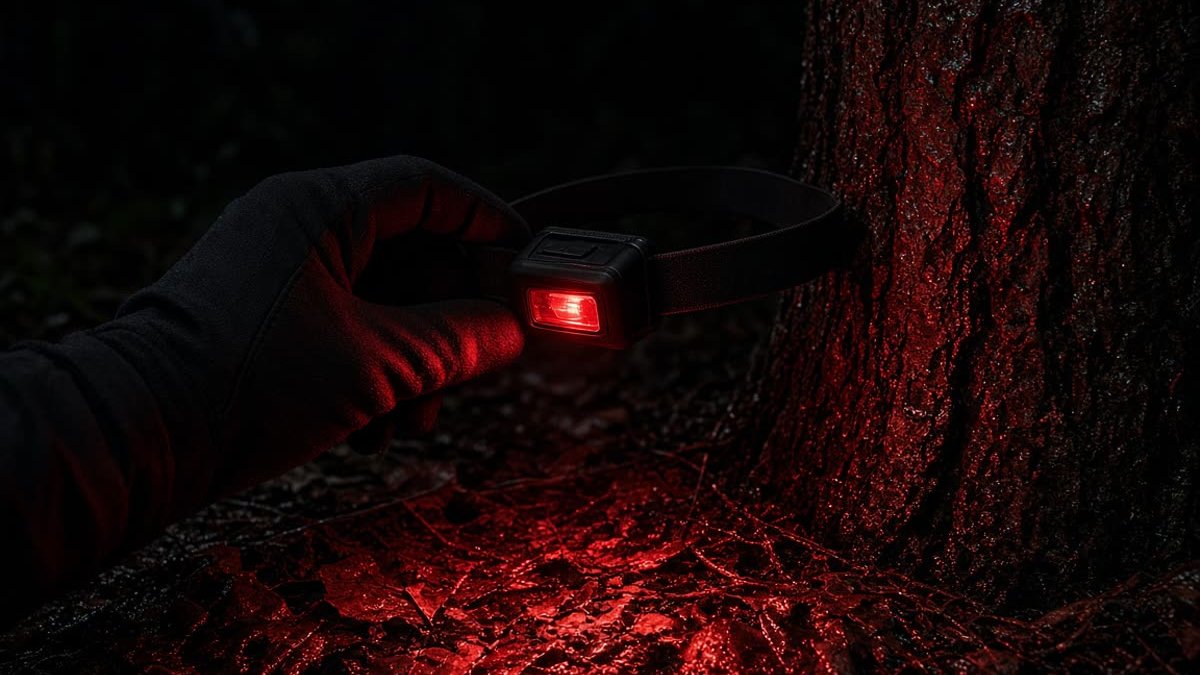
Red light keeps your eyes adjusted to the dark. AI-generated editorial image of a gloved hand holding a headlamp glowing red against a tree trunk at night, with red light spilling onto leaf litter.
Late November puts most of the evening on the wrong side of sunset. Dinner, dishes, the walk to the outhouse and the last look at the sky all happen in the dark, and nearly every headlamp sold now has a red button or a red mode hidden somewhere in its click sequence. Plenty of people never use it. Others leave it on all night and then wonder why the trail looks flat and the map looks wrong.
Red and white light are tools for different jobs. Red protects the night vision your eyes spend the better part of half an hour building, and it is kinder to the people around you. White shows you the world as it is: color, contrast, depth and the rock or root that is about to trip you. This guide explains what is going on in your eyes, when each color earns its place, and how to set up a headlamp so you can reach the right one without fumbling. The vision science comes from the University of Pittsburgh's Webvision text, the National Park Service and the FAA's Aeronautical Information Manual; the lamp details come from Petzl and from published specs for a Black Diamond model.
Why does a red light headlamp help you keep your night vision?
Rods, the cells that do most of the seeing in the dark, are far more sensitive than cones to blue-green light but lose that advantage at deep-red wavelengths. A dim red light lets you see close tasks without wiping out the dark adaptation your rods have built up, which a white beam can undo in seconds.
Your retina has two kinds of light-sensing cells. Cones handle daylight, sharp detail and color. Rods take over in dim light; the National Park Service's Valles Caldera page describes them as helping us at night while capturing shades of gray. When you step away from a fire or a lantern, your rods slowly become more sensitive as their light-sensitive pigment, rhodopsin, regenerates. Webvision notes that the time course of dark adaptation tracks rhodopsin regeneration closely.
Wavelength is where red earns its reputation. In Webvision's chapter on light and dark adaptation, Michael Kalloniatis and Charles Luu explain that dark-adapted rods are much more sensitive than cones to short-wavelength light, while rods and cones have similar sensitivities to long wavelengths such as extreme red. The National Park Service puts the practical version more bluntly: rods cannot detect red light, so red lets you see while preserving your night vision. Either way, a dim red light mostly talks to your cones and leaves your rods alone.
The word that matters is dim. Red is not magic; a bright red beam still floods your cones and makes the dark around it look darker by comparison. The FAA's guidance for pilots, who have dealt with this problem for decades, talks specifically about dim red lighting. Treat red mode as the low, close-range light it was designed to be, not as a red spotlight.
There is a social side too. The Park Service says white light from flashlights, phones and vehicle headlights can harm night vision, and that red light is better for stargazing because it won't affect your night vision, or anyone else's, as much. Petzl describes the red mode on its Tikka the same way: continuous red to preserve night vision without blinding the people around you. At a crowded campsite or a group stargazing spot, that courtesy matters as much as your own eyes.
How long does it take your eyes to adjust to the dark?
The National Park Service says it takes 20 to 30 minutes for your eyes to reach their best low-light vision, and the FAA says complete dark adaptation needs at least 30 minutes of total darkness. Vision science texts show sensitivity still creeping up to about 40 minutes.
Different sources give slightly different numbers because they are measuring different things. Webvision describes the classic dark adaptation curve: sensitivity improves quickly for the first few minutes as cones adapt, the rod system takes over after roughly 5 to 10 minutes, and the curve flattens at its lowest threshold after about forty minutes in the dark. The National Park Service's stargazing guidance gives 20 to 30 minutes for the eye to make the most of very low light. The FAA's Aeronautical Information Manual says at least 30 minutes of total darkness is needed for complete dark adaptation, and that a moderate degree can be reached in about 20 minutes under dim red cockpit lighting.
The part that catches people out is how fast it disappears. The FAA says any degree of dark adaptation is lost within a few seconds of viewing a bright light. A single glance at a white headlamp, a car's headlights or a phone screen at full brightness can send you back toward the start. The Park Service suggests keeping phones off while stargazing for exactly this reason.
Two habits help. First, switch to red, or turn your light off, a good while before you need full night vision, not when you sit down. Second, borrow the pilot's trick: the FAA suggests closing one eye when using a light so that eye keeps some of its dark adaptation. If someone swings a white beam across the group, shutting one eye saves half the work.
When should you use white light instead of red?
Use white whenever seeing accurately matters more than keeping your night vision: walking or scrambling on uneven ground, scanning for hazards, route finding, reading a map with colored symbols, and first aid. White light shows color, contrast and texture that red light flattens out.
Moving over rough ground. A red mode is typically a small, low-output LED. Petzl's spec table for the current Tikka gives its red continuous mode a beam distance of 5 meters, against 45 meters for the standard white setting and 70 meters for the brightest one. That's enough to find a tent zipper and nowhere near enough to read a rocky descent, a stream crossing or a junction sign. If you are walking anywhere other than a flat, familiar path, use white.
Spotting hazards. Rods see in shades of gray, and red light gives your cones only one narrow band of color to work with. Depth and texture suffer. Ice on a rock, a wet root, a drop at the edge of a switchback and the difference between a puddle and a hole are all easier to judge under white light. When the question is "what is that?" or "is that safe to step on?", the answer comes faster in white.
First aid. Assessing an injury depends on color: the color of skin, the spread of bleeding, whether a cut is clean. The FAA's warning that red light severely distorts colors applies here as much as it does to a chart. Switch to white, and the brightest setting you need, before you start treating anyone.
Finding things. Searching for a dropped key, a stake in leaf litter or a dark stuff sack in a pack is far easier with white light. Red tends to make everything look like the same dark red-gray.
Signalling. If you need to be seen, a bright white beam or the lamp's strobe does far more than a red glow. Petzl notes that its red strobe is meant for signalling your location, especially in an emergency, and rates it as visible at 700 meters; for actually lighting a path, it's still white.
A useful rule: red for sitting, white for moving. If you are going to stand up and walk somewhere, decide first whether the ground is simple enough for red. Most of the time on a trail, it isn't.
Can you read a map with a red headlamp?
You can read black print and contour lines under dim red light, but colors suffer. The FAA warns that red light severely distorts colors, especially on charts, and says white light must be available for map reading. Expect red and some other colored symbols to fade or blend in.
Pilots learned this the hard way. The FAA's Aeronautical Information Manual says that because red light severely distorts colors, especially on aeronautical charts, and makes it hard to focus on things inside the aircraft, it should be used only where the best outside night vision is necessary, and that white lighting must be available when needed for map and instrument reading. Hiking maps have the same problem. They lean on color to tell you what is a trail, what is a road, what is water, what is a boundary and what is a highway route.
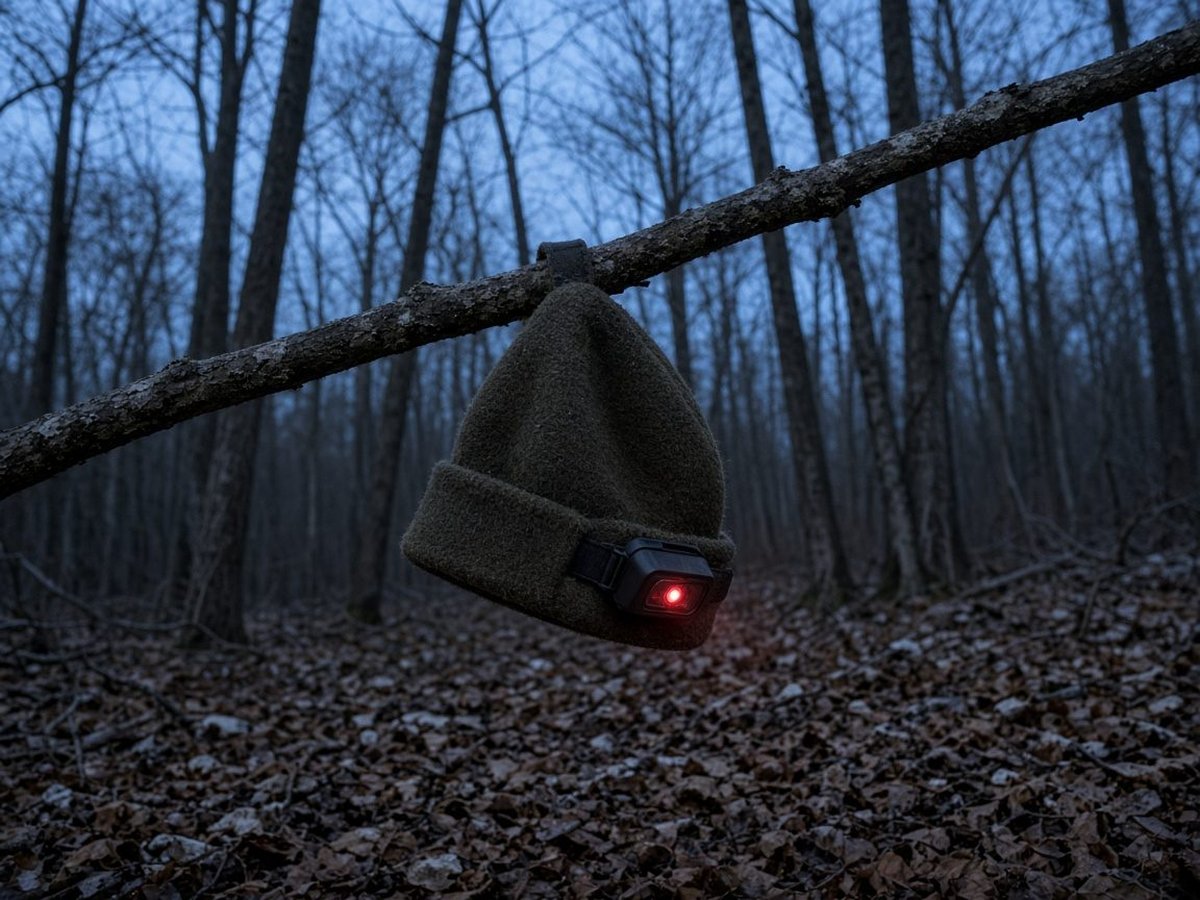
Under a red headlamp, anything printed in red tends to vanish into the paper, because both reflect the same light back to your eye. Other colors don't disappear completely, but they lose the differences you rely on, so a trail line and a boundary line can look alike. Black contour lines and text usually stay readable, which is why red is fine for a quick check of a route you already know.
For real navigation decisions, such as which fork to take, where the water is, or whether you are inside a closure area, turn on white at a low setting, cup the light with your hand, read what you need and switch back. If you are in a group trying to keep their night vision, step away and turn your back before you switch. The same logic applies to a phone map: dim the screen, use a night or red filter if your phone offers one, and accept that color-coded layers will be harder to read.
How bright should a red headlamp be?
Dim. The point of red is to avoid disturbing your dark adaptation, so use the lowest level that lets you see your task. Petzl rates the red mode on its current Tikka at 2 lumens, compared with 350 lumens for the same lamp's brightest white setting.
Most dedicated red modes are deliberately weak. Petzl's specification table for the current Tikka, measured to the ANSI/PLATO FL 1 standard, rates its red continuous mode at 2 lumens with a 5-meter reach. The same lamp's white modes run 7, 100 and 350 lumens on AAA batteries. That gap is the design: red is for close, quiet tasks.
If your lamp lets you dim the red, start low and raise it only until you can do the job. Reading a star chart, finding the stove valve or checking a food bag doesn't need much. A brighter red helps if you have to walk a short, easy stretch to the latrine, but it also costs you more of your own dark adaptation and lights up the people around you.
White light has the same rule in reverse. You don't need full power for most camp jobs, and high output at close range bounces off tent walls, snow and pale rock straight back into your eyes. Use the lowest white that shows the task clearly, and save maximum output for route finding and searching. For stargazers and night photographers, our guide to photographing the night sky with a phone covers how to keep screens and lights from spoiling a dark site.
Does red light save headlamp battery?
Not automatically. A low red mode runs a long time, but so does a low white mode. On Petzl's current Tikka with AAA batteries, red continuous is rated for 60 hours while the lowest white setting is rated for 110 hours, so check your own lamp's burn-time table.
It is easy to assume that red is the battery-saving mode. Petzl's own burn-time table for the current Tikka shows why that's not always true. On three AAA batteries, red continuous is rated for 60 hours, while the white MAX BURN TIME setting is rated for 110 hours, the standard 100-lumen setting for 12 hours and the 350-lumen setting for 2 hours. On the same table, the red strobe is rated for 400 hours.
So the real battery lesson is about output, not color. Low settings of either color last a long time; high white burns through cells quickly. Black Diamond's published burn times for the rechargeable Storm 500-R, as listed by retailer NRS, follow the same pattern: 7 hours on high, 19 hours on medium and 350 hours on low.
Cold makes every battery look weaker, and long November nights mean more hours on the lamp. Check your own lamp's table, start a trip with full or fresh batteries, and carry a backup. Our post on carrying two lights once the evenings get short makes the case for a second light.
Setting up your headlamp before it gets dark
The most common red-light failure is not knowing how to reach it. On some lamps, reaching red means clicking through one or more white modes first, which means a flash of white every time you want to protect your eyes. Learn your lamp's sequence at home, in a dark room, until you can get to red without looking. Some lamps put red on its own button or a long press; Petzl's Tikka uses a single button to select brightness or light color, so practice matters.
Next, learn the lockout. Petzl says the Tikka's LOCK function prevents the lamp from turning on during transit or storage, and Black Diamond lists a lock mode on its Storm 500-R. A lamp that switches itself on in a pack drains its battery and leaves you with a dead light at dusk. Lock it whenever it goes into a pack or pocket, and unlock it by feel before you need it.
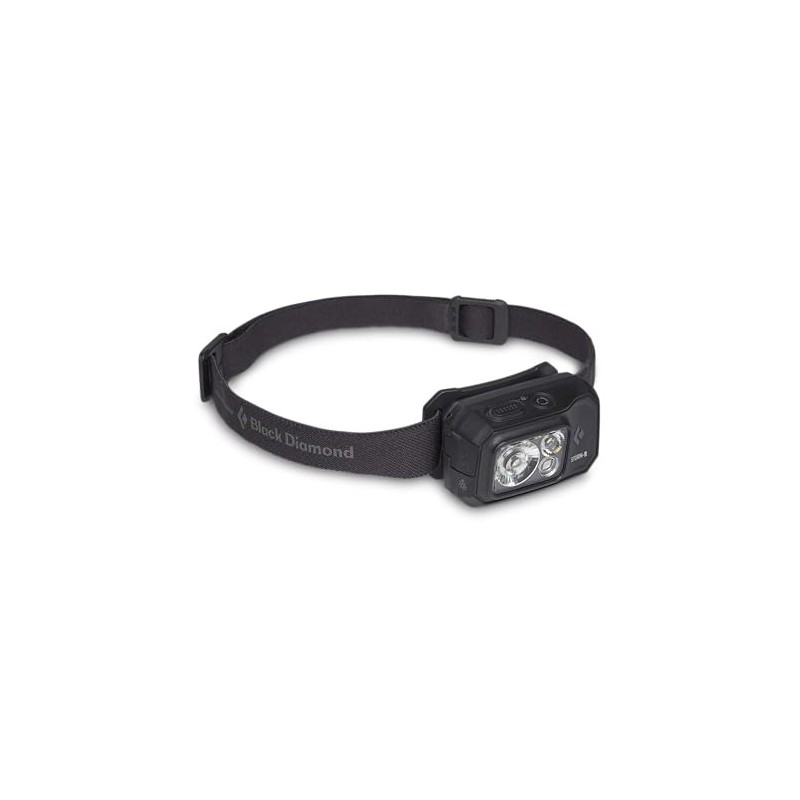
Features worth looking for if you are shopping: a red mode that is easy to reach, a lockout, a battery level indicator, and brightness memory so the lamp doesn't come on at full power. Black Diamond's Storm 500-R is one example that covers all of those. Retailer NRS lists it with a 500-lumen maximum, red, green and blue night-vision modes, dimming, strobe, lock mode, Brightness Memory that lets you turn it on and off at a chosen brightness, an integrated battery meter, a 2,400 mAh rechargeable lithium-ion battery and IP67 waterproof testing. A review in Advnture describes using the smaller button to cycle modes and holding it to change the night-vision color, with the lock engaged by holding both buttons.
If you hunt, the choice between red and white lights, and when you may carry or use a light at all, can be affected by state rules that vary from place to place; check your state wildlife agency's regulations. Our guides to the best headlamps for hunting and tactical headlamps cover more lamps with red modes and lockouts.
Once the lamp is set up, the routine is simple. Red at camp and under the stars, kept dim and pointed at your hands rather than other people's faces. White, at the lowest useful setting, for walking, hazards, maps and first aid. And when you do switch, close one eye.
Sources: Webvision (University of Pittsburgh): Light and Dark Adaptation, Kalloniatis and Luu, National Park Service: I Didn't Know That! Stargazing 101, National Park Service: Night Sky, Valles Caldera National Preserve, FAA Aeronautical Information Manual, Chapter 8, Section 1: Fitness for Flight, Petzl: TIKKA headlamp specifications, NRS: Black Diamond Storm 500-R Headlamp specs, and Advnture: Black Diamond Storm 500R headlamp review; Amazon B09NQKZ4BP.
Frequently asked questions
Why does a red light headlamp help you keep your night vision?
Rods, the cells that do most of the seeing in the dark, are far more sensitive than cones to blue-green light but lose that advantage at deep-red wavelengths. A dim red light lets you see close tasks without wiping out the dark adaptation your rods have built up, which a white beam can undo in seconds.
How long does it take your eyes to adjust to the dark?
The National Park Service says it takes 20 to 30 minutes for your eyes to reach their best low-light vision, and the FAA says complete dark adaptation needs at least 30 minutes of total darkness. Vision science texts show sensitivity still creeping up to about 40 minutes.
When should you use white light instead of red?
Use white whenever seeing accurately matters more than keeping your night vision: walking or scrambling on uneven ground, scanning for hazards, route finding, reading a map with colored symbols, and first aid. White light shows color, contrast and texture that red light flattens out.
Can you read a map with a red headlamp?
You can read black print and contour lines under dim red light, but colors suffer. The FAA warns that red light severely distorts colors, especially on charts, and says white light must be available for map reading. Expect red and some other colored symbols to fade or blend in.
How bright should a red headlamp be?
Dim. The point of red is to avoid disturbing your dark adaptation, so use the lowest level that lets you see your task. Petzl rates the red mode on its current Tikka at 2 lumens, compared with 350 lumens for the same lamp's brightest white setting.
Does red light save headlamp battery?
Not automatically. A low red mode runs a long time, but so does a low white mode. On Petzl's current Tikka with AAA batteries, red continuous is rated for 60 hours while the lowest white setting is rated for 110 hours, so check your own lamp's burn-time table.