
How to Winterize an Outboard Motor, Step by Step
Written by Outdoors Magazine|
Outdoors Magazine is a participant in the Amazon Services LLC Associates Program. We may earn a commission if you buy through links on this page, at no extra cost to you. Affiliate disclosure.
To winterize an outboard motor, stabilize fresh fuel and run it through the engine, or drain the fuel system if your maker says to. Then flush the cooling system, fog the engine, change the gear oil and check it for water, grease the fittings, check the prop, care for the battery, and store the motor upright under a breathable cover.
Key takeaways
- Stabilize fresh fuel and run it through, or drain it if your maker says to.
- Never put E15 in a boat; the EPA says it cannot be used in boats.
- Milky gear lube means water got in; the gearcase needs resealing.
- Store the motor upright so water drains, and follow your owner's manual.
Here's how to winterize an outboard motor: stabilize fresh fuel and run it through the engine, or drain the fuel system if your maker says to, then flush, fog, change the gear oil and look for water in it, grease the fittings, check the propeller, take care of the battery, and store the motor upright under a breathable cover.
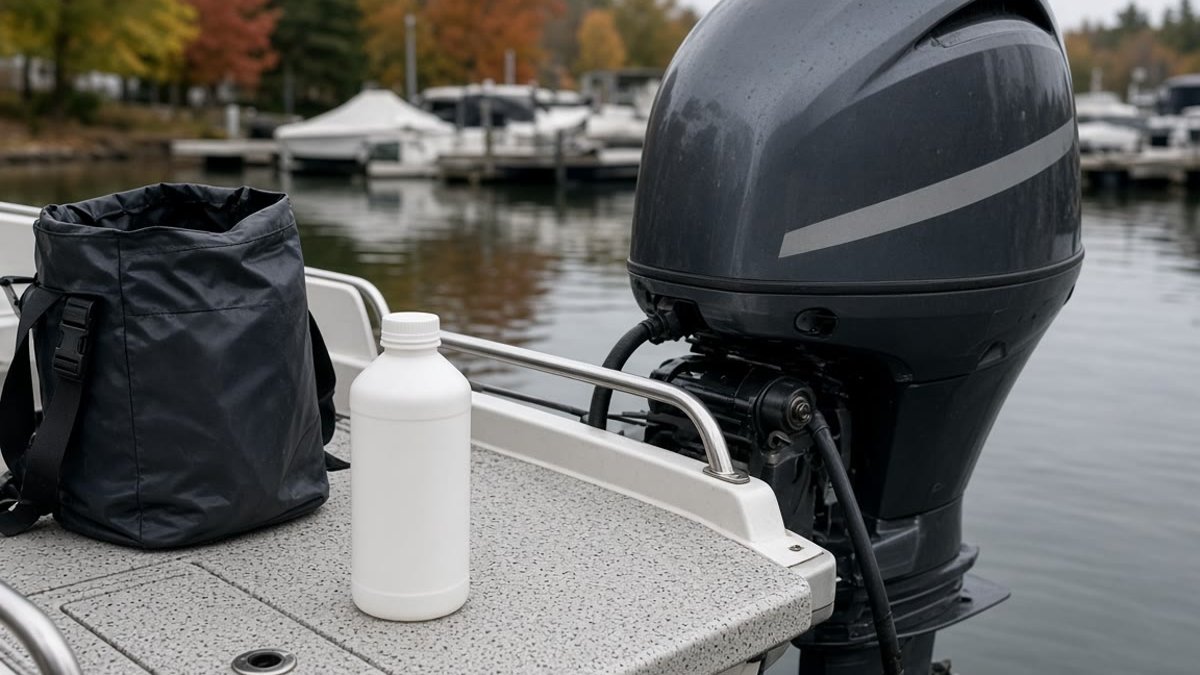
Tilted up is fine for the trip to the yard, but for the winter the motor goes back down. AI-generated editorial image of a gray outboard motor tilted up on the transom of a small white boat tied at an autumn marina, with a white plastic bottle and a black dry bag on the deck and fall-colored trees and moored boats behind.
Cold itself is not what ruins outboards over the winter. Water and time are. Water left in the cooling passages or the gearcase can freeze and crack the metal around it, water in the gear lube rusts bearings and shafts while the boat sits, and Honda warns that fuel left sitting in a float bowl or partly filled tank can cause starting problems within 30 to 60 days. BoatUS notes the work can be done at home with hand tools, an afternoon and inexpensive supplies.
This guide covers a small or mid-size outboard, drawing on BoatUS, Discover Boating, Yamaha, Honda and the EPA. One rule sits above everything here: your owner's manual wins. As BoatUS notes, procedures vary between older and newer engines and between two-strokes and four-strokes, and some modern motors have their own special flushing and winterizing instructions. Evinrude E-TEC outboards, for example, have a self-winterizing mode built into their electronics. BoatUS also warns that if your engine is under warranty and you skip the manufacturer's winterizing steps, you could void that coverage.
When should you winterize an outboard motor?
Winterize before the first freeze if the boat will sit unused for the season. If you live somewhere mild and can run the motor every few weeks until it reaches normal operating temperature, Discover Boating says the extra winterizing steps usually aren't needed.
The deadline is set by the weather and by how long the boat will sit. BoatUS says to prepare the outboard well before cold weather arrives, especially anywhere freezing could occur. Discover Boating adds that it is long periods of inaction, not low temperatures, that cause trouble for outboards.
For everyone else, pick a dry day right after the last trip of the season. If the boat is coming out of the water for the year, our guide to pulling the boat before the first hard frost covers the trailer and haul-out side of the job.
What supplies do you need to winterize an outboard?
You need a marine fuel stabilizer, fresh fuel, fogging oil or your maker's storage product, the correct gear lube and new drain-screw gaskets, marine grease, and a flushing attachment or hose fitting. A four-stroke also needs engine oil and a filter, and most motors need a new fuel filter.
Start with the manual's list of lubricants, additives and filters. Yamaha suggests gathering them before you begin. A typical shopping list looks like this:
- Fuel: a marine fuel stabilizer and, for many procedures, a portable tank of fresh gasoline.
- Cooling system: flush muffs or your engine's hose adapter, plus a garden hose.
- Storage lubricant: fogging oil, or the storage product your maker specifies for mixing into fuel.
- Lower unit: the specified gear lube, new drain and vent screw gaskets, and a drain pan.
- Engine oil (four-strokes): the specified oil and a new oil filter.
- Filters: a replacement fuel filter or fuel/water separator.
- Grease and protection: marine grease, a grease gun, wax and a cover made for outboards.
BoatUS says to check your manual or ask a dealer to make sure you are using the correct gear lube, because using the wrong one could void your warranty.
How do you treat or drain the fuel before storage?
Most makers have you add a marine fuel stabilizer to fresh fuel and run the engine so treated fuel reaches the whole system, then change the fuel filter. Honda says to completely drain the fuel system and tank for storage longer than 60 days, so follow your own maker's rule.
BoatUS sums up the choice: the fuel supply must either be treated for storage or drained completely. Which one you do depends on the engine and on the maker's instructions, and they do not all agree.
Treat and run. Yamaha tells owners to top off the tank and treat it with fuel stabilizer before starting the rest of the winterizing work. Honda Marine Canada says fuel left in a float bowl or a partly filled tank can cause starting problems after as little as 30 to 60 days, and that storage beyond 30 days needs extra steps such as a fuel conditioner. Honda also says to fill the tank before adding stabilizer, because air in the tank promotes fuel deterioration, to follow the stabilizer maker's instructions, and to run the engine for 10 minutes before storing it.
Drain. Honda's guidance goes further for long layups: for storage of more than 60 days, it says to completely drain the fuel system and the fuel tank. Carbureted motors may have their own steps for emptying the float bowl, so check the manual. Whatever you drain, collect it in a proper fuel container and dispose of it the way your local rules require.
Mind the ethanol. Discover Boating warns that putting a boat away with ethanol-blended fuel and no stabilizer can be disastrous, because the fuel can undergo phase separation, leaving you with water-saturated fuel in the spring. Stronger blends are a separate issue. The EPA lists nonroad vehicles such as boats among the engines that cannot use E15, a blend of 15 percent ethanol and 85 percent gasoline, and the orange-and-black label the EPA requires on E15 pumps warns against using it in watercraft. When you top off the tank before storage, check the pump label and use only the ethanol content your owner's manual allows.
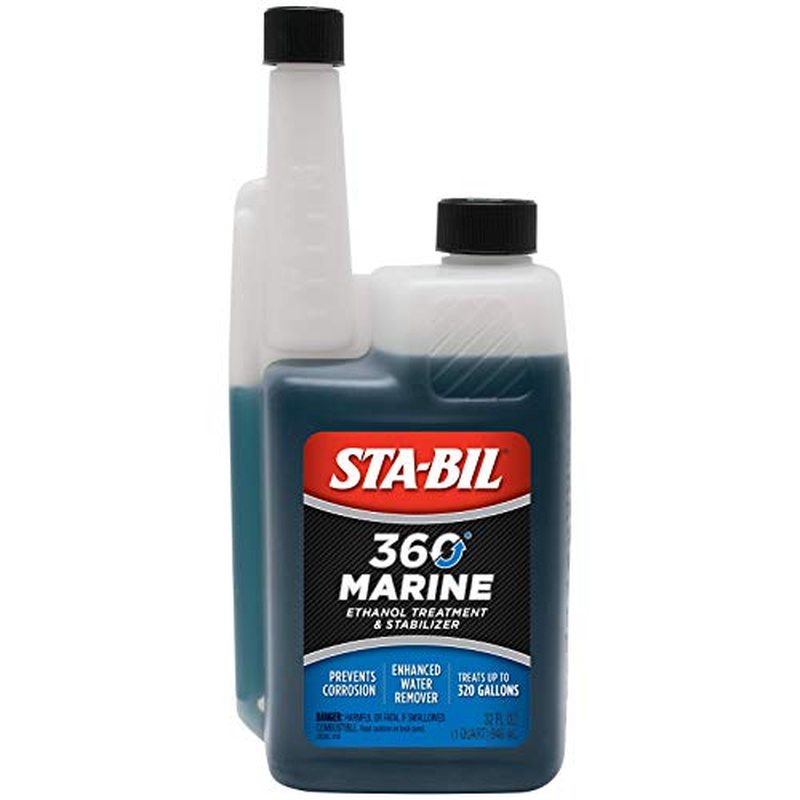
One fuel stabilizer marketed for boats is STA-BIL 360 Marine. Retailer Hamilton Marine's listing for the 32-ounce bottle says 1 ounce treats up to 10 gallons of fuel, that it keeps fuel fresh for up to 12 months, and that it is meant to defend against the harmful effects of ethanol-blended fuel. Use the dose on the bottle, and if your engine maker sells or specifies its own stabilizer, follow the manual.
Change the filter. Discover Boating says to change the engine's fuel filters and any fuel/water separators before storage, and to replace the canister rather than draining and reusing it. Pouring water out of an old one can push water and debris to the wrong side of the filter. BoatUS adds that if your engine doesn't have a water-separating fuel filter, now is a good time to install one.
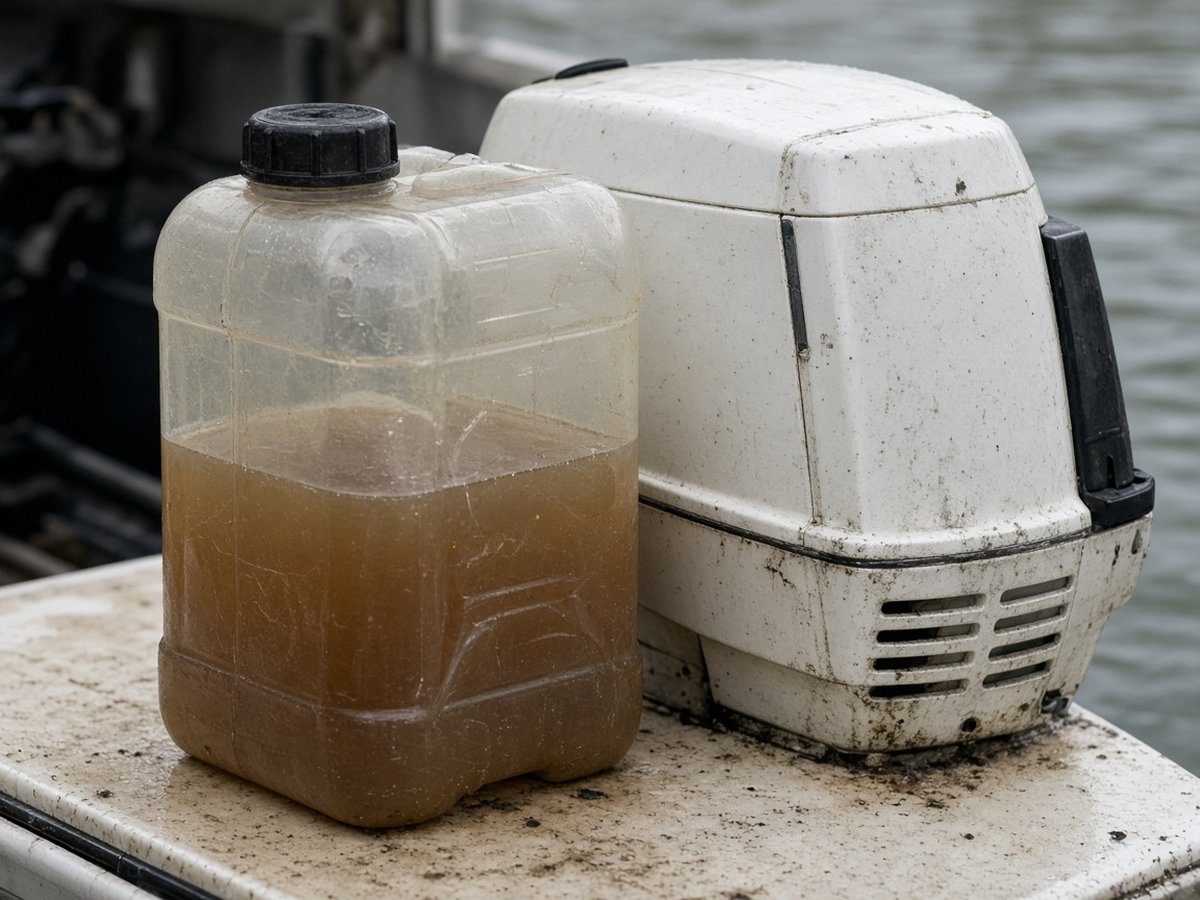
Stabilizer is sold to keep fresh fuel fresh, and Honda's advice is to keep only fresh gasoline, even in a spare can. If the gas in the tank already looks dark, smells sour or shows a separate layer at the bottom, plan to drain it rather than treat it, and ask a shop if you aren't sure. Our guide to how old fuel can damage your boat explains what stale and phase-separated fuel does inside an engine.
Should you flush and fog an outboard for winter?
Yes, in most cases. Flush the cooling system with fresh water the way your manual describes, then coat the engine's internals with a storage lubricant: fogging oil sprayed into the intake or cylinders on older and carbureted motors, or a maker's storage product or electronic winterize mode on many modern outboards.
Flushing. Flushing rinses salt, silt and debris out of the cooling passages before they sit all winter. Honda's storage tips list flushing and draining the cooling system among the basic steps. BoatUS says to flush according to the manufacturer's instructions and notes that on some newer engines this doesn't involve running the engine at all; a garden hose fitting allows a quick flush with the motor off. On motors that are run during the flush, the water supply goes on first. In Yamaha's four-cylinder procedure, the flushing hose is connected to the lower unit water pickups and the water turned on before the engine is started.
Fogging. Fogging leaves a thin film of lubricant on bearings, seals and other rotating surfaces to help keep rust and corrosion away while the engine sits. BoatUS describes the traditional method: after treating the fuel and running the engine for a few minutes, spray fogging oil into the carburetor or electronic fuel injection air intakes while the engine runs until it smokes, then keep fogging until it stalls. It can also be done with the engine off by removing the spark plugs, spraying oil into the cylinders and turning the flywheel to spread it, which is a good moment to inspect the plugs and replace them if your maintenance schedule calls for it.
Discover Boating notes that fogging oil was historically the method for carbureted outboards and older two-strokes, while most modern outboards are protected an easier way. Some makers offer a storage product that is mixed into a remote fuel can and run through the engine, and some engines handle it electronically through a winterize mode in the control system. Yamaha's four-cylinder procedure is an example of the fuel-can method. With the flushing hose running, the owner connects a portable tank of fresh gas treated with Yamaha's storage fogging oil and fuel stabilizer, runs the engine for 10 minutes at fast idle, revs it briefly until fogging smoke appears at the prop hub, then shuts it down and lets the cooling system drain. Methods differ between brands and even models, so follow the manual here above all.
On four-strokes, BoatUS recommends changing the engine oil and filter at the same time, after running the engine to warm the oil so it flows easily and carries contaminants out with it.
How do you change the lower unit gear oil and check for water?
Remove the drain screw at the bottom of the gearcase and the vent screw above it, let the old lube run into a pan, and look at it. Clean lube is clear; milky, coffee-with-cream lube means water got in. Refill through the bottom hole until lube comes out of the vent, then refit both screws with new gaskets.
BoatUS calls a yearly lower-unit lube change, preferably at season's end, a necessity. Lube breaks down and picks up metal shavings and moisture, and any water left inside over the winter clings to gears, bearings and shafts and causes corrosion. A serious case of water contamination can also crack the gearcase if it freezes.
The basic job, as BoatUS describes it:
- Run the engine for a few minutes on a flusher to warm the lube so it drains well, especially in cold weather.
- Put a pan under the gearcase, remove the lower drain screw and upper vent screw, and let all the old lube drain out.
- Inspect the lube and the drain screw before you refill (see below).
- Pump fresh lube in through the lower drain hole, not from the top. Fill slowly; the gearcase is full when a solid, bubble-free flow comes out of the vent hole. Filling too fast can trap an air bubble that starves the upper driveshaft bearing of lube.
- Refit the vent screw first. That creates a slight vacuum so little lube is lost when you pull the pump tube and refit the drain screw.
- Use new gaskets on both screws, wipe up drips, and recycle the old lube at a recycling facility or a marina that accepts it.
What the old lube tells you. BoatUS says healthy gear lube is typically clear and amber, blue or red, depending on the dye. Water-contaminated lube looks milky with a coffee-with-cream color. Blackish lube with a burnt smell points to a wear problem or an improper gear setup. Many drain screws have a magnet that collects metal shavings, and a small amount of fine material on it is normal. Heavy filings larger than a pencil eraser, together with burnt, blackish lube, point to serious wear inside the gearcase.
The usual culprit is fishing line. Both BoatUS and Yamaha say line wrapped behind the propeller can damage the propeller shaft seals, letting lube out and water in. BoatUS says that if water is present, the gearcase must be resealed. That is a job to book with a shop, but refill with fresh lube in the meantime so the gears aren't sitting in water all winter.
How should you store an outboard motor over winter?
Let all the water drain out, then store the motor in its vertical running position, not tilted up. Grease the fittings and propeller shaft, look over the prop, deal with the battery, wax the cowling, and cover the motor with a secured cover that still lets moisture escape.
Drain it and leave it down. BoatUS says most outboards drain simply by being lowered to the upright running position, which lets water run out of the powerhead through the propeller and exhaust outlets. It then says to store the engine in that running position, because water that gets in through the hub of a tilted motor can freeze and crack the lower unit housing. Discover Boating and Honda give the same advice. BoatUS also suggests sealing the exhaust opening with plastic tape after the motor has drained, to keep water and rodents out.
Grease the fittings. BoatUS says to check the manual for grease points and use a water-resistant marine grease, preferably synthetic. Typical points are at pivots: steering, tilt, trim and the cowl latches. Don't over-grease, BoatUS warns, because the excess hardens over time and clogs things up.
Check the propeller. Pull the prop, check behind the thrust washer for fishing line, and turn the shaft to check for damage. BoatUS says to look over the blades for cracks, especially on stainless steel props, and to get a damaged prop repaired now rather than in spring. Grease the propeller shaft before you reinstall the prop. BoatUS says this is also a good time to replace the anodes.
Take care of the battery. BoatUS says that if the boat is stored out of the water, remove the batteries, store them somewhere cool and dry, clean the terminals and keep them charged over the winter. Yamaha adds that if your boat's onboard charger can stay plugged into shore power during storage, you can leave it connected; otherwise charge the batteries fully and disconnect them. Our guide to storing a boat battery for winter covers charging, maintainers and battery chemistry in detail.
Protect the outside and cover it. Wash and dry the motor. BoatUS recommends a coat of wax on the painted surfaces, and Honda suggests a thin film of oil on surfaces likely to rust. BoatUS says the cover should be fastened tightly enough that it doesn't flap and wear the paint, while Discover Boating stresses enough ventilation that condensation doesn't form underneath. Honda recommends a cover made specifically for outboards.
When should you take your outboard to a dealer?
Hand the motor to a dealer if it is under warranty and you aren't confident following the manual exactly, if the gear lube came out milky or burnt, if you found heavy metal on the drain magnet, or if routine service such as valve or belt adjustment is due. Yamaha recommends having its engines winterized by a certified dealer where possible.
Most of this work is within reach of a careful owner. Yamaha says its winterizing process is designed so owners can do it themselves, and its authorized service centers often offer winterizing as a package. BoatUS draws the line at periodic maintenance such as valve and belt tension adjustments, which it says is beyond most do-it-yourselfers and should be done by a qualified technician.
Some findings during winterization should go straight to a shop. Milky lube means the gearcase needs resealing. Our list of boat maintenance tasks to leave to a professional covers these handoffs in more detail.
Sources: BoatUS: Long Winter's Nap, BoatUS: How To Replace Your Engine's Gearcase Lubricant, Discover Boating: How to Winterize a Boat, Yamaha Outboards: How to Winterize Your Yamaha Four-Cylinder Outboard, Yamaha Outboards: Are You Ready for Winter?, Honda Marine Canada: Storage Tips, U.S. EPA: E15 Fuel Registration, U.S. EPA: 2011 E15 pump label release, Hamilton Marine: STA-BIL 360 Marine 32 oz listing; Amazon B001CAW2DK.
Frequently asked questions
When should you winterize an outboard motor?
Winterize before the first freeze whenever the boat will sit unused for the season, ideally right after the last trip while the motor is easy to warm up. If you live somewhere mild and can run the motor every few weeks until it reaches normal operating temperature, Discover Boating says the extra winterizing steps usually aren't necessary.
What supplies do you need to winterize an outboard?
You need a marine fuel stabilizer, fresh fuel, fogging oil or your maker's storage product, the correct gear lube with new drain-screw gaskets, marine grease, and a flushing attachment. Four-strokes also need engine oil and a filter, and most motors need a new fuel filter. Check the owner's manual for the exact products.
How do you treat or drain the fuel before storage?
Most makers have you add a marine fuel stabilizer to fresh fuel and run the engine so treated fuel reaches the whole system, then replace the fuel filter or fuel/water separator. Honda says to completely drain the fuel system and tank for storage longer than 60 days, so follow your own maker's instructions. Never use E15, which the EPA says cannot be used in boats.
Should you flush and fog an outboard for winter?
In most cases, yes. Flush the cooling system with fresh water as the manual describes, then protect the internals with fogging oil on older and carbureted motors, or with the maker's fuel-mixed storage product or electronic winterize mode on many modern outboards. Methods vary by brand and model, so follow the owner's manual.
How do you change the lower unit gear oil and check for water?
Remove the lower drain screw and upper vent screw, drain the old lube into a pan and inspect it: milky, coffee-with-cream lube means water has entered the gearcase. Pump fresh lube in through the bottom hole until it flows from the vent without bubbles, then refit the vent screw first and the drain screw second, using new gaskets.
How should you store an outboard motor over winter?
Let the water drain out and store the motor in its vertical running position, not tilted up, so water can't collect in the lower unit and freeze. Grease the fittings and propeller shaft, check the prop, take care of the battery, wax the cowling, and use a secured cover that still allows ventilation.