
Uniden UM385BK vs Standard Horizon GX1400
Written by John Wren|
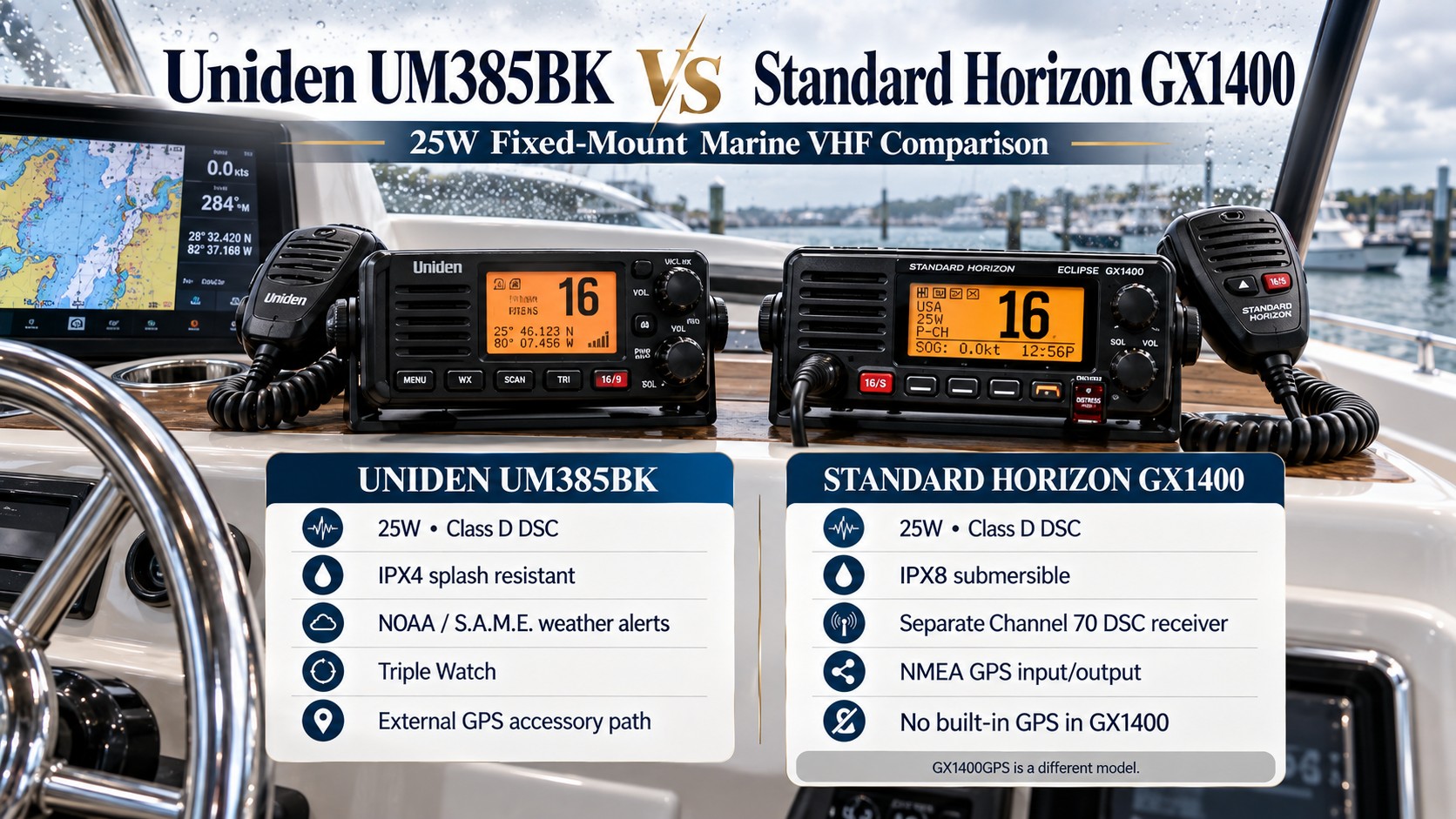
UM385BK if you want IPX4, NOAA/S.A.M.E., Triple Watch, and external GPS via a path such as MRN-GPSK. GX1400 if you want IPX8 1.5m/30min language, a separate CH70 DSC receiver, and NMEA GPS in/out on ASIN B07MQBXXF1.
Key takeaways
- UM385BK on B076DHZQ42 prints 25 watts, Class D DSC, IPX4, NOAA with S.A.M.E., and Triple Watch.
- GX1400 on B07MQBXXF1 prints Class D DSC, IPX8 submersible rating, and NMEA GPS in/out. GX1400GPS is a different SKU.
- External GPS is not the same as a built-in GPS receiver. Do not paste GX1400GPS claims onto B07MQBXXF1.
- No manufacturer promo clip is embedded on this page.
Buy the Uniden UM385BK, ASIN B076DHZQ42, when you want the fixed-mount VHF whose card language for this radio prints 25 watts, Class D DSC, IPX4, NOAA weather with S.A.M.E. alerts, Triple Watch, and external GPS through an accessory path such as MRN-GPSK, in a chassis near 6.25 by 2.5 by 5.08 inches. Buy the Standard Horizon Eclipse GX1400, ASIN B07MQBXXF1, when you want the fixed-mount VHF whose card language prints 25 watts, Class D DSC, IPX8 with a 1.5 meter for 30 minute submersion claim, a separate Channel 70 DSC receiver, and NMEA GPS in and out. GX1400GPS is a different SKU with built-in GPS. Do not paste built-in GPS onto ASIN B07MQBXXF1 unless the card you opened actually says that. A product image that shows latitude and longitude can be a radio with GPS connected, not proof the SKU has a receiver inside.
Short version. A Shakespeare 5225-XT and a Perko 1212DP2CHR are antenna and mount, not the radio. An ACR 2830 and an Ocean Signal 702S-01540 are EPIRBs. A Mustang MD2030-191 and an Onyx 132000 are PFDs. An Attwood 5550-24Z1 and a Perko 1311DP2CHR are all-round lights. A Ritchie X-10B-M and a Plastimo Iris 50 are compasses. A VHF does not replace a beacon, a life jacket, a pole light, or a compass.
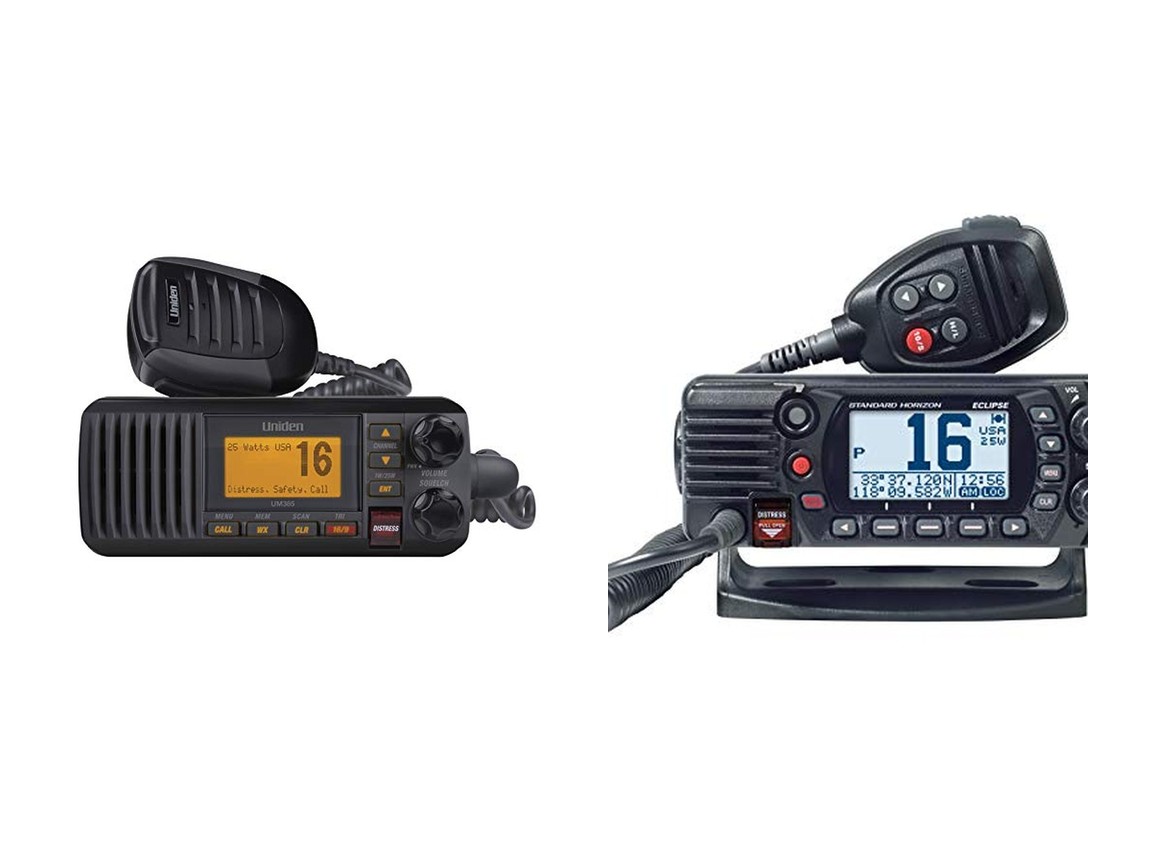
| Job | Uniden UM385BK | Standard Horizon GX1400 | Buy |
|---|---|---|---|
| What the card says you are holding | UM385BK, ASIN B076DHZQ42 | Eclipse GX1400, ASIN B07MQBXXF1. Not GX1400GPS | Match the model cell. GPS in the photo is not always GPS in the SKU. |
| Power and DSC | 25W, Class D DSC | 25W, Class D DSC, separate CH70 DSC receiver | Both are 25-watt Class D. The separate CH70 receiver is the Horizon sentence. |
| Water rating | IPX4 | IPX8, 1.5 m / 30 min claim | IPX4 is splash. IPX8 is the deeper claim. Do not average them. |
| GPS path | External GPS via accessory path such as MRN-GPSK | NMEA GPS in/out. Built-in GPS belongs to GX1400GPS, a different SKU | Do not paste built-in GPS onto B07MQBXXF1. |
| Weather and watch | NOAA with S.A.M.E., Triple Watch | Read the Eclipse listing for weather and watch cells on the card you open | S.A.M.E. is the Uniden sentence on this brief. |
| What this is not | Not an EPIRB, not a handheld | Not GX1400GPS, not an antenna | Buy the radio model on the card you opened. |
Who should buy the Uniden, and who should buy the Eclipse?
Buy UM385BK if you want ASIN B076DHZQ42, the 25-watt Class D Uniden with IPX4, NOAA and S.A.M.E., Triple Watch, external GPS through an accessory path such as MRN-GPSK, and the chassis size near 6.25 by 2.5 by 5.08 inches, and if you will budget a GPS source the radio can hear instead of assuming coordinates appear from nowhere. Buy GX1400 if you want ASIN B07MQBXXF1, the Eclipse with 25 watts, Class D DSC, the IPX8 1.5 meter for 30 minute claim, the separate Channel 70 DSC receiver, and NMEA GPS in and out, and if you will refuse to shop GX1400GPS by accident when the photograph shows a lat-long screen.
Buy neither if you wanted an EPIRB. The ACR and Ocean Signal page is that distress beacon. Buy neither if you wanted only an antenna. Shakespeare and Perko are that hardware. Buy neither if you wanted a handheld VHF. Both of these cards are fixed-mount conversations on this page.
What is UM385BK actually for?
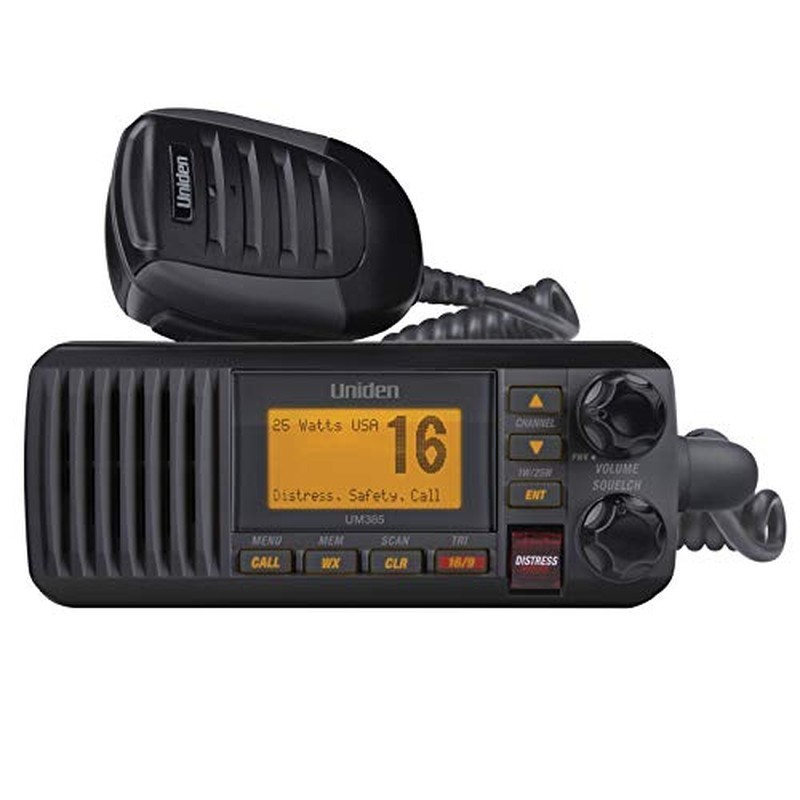
This card is a Uniden fixed-mount VHF, model UM385BK, ASIN B076DHZQ42. The language that belongs to this comparison prints 25 watts of transmit power, Class D DSC, an IPX4 water rating, NOAA weather reception with S.A.M.E. alerting, Triple Watch, and external GPS through an accessory path such as the MRN-GPSK. The chassis size language sits near 6.25 inches by 2.5 inches by 5.08 inches. Those cells are the Uniden. They are not a promise the radio replaces a flotation device or a navigation light after sunset.
IPX4 is splash resistance language. It is not IPX8. Do not tell a buyer the Uniden matches the Horizon submersion claim. S.A.M.E. is Specific Area Message Encoding on the weather side. Triple Watch is the Uniden watch language on this brief. External GPS means the radio needs a position source for the DSC position story. MRN-GPSK is an accessory path named in the Uniden ecosystem language. It is not soldered into every photo of every Uniden face.
Twenty-five watts is the same headline power as the Eclipse. Power parity does not erase the IP rating split or the GPS path split. A black faceplate and a white faceplate are cosmetics. Match UM385BK before you match a color.
What is GX1400 actually for?
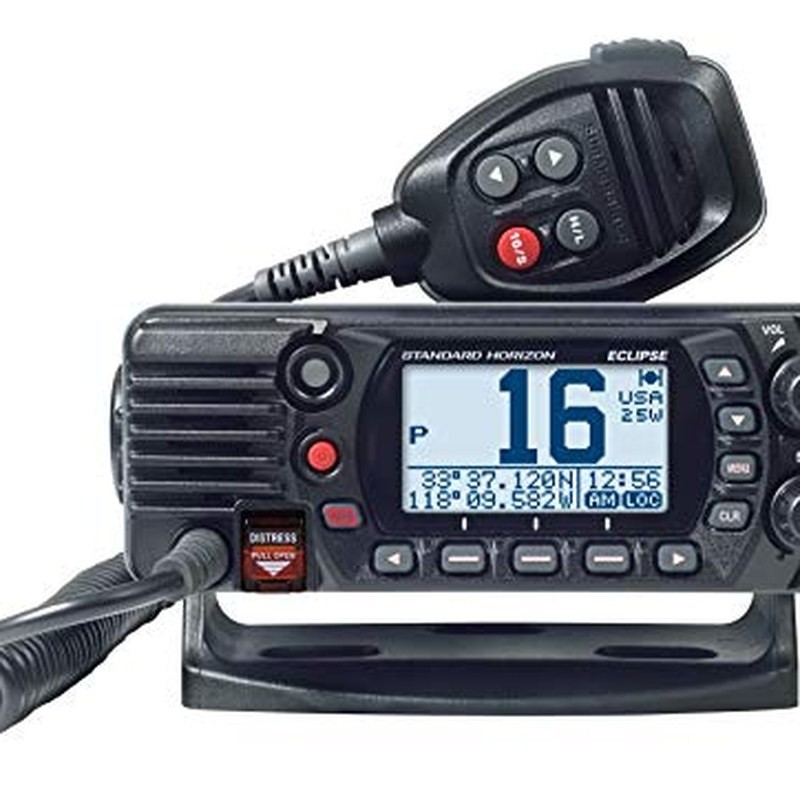
This card is a Standard Horizon Eclipse fixed-mount VHF, model GX1400, ASIN B07MQBXXF1. The language that belongs to this comparison prints 25 watts, Class D DSC, IPX8 with a claim of 1.5 meters for 30 minutes, a separate Channel 70 DSC receiver, and NMEA GPS input and output. The separate Channel 70 receiver is the Horizon sentence that keeps DSC watch while you are on a working channel. NMEA in and out is how position and other talker sentences move between the radio and a plotter or GPS talker on the boat network.
GX1400GPS is a different SKU. Built-in GPS belongs to that other model string when the card says so. ASIN B07MQBXXF1 is the Eclipse this page is comparing. A gallery image that shows latitude and longitude can be a radio that has already received position from a connected talker. It is not automatic proof that B07MQBXXF1 contains a GNSS receiver. Read the model cell. If you need built-in GPS, shop the SKU that prints built-in GPS, and do not launder that sentence onto this ASIN.
IPX8 is a deeper water claim than IPX4. It is still not permission to run the radio as a depth sounder. Mount it where the manufacturer allows, keep the gasket story honest, and remember a VHF is not an EPIRB.
How do you wire position and antennas without mixing the safety pages?
Both radios want an antenna. The Shakespeare 5225-XT and Perko 1212DP2CHR page is antenna and mount hardware. A radio without an antenna is a display. DSC position wants a GPS talker. On the Uniden, that is the external path such as MRN-GPSK in the ecosystem language. On the Eclipse GX1400, that is NMEA in. Built-in GPS is the other SKU. Do not invent a satellite out of a screenshot.
An EPIRB is a distress beacon with its own registration story. The ACR and Ocean Signal page is that object. A PFD keeps you afloat. The Mustang and Onyx page is that object. An all-round light is navigation lighting. The Attwood and Perko light page is that object. A compass is orientation when the plotter is dark. The Ritchie and Iris page is that object. None of those pages is a substitute for a working VHF, and a VHF is not a substitute for those pages.
MMSI programming and DSC calling are installer and owner responsibilities this article will not turn into a fake how-to that invents a menu path for every firmware. Read the manual that ships with the radio you buy. Keep the MMSI legal where you boat.
What actually fails on these two cards?
The Uniden card fails when IPX4 is sold as IPX8. It fails when S.A.M.E. is treated as a DSC distress button. It fails when external GPS is forgotten and the owner expects a lat-long screen with nothing connected. It fails when an EPIRB is skipped because the radio has DSC. It fails when a handheld is ordered because the brand matched. It fails when chassis inches are ignored and the radio will not fit the dash cutout.
The Eclipse card fails when GX1400 and GX1400GPS are treated as one ASIN. It fails when a lat-long screenshot is used as proof of built-in GPS on B07MQBXXF1. It fails when IPX8 is read as a diving certification for the operator. It fails when the separate CH70 receiver sentence is deleted because another radio also says Class D. It fails when the antenna page is skipped and the radio is blamed for range.
What is this comparison not?
This is not a handheld VHF comparison. This is not every Uniden marine radio and every Standard Horizon Eclipse. UM385BK and GX1400 on B07MQBXXF1 are the cards. This is not GX1400GPS. This is not a price quote. The price moves. Use the buttons if you want the live listing. This is not an EPIRB review, a PFD review, a light review, or a compass review. Those pages are linked above.
This is also not a coverage map. Neither card prints a mile range this page will invent from marketing adjectives.
How do you read Class D DSC without inventing a coast-guard lecture?
Class D DSC on both cards is digital selective calling language for a fixed-mount VHF in this class. It is not an EPIRB. It is not a satellite messenger. When a position is available to the radio, DSC can include position in a digital call. When a position is not available, the radio still transmits as a VHF, and the DSC position story is incomplete. That is why the Uniden external GPS path and the Eclipse NMEA input matter. Leaving the GPS wire in the parts drawer is a wiring choice, not a feature the card printed as optional forever.
The separate Channel 70 DSC receiver on the GX1400 language is the Horizon claim that DSC watch continues on Channel 70 while you work another channel. Radios without that separate receiver still claim Class D on many cards. Do not invent a second receiver on UM385BK because the Eclipse has one. Read each card. The Uniden Triple Watch sentence is a watch mode on that radio. It is not the same sentence as a dedicated CH70 receiver.
NOAA weather with S.A.M.E. on the Uniden brief is weather-alert language keyed to SAME codes. It is not a substitute for looking outside. It is not DSC distress. Keep weather listen and distress calling in separate mental buckets when you set up the radio. Program the MMSI where your jurisdiction requires it, using the manual that ships with the unit. This article will not invent a keypress sequence that drifts across firmware revisions.
Dash fit is the other quiet failure. The Uniden chassis language near 6.25 by 2.5 by 5.08 inches is a planning number for the cutout and the depth behind the panel. Measure twice. A radio that hangs on the wires behind a thin console is a mount problem, not a transmit-power problem. The Eclipse has its own cutout drawing in the documentation you open with the listing. Do not assume the two faces swap into one hole without checking.
So which fixed-mount VHF should you buy?
Buy the Uniden if you want ASIN B076DHZQ42, model UM385BK, 25-watt Class D with IPX4, NOAA and S.A.M.E., Triple Watch, external GPS via a path such as MRN-GPSK, and the chassis near 6.25 by 2.5 by 5.08 inches. Buy the Standard Horizon if you want ASIN B07MQBXXF1, model GX1400, 25-watt Class D with IPX8 1.5 m / 30 min language, a separate Channel 70 DSC receiver, and NMEA GPS in and out, without pasting GX1400GPS built-in GPS onto this ASIN. Buy neither if you wanted a beacon, a handheld, or a GPS-built-in SKU this card is not.
Manufacturer promo clips exist in the wild. No public clip that honestly names both UM385BK and GX1400 as this comparison's verdict belongs embedded here. This comparison does not embed a video.
Frequently asked questions
Uniden UM385BK or Standard Horizon GX1400?
UM385BK if you want IPX4, NOAA/S.A.M.E., Triple Watch, and external GPS via a path such as MRN-GPSK. GX1400 if you want IPX8 1.5m/30min language, a separate CH70 DSC receiver, and NMEA GPS in/out on ASIN B07MQBXXF1.
Does GX1400 on B07MQBXXF1 include built-in GPS?
Do not paste built-in GPS onto this ASIN. GX1400GPS is a different SKU. A lat-long image can mean GPS is connected over NMEA, not that the receiver is inside.
Are both radios 25-watt Class D?
Yes. Both conversations print 25 watts and Class D DSC. The water rating and GPS path still differ.
Does a VHF replace an EPIRB or a PFD?
No. The ACR/Ocean Signal page is the beacon fight. The Mustang/Onyx page is the PFD fight. Keep those objects separate.
What antenna page pairs with these radios?
The Shakespeare 5225-XT versus Perko 1212DP2CHR comparison is the antenna and mount hardware on this site.
Does a video show both radios?
No. Manufacturer promo clips are skipped here. This comparison does not embed a video.