
Standard Horizon HX210 vs Icom IC-M25
Written by John Wren|
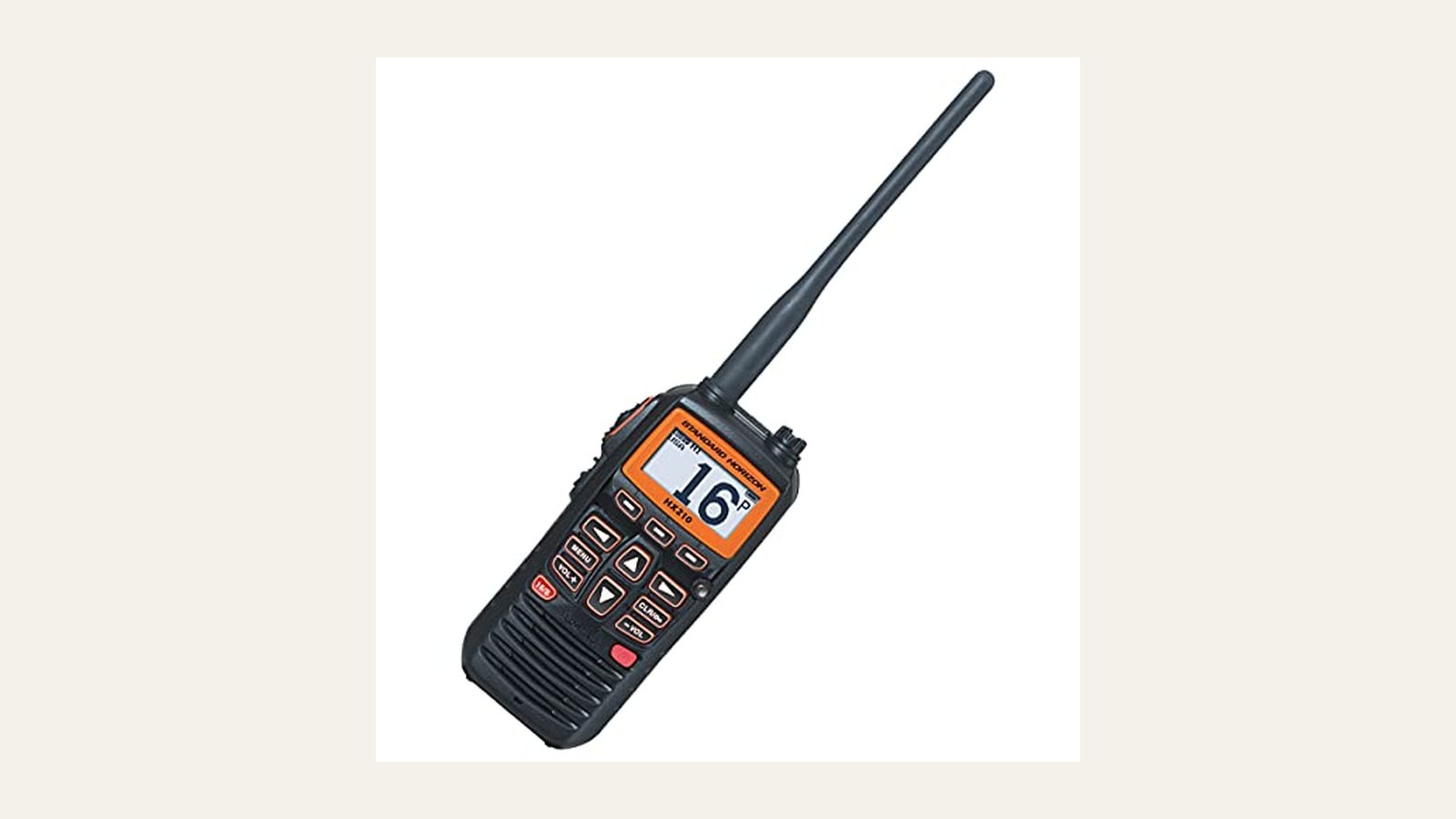
Choose the Standard Horizon HX210 for a 6-watt floating handheld with NOAA weather and an 1850 mAh pack. Choose the Icom IC-M25 for a lighter 5-watt floater with Float'n Flash and Micro-B charging. Neither has DSC or GPS.
Key takeaways
- HX210 is 6 watts with NOAA and a strobe.
- IC-M25 is 5 watts, Float'n Flash, Micro-B.
- Neither handheld is DSC or GPS.
- Clip the radio to the person wearing the jacket.
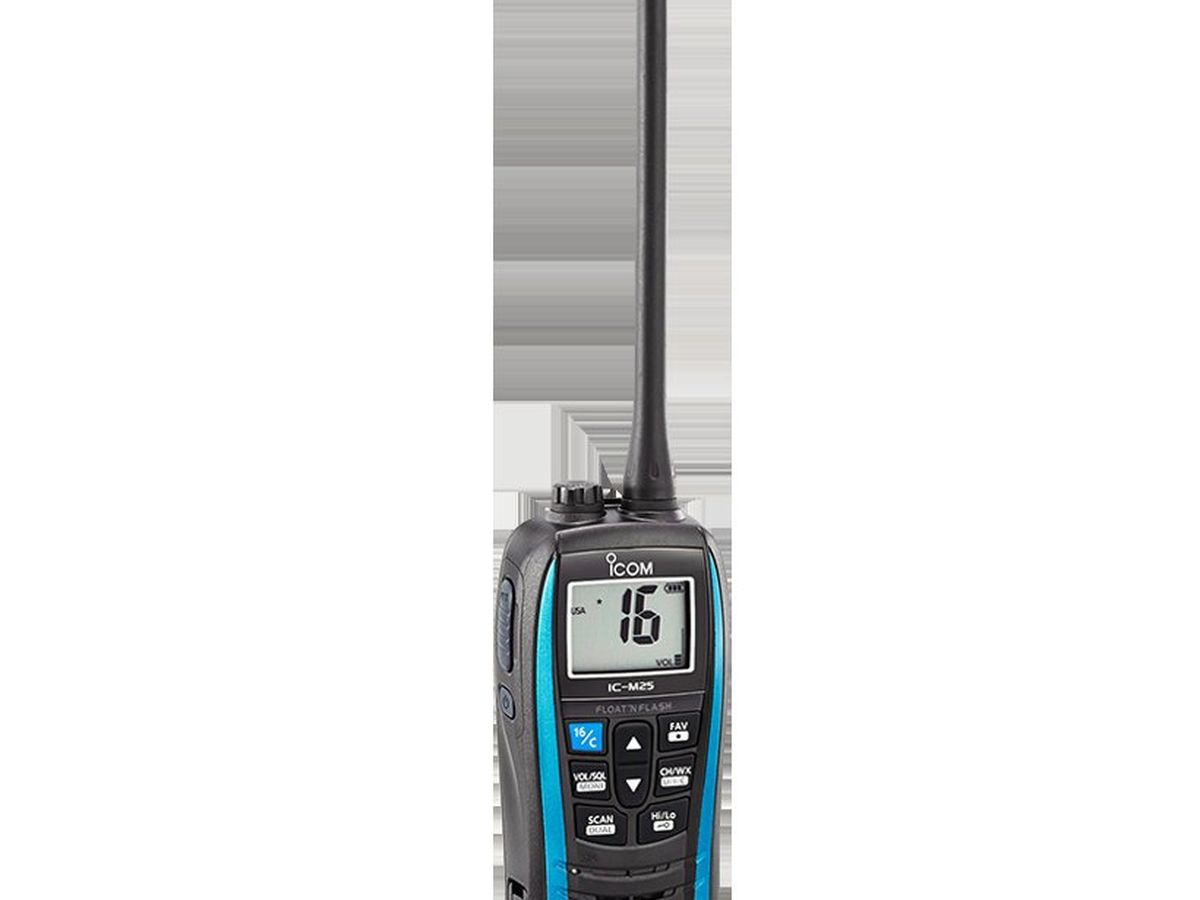
Standard Horizon HX210 vs Icom IC-M25 is a floating handheld VHF fight for a skiff, a kayak, and the boat whose fixed radio already lives at the helm. The HX210 is the 6-watt Standard Horizon: selectable 6, 2.5, and 1 watt, IPX7 when the mic cap is on, an 1850 mAh pack, NOAA weather, an FM broadcast receiver, and a water-activated strobe. The IC-M25 on this listing is Icom's navy-blue floater: 5 watts and 1 watt, Float'n Flash, about 11 hours on Icom's 5:5:90 duty, Micro-B USB charging, AquaQuake on the speaker, about 7.8 ounces. If you want the louder transmit option and a radio that also plays an FM station while you wait on the hook, buy the HX210. If you want the lighter Icom that flashes when it hits the water and charges from a common Micro-B cable, buy the IC-M25. Neither radio is DSC, and neither radio is GPS. A handheld does not replace a fixed VHF with a distress button if that is the boat you run.
Short version. A life jacket is what floats you. The radio is what calls for you. A bilge pump is the water already in the boat. Wind is the reason the radio should be charged before you leave. A boat day still starts with a float plan somebody on shore can read. Check live prices.
This comparison is two handheld marine VHFs. It is not a fixed-mount radio with DSC, it is not an AIS receiver, and it is not the newer IC-M25 EVO with USB-C and an Eco mode. Confirm HX210, not a bundle that adds a random antenna and a hanger you did not mean to buy. Confirm IC-M25, navy blue on this listing, not the EVO and not a discontinued color that shares a photo.
| Job | HX210 | IC-M25 | Our call |
|---|---|---|---|
| A backup in a skiff that already has a fixed VHF | 6 W, NOAA, FM, strobe | 5 W, Float'n Flash, lighter | HX210 if you want the watt and the weather radio |
| A kayak or a tender, one radio, one pocket | Heavier pack, cradle charger | About 7.8 oz, Micro-B charge | IC-M25 |
| It goes in the water | Floats, IPX7 with the cap on, strobe | Floats and flashes, IPX7 | Either, if the cap and antenna are on |
| DSC distress from the handheld | No | No | A fixed DSC radio, not these |
| The pump and the jacket | Not a pump | Not a jacket | Buy those too |
IPX7 on both is one meter for 30 minutes, and only with the seals they shipped with. On the HX210 that includes the mic/speaker cap installed. A missing cap is a radio you just drowned.
Who should buy the HX210, and who should buy the M25?
Buy the HX210 if the handheld is the serious radio on a small boat, or the backup you will actually transmit on when the helm radio is a long way from the person who fell in. Six watts against five is not a miracle of range. Antenna height is the range. The extra watt, the bigger battery number, NOAA, and the FM receiver are why the HX210 earns the pocket on a boat that already has room for a cradle charger. Buy the IC-M25 if the radio lives on a kayak PFD or in a small hatch, you want it light, and you want a cable you already own in a drawer. Micro-B is an old connector. It is also the connector this model uses. The EVO moved to USB-C. If your listing says USB-C, you are not looking at this M25.
Neither radio knows where you are. Say your position out loud on channel 16 if you are in trouble, or read it off a separate GPS, a phone that still has a signal, or the fixed radio's distress function if you are still at the helm. A handheld is a voice. It is not a rescue beacon. A satellite messenger is a different tool for water where VHF will not reach a coast station. Do not pretend a 6-watt antenna in a kayak cockpit is a mayday to the horizon.
What the HX210 is actually for
The HX210 is Standard Horizon's compact floating handheld. Transmit is selectable: 6 watts high, 2.5 watts medium, 1 watt low. In some countries the high setting is limited to 5 watts. The US radio is the 6-watt set. It covers USA, International, and Canadian marine channels, with a 16 key that jumps to the hailing and distress channel from anywhere in the menu. NOAA weather and weather alert are in the receiver, and so is the FM broadcast band, about 76 to 108 MHz, which is the feature you will use on a slow day and forget to turn off before you need channel 16. The battery is an 1850 mAh lithium-ion pack. The charger is a desktop cradle with 12-volt and 110-volt cables, about a three-hour charge on Standard Horizon's sheet. The case is small because that pack is inside it. It floats face up. A water-activated strobe is part of the US model's emergency behavior. IPX7 is one meter for 30 minutes, and the manual is blunt: the mic/speaker cap has to be in the jack.
There is a speaker-mic jack if you want the radio on a belt and the mic in a hand. That is a boat install, not a kayak install. The moment you pull the cap to plug a mic in, the waterproof story changes until the cap is back. Read that twice if you fish in a wet cockpit.
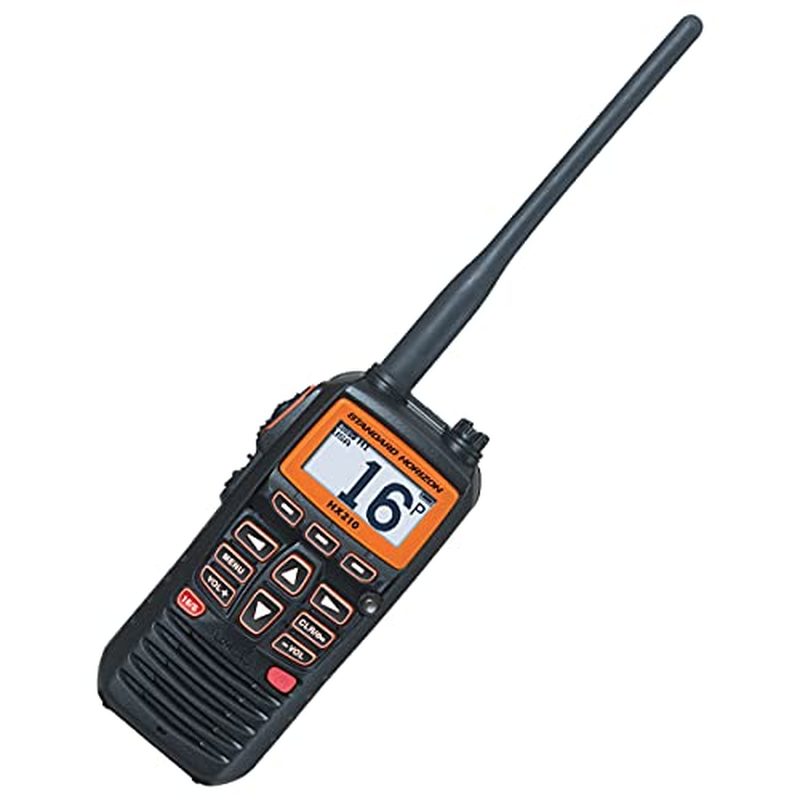
Do: charge it on the cradle the night before, and check that channel 16 still works with a radio check, not with a mayday. Don't: buy a bundle whose extra antenna is a land antenna someone screwed onto a marine radio. The antenna that ships with the HX210 is the one cut for the marine band. Don't: run high power for a radio check in a marina. One watt reaches the boat next to you. Six watts is for distance, and it spends the pack.
What the IC-M25 is actually for
The IC-M25 on this listing is Icom's floating handheld in navy blue, the model before the EVO refresh. Output is 5 watts and 1 watt. Float'n Flash means it floats and the red light and the backlight flash so you can see it. Icom's battery story for this generation is about 11 hours at a 5:5:90 transmit, receive, and standby split, on an internal lithium-ion pack around 1500 mAh. Charging is 5-volt USB, Micro-B, not a proprietary cradle and not USB-C. AquaQuake is the buzz that shakes water out of the speaker grill so the next transmission is not a mumble. The body is the light one: Icom prints about 220 grams, about 7.8 ounces, with the antenna and the belt clip. IPX7 is the same one-meter, 30-minute idea, with the antenna and the covers on.
The EVO is the current refresh: USB-C, a longer Eco-mode number, a slightly different grip. If you want that radio, buy that model on purpose. This article is the Micro-B M25 because that is the radio this listing is. A photo of a white M25 is the same radio in another color. Navy is the one in the cart here. Function does not change with the paint. Fit in a pocket might, if a lanyard and a clip are in the way.
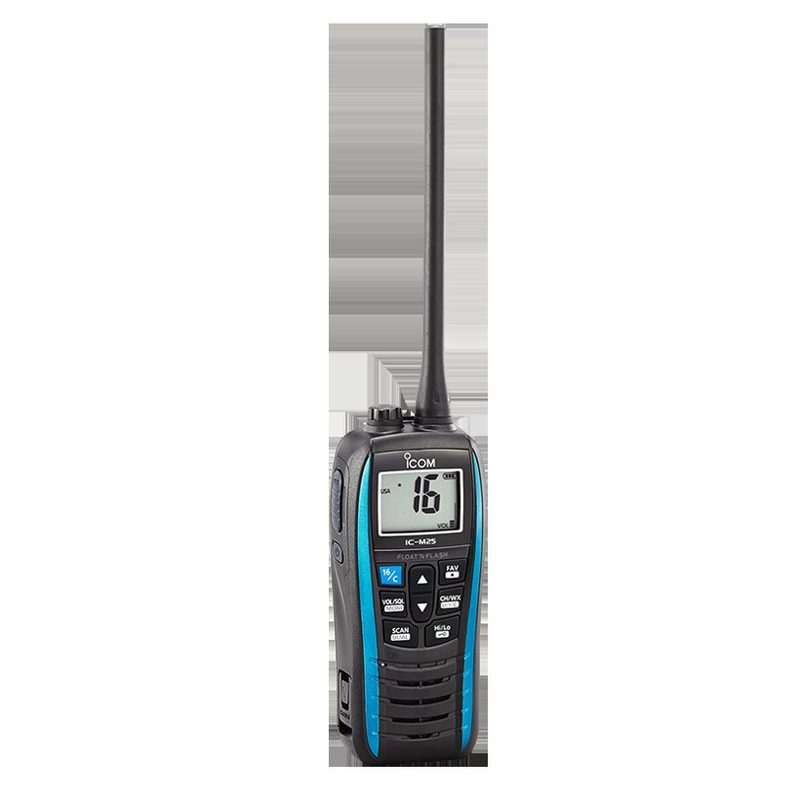
Do: cable it to the same battery brick you use for a phone, and confirm it actually charges before a trip. A Micro-B cable that only fits when you hold it is a bad cable. Don't: expect this radio to charge other devices just because a bullet on an old brochure mentioned USB. Treat it as a radio that takes a charge. Don't: skip AquaQuake after a splash. A wet speaker is a quiet radio, and a quiet radio is how people repeat themselves on 16 until someone annoyed answers.
Channel 16 is a procedure. The radio is just the microphone.
Both radios can jump to 16. That does not make the transmission a distress call. A radio check is "radio check" and the boat name, on a working channel if you can, not a fake mayday. A real distress call is mayday three times, the boat name, the position, and what is wrong, then you listen. Write the boat name and a shore contact on a card in the same pocket as the radio. A handheld with a dead battery and no boat name in your head is a brick that floats.
Power follows distance. One watt inside a marina. High power when you are actually reaching for a bridge, a coast station, or another boat you cannot see. Holding high power for a long conversation spends the HX210's 1850 mAh and the M25's smaller pack the same way: faster than the standby number on the box. The 11-hour figure is a duty cycle with almost no talking. A long talk on high is a different afternoon.
The boat's own battery is a separate problem. A handheld does not start an outboard. Charge the handheld from shore power or a brick, not from a boat battery you have already run flat.
Floating is not a license to drop it.
Both radios float. Both are IPX7 only when they are closed up. A lost cap, a loose antenna, or a mic plugged in and then soaked is how a "waterproof" radio comes home dead. Clip it to the PFD or the console. A lanyard that is longer than the cockpit is a radio that will bang the hull and still be in the water if you go in without the jacket. Put the radio on the same body that is wearing the life jacket. A radio clipped to a boat that just left you is a radio you can see and cannot use.
Rinse salt off the case with fresh water. Do not aim a hose into the speaker or the mic jack. Dry the terminals on the HX210 cradle if the boat lives outside. A green terminal is a radio that will not charge on Friday.
What this fight is not
It is not a fixed VHF with DSC and a red distress button. If the boat is big enough to have a helm, that radio is the one the coast guard story assumes, and the handheld is the one you take with you when you leave the helm. It is not a bilge pump. Calling for help does not empty the hull. It is not a weather forecast by itself. NOAA on the HX210 is a receiver. You still decide whether to go. It is not a personal locator beacon. Different antenna, different orbit, different job.
A listing that says HX890 or HX891 is a GPS and DSC handheld, a different price and a different radio. A listing that says M25 EVO is USB-C. Read the model. HX210 and IC-M25 are the two in this comparison.
So which handheld VHF should you buy?
Buy the Standard Horizon HX210 if you want 6 watts, NOAA, an FM receiver, an 1850 mAh pack, and a strobe, and you have a place to cradle-charge it. Buy the Icom IC-M25 if you want the lighter floater, Float'n Flash, AquaQuake, and Micro-B charging, and you have confirmed it is not the EVO. Put the cap on. Charge it before you need it. Clip it to the person wearing the jacket. Check live prices. Then tell somebody on shore what time you will be back, because a radio only helps if someone is listening and someone knows you are gone.
The rest of a boat day is the jacket, the pump, and the decision to stay in. The handheld is the voice you still have when you are no longer at the helm.
Frequently asked questions
Standard Horizon HX210 or Icom IC-M25?
HX210 if you want 6 watts, NOAA, an FM receiver, and the larger pack. IC-M25 if you want the lighter floater with Float'n Flash and Micro-B charging.
Is the IC-M25 the same as the M25 EVO?
No. This listing is the Micro-B IC-M25. The EVO charges by USB-C and is a different radio.
Do these handhelds have DSC or GPS?
No. They are voice radios. A fixed VHF with DSC is a different install. Say your position out loud if you need help.
Are the HX210 and the IC-M25 waterproof?
Both are IPX7, one meter for 30 minutes, only with the caps and antenna in place. On the HX210 the mic cap has to be installed.
Which handheld floats?
Both float. The HX210 has a water-activated strobe. The M25 flashes with Float'n Flash. Clip the radio to the person wearing the life jacket.
Does a handheld replace a bilge pump or a life jacket?
No. The radio calls for help. The jacket floats you. The pump empties the boat.