
ACR 2830 vs Ocean Signal 702S-01540
Written by John Wren|
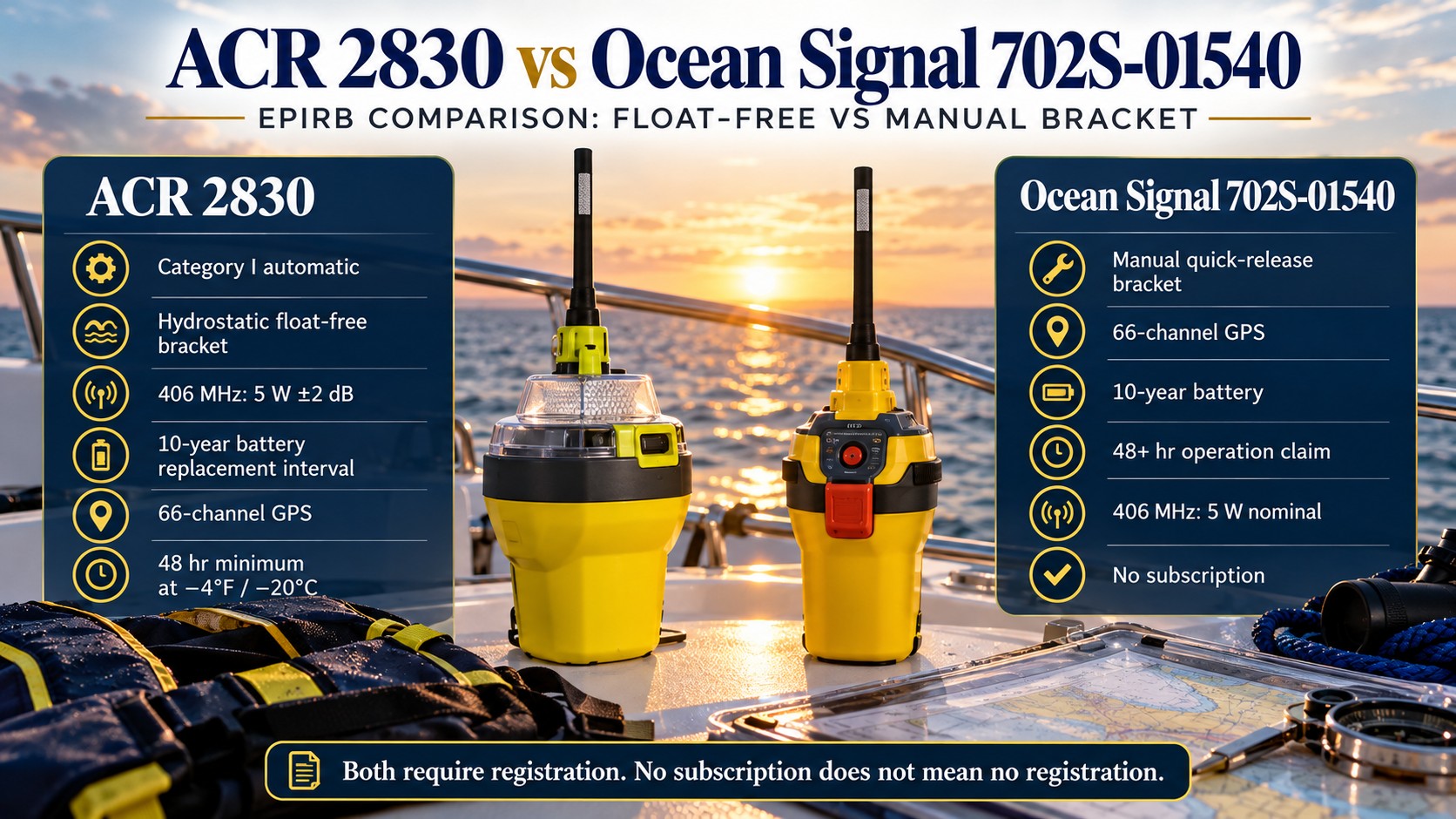
Choose ACR part 2830, ASIN B01C6RCRIW, for the Category I automatic EPIRB programmed for a US MMSI. The features say 5 watts plus or minus 2 dB. A parenthesis puts plus 20 Celsius next to minus 4 Fahrenheit. Choose Ocean Signal part 702S-01540, ASIN B00T0UQ05K, for the EPIRB1 whose features name a 66-channel GPS, a 10-year battery, and a quick-release bracket. The manual calls that bracket manual release, not hydrostatic.
Key takeaways
- 2830's title says Category I automatic and US registration. The features say 5 watts plus or minus 2 dB.
- The ACR feature pairs minus 4 Fahrenheit with plus 20 Celsius. The specification sheet says minus 20 Celsius.
- 702S-01540's features name a quick-release bracket, a 10-year battery, and no subscription. The manual says manual release.
- Ocean Signal's product page says 5 watts nominal. The manual's transmitter table says 12 watts maximum EIRP. The Amazon card prints neither.
Buy the ACR GlobalFix V4, manufacturer part 2830, ASIN B01C6RCRIW, when you want the Category I automatic EPIRB whose title says it is programmed for US registration and whose features print 5 watts plus or minus 2 dB and 50 milliwatts plus or minus 3 dB. Buy the Ocean Signal rescueME EPIRB1, manufacturer part 702S-01540, ASIN B00T0UQ05K, when you want the compact beacon whose features name a 66-channel GPS, a 10-year battery, 48-plus hours of operation, a quick-release bracket, and no subscription. The ACR feature's temperature clause says 48 hours minimum at minus 4 degrees Fahrenheit and then, in the same parenthesis, plus 20 degrees Celsius. Minus 4 Fahrenheit is minus 20 Celsius, not plus 20. That parenthesis is a unit error on the card. Do not navigate by it.
Short version. A Mustang MIT 100 and an Onyx A/M-24 are life jackets, the thing you are wearing when a beacon is the next decision. Life jackets for a personal watercraft are the same problem on a smaller hull. A NOCO GENIUS1 and a Battery Tender charge the boat's battery. They do not replace the lithium pack sealed in an EPIRB. A SHURFLO and a Jabsco pump move water. An EPIRB calls for help. Register the beacon. A beacon in a drawer with no registration is a radio, not a rescue plan.
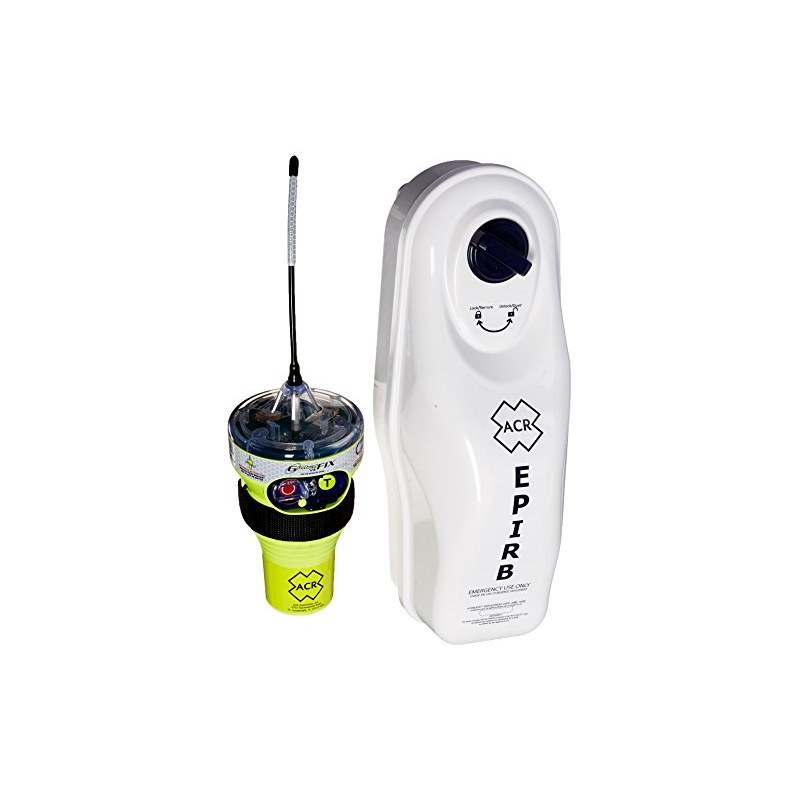
The ACR card is ASIN B01C6RCRIW. The brand is ACR. The model is 2830. The UPC is 791659028308. The title says Category I, automatic, programmed for US registration, and it says the beacon must be registered to a vessel with a US MMSI. The features say the 406 output is 5 watts plus or minus 2 dB and the 121.5 output is 50 milliwatts plus or minus 3 dB, and they say operational life is 48 hours minimum at minus 4 degrees Fahrenheit. The parenthesis that follows says plus 20 degrees Celsius. That is the error. ACR's GlobalFix V4 specification sheet for models 2830 and 2831 says 48 hours minimum at minus 4 degrees Fahrenheit, which it prints as minus 20 degrees Celsius, Class 2. The sheet is the document that agrees with the Fahrenheit. The Amazon parenthesis agrees with neither the Fahrenheit nor the sheet. Quote the sheet if you need Celsius, and say it is the sheet.
The same Amazon card has specification cells that do not describe a beacon in ordinary language. Screen size says 1. Additional features say Bluetooth. Map type says Worldwide. Compatible vehicle type says Boat, which is the one of those cells that belongs. An EPIRB is not a chartplotter. Do not buy 2830 because a screen-size cell exists. The features also say that registration outside the US belongs on a different listing, that registration is mandatory in most countries, that the beacon is for grave and imminent danger, and that deliberate misuse can bring a penalty. Those sentences are the legal content of the listing. They are more important than the Bluetooth cell.
ACR's specification sheet, not the Amazon cells, is where the rest of 2830 lives. Category I, Class 2, product family RLB-41, size 8.13 inches high by 4.28 inches wide, weight 27 ounces, internal GPS described as 66-channel, user-replaceable battery with a 10-year replacement interval, hydrostatic release for Category I, waterproof for 5 minutes at 33 feet, operating temperature minus 4 to 131 Fahrenheit, and a note that a Category II version, model 2831, is the manual bracket. Model 2830 is the Category I line on that sheet. The Amazon title agrees: Cat 1, automatic. The sheet's weight and the 8.13-inch height are not Amazon cells on the extract this page is using. Do not promote them to cells. Category I means a float-free bracket that is supposed to release the beacon if the boat sinks. It does not mean you are excused from mounting the bracket where it can float free. A bracket buried in a cabin is a Category I beacon installed as a paperweight.
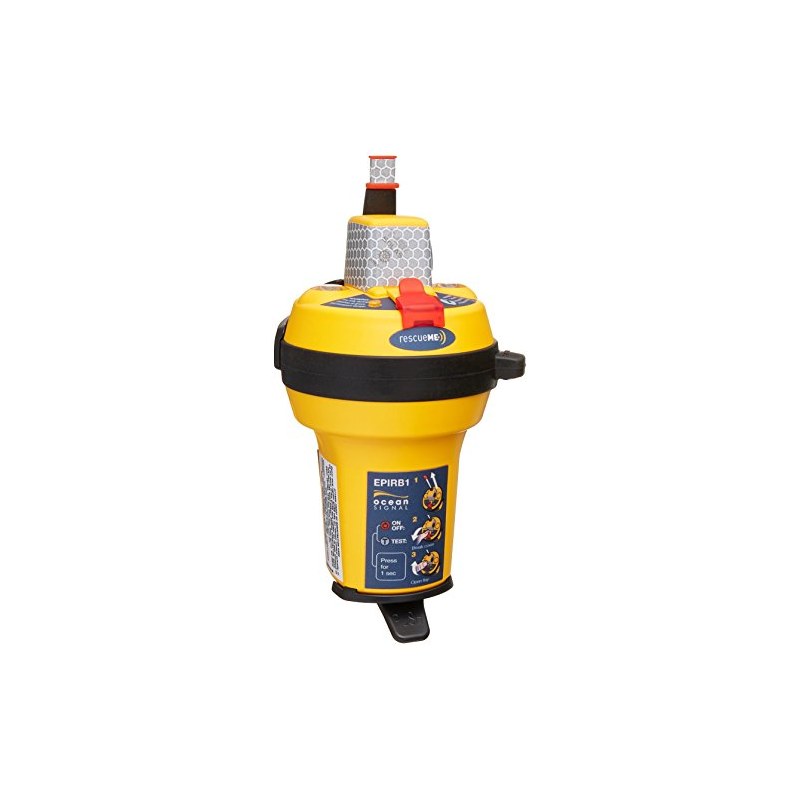
The Ocean Signal card is ASIN B00T0UQ05K. The brand is Ocean Signal. The model is 702S-01540. The UPC field prints 617297093426 and also 796793930890. Two UPCs are two claims. The color cell says Multicolor. The size cell says 5, which is not a dimension. The power source says Battery Powered. The battery description says Lithium. Compatible devices says search and rescue services, which is a category error dressed as a specification. The features name a 66-channel GPS, a claim of being 30 percent smaller than other competitors, a quick-release bracket, a retractable antenna, an integrated lanyard, a 10-year battery life, 48-plus hours of continuous operation, and no subscription. The features do not say Category I or Category II. They do not print a weight. They do not print the 406 power in watts.
Ocean Signal's product page for the EPIRB1 says 406.040 MHz at 5 watts nominal, 121.5 MHz at 50 milliwatts nominal, operation up to 48 hours at minus 20 Celsius, weight 422 grams, and auto activation on immersion except in Australia and New Zealand. The user manual's specification table says the 406 transmitter is 12 watts maximum EIRP, the body is 178 by 89 by 100 millimeters, the weight is 422 grams, waterproof to 10 meters, and Class 2 units activate in water while Class 3 units, approved for Australia and New Zealand, are manual only. Five watts nominal and 12 watts maximum EIRP are two Ocean Signal numbers. They are not the same unit written twice. Nominal is the product page. Maximum EIRP is the manual's transmitter table. The Amazon card prints neither. The 30 percent smaller claim on Amazon does not name the other beacon. The product page's footnote says the comparison is to other products approved to recognized standards as of July 2014. A 2014 footnote is not a 2026 measurement against the GlobalFix V4. Do not use it as one.
Category is the split that decides the install. ACR 2830's title says Category I automatic, and the sheet says hydrostatic release. Ocean Signal's manual says the EPIRB1 is manual release, supplied with a manual bracket for internal or protected areas, and a dealer page calls 702S-01540 Category 2. Category II is the manual bracket. It does not float free of a sinking boat by itself. The Amazon features for the Ocean Signal say quick-release bracket, which matches a manual bracket, and they never say hydrostatic. If you need the beacon to leave the boat when you cannot, 2830 is the title that says Category I. If you need the smaller beacon you will carry, 702S-01540 is the model, and you have to be able to reach it. Both require registration. Both say, in their own documents, that a false alert is not a toy.
| Job | ACR 2830 | Ocean Signal 702S-01540 | Buy |
|---|---|---|---|
| Category on the documents you can cite | Title says Cat 1 automatic. The sheet says Category I hydrostatic release. | Amazon features do not say a category. The manual says manual release. A dealer calls it Category 2. | 2830 if the beacon has to float free. 702S-01540 if you will carry it and release it. |
| 406 power | Feature says 5 W plus or minus 2 dB. | No watt cell. Product page says 5 W nominal. Manual table says 12 W max EIRP. | Quote the page. Do not merge 5 and 12. |
| Battery life claim | Sheet says a 10-year replacement interval. Confirm the cell you are reading. | Feature says 10-year battery and 48-plus hours. | Either claim is a replacement clock, not a reason to skip the test. |
| Temperature | Feature says minus 4 F and, wrongly, plus 20 C. Sheet says minus 20 C. | Product page says up to 48 hours at minus 20 C. | Throw out the ACR parenthesis. Use the sheet. |
| Registration | Title says US MMSI, US programming. | Manual says registration is a legal requirement. Features say no subscription. | Register whichever you buy. No subscription is not the same as no registration. |
Who should buy the GlobalFix V4, and who should buy the EPIRB1?
Buy 2830 if you want part 2830, the Category I title, US programming, the 5-watt feature, and a float-free install, and if you will throw out the Celsius parenthesis and the Bluetooth cell. Buy 702S-01540 if you want part 702S-01540, the 66-channel feature, the 10-year and 48-hour features, the quick-release bracket, and the no-subscription sentence, and if you understand that the manual describes a manual bracket and a Class 2 water activation that is not the same thing as a hydrostatic Category I release. Buy the ACR if the boat can sink while you are not standing at the bracket. Buy the Ocean Signal if you will take the beacon with you and the size claim, read with its 2014 footnote, is the reason you can stow it.
Do not buy either beacon instead of a life jacket. The Mustang and the Onyx are the jackets. Do not buy either beacon instead of a charged handheld radio for the last few hundred yards. The 121.5 signal is a homing aid in the feature and on the product page. It is not a VHF conversation. Do not buy the ACR's other listing if you needed rest-of-world programming, and do not buy this US-programmed listing for a foreign flag. The feature tells you there is another listing. Do not buy the Ocean Signal and call it Category I because the ACR title used those words.
What is 2830 actually for?
This card is a Category I EPIRB, model 2830, ASIN B01C6RCRIW, programmed for US registration. Use it when you are in grave and imminent danger, which is the feature's own standard, and register it to the vessel before that day. The MMSI in the title is how the rescue center is supposed to know who owns the hex ID. An unregistered beacon still transmits. The feature says the registration is how teams know who you are. Mount the hydrostatic bracket where it can release, not in a locker that stays shut. The sheet's 27 ounces and 8.13-inch height are how you plan the mount, and only if you cite the sheet. The user-replaceable battery on the sheet is a 10-year interval, not a battery you swap with the NOCO charger. The chemistry and the procedure are ACR's, and the Amazon extract quoted here does not print the battery part number.
The self-test is the habit. The sheet describes functional tests and a 406Link path for the Americas. The Amazon features quoted here do not print the test steps. Read the card in the box. A test that runs long is an activation. The feature's penalty sentence is about deliberate misuse. A monthly test done the way the manual says is not that sentence. A test done by pulling the beacon out of the bracket and walking away is how false alerts start. Put it back.
What is 702S-01540 actually for?
This card is the rescueME EPIRB1, model 702S-01540, ASIN B00T0UQ05K, two UPCs, multicolor, with the GPS, battery, bracket, and no-subscription features listed above. Use the manual for the class. Class 2 activates in water and by the ON key. Class 3, Australia and New Zealand, is manual only. The Amazon features do not print the class. If the label on your unit says Class 3, the water will not turn it on, and the feature's silence is how you would have missed that. The manual says the bracket is for internal or protected areas. That is the opposite of a float-free hydrostatic bracket. Install it where you can grab it, and clip the lanyard to you or to the raft when you go, because the feature names the lanyard for that reason.
The 422-gram weight and the 178-by-89-by-100-millimeter body are the manual, not Amazon cells. Five watts nominal and 12 watts maximum EIRP stay on their own Ocean Signal pages. Forty-eight-plus hours in the feature and "up to 48 hours at minus 20 Celsius" on the product page are close and not identical. Plus and up to are different words. The 10-year battery is a replacement date on the unit, and the manual says to replace the battery after activation, after a test that shows the battery used, or after the expiry date. The Amazon feature does not print those three triggers. Read them in the manual before you trust a green test from a previous owner.
How do you register and mount them without mixing the cards?
Register the hex ID with the authority the beacon was programmed for. The ACR title says US registration and a US MMSI. The Ocean Signal manual says the national authority. No subscription, which the Ocean Signal feature prints, means you do not pay a satellite fee. It does not mean the beacon is registered. Write the registration in the ship's papers and in the ditch kit. Mount 2830 in the hydrostatic bracket, clear to float, and mount 702S-01540 where a hand can release it. Do not swap the brackets and call both installs Category I. The brackets are the category.
Test on the schedule in the manual you received, not on a schedule you invent from the Bluetooth cell. The ACR Bluetooth cell is not a test procedure. Teach the crew which beacon is which before the weather is the teacher. A Category I beacon that nobody can identify is a device. A Category II beacon left in a sinking cabin is a device that needed a person. The life jacket is what keeps that person on the surface long enough for either radio to matter.
What actually fails on these two cards?
The ACR card fails when plus 20 Celsius is taught as the same temperature as minus 4 Fahrenheit. It fails when the Bluetooth cell or the screen-size cell is read as a plotter. It fails when the sheet's 27 ounces are called an Amazon weight cell. It fails when model 2831's manual bracket is ordered as 2830. It fails when a US-programmed beacon is used for a flag the feature told you to buy on the other listing. It fails when the bracket is installed where it cannot float free and the title's Category I is treated as magic.
The Ocean Signal card fails when the 30 percent claim is used against the GlobalFix V4 without the July 2014 footnote. It fails when 5 watts nominal and 12 watts maximum EIRP are merged. It fails when 422 grams is called an Amazon weight. It fails when Class 3 manual-only is ignored because the feature did not mention Australia. It fails when no subscription is read as no registration. It fails when the quick-release bracket is described as a hydrostatic Category I release. It fails when two UPCs are treated as one barcode.
What is this comparison not?
This is not a personal locator beacon comparison. A PLB is registered to a person and is a different model. This is not a life-jacket comparison and it is not a battery-charger comparison. This is not every GlobalFix. Later V5 and V6 models are other part numbers, and this card is 2830. This is not a price quote. Use the buttons. This is not permission to test the beacon by letting it transmit. The manuals and the ACR feature are the law-and-penalty section. Read them before you push a button that is not the test button.
So which EPIRB should you buy?
Buy the ACR if you want part 2830, ASIN B01C6RCRIW, the Category I automatic title, US programming, and the 5-watt feature, and if you will throw out the Celsius parenthesis. Buy the Ocean Signal if you want part 702S-01540, ASIN B00T0UQ05K, the 66-channel feature, the 10-year and 48-hour features, and a quick-release bracket you will actually reach, and if you will keep nominal watts and maximum EIRP on the pages that printed them. Buy neither if you wanted a float-free Ocean Signal, a weight cell on both Amazon cards, or a beacon you do not plan to register. The category is the decision. The ACR parenthesis is the warning.
No beacon video is embedded. A clip that shows a later GlobalFix, or a PLB, would not be parts 2830 and 702S-01540. There is no video object.
Frequently asked questions
ACR 2830 or Ocean Signal 702S-01540?
2830 if you want the Category I automatic title and US programming. 702S-01540 if you want the quick-release EPIRB1 and you understand the manual describes a manual bracket, not a hydrostatic release.
What is wrong with the ACR temperature line?
The feature says 48 hours minimum at minus 4 degrees Fahrenheit and then says plus 20 degrees Celsius. Minus 4 Fahrenheit is minus 20 Celsius. ACR's specification sheet prints minus 20 Celsius. Throw out the parenthesis.
Does the Ocean Signal card say Category I?
No. The features name a quick-release bracket and do not say hydrostatic. The manual says manual release and a bracket for protected areas. A dealer page calls 702S-01540 Category 2.
What watts does each beacon claim?
The ACR feature says 5 watts plus or minus 2 dB. The Ocean Signal Amazon card prints no watt figure. The product page says 5 watts nominal. The manual table says 12 watts maximum EIRP. Do not merge those.
Does no subscription mean the beacon is registered?
No. The Ocean Signal feature says no subscription. The manual says registration is a legal requirement. The ACR title says the beacon must be registered to a vessel with a US MMSI.
Does a video show either EPIRB?
No. This page does not embed a video. A clip of a later GlobalFix, or of a personal locator beacon, would not be parts 2830 and 702S-01540.