
Mustang MD2030-191-0-235 vs Onyx 132000-500-004-15
Written by John Wren|
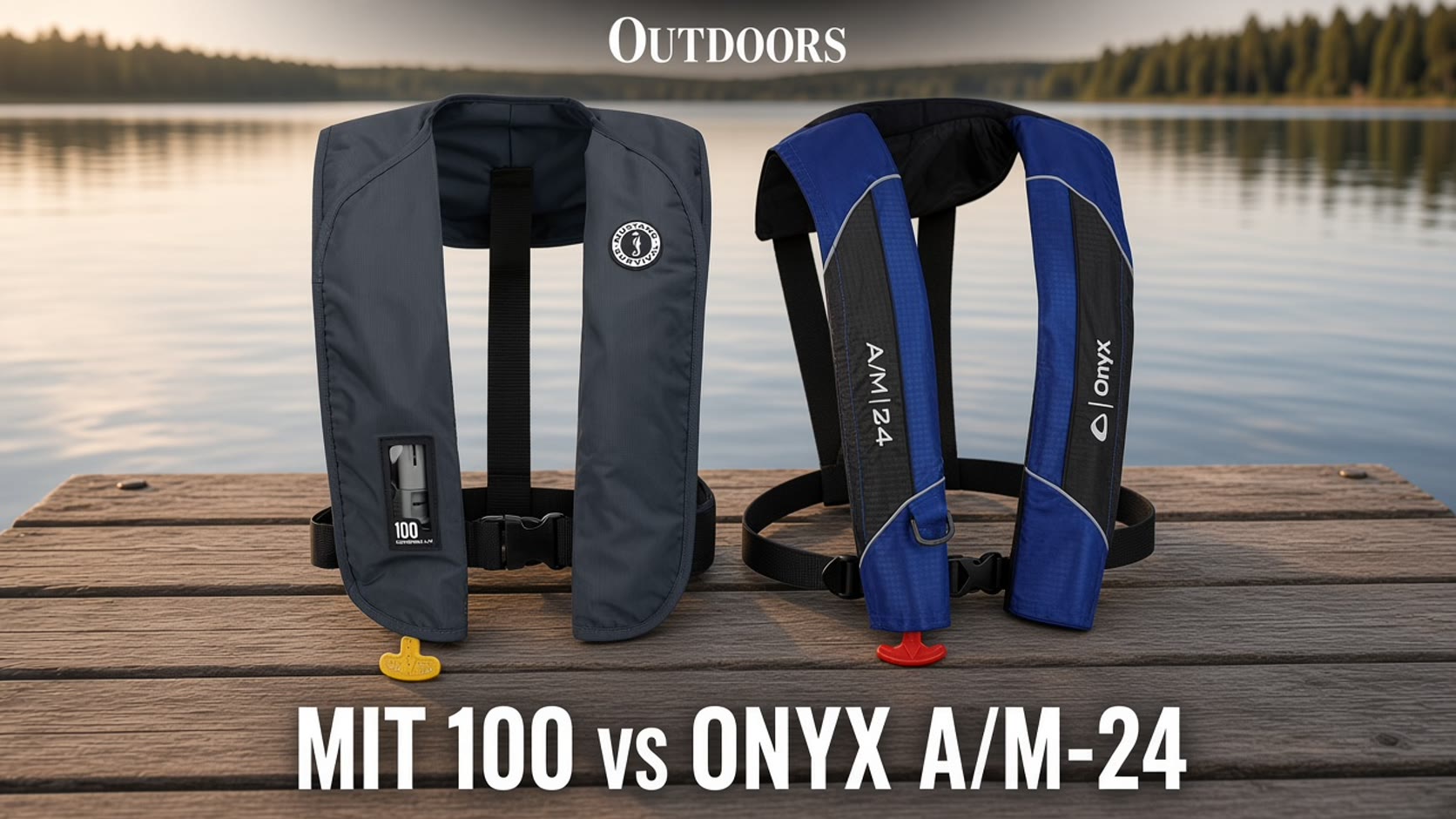
Choose Mustang part MD2030-191-0-235, ASIN B0CMG86LLF, for the admiral-gray MIT 100. The feature list says 28 pounds of buoyancy. The title says Convertible A/M, the description says automatic, and a feature says manual. Choose Onyx part 132000-500-004-15, ASIN B00NXVUM60, for the blue A/M-24. The features say 22.5 pounds, a chest from 30 to 52 inches, and rearming kit 1352. The additional-features cell says Not_Performance_Used.
Key takeaways
- The Mustang feature list says 28 pounds of buoyancy. The Onyx feature list says 22.5 pounds.
- The Mustang title says Convertible A/M. A feature on the same card says manual. The description says automatic.
- The Onyx card fits chests from 30 to 52 inches and names rearming kit 1352. The Mustang card does not name a kit.
- The review clip shows an Onyx A/M-24. It does not show the Mustang MIT 100.
Buy the Mustang Survival MIT 100 Convertible A/M inflatable PFD, manufacturer part MD2030-191-0-235, ASIN B0CMG86LLF, when you want the admiral-gray belt whose model cell says that part and whose feature list claims 28 pounds of buoyancy, and when you will ignore a feature that calls it manual and a material line that says both 200D and 500D. Buy the Onyx A/M-24, manufacturer part 132000-500-004-15, ASIN B00NXVUM60, when you want the blue inflatable whose model cell says that part, whose features say 22.5 pounds of buoyancy, and whose additional-features cell says Not_Performance_Used. These are inflatable life jackets. They are not the same buoyancy number, and the Mustang card does not agree with itself about how the vest inflates.
Short version. An NRS Chinook and an Astral EV-Eight are foam vests with a fit you can see. An Onyx MoveVent Dynamic and a Stohlquist FIT are the paddle vests with foam, a zip or buckles, and no CO2 cylinder. A SHURFLO 4008 and a Jabsco 31395 are pumps, not flotation. A Werner Skagit and an Angler Classic are paddles. An inflatable belt is a different object from a foam vest. It has to be armed, and it has to be repacked after it fires. Match the part number before you match the words life jacket.
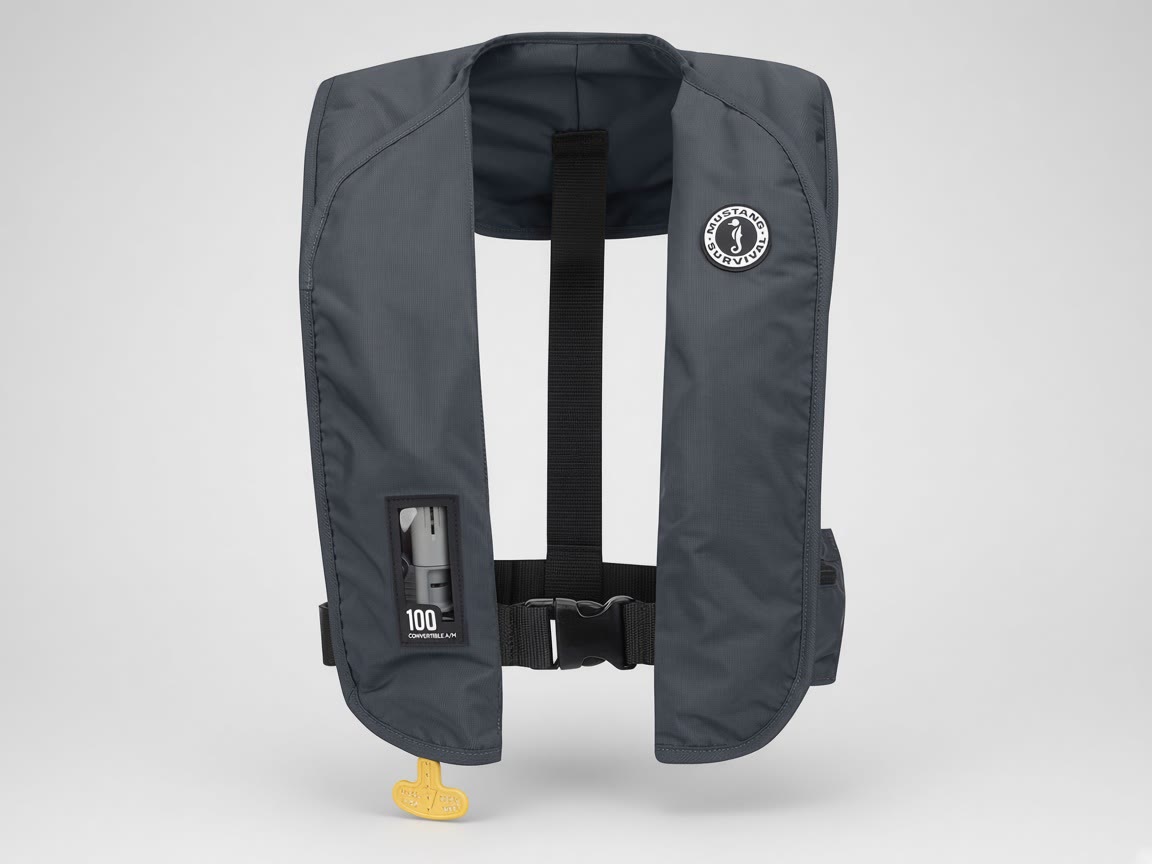
The Mustang card is the gray MIT 100. The brand cell says MUSTANG SURVIVAL. The model is MD2030-191-0-235. The ASIN is B0CMG86LLF. The UPC is 062533004191. The color cell says Admiral Gray. The material cell says 200D high-tenacity nylon. The size cell says One Size. The style cell says Life Jacket / Personal Flotation Device. The pattern cell says Solid. The title says Convertible A/M. The description calls it the MIT 100 Automatic Inflatable PFD, names Membrane Inflatable Technology, a manual inflation cord, a single-fold repack, an inspection window, and a highly adjustable waist belt. A feature bullet says the jacket is USCG approved and then, in the same list, calls it a manual inflatable and assigns it 28 pounds of buoyancy. Another bullet says 500D Cordura. The material cell says 200D. The title says convertible automatic and manual. The description says automatic. A feature says manual. Three inflation stories and two fabric weights are on one card.
Twenty-eight pounds is the buoyancy figure you can quote, and only as a feature sentence, not as a buoyancy cell with a test method. The camo listing of a different part, MD2030CM-261-0-202, also says 28 pounds in its description and says the inflated vest can turn most wearers face-up. That sentence is the camo ASIN. Do not paste face-up onto B0CMG86LLF unless the gray card's own text says it. The gray description in the extract does not. USCG approved, in the feature, does not print a type number. Type II, Type III, and Type V are different approvals. If the label in the vest says a type, that label beats a feature that stopped at the word approved. The card does not print a user weight, a chest size, or an age. One Size is the size cell. One size on an inflatable belt is a belt that adjusts, not a vest that fits every body. The description says the belt conforms to outerwear. It does not print a minimum chest.
200D in the material cell and 500D in a feature cannot both be the shell unless the vest uses two fabrics and the card does not say which panel is which. The gray photo on the listing is a single shell. Read the tag. If the tag says 200D, the 500D bullet is a leftover from another product. If the tag says 500D, the material cell is the leftover. Do not average them into 350D. An older automatic-only MIT 100, model MD201603191, ASIN B01KH4CC3G, names re-arm kit D, model MA2014. That kit number is not on the MD2030 card this page is reading. Do not buy MA2014 for this gray vest until the owner's card in the box names it.
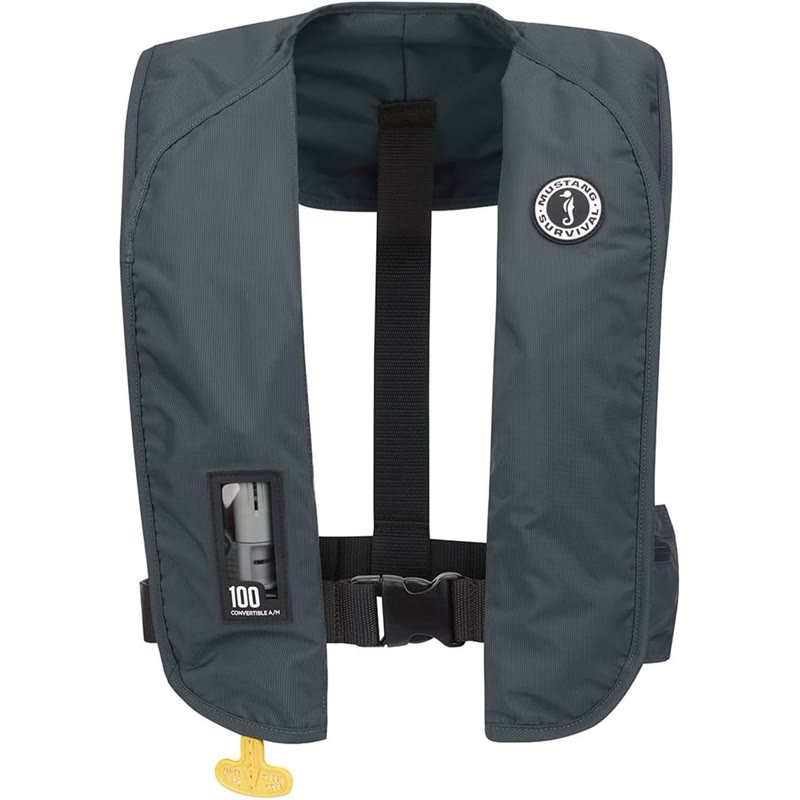
The Onyx card is the blue A/M-24. The brand is Onyx. The model is 132000-500-004-15. The ASIN is B00NXVUM60. The UPC is 043311048217. The color cell says Blue. The material cell says Nylon. The size cell says One Size. The age cell says Adult. The additional-features cell says Not_Performance_Used. That string is a broken field. It is not a feature of the vest. The real features say the jacket is USCG approved, inflates on immersion or when the handle is pulled, includes an oral tube, is approved for users 16 or older and over 80 pounds, and fits a 30-to-52-inch chest. They say 22.5 pounds of buoyancy when fully inflated. They say it converts to manual-only with a cap included, for paddling and fly-fishing where you expect to get wet. They name rearming kit 1352. They say the cover uses 200-denier nylon ripstop and 200-denier nylon oxford. They name a stretchable Flex-Back insert and a neoprene neckline.
22.5 pounds is the Onyx buoyancy sentence. 28 pounds is the Mustang feature sentence. Those are different numbers. Do not split the difference at 25. A foam Type III vest is often sold around 15.5 pounds of inherent buoyancy. These two are inflatables, so the buoyancy is in the fired bladder, not in the nylon you wear all day. Until the cylinder fires, you are wearing a belt. The Onyx card says that clearly enough: automatic on immersion, manual on the handle, oral tube as backup, and a conversion to manual-only when you do not want a splash to fire the vest. The Mustang title says convertible A/M, which is the same idea, and then the feature list calls the vest manual. Believe the part number and the label in the bladder cover. The yellow handle on the gray vest is a manual pull. It does not, by itself, prove the vest cannot also fire when it is submerged. The card's own title says A/M.
Not_Performance_Used is the cell you throw out. It does not mean the vest is not for performance paddling, even though the features do warn you to convert to manual-only when you expect to swim or get waved on. It means the additional-features field was filled with a placeholder. Nylon in the material cell is true and less specific than the 200-denier sentence in the features. The denier is the number you can use. 200 denier on the Onyx is at least a number that matches itself. The Mustang card's 200D cell and 500D bullet do not.
| Job | Mustang MD2030-191-0-235 | Onyx 132000-500-004-15 | Buy |
|---|---|---|---|
| What you are holding | MIT 100 Convertible A/M, admiral gray | A/M-24, blue | Match the part on the label. |
| Buoyancy | Feature says 28 pounds. | Feature says 22.5 pounds. | Mustang if you are quoting the higher feature. Onyx if you want the chest size that comes with the lower number. |
| Who it fits | Size cell says One Size. No age cell. | 16 or older, over 80 pounds, chest 30 to 52 inches. | Onyx if you need a printed chest range. |
| How it inflates | Title says A/M. Description says automatic. A feature says manual. | Automatic on immersion, manual handle, oral tube, converts to manual-only. | Onyx if you want one story. Mustang only after you read the label in the vest. |
| Fabric | Material cell says 200D. A feature says 500D Cordura. | 200-denier ripstop and 200-denier oxford. | Onyx if you want the denier to agree with itself. |
| Rearm | This card does not name a kit. An older MIT 100 names MA2014. | Features name kit 1352. | Buy the kit the vest's own card names, not a kit from a different model. |
Who should buy the MIT 100, and who should buy the A/M-24?
Buy MD2030-191-0-235 if you want the admiral-gray convertible MIT 100, the 28-pound feature sentence, and the 200D material cell, and if you will throw out the 500D bullet and the feature that calls a convertible vest manual-only. Buy 132000-500-004-15 if you want the blue A/M-24, the 22.5-pound feature, the printed chest of 30 to 52 inches, the age and weight limits, and kit 1352, and if you will throw out a cell that says Not_Performance_Used. Buy the Onyx if you paddle and you need the manual-only conversion the features describe, because a splash should not empty your cylinder. Buy the Mustang if the gray vest's label, not just the messy bullets, confirms the convertible inflator and you want the higher buoyancy figure the feature prints.
Do not buy either inflatable for a child. The Onyx card says 16 or older and over 80 pounds. The Mustang card does not print an age, which is not permission to put it on a kid. Do not buy either one as a whitewater vest or a ski vest. The Onyx features point at boating, fishing, and paddling, and they tell you to convert to manual when you expect to get wet. A foam Chinook or a foam FIT is the vest you wear when you will be in the water on purpose. Do not buy a rearm kit from the wrong model and call the vest armed. An unarmed inflatable is a belt.
What is MD2030-191-0-235 actually for?
This card is one admiral-gray MIT 100, part MD2030-191-0-235, ASIN B0CMG86LLF, UPC 062533004191. Use it as an adult inflatable belt whose title says you can run it automatic or manual, whose feature claims 28 pounds once it inflates, and whose shell the material cell calls 200D nylon. The description's single-fold repack and inspection window are the service story. Look through the window before you leave the dock. A red or a missing indicator means the vest is not armed. The card does not print the color of a good indicator. The owner's paper in the box does. The yellow handle is the manual pull. Know where it is before you need it. Practice the pull on land only if you own a spare cylinder and you are willing to repack. A practice firing with no spare is how you boat the rest of the day in a nylon belt.
One Size means the belt adjusts. It does not mean the bladder will roll every body face-up. The card does not print a turning test. If you need a vest that floats you face-up without a fired bladder, you need foam, and you need the type printed on that foam vest. This inflatable's USCG word, without a type number, is not that vest. Wear it closed. An open belt does not become 28 pounds of buoyancy when you fall in, because you are no longer wearing it.
What is 132000-500-004-15 actually for?
This card is one blue A/M-24, part 132000-500-004-15, ASIN B00NXVUM60, UPC 043311048217. The useful identity is that part, the 22.5-pound feature, the 30-to-52-inch chest, 16 years and older, over 80 pounds, kit 1352, and the 200-denier cover. Use the automatic mode on a boat when you do not expect to swim. Use the manual-only cap when you are paddling, fly-fishing, or anywhere a wave can soak the inflator. The features say the cap is included. If it is not in the bag, the conversion the card sold you is missing. The oral tube is the third way to put air in, after the cylinder and the handle. It is also how you empty the bladder. Do not twist the bladder to wring it. The Onyx how-to film says the same thing about not wringing, and that film is a manufacturer's demonstration, not this page's review embed.
The rearming-kit page for the A/M-24 lists a 24-gram CO2 cylinder with a half-inch thread, a Halkey-Roberts green indicator clip, and a water-soluble bobbin. That list is the kit page, not a cell on B00NXVUM60. The PFD card only names kit 1352. Buy 1352, then read the kit. A green A/M-24, part 132000-400-004-18, and a pink one, part 132000-105-004-14, are different ASINs. Blue is this one. Not_Performance_Used is not a reason to skip the chest measurement. If your chest is outside 30 to 52 inches, this card does not fit you, whatever the additional-features cell says.
How do you arm them without mixing the two cards?
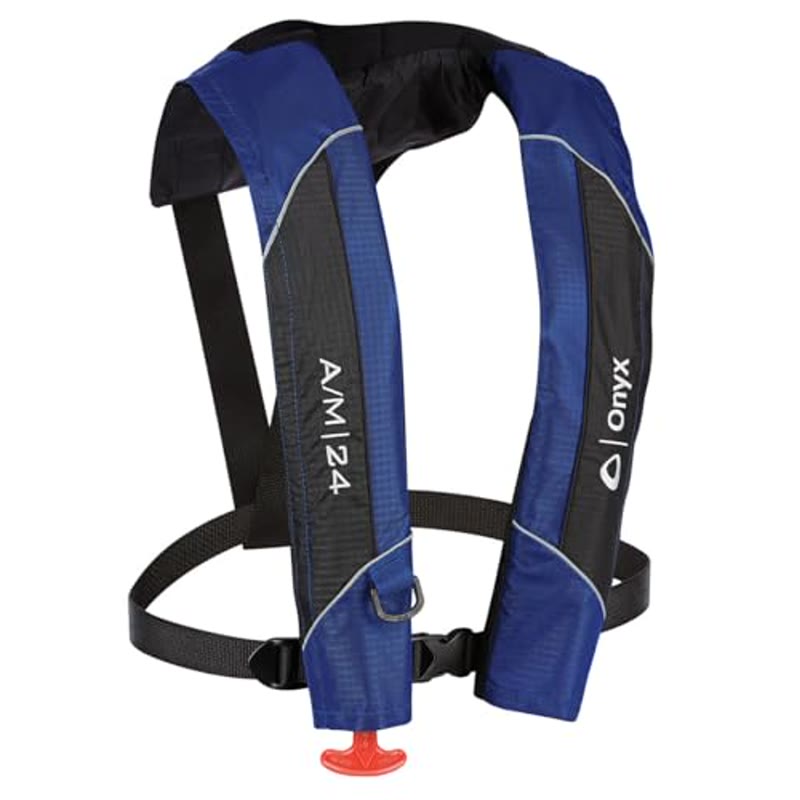
Arm the Onyx with kit 1352, the bobbin dated within the window the kit's own instructions print, the indicator that shows green, and the cylinder that has no hole in the end. Arm the Mustang with the kit the paper in that box names, not with MA2014 from the older automatic-only model unless that paper says so. A green clip in the wrong housing is not an armed vest. After a firing, the cylinder is empty. The vest will not fire again until you replace it. Repack on a dry table. Moisture in the inflator is how an automatic vest fires in a locker. The Onyx features tell you to buy an extra kit so you can learn the vest. That is the right use of a spare. Learning it in the parking lot once is worth more than reading the 28-pound sentence twice.
Convert the Onyx to manual-only before a day when you will get splashed. Leave it automatic on a calm deck if the risk you care about is falling overboard unconscious. The Mustang title says you have the same choice, and a feature says you do not. Resolve that on the inflator, not in the bullet list. Neither card prints a service interval in months. The bobbin on an automatic inflator has a date. Read it every spring. A three-year-old bobbin is a bobbin the Onyx kit instructions tell you to question. That three-year note is the kit film's instruction, not a cell on the gray Mustang card.
What actually fails on these two cards?
The Mustang card fails when manual, automatic, and convertible are averaged into a vest that is somehow all three without a look at the inflator. It fails when 200D and 500D are averaged. It fails when 28 pounds is called a cell instead of a feature sentence. It fails when a USCG type number is invented. It fails when MA2014 from the older model is ordered for MD2030 without the paper in the box. It fails when One Size is read as a chest measurement. It fails when the face-up sentence from the camo ASIN is pasted onto the gray one.
The Onyx card fails when Not_Performance_Used is read as a use instruction. It fails when 22.5 pounds is rounded up to the Mustang's 28. It fails when kit 1352 is replaced with a 33-gram or a 16-gram cylinder from a different vest. It fails when the 24-gram note on the kit page is cited as a cell on the PFD. It fails when a child under 16 is put in a vest the features forbid. It fails when automatic mode is left on for a day of rolling a kayak. It fails when a green or pink part number is accepted as 132000-500-004-15 because the family name matches.
What is this comparison not?
This is not a claim that 28 pounds of inflated buoyancy is safer than 22.5 for every body. The cards do not print a turning study you can compare side by side. This is not a foam-vest review. The Chinook and the FIT are foam. This is not a price quote. The price changes. Use the buttons if you want the live listing. This is not legal advice about which PFD your state requires on a given boat. The label in the vest and the local rule are the approval. The word USCG on a bullet is the start of that reading, not the end.
So which inflatable should you buy?
Buy the Mustang if you want part MD2030-191-0-235, ASIN B0CMG86LLF, admiral gray, the 28-pound feature, and the 200D material cell, and if you will throw out the 500D bullet and the feature that calls the vest manual. Buy the Onyx if you want part 132000-500-004-15, ASIN B00NXVUM60, blue, 22.5 pounds, a 30-to-52-inch chest, kit 1352, and one inflation story, and if you will throw out Not_Performance_Used. Buy neither if you wanted a foam vest, a child's vest, or a rearm kit the card does not name. The part number is the decision. The Mustang feature list is the warning.
St. Augustine Kayak Fishing's film, "Product Review: Onyx A/M 24 Inflatable PFD," shows an Onyx A/M-24. The title does not say 132000-500-004-15, and the clip does not show the Mustang MIT 100 or part MD2030-191-0-235. Use it for an A/M-24 on a paddler. Do not use it as a measurement of the 28-pound Mustang feature.
Frequently asked questions
Mustang MD2030-191-0-235 or Onyx 132000-500-004-15?
The Mustang if you want the admiral-gray MIT 100 and the feature that says 28 pounds of buoyancy, and you will ignore a bullet that calls it manual and another that says 500D. The Onyx if you want the blue A/M-24, 22.5 pounds, a 30-to-52-inch chest, and rearming kit 1352.
What buoyancy does each card print?
The Mustang feature list says 28 pounds. The Onyx feature list says 22.5 pounds when fully inflated. Neither figure is printed in a separate buoyancy cell with a test method.
How does each card say the vest inflates?
The Mustang title says Convertible A/M, the description says automatic, and a feature says manual. The Onyx features say it inflates on immersion or with the handle, includes an oral tube, and converts to manual-only with a cap.
Who does the Onyx card say the vest fits?
Users 16 or older, over 80 pounds, with a chest from 30 to 52 inches. The Mustang size cell says One Size and does not print an age or a chest range.
Which rearming kit does each card name?
The Onyx features name kit 1352. The Mustang card for MD2030-191-0-235 does not name a kit. An older automatic-only MIT 100 names kit MA2014, and that kit is a different model.
Does the video show both life jackets?
No. The clip is titled Product Review: Onyx A/M 24 Inflatable PFD. It shows an Onyx A/M-24. It does not name part 132000-500-004-15 and it does not show the Mustang MIT 100.