
National Forest Christmas Tree Permit: 2026 Guide
Written by Outdoors Magazine|
Outdoors Magazine is a participant in the Amazon Services LLC Associates Program. We may earn a commission if you buy through links on this page, at no extra cost to you. Affiliate disclosure.
Buy a Christmas tree permit for a national forest online through Recreation.gov or at a ranger district office, print it, and follow that forest's rules on tree height, stump size, no-cut zones and tree limits. Fees and rules vary by forest, and fourth graders with an Every Kid Outdoors pass can get a free permit.
Key takeaways
- Buy and print your permit on Recreation.gov or at a ranger district office.
- Rules vary by forest: height caps of 12 to 15 feet and 6-inch stumps are common.
- Fourth graders with an Every Kid Outdoors pass can get a free tree permit.
- Expect unplowed roads: carry chains, a shovel, food, water and a full tank.
Buy a national forest Christmas tree permit online through Recreation.gov or at a ranger district office, print it, and follow that forest's rules on tree height, stump size, no-cut zones and tree limits. Fees and rules vary by forest, and fourth graders with an Every Kid Outdoors pass can get a free permit.
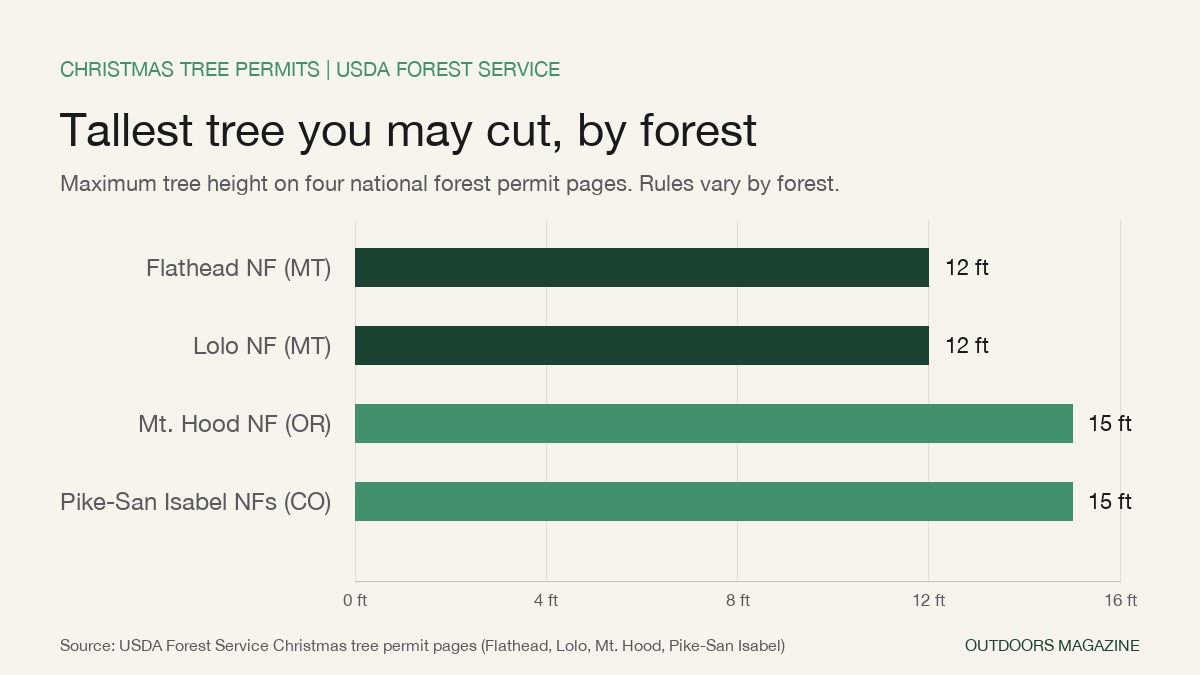
Maximum Christmas tree height allowed on four national forests: 12 feet on the Flathead and Lolo in Montana, 15 feet on Mt. Hood in Oregon and the Pike-San Isabel in Colorado. Source: USDA Forest Service Christmas tree permit pages.
Cutting your own tree on public land is one of the cheapest and most memorable ways to bring a tree home. It is also a real winter trip into country that is not plowed, patrolled or signed the way a tree lot is. The permit is the easy part. The harder parts are knowing which rules apply on your forest, getting to a legal cutting area on snowy roads, and getting a fresh-cut tree home without losing half its needles on the way.
This guide walks through how the Forest Service permit program works in 2026, using real rules from several national forest pages as examples. Treat those examples as just that. Every forest sets its own season, fee, size limits and no-cut zones, and the permit you print is the document that governs your trip. When this guide and your forest's page disagree, your forest's page wins.
How do you get a Christmas tree permit for a national forest?
Most people buy online. Recreation.gov runs a Christmas tree permit page where you pick a participating forest, read its rules and need-to-know information, then buy and print the permit before you go. Recreation.gov says each participating forest has its own guidelines and cutting-season dates. You need a Recreation.gov account to buy, and the Pike and San Isabel National Forests page notes that permits must be printed to be valid.
The list of participating forests is long but not universal. Recreation.gov lists forests in Arizona, California, Colorado, Florida, Idaho, Illinois, Michigan, Minnesota, Montana, Nebraska, Nevada, New Hampshire, New Mexico, North Dakota, Oregon, South Dakota, Utah, Vermont, Washington, West Virginia, Wisconsin and Wyoming. The Forest Service itself says that not every national forest or grassland offers the program, so if your nearest forest is missing, check its own website or call the district.
You can usually buy in person, too. The Forest Service says permits are available at its offices and from local vendors as well as online. On Oregon's Mt. Hood National Forest, for example, permits are sold at the Sandy, Welches, Parkdale and Dufur district offices and through vendors in several nearby towns, and the forest advises calling ahead because hours vary and vendors may sell out. Montana's Flathead and Lolo forests sell permits at local ranger district offices. Payment options can differ: the Pike and San Isabel page says its La Veta offices accept only cash or check.
Timing matters. Sales open on different dates by forest and even by district. The Kaibab National Forest in Arizona says its 2026 permits are available on Recreation.gov from October 8 through December 31. On the Pike and San Isabel, the page lists online sales starting as early as October 9 on one district and mid-November on others, and it warns that South Platte permits are online only and may sell out. Buy early if your forest is popular, and read the dates before you plan a weekend around them.
Once you have the permit, the Forest Service says to print it and display it on the dash of your vehicle on the day you cut. The Flathead and Lolo pages both say to print the permit, bring it with you and display it on your dashboard while you harvest.
How much does a national forest Christmas tree permit cost?
There is no single national price. Each forest sets its own fee, so the only reliable number is the one on your forest's permit page. To give a sense of the range, here is what several Forest Service pages list:
- Mt. Hood (Oregon): $5 per permit, per tree.
- Flathead and Lolo (Montana): $5 per tree.
- Superior (Minnesota): $5 plus a handling fee online.
- San Isabel (Colorado): $10 per tree.
- Kaibab (Arizona): $15 per tree for 2026, plus a processing fee.
- Pike (Colorado): $20 per tree.
Buying online often adds a small charge. Mt. Hood, Flathead and Lolo each list a $2.50 Recreation.gov fee, and Mt. Hood says its vendors and district offices add no extra fee. Household limits vary as widely as prices: Mt. Hood allows five trees per household per year, Flathead up to three, Lolo up to three permits per person, the Superior two tags per household, the Pike up to five per family and the San Isabel up to two.
Do not skip the permit to save a few dollars. The Pike and San Isabel page warns that cutting without a valid permit can bring a fine of up to $5,000, up to six months in prison, or both.
What are the rules for cutting a Christmas tree on a national forest?
The rules fall into a few predictable groups, but the numbers inside each group change from forest to forest. Read the permit and the cutting guidelines that come with it before you leave home, and carry them with you. The main categories:
Tree height. Most forests cap height. The Flathead and Lolo set a 12-foot maximum, while Mt. Hood and the Pike-San Isabel allow up to 15 feet. The Superior lists no height limit and simply asks you to pick a tree the right size for your home. Whatever the cap, measure your room and your vehicle first, a step the Lolo page specifically recommends.
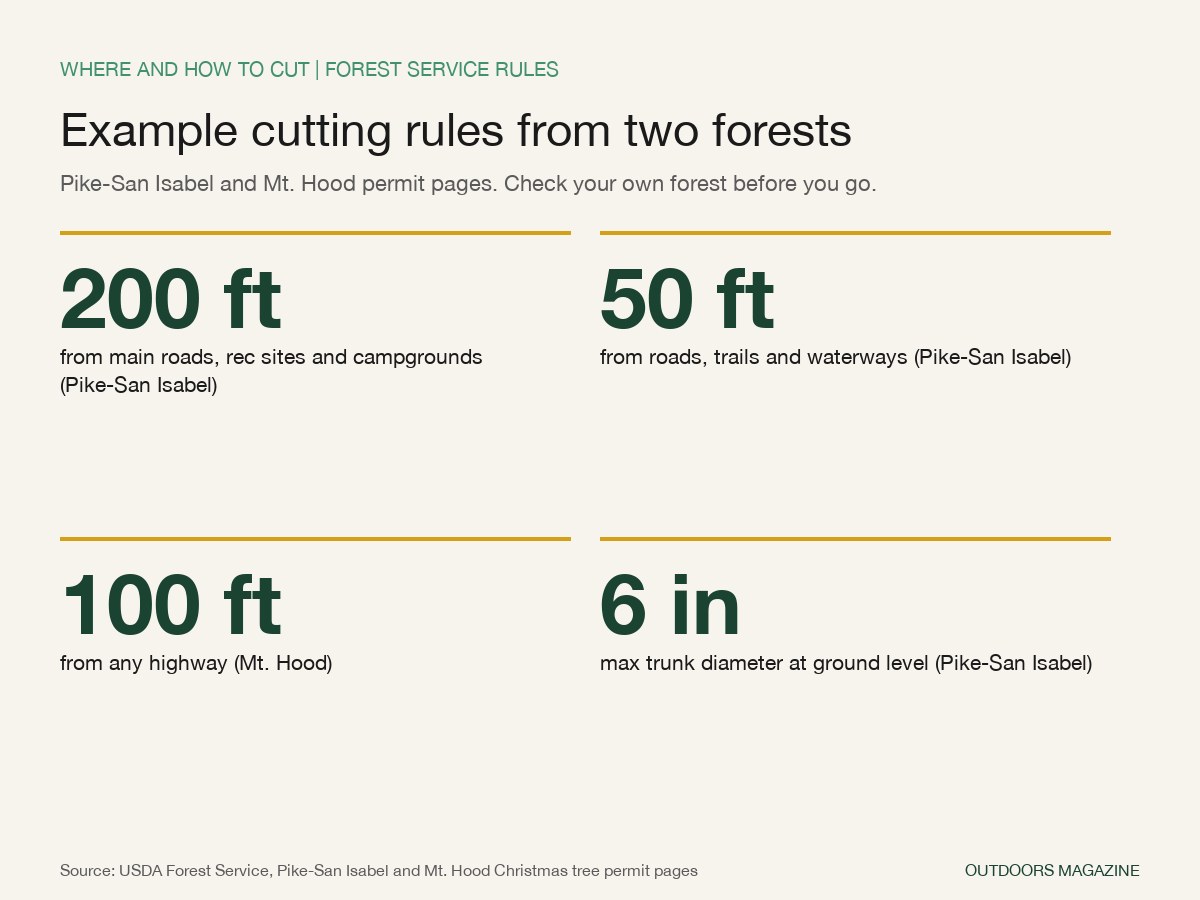
Trunk and stump size. The Pike-San Isabel caps trunk diameter at 6 inches at ground level. The Flathead and Lolo cap stump diameter at 6 inches and stump height at 6 inches, and Mt. Hood also requires a stump no more than 6 inches from the ground. The Superior allows a stump up to 12 inches. Recreation.gov's general advice is to cut close to the ground, leaving a stump of about 6 inches.
Take the whole tree. Nearly every page says the same thing: never cut the top off a taller tree and leave the rest standing. The Flathead, Lolo, Superior and Pike-San Isabel pages all prohibit topping.
Where you can cut. The Mt. Hood, Flathead, Lolo, Superior and Pike-San Isabel pages all put wilderness off limits, and most also bar cutting in campgrounds, active timber sales, plantations or recently planted areas. Some forests use exact buffers. The Pike-San Isabel says to stay at least 200 feet from main roads, recreation sites and campgrounds, and at least 50 feet from roads, trails and waterways. Mt. Hood bans cutting within 100 feet of any highway and adds that the tree must be growing within 12 feet of another tree, which keeps cutting focused on crowded stands. The Flathead and Lolo give no distances but forbid cutting trees visible from major roads, in campgrounds or in other well-used areas. The Superior bars cutting in the Boundary Waters Canoe Area Wilderness.
Species. Some trees are protected. The Flathead prohibits whitebark pine, white pine and western red cedar, and the Superior prefers balsam fir and does not allow white pine or cedar. Your permit or the forest's map will say which species you may take.
Land ownership. National forest boundaries are patchy, with private and state land mixed in. The Pike-San Isabel tells cutters to confirm they are on National Forest System land, and the Flathead points visitors to its Motor Vehicle Use Map and ownership maps. Many forests also provide maps for the Avenza mapping app.
One tree per permit, or more. This one surprises people. On Mt. Hood, the Lolo and the Superior, each permit covers one tree. A Flathead permit bought on Recreation.gov covers up to three trees, and a Kaibab permit covers up to five. If you buy at a Flathead office, you get one tag per tree.
Tags and display. Where tags are used, attach them before you drive. The Pike-San Isabel says to attach the permit tag to the main stem of the tree before transporting it and to display the printed permit on the dash. Mt. Hood sells tags at its district offices and requires online buyers to print and carry the permit and guidelines.
Tools. Some forests restrict what you can cut with. The Pike-San Isabel allows an axe or hand saw only and does not permit chainsaws. If your forest is silent on tools, a hand saw is still the simplest choice for a trunk this size.
Can fourth graders get a free Christmas tree permit?
Yes, on many forests. The Forest Service says fourth graders with an Every Kid Outdoors pass can get a free Christmas tree permit, either by bringing the voucher to a local Forest Service office or by entering the pass or voucher number when buying online. Recreation.gov says the pass is for fourth graders or the age equivalent and is valid from September 1 to August 31, and that a $2.50 reservation fee still applies to the free permit online.
The pass itself comes from everykidoutdoors.gov, which offers fourth graders and their families free access to federal parks, lands and waters for a full year. The site notes that not every site accepts the paper pass and suggests having an adult call ahead if you are unsure.
Forest details differ here too. Mt. Hood says the student must be present to get the free permit at a district office and that vendors do not offer it. The Flathead and Lolo offer one free permit to fourth graders through their offices or Recreation.gov. The Superior describes getting a voucher online and then picking up a Fourth Grade Pass at a national forest or park office. Whichever route you use, it is a good excuse to let the fourth grader pick the tree.
Can you cut a Christmas tree on BLM land?
Often, yes. The Bureau of Land Management sells personal-use Christmas tree permits in many western states, but there is no single national program. BLM permits are sold through the BLM's online forest products permit system at forestproducts.blm.gov and at participating field offices, and each field office sets its own sale dates, fees and cutting areas.
Colorado is a good example of the variety. The BLM Colorado page lists online permits for ten field offices with standard fees of $8 or $10 and sale dates scattered through November. Its rules echo the Forest Service: you need a valid permit to cut or remove a tree from BLM land, you may not top trees, you should cut below the lowest live limb and leave a stump no higher than six inches, and you must stay on existing roads and off private land. In southwest Oregon, a BLM Medford District announcement for last season described $5 permits valid on open lands of both the Medford District and the Rogue River-Siskiyou National Forest.
The BLM has also run reduced-fee promotions on tree permits in recent seasons. Terms and dates change, so check your state's page on forestproducts.blm.gov or call the field office for this year's price instead of relying on last year's headlines.
How do you stay safe on winter forest roads?
Treat a tree trip like a winter backcountry drive, because that is what it is. Forest pages are blunt about this. Mt. Hood says its forest roads are not plowed for winter travel, recommends four-wheel drive and high clearance, notes that many roads close seasonally, and says chains or traction tires are required on the mountain pass. The Pike-San Isabel says most Forest Service roads are unplowed and close after enough snow, that seasonal road closures take effect December 1, and that you may need snowmobiles, skis or snowshoes to reach some areas.
The Flathead and Lolo give a practical checklist: carry tire chains, a shovel and a tow chain, keep a full tank of gas, bring a spare key and give it to someone else in your group, and pack food, water and an overnight survival kit. They also warn that plowed winter roads may carry logging traffic, so drive carefully, park where others can pass and never block a gate. Plan to find your tree and leave the woods before dark.
A few habits help on any forest:
- Call the district first. The Forest Service says it is always best to check in with the local ranger district before heading out in winter, because rangers know current conditions and the best maps.
- Check the weather for the elevation you are going to. Mt. Hood points visitors to Weather.gov because higher elevations often differ from town.
- Tell someone your plan. BLM Colorado says to let someone know where you are going and when you plan to return, and if you are stranded, to call for help and stay with your group and vehicle.
- Go early in the season. BLM Colorado notes that some areas may be inaccessible after snowfall, so cutting early is advisable.
- Wear something bright. Hunting seasons are often open in December, and BLM Colorado suggests brighter clothing.
Get the vehicle ready before the trip. Our winter car emergency kit guide covers what to keep in the car, and our explainer on tire pressure in cold weather explains why your tires can read low on a frosty morning at the trailhead.
How do you cut and haul your tree home?
Start with the right gear. Recreation.gov suggests bringing a tape measure or your home's measurements, a rope and tarp for moving the tree to your vehicle, and a way to secure it for the drive. The Lolo page adds a hand saw, gloves and boots, plus rope or straps.
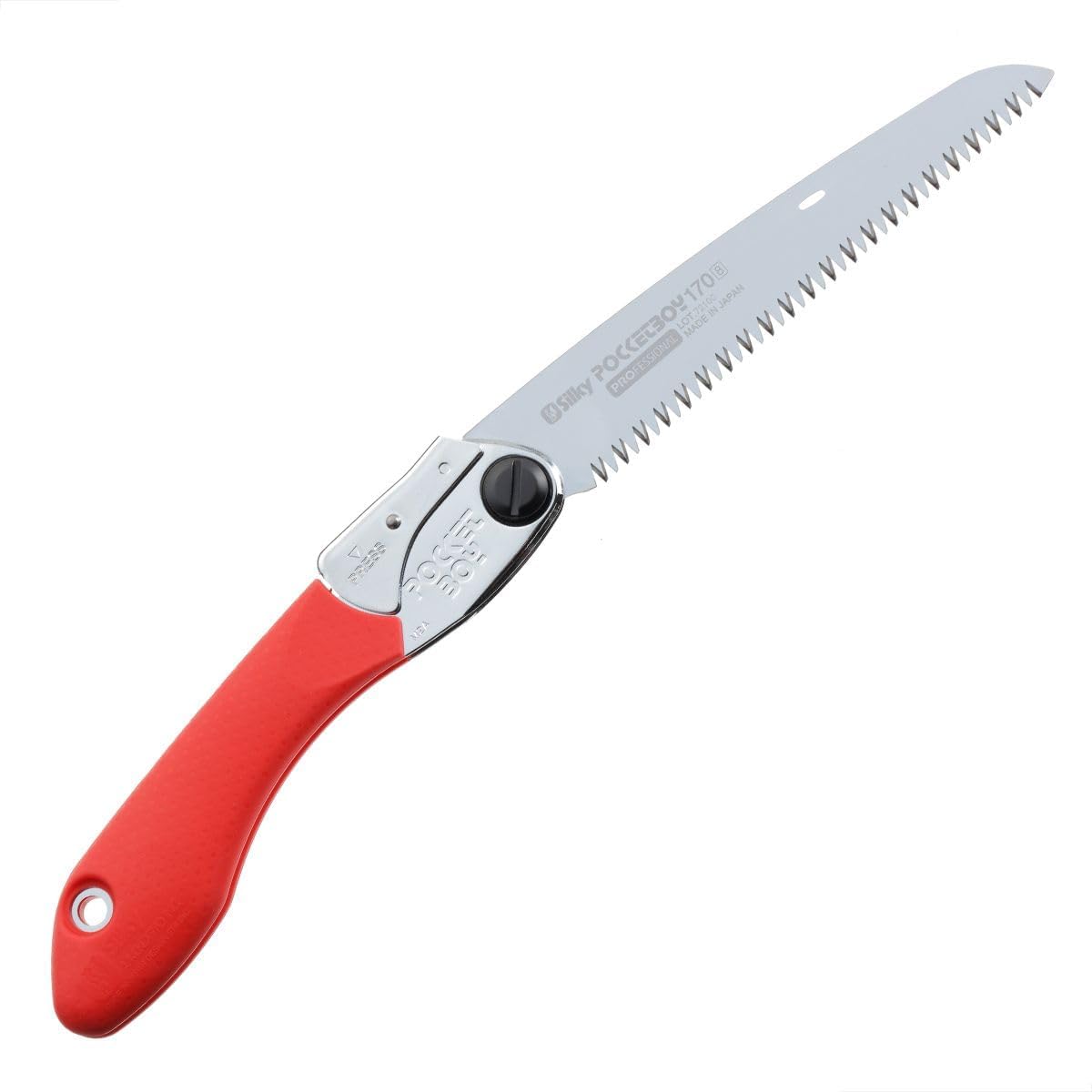
For a trunk that most forests cap at around 6 inches, a sharp folding saw or bow saw does the job and packs easily if you have to walk or snowshoe in. A folding pruning saw with large teeth is one option. The Silky PocketBoy 170 with large teeth, model 346-17, has a 6-3/4-inch blade with 6.5 teeth per 30mm, a non-slip rubberized handle and a blade that locks in two positions, according to the retailer Sherrill Tree, and it comes with a carrying case with a belt clip. It folds to about 8-1/4 inches.
If your forest allows an axe and you prefer one, keep it sharp; our guide on how to sharpen an axe walks through it. Check the permit first, because some forests, like the Pike-San Isabel, allow only an axe or hand saw and ban chainsaws.
Once you are in a legal area:
- Pick from a crowded stand. Recreation.gov suggests choosing a tree from an overcrowded stand, which helps thin the area, and the Lolo page says thinning helps the remaining trees grow faster.
- Measure honestly. Clear snow from the base so you can measure the stump height accurately, as the Lolo advises, and check the height and diameter against your permit.
- Cut low and take the whole tree. Cut close to the ground within your forest's stump limit. Never top a tree.
- Clean up. The Lolo says to cut leftover branches off the stump and scatter them, and the Pike-San Isabel says to limb the tree and scatter unused portions.
- Tag it. If your forest uses tags, attach the tag to the main stem before you move the tree.
Carry rather than drag. The Lolo page says dragging rubs off needles and bark, so carry the tree out or slide it on a tarp. For the drive home, the Lolo suggests wrapping oversized trees in canvas or a tarp to prevent wind damage, and Recreation.gov stresses securing the tree so it stays in place on the vehicle. Check the load after the first few miles.
Last, keep the printed permit with you until the tree is home. Forests such as the Pike-San Isabel require you to carry it while in the forest and to have the tag on the trunk before the tree is transported.
Sources: Recreation.gov: Christmas Tree Permits, Recreation.gov: Cut a Tree for the Holidays from Your National Forest, USDA Forest Service: Cut a Tree, Create a Memory, Mt. Hood National Forest: Christmas Trees, Flathead National Forest: Christmas Trees, Lolo National Forest: Christmas Tree Permits, Pike-San Isabel National Forests: Christmas Tree Permits, Kaibab National Forest: Christmas Tree Permits, Superior National Forest: Christmas Tree Tags, Every Kid Outdoors, BLM Colorado: Christmas Trees, BLM: A Holiday Tradition, Finding Your Christmas Tree in the Woods, Sherrill Tree: Silky PocketBoy 170 Large Teeth; Amazon B0014C7XS0.
Frequently asked questions
How do you get a Christmas tree permit for a national forest?
Buy it online through Recreation.gov by choosing a participating forest, or in person at a ranger district office or local vendor where the forest offers that. Print the permit, read the forest's cutting rules, and display the permit on your dashboard while you cut.
How much does a national forest Christmas tree permit cost?
Each forest sets its own fee, so check your forest's page. Examples include $5 per tree on Mt. Hood, the Flathead and the Lolo, $15 on the Kaibab for 2026 and $20 on the Pike, and Recreation.gov often adds a $2.50 fee.
What are the rules for cutting a Christmas tree on a national forest?
Rules vary by forest but usually cap tree height (12 to 15 feet on the forests reviewed here) and stump height or trunk diameter (often 6 inches), ban topping trees, and bar cutting in wilderness, campgrounds, timber sales and near roads. Your printed permit and cutting guidelines are the rules that apply to you.
Can fourth graders get a free Christmas tree permit?
Yes, on many forests. Fourth graders with an Every Kid Outdoors pass can get a free permit at a Forest Service office or by entering the pass or voucher number on Recreation.gov, where a $2.50 reservation fee still applies. Some forests require the student to be present for in-person permits.
Can you cut a Christmas tree on BLM land?
Often, yes. Many BLM field offices sell personal-use Christmas tree permits online at forestproducts.blm.gov or in person, with fees, dates and cutting areas set by each office. BLM rules generally require a valid permit, prohibit topping trees and limit stump height.
How do you stay safe on winter forest roads?
Expect unplowed or closed roads and carry chains, a shovel, a tow chain, a full tank of gas, food, water and an overnight survival kit. Call the ranger district for conditions, tell someone your plan, park so others can pass, and leave before dark.