
How to Use a Tree Stand Safety Harness the Right Way
Written by Outdoors Magazine|
Outdoors Magazine is a participant in the Amazon Services LLC Associates Program. We may earn a commission if you buy through links on this page, at no extra cost to you. Affiliate disclosure.
Wear a full-body fall-arrest harness that meets TMA-recognized standards every time you leave the ground. Stay connected with a lifeline or lineman's strap while climbing, attach the tether above your head with no slack when seated, carry a suspension relief strap and a phone, inspect the harness before each hunt, replace it after any fall, and tell someone your plan.
Key takeaways
- Wear a full-body harness from the ground up; single-strap belts are out.
- Attach the tether above your head with no slack when you sit.
- Use a lifeline or doubled lineman's strap so you are never unclipped.
- Suspension trauma can start within 20 minutes; carry a relief strap.
A tree stand safety harness works only if it is a full-body fall-arrest harness, worn from the moment you leave the ground until you are back on it, with the tether attached above your head and no slack when you sit. Add a lifeline for the climb, a suspension relief strap and a plan someone knows.
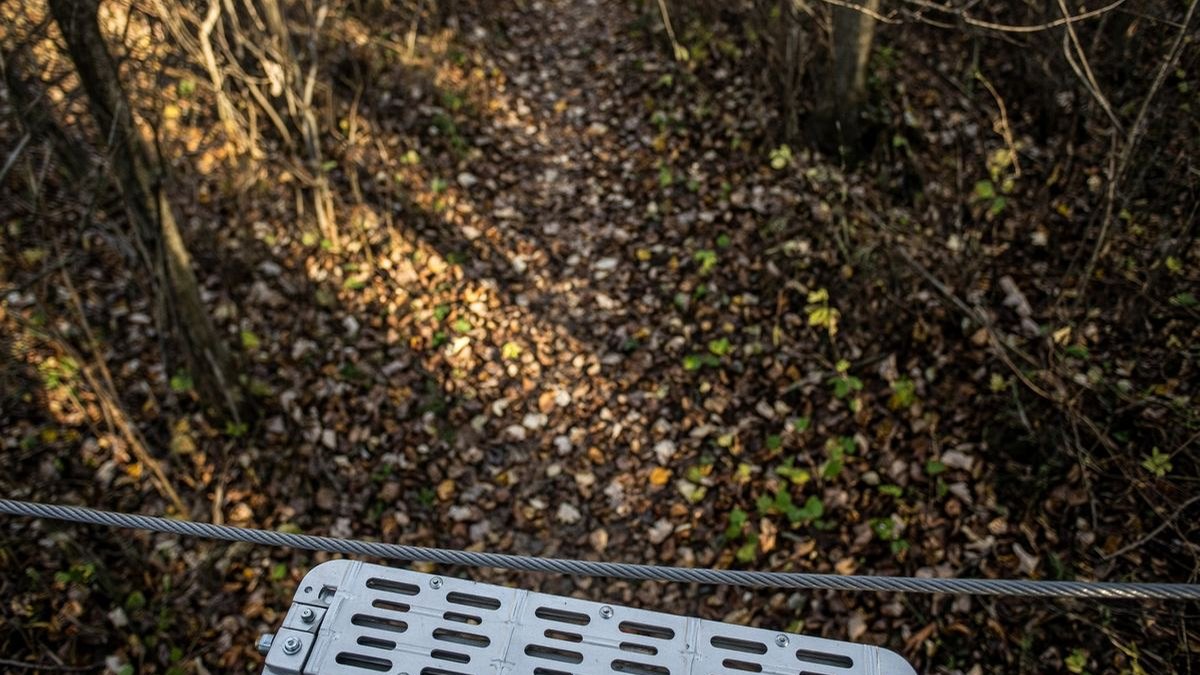
The ground looks a long way off from up here, which is exactly why the harness goes on before the first step. AI-generated editorial image of a view down from a tree stand, with the metal grated platform of a climbing tree stand and a cable in the foreground, high above a leaf-covered forest floor in low autumn light.
Late season brings bitter mornings, bulky coats and stands that have hung since October, a bad combination at height. The Wisconsin Department of Natural Resources says about one in four bowhunters it surveyed had fallen or nearly fallen from an elevated stand, and that fewer than half of Wisconsin deer hunters wear a harness every time they climb. In a 2003 survey of the state's gun deer hunters, about two-thirds of tree stand users owned a harness, but fewer than a third said they used it.
This guide draws on the Treestand Manufacturers Association (TMA), wildlife agencies in Wisconsin, Minnesota and New York, an OSHA bulletin and Hunter Safety System's instructions. One rule sits above all of it: the manual for your harness and stand wins. The TMA tells hunters to attach the harness the way the manufacturer describes and to read the warnings every season.
How does a tree stand safety harness work?
A full-body fall-arrest harness wraps your torso and legs and connects to the tree through a tether. Set up correctly, it keeps you at the stand if you slip, so you can get back onto the platform instead of hitting the ground or hanging far below it.
The TMA calls the gear a Full Body Fall Arrest Harness System and tells hunters to wear one that meets industry standards it recognizes every time they leave the ground, including while climbing up and down. Its guidelines are blunt about older gear: single-strap belts and chest harnesses are no longer allowed and should not be used. An old waist belt is not a fall-arrest device.
The tether is short on purpose. In Wisconsin DNR's words, the tether is designed to keep you in the seat, not to catch you after you fall. The Minnesota DNR says to attach the safety strap to the tree so that you cannot fall more than 12 inches, and notes that a harness gives about four inches of cushion in a fall as it tightens, slips and stretches. A long, loose tether defeats all of that.
On standards, the TMA says its members' products have had to comply with current ASTM standards since January 1, 2016, and are certified by a third-party testing firm. The association itself does not test or certify products.
How should a tree stand harness fit?
A harness should be snug but comfortable, with every buckle fastened and every strap lying flat. Adjust it over the clothing you will actually hunt in, then practice hanging in it close to the ground with another adult present before you climb.
A harness adjusted in September over a T-shirt may hang loose over a parka and bibs in December. Hunter Safety System says its vest-style harness adjusts for light and heavy clothing, and that big adjustments are easier with the harness off. Afterward, make sure no strap is twisted.
Hunter Safety System's manual covers the basics:
- Waist buckle: fasten it, listen for a full snap, then pull sharply on both sides to make sure it is locked. HSS warns never to rely on a vest's zipper to hold you in a fall.
- Leg straps: bring each leg strap between your legs to its own buckle, snap it in, and pull to check it, making sure no clothing is caught in the buckle. Both leg buckles must be used whenever the harness is worn.
- Snugness: adjust each leg strap so the webbing is comfortably snug to the leg.
- Tether routing: never wrap the tether around or across your neck or under your arms.
Then practice. The TMA says to practice with a responsible adult present and learn what it feels like to hang in the harness at ground level. Hunter Safety System adds that you should practice at least one self-recovery or suspension relief method near the ground.
What is the difference between a lineman's belt and a tether?
The tether is the strap that runs from the back of the harness to the tree and is what keeps you in the stand. A lineman's belt wraps around you and the trunk at waist level and is used while climbing or hanging a stand. It is a climbing aid, not a substitute for the tether.
In Hunter Safety System's design, the tether extends from the rear of the harness neckline to a tree strap, while the lineman's strap clips to loops on the front of the harness and runs around the trunk.
The manual is firm about how the two work together. Anytime you use the lineman's strap to go up or down a tree, you must stay doubly connected with both the lineman's strap and the tree strap and tether, and that second connection has to be made before you leave the ground. Slide the tether and tree strap up as you climb and down as you descend. When you reach a limb, you move one connection past it while the other stays attached, and you never have both removed at the same time. HSS also warns that whenever the tether is not attached to the tree, the harness used with a lineman's strap should be treated as a climbing aid only and not a fall restraint.
Only once you are on the stand with the tree strap secured do you remove the lineman's belt. And before adjusting a lineman's strap, HSS says to lean forward and take all pressure off the buckle, because webbing under load can pull through.
How do you stay connected from the ground up?
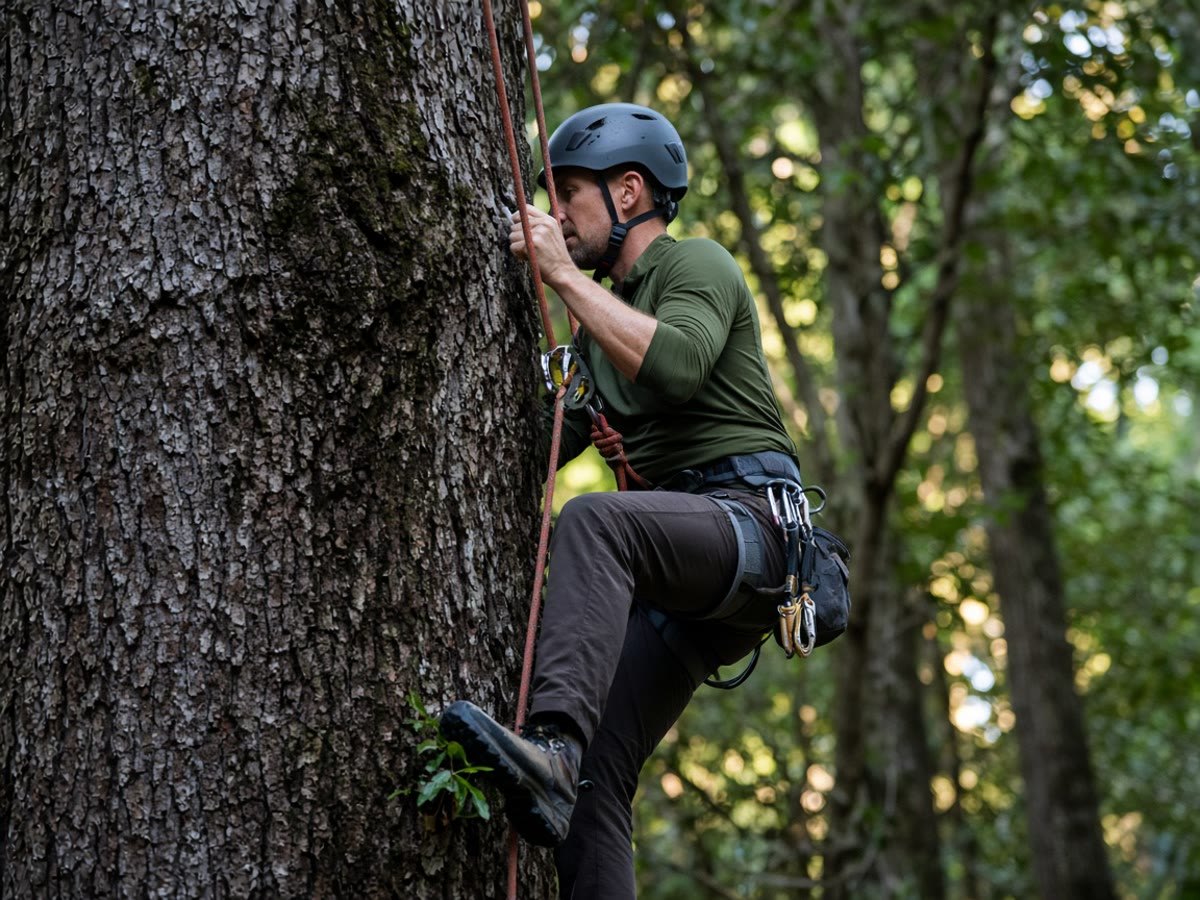
Use a lifeline or a lineman's strap with a tether so you are attached to the tree before your feet leave the ground and stay attached until they are back on it. A lifeline runs from the base of the tree to above your seat, and a prusik knot on it slides with you.
Wisconsin's DNR recommends a lifeline for climbing up and down, and New York's Department of Environmental Conservation describes how one works. It is a safety rope secured at the base of the tree or stand and to the tree just above your head when you are sitting in the stand. You attach the tether from your full-body harness to the lifeline using a carabiner and a prusik knot, which slides up and down the rope and keeps you connected at all times. Hunter Safety System recommends its Life Line accessory for ladder stands and hang-on stands. With a climbing stand, it says to attach the tether and tree strap at ground level and move them with you as you climb.
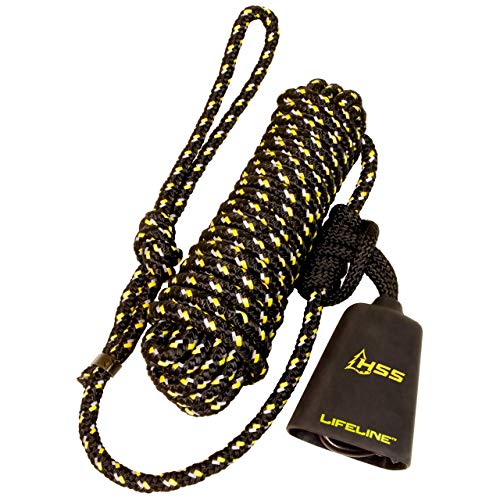
A ready-made lifeline is one way to get there. Sportsman's Warehouse's listing for the Hunter Safety System Reflective Lifeline, model LLS+, says it straps to the tree when you hang the stand, that you attach your tether to its carabiner and slide the prusik knot up to climb and back down when leaving, and that it has reflective material that lights up in a flashlight beam. The listing also says it comes with a Recon carabiner and a cowbell sound dampener meant to cut rattles. Follow the lifeline's own instructions for how high it can be used and how long it stays in service.
The TMA says never to climb with anything in your hands or on your back; use a haul line to raise your pack, gear, unloaded firearm or bow once you are at hunting height. When climbing with a stand, the TMA says to make slow, even movements of no more than ten to twelve inches at a time. On a ladder or steps, keep three points of contact. Minnesota's DNR says frost, ice or snow can make steps very slippery, so test each one. Hunter Safety System says never to hunt elevated in rain, lightning, high wind or icy conditions.
If you hunt from a climbing stand, our guide to the best climbing treestands covers the stands themselves and why practice at low height matters.
Where should the tether be attached in the tree stand?
Attach the tether to the tree above your head, at a height that leaves no slack in it when you are sitting. That keeps any fall short, so you stay at the platform and can get back onto it.
The TMA's guidelines say the tether should have no slack when you are sitting, and warn that failing to attach the harness properly can leave you suspended without the ability to recover into your stand. Hunter Safety System's instructions say to place the tree strap at a height that allows no slack in the tether while seated, which is often at or just above head height while standing on the stand. Its manual also says to pull the tree strap tight, test it by tugging sharply on the tether connection, and leave at least eight inches of webbing beyond the buckle.
That fits Minnesota's 12-inch rule: the higher and tighter the attachment, the less you drop and the easier it is to reach the platform again.
What is suspension trauma, and how do relief straps help?
Suspension trauma is what can happen when you hang motionless in a harness: blood pools in the legs, less reaches the brain and other organs, and a person can faint and, in serious cases, die. A relief strap lets you stand up in the harness and keep your legs working until you recover or help arrives.
OSHA's bulletin on suspension trauma, written for workers in fall-arrest harnesses, explains that leg muscles normally help push blood back to the heart; when the legs hang still, blood collects in the veins. If blood flow to the brain drops far enough, the result can be fainting, and someone unconscious in a harness stays upright instead of falling flat. OSHA says research indicates suspension in a fall-arrest device can lead to unconsciousness, followed by death, in less than 30 minutes. Wisconsin's DNR gives a shorter warning, saying suspension trauma can happen within 20 minutes and can be fatal. Treat the shorter figure as your clock.
OSHA lists warning signs that a person may be approaching this point, including faintness, breathlessness, sweating, paleness, nausea, dizziness and graying or loss of vision. Factors that can raise the risk include being unable to move the legs, injuries from the fall, fatigue, dehydration, hypothermia and shock.
The tools for staying ahead of it are simple:
- Get back to the stand fast. Minnesota's DNR says to recover as quickly as possible, because the longer you hang, the harder recovery gets. Grab the trunk or the climbing steps to take weight off the harness, then use three points of contact to get back on the stand or down.
- Use the relief strap. Wisconsin's DNR recommends an extra foot strap to relieve pressure on your upper legs if you fall, and New York's DEC says to make sure your harness has one. Hunter Safety System's manual says to clip its relief strap to the loop at the rear bottom of the harness and adjust it so you can step into it and stand. The company says never to use that strap or loop to attach yourself to the tree.
- Keep your legs moving. The TMA says that if you must hang while waiting for help, exercise your legs by pushing against the tree or keeping up some other continuous motion. OSHA's bulletin likewise advises pumping the legs and using footholds when rescue cannot happen right away.
- Keep help within reach. The TMA says to carry signal devices such as a cell phone, two-way radio, whistle, signal flare, personal locator device and flashlight on your person, within reach even while suspended. New York's DEC says pockets, not a pack hanging in the tree.
OSHA also says that anyone rescued after hanging in a harness should be monitored and evaluated by a health-care professional, because delayed effects such as kidney failure are hard to assess on the scene. If you or a partner has hung in a harness for any length of time, call for medical help rather than shrugging it off.
Finally, tell someone your plan. The TMA says to let others know your exact hunting location, when you plan to return and who is with you, and to hunt with a buddy when you can. Wisconsin's DNR adds where you will park. New York's DEC suggests leaving a map showing your stand location so others can find you if you do not return on time. Our first deer hunt checklist is a good place to write it down, and if you sit through long cold mornings, know how long hand warmers last so your fingers can still work buckles and a phone.
When should you inspect or replace a tree stand harness?
Inspect the harness, straps and buckles before every hunt, and replace it after any fall, when it reaches the maker's expiration date, or when parts are worn or damaged. Never repair or modify a harness yourself.
The TMA tells hunters to inspect both the stand and the harness for signs of wear or damage before each use, to contact the manufacturer for replacement parts, and to destroy products that cannot be repaired by the maker or that are past the recommended expiration date. It says a harness must be discarded and replaced after a fall. Minnesota's DNR says the same, especially if the tree tether had to be cut.
Hunter Safety System puts a firm date on its harnesses. Its manual says a harness bought new in a sealed package must be removed from service five years from the date of purchase, so keep your receipt. A harness obtained used must come out of service five years from the date of manufacture, which is printed on the tether label. The company also says not to modify, repair, alter, sew or cut its products, and to inspect belts, buckles and tree straps before each use.
The stand and its straps need the same attention. New York's DEC says to check your stand, including straps and chains, every season, replace worn or missing parts, and not leave a stand up all year. The TMA goes further and says never to leave a stand installed for more than two weeks, since weather and other factors can cause damage you cannot see. A stand hung in early fall has been through a lot by December. The TMA also says never to use homemade or permanently elevated stands, and Minnesota's DNR warns against trusting a permanent stand someone else built.
If you have a question about wear or damage, the TMA says to contact the manufacturer. And if the day ends with a deer down, the harness comes off only once you are on the ground; then it is time for field dressing the deer.
Last, know your limits. The TMA says that if you cannot recover or escape from a fall, hunt from the ground. Hunter Safety System says not to hunt elevated unless you are rested and alert, never after drinking alcohol, and not with back, heart or other conditions that could cause trouble at height; ask your doctor if that may be you. The TMA also offers a free online treestand safety course, which Wisconsin's DNR says takes about 15 minutes.
Sources: Treestand Manufacturers Association: Treestand Safety Guidelines, TMA: Standards, TMA, Wisconsin DNR: Tree Stand Safety, Minnesota DNR: Tree stand safety, New York DEC: Tree Stand Best Practices, OSHA: Suspension Trauma/Orthostatic Intolerance bulletin, Hunter Safety System: Harness with Lineman's Climbing Strap manual, Sportsman's Warehouse: HSS Reflective Lifeline listing, Aztek: HSS LLS+ Lifeline listing; Amazon B00QQNVDVA.
Frequently asked questions
How does a tree stand safety harness work?
A full-body fall-arrest harness wraps your torso and legs and connects to the tree with a short tether, so a slip leaves you at the stand instead of on the ground. The TMA says to wear one every time you leave the ground, and that single-strap belts and chest harnesses should no longer be used.
How should a tree stand harness fit?
It should be snug but comfortable, with the waist and both leg buckles fastened and tested and no twisted straps. Adjust it over the clothing you will actually hunt in, and practice hanging in it near the ground with another adult present, as the TMA and Hunter Safety System recommend.
What is the difference between a lineman's belt and a tether?
The tether runs from the back of the harness to the tree and is what keeps you in the stand. A lineman's belt goes around you and the trunk at waist level and is used while climbing or hanging a stand. Hunter Safety System says to stay doubly connected with both while climbing, and treats a lineman's belt without the tether attached as a climbing aid, not fall restraint.
How do you stay connected from the ground up?
Use a lifeline or a lineman's strap plus tether so you are attached before you leave the ground and until you are back on it. New York's DEC describes a lifeline secured at the base of the tree and just above your seated head, with your tether clipped to it by a carabiner and a sliding prusik knot. Raise gear with a haul line instead of climbing with it.
Where should the tether be attached in the tree stand?
Attach it to the tree above your head, high enough that there is no slack when you sit. The TMA says the tether should have no slack when sitting, and Minnesota's DNR says to set it so you cannot fall more than 12 inches, which keeps the platform within reach.
What is suspension trauma, and how do relief straps help?
Suspension trauma happens when you hang still in a harness and blood pools in your legs, which can cause fainting and can be fatal; Wisconsin's DNR says it can happen within 20 minutes. A relief strap lets you stand in the harness and keep your legs working, while you recover to the stand or wait for help. Anyone who has hung in a harness should be checked by a health-care professional.