
How to Sharpen an Axe by Hand: File, Stone and Strop
Written by Outdoors Magazine|
Outdoors Magazine is a participant in the Amazon Services LLC Associates Program. We may earn a commission if you buy through links on this page, at no extra cost to you. Affiliate disclosure.
Here's how to sharpen an axe by hand: clamp the axe so the head overhangs a bench, wear leather gloves, and push a guarded mill bastard file from the edge into the cheek on both sides, keeping the original curved bevel. Then hone with a coarse, then fine, axe stone in small circles until the burr is gone.
Key takeaways
- Clamp the axe, wear gloves and use a file with a handle and guard.
- Push the file from the edge toward the center; never saw or file toward the edge.
- Keep the original curved bevel; hone coarse then fine until the burr is gone.
- Skip the high-speed dry grinder; heat can ruin the edge's temper.
Here's how to sharpen an axe by hand: clamp the axe so the head overhangs a bench, wear leather gloves, and push a guarded mill bastard file from the edge into the cheek on both sides, keeping the original curved bevel. Then hone with a coarse, then fine, axe stone in small circles until the burr is gone.
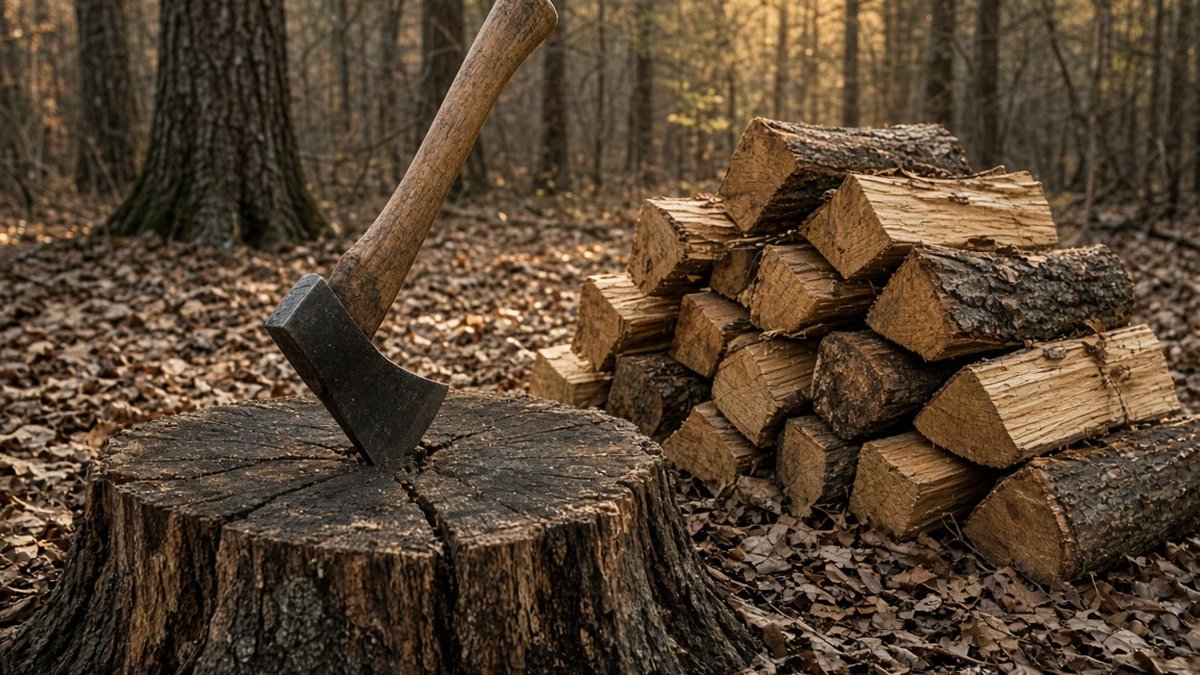
A sharp edge starts at the bench, long before the first swing. AI-generated editorial image of an axe sunk in a tree stump beside a stack of split firewood in an autumn forest at golden hour.
A dull axe is not just slow. It tends to glance off wood instead of biting into it, and a glancing blade is a safety hazard. The U.S. Forest Service puts it simply in its current ax manual: a sharp ax is a safe ax. The good news is that keeping one sharp needs nothing more than a file, a stone and some patience, and none of it needs electricity.
This guide follows the hand method laid out in the Forest Service manuals, An Ax to Grind from 1999 and its 2020 successor, One Moving Part, along with care guidance from the Swedish axe maker Gränsfors Bruk. It covers the tools, how to hold the axe and the file safely, how to keep the curved bevel that makes a chopping axe work, how to hone and test the edge, and why the bench grinder in the garage is the wrong tool for the last step. If your axe has deep chips, a cracked or bulging eye, or an edge filed back past the hardened steel, it may need more than sharpening; the Forest Service says some heads are simply not worth restoring.
What tools do you need to sharpen an axe?
You need a single-cut mill bastard file fitted with a handle and a guard, leather or cut-resistant gloves, a way to clamp the axe, and a round axe stone with a coarse and a fine side. A fine finishing stone and a leather strop are optional extras for a keener final edge.
A mill bastard file. The 1999 Forest Service manual names 8-, 10- and 12-inch mill bastard files for ax work. They are single-cut files, which means they cut only on the push stroke. That one detail shapes the whole technique: you push, lift, return and push again. Keep files apart from each other and from other tools in storage, because banging them together dulls their teeth, and clean clogged teeth with a file card.
A handle and a guard. Fit the file with a handle and a guard, so that if the file slips your knuckles stop against the guard rather than the edge. The 1999 manual notes that guards can be made of leather, wood or old fire hose.
Gloves. Both Forest Service manuals call for leather gloves while sharpening, and the 2020 edition accepts good cut-resistant gloves as an alternative, at a minimum on the hand that could touch the edge. The edge gets sharper with every stroke, so the risk climbs as you finish.
An axe stone. Axe stones are small round stones, typically with a coarse side and a fine side, sized to fit in one hand. Some have a groove around the middle that keeps your fingertips back from the edge. Gränsfors sells a ceramic stone, a natural whetstone, a diamond file and a finely cut axe file, and says the choice among them is largely personal preference. A fine diamond stone or a hard Arkansas stone is useful for the last, finest pass.
Optional: a strop. A piece of leather glued to a board, with or without honing compound, polishes the edge and pulls off the last wire of burr. The Forest Service author uses a strop mounted on a hardwood board 3 inches wide and 12 inches long, and suggests leather at least 1/8 inch thick if you make your own.
How do you file an axe without cutting yourself?
Secure the axe to a bench with the head sticking out, fit the file with a handle and guard, and wear gloves. Use firm push strokes from the cutting edge toward the center of the head, lift the file on the return, and never saw back and forth or file from the back toward the edge.
Start with a clean head. Wipe off sap, dirt, oil and rust so you can see what you are doing and so grit doesn't load the file. Then secure the axe to a workbench so that it cannot shift, with the head sticking out over the edge of the bench. Good light matters: the Forest Service recommends enough lighting to work safely and to watch the progress of the filing, and a lamp raking across the steel shows low and high spots that overhead light hides.
Before you file, run your gloved fingertips across both cheeks and along the edge. You are looking for chips, flat spots and thick areas, and planning where metal needs to come off. A felt marker helps: the Forest Service suggests marking the high spots you want to file down and the low spots to leave alone.
Hold the file with both hands, one on the handle and one on the far end, and make long push strokes from the cutting edge toward the center of the head. Lift the file at the end of the stroke, bring it back to the start in the air, and push again. Don't drag it back across the steel in a sawing motion; a bastard file only cuts on the push, and sawing just clogs and wears it. Don't file from the back of the head toward the edge either, because that can roll the thin edge over. Keep the pressure even through the whole stroke. The 2020 manual notes that beginners tend to bear down in the middle of the stroke, which digs a hollow into the cheek.
Work both sides. Unclamp, flip the head, clamp it again and file the other side, alternating rather than finishing one side completely first. Aim for a fan shape across the bit and leave the toe and heel, the two unsupported corners of the edge, a little thicker than the middle so they don't chip. As the edge thins, a fine wire, or burr, forms on the opposite side. That burr is a sign that you have filed all the way to the edge on that side. As the edge takes shape, the 2020 manual switches to draw strokes, with the file tipped slightly so its back edge cuts, to remove steel just behind the edge and leave a smoother finish.
What angle should an axe edge be?
Keep the shape the maker gave it. The Forest Service ax manual gives about 18 degrees for the bevel of a typical work ax, with a tiny microbevel near 25 degrees for strength, while Gränsfors Bruk lists 25 to 30 degrees only for a thin, straight carving edge. A convex, curved profile is standard for chopping.
Angles get a lot of attention, but the bigger mistake is changing the shape. Gränsfors Bruk's first rule of sharpening is to always keep the original shape of the edge, removing the same amount of steel from each side and along the whole length. It warns that a wrongly ground axe slips more easily. If your axe came with a curved bevel, keep it curved; if it came with a straight bevel, keep that straight and lay the whole bevel face on the stone or file.
For a general work axe, the Forest Service teaches a convex profile: lay a straightedge across the cheek and it rocks on a rise, with space on either side. That curve lets the head penetrate, push the wood apart like a wedge, and release cleanly. A flat profile can bite deeper but tends to stick and is more prone to chipping, and an edge that is too thick bounces off. Gränsfors says much the same thing from the other direction: hardwood and frozen wood call for a fairly thick bit with a rounded bevel, softwood allows a more pointed edge, and curved edges on forest axes are stronger.
Where numbers are given, they come with context. The 2020 Forest Service manual says a typical Forest Service double-bit ax has a bevel of about 18 degrees on its clear-wood side and up to 28 degrees on the side used for knots, and its diagram gives a range of 17 to 21 degrees for the bevel and 25 to 32 degrees for the microbevel. The microbevel is a tiny secondary edge, perhaps 1/16 inch wide, that adds strength. Gränsfors gives 25 to 30 degrees for a thin, straight carving edge. Your axe's maker may publish its own figure, and that figure, or the shape your axe already has, is the one to follow. The 1999 manual adds that a splitting axe should have a steeper angle than a felling or bucking axe. If you are still choosing a camp axe, our guide to the best bushcraft axes is a good place to start.
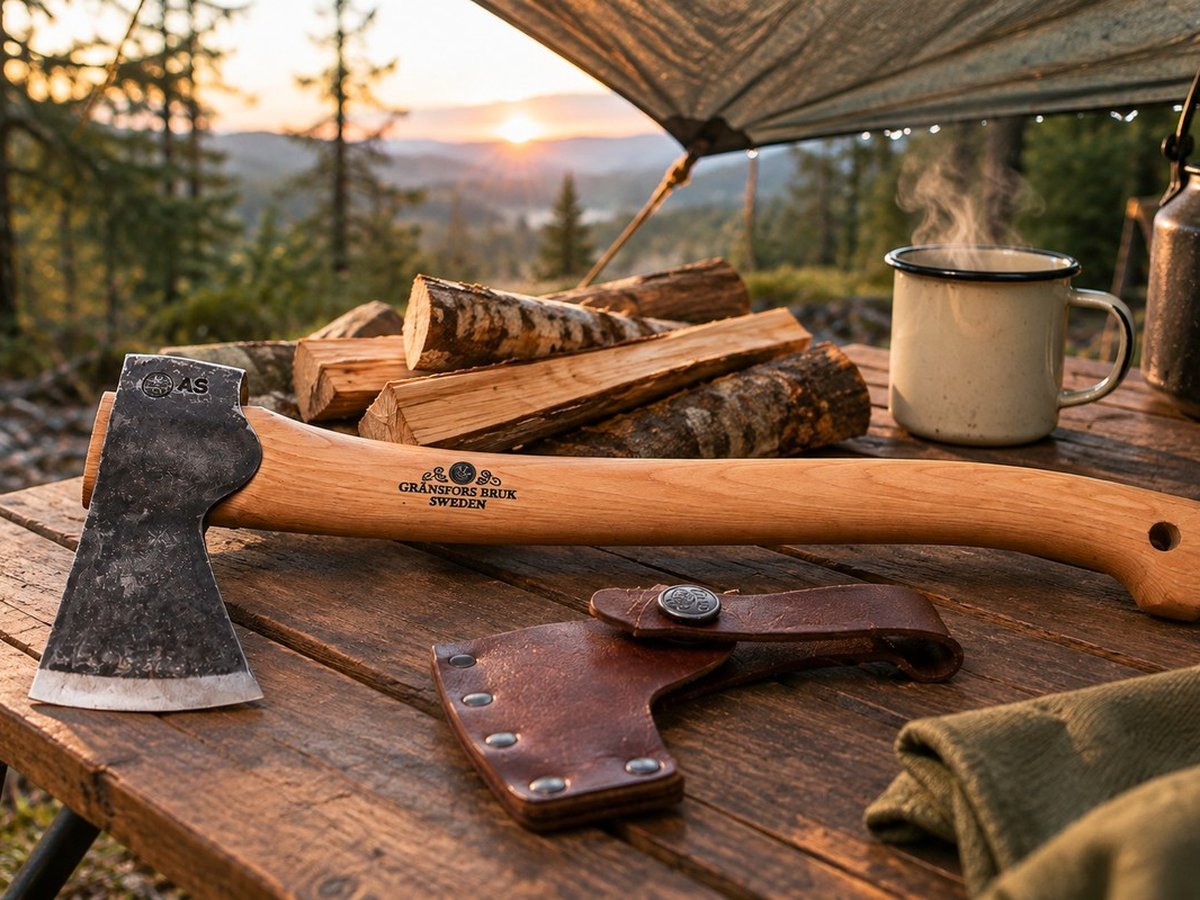
Filing is also where you can overdo it. Each pass moves the edge back toward the eye. The hardened zone at the bit is limited, and the Forest Service warns that filing a major chip out can take the edge past the temper line into softer steel that won't hold an edge. Small nicks can come out with the file; a deep one may be a reason to accept a slightly imperfect edge rather than grind half the bit away.
How do you use an axe puck or whetstone?
Wet or oil the stone, then work the coarse side in small circles along the bevel up to the edge until a burr forms on the other side. Flip the axe and repeat, then do both sides again with the fine side. Turn the axe often so the burr comes off evenly.
Once the file has set the shape, the stone refines the edge. The Forest Service manual describes the routine for a round axe stone: apply a lubricant, then work the coarse side in a circular motion along the cheek and up to the edge. When you feel a burr on the opposite side, turn the axe over and do the same there. Then repeat the whole process with the fine side. Gränsfors recommends the same rotating motion and adds two refinements: use the outer parts of the stone rather than its middle, so it doesn't wear hollow, and wipe the stone off now and then so the loose steel doesn't scratch the edge.
Lubricant depends on the stone. The Forest Service lists water, saliva or oil for axe stones, and names mineral oil, a light machine oil or automatic transmission fluid as acceptable oils for whetstones. Gränsfors suggests water for clay and sandstone stones and honing oil or sewing machine oil for carborundum and Arkansas stones. The one firm rule: once a stone has had oil on it, keep using oil on that stone.
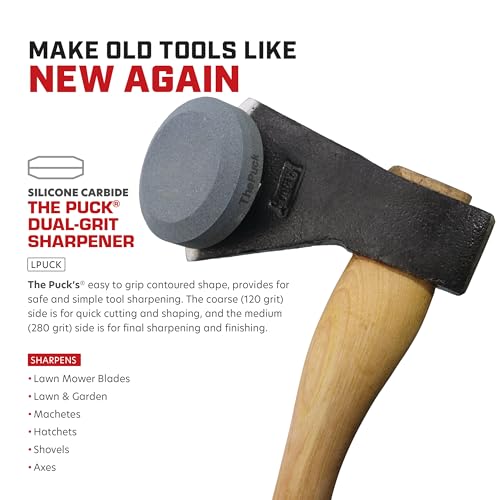
A pocket-size, two-sided puck is the classic camp version of the axe stone. The Lansky Puck, model LPUCK, is a round dual-grit sharpener with a 120-grit coarse side for quick cutting and shaping and a 280-grit medium side for final sharpening, and its product description lists hatchets and axe blades among the tools it is meant for. Use it the same way as any axe stone: lubricate, circles on the coarse side until the burr forms, flip, then repeat on the finer side. Its contoured shape is meant to give a secure grip, but gloves still belong on your hands.
For a keener edge, the Forest Service recommends a fine diamond stone or a hard Arkansas stone to set a small microbevel, then a leather strop. Strop by pulling the axe backward over the leather so the edge trails and never cuts into it; the manual gives an angle of 35 to 40 degrees, with pressure on the back of the head rather than on the edge. Stropping is the most reliable way to remove the last feather-thin burr.
Can you sharpen an axe on a bench grinder?
Avoid a high-speed dry bench grinder. The Forest Service warns it can draw the temper from the edge, and blue or purple steel means the hardness is already gone. Slow, wet grindstones are safer, and power tools should only shape the head, never put the final edge on it.
Heat is the problem. An axe's edge is hardened and tempered steel, and the thin edge heats up much faster than the body of the head. The 1999 Forest Service manual specifically warns against an electric high-speed dry bench grinder, explaining that it can draw the temper and ruin the ax; drawn temper shows as a blue color at the edge, and the softened zone can extend at least 3/16 inch back.
The 2020 manual accepts that crews use belt sanders and other power tools to reshape heads, but with strict limits: mark the edge with a felt pen and never let the tool touch past that line, lift off often to let the steel cool, stop at once if the steel turns blue or purple, and keep the head cool enough to hold in a bare hand. It is equally clear that the final sharpening should be done by hand with a stone. Gränsfors, for its part, lists an emery wheel or a fine flat file for repairing large nicks and a wet grinder or hand stone for restoring the edge, and warns to cool the steel often so it does not lose its temper. The 1999 Forest Service manual's only recommended grinder is a pedal grindstone kept wet.
How can you tell when an axe is sharp?
Look straight down at the edge in good light: a sharp edge reflects no light, while bright spots show dull or rolled sections that need more honing. The Forest Service also suggests a careful fingernail test, where a sharp edge bites into the nail instead of sliding off it.
The reflected-light test from the 1999 Forest Service manual is the most useful one. Hold the axe with the edge pointing straight at you under a bright light and look along it. A truly sharp edge is a line with no width, so it reflects nothing. Any glint shows a flat, dull or rolled spot, and you go back and hone that section. The same manual says a correctly honed edge is sharp, has no wire edge, and reflects no light.
Check for the burr too. Gränsfors describes the feather edge as a very thin tip, only a few tenths of a millimetre long, that bends to one side, and says you can feel it by carefully sliding a fingertip down over the edge. If you can still feel a wire, keep honing both sides, or strop it away. The fingernail test is another option: according to the 1999 manual, the edge should bite into your fingernail and not slide down it. Shaving hair off the back of the hand is a traditional test, but the Forest Service notes it is less safe.
Finally, test it on wood. A sharp axe with the right profile bites cleanly and throws a chip; one that bounces or sticks is telling you about its shape as much as its edge.
Keeping the edge after you sharpen it
Most sharpening is maintenance, not restoration. The Forest Service notes that experienced axemen carry a small stone and touch up the edge during the day, which keeps the edge from ever getting truly dull and spares a lot of filing later.
At the end of the day, clean pitch off the head, hone the edge, and rub light machine oil or wax over the steel. Gränsfors advises oiling the head before an axe is put away for any length of time, because an unoiled axe may rust, and storing it somewhere dry but not so dry or warm that the handle shrinks in the eye. Make sure both the bit and the sheath are dry before the sheath goes on, and keep the leather supple with a wax or grease made for it.
A sheath is also a safety device. The 1999 Forest Service manual says an ax should always be sheathed or boxed for transport, and kept sheathed while walking. Sinking a single-bit axe into a stump or log is fine for a short break, but don't leave it there long, because it will rust; never lean an unsheathed axe against a tree or wall with the edge exposed. Carry a single-bit axe at its balance point near the head, edge down, and on the downhill side when you are on a slope.
If you are shopping for a small camp axe, our Gränsfors Small Forest Axe 420 review looks at a small axe from the maker whose care advice is quoted here. And if you are wondering how often other edges in your kit need attention, see how often you should sharpen a pocketknife. Light, frequent touch-ups are the theme there as well.
Sources: USDA Forest Service: One Moving Part, The Forest Service Ax Manual, Chapter 8 (Sharpening and Shaping an Ax Head), USDA Forest Service: An Ax to Grind, sharpening section, USDA Forest Service: An Ax to Grind, using, carrying and storing axes, Gränsfors Bruk: Resharpening, Gränsfors Bruk: Axe care, and the Lansky LPUCK Dual Grit Sharpener listing at KYGUNCO; Amazon B000B8FW0Y.
Frequently asked questions
What tools do you need to sharpen an axe?
You need a single-cut mill bastard file fitted with a handle and a guard, leather or cut-resistant gloves, a way to clamp the axe, and a round axe stone with a coarse and a fine side. A fine finishing stone and a leather strop are optional extras for a keener final edge.
How do you file an axe without cutting yourself?
Secure the axe to a bench with the head sticking out, fit the file with a handle and guard, and wear gloves. Use firm push strokes from the cutting edge toward the center of the head, lift the file on the return, and never saw back and forth or file from the back toward the edge.
What angle should an axe edge be?
Keep the shape the maker gave it. The Forest Service ax manual gives about 18 degrees for the bevel of a typical work ax, with a tiny microbevel near 25 degrees for strength, while Gränsfors Bruk lists 25 to 30 degrees only for a thin, straight carving edge. A convex, curved profile is standard for chopping.
How do you use an axe puck or whetstone?
Wet or oil the stone, then work the coarse side in small circles along the bevel up to the edge until a burr forms on the other side. Flip the axe and repeat, then do both sides again with the fine side. Turn the axe often so the burr comes off evenly.
Can you sharpen an axe on a bench grinder?
Avoid a high-speed dry bench grinder. The Forest Service warns it can draw the temper from the edge, and blue or purple steel means the hardness is already gone. Slow, wet grindstones are safer, and power tools should only shape the head, never put the final edge on it.
How can you tell when an axe is sharp?
Look straight down at the edge in good light: a sharp edge reflects no light, while bright spots show dull or rolled sections that need more honing. The Forest Service also suggests a careful fingernail test, where a sharp edge bites into the nail instead of sliding off it.