
Blaze Orange Requirements by State for Deer Hunters
Written by Outdoors Magazine|
Outdoors Magazine is a participant in the Amazon Services LLC Associates Program. We may earn a commission if you buy through links on this page, at no extra cost to you. Affiliate disclosure.
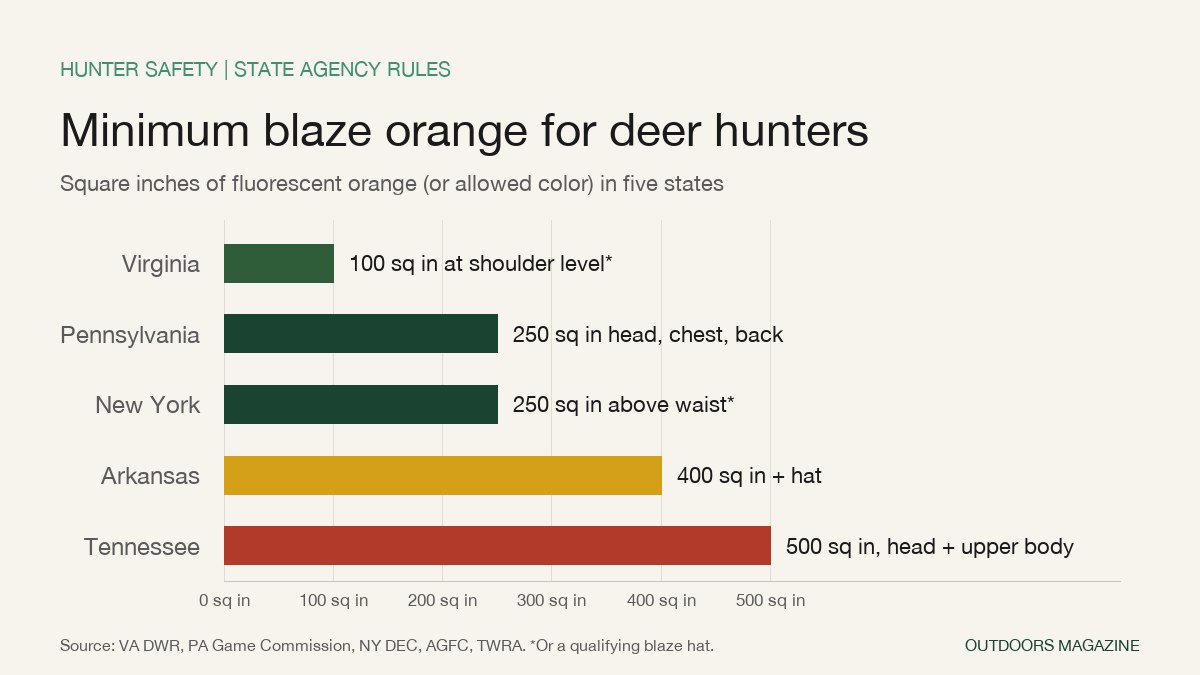
Blaze orange requirements vary by state. Pennsylvania requires 250 square inches on the head, chest and back during firearms seasons, Tennessee 500 square inches on the head and upper body, and Arkansas 400 square inches plus a hat, while Michigan accepts one orange garment. Several states allow blaze pink, and archery and blind rules differ, so check your state's 2026-27 regulations.
Key takeaways
- No national rule: states require anywhere from one orange garment to 500 square inches.
- In Pennsylvania in 2025, all 3 hunters shot as game wore no orange.
- Blaze pink is legal in some states, not all; solid orange works everywhere.
- Bowhunters often must wear orange once a firearms season opens.
Blaze orange requirements set how much fluorescent orange a deer hunter must wear during firearms seasons, and they vary widely by state. Pennsylvania wants 250 square inches on the head, chest and back, Tennessee 500 square inches, while Michigan accepts a single orange hat or vest. Many states now allow blaze pink. Always check your state's current digest.
Minimum square inches of fluorescent orange (or another allowed safety color) for deer hunters in five states; Virginia and New York also accept a qualifying blaze hat instead. Source: Virginia DWR, Pennsylvania Game Commission, New York DEC, Arkansas Game and Fish Commission and the TWRA 2026-27 hunting guide.
Late November puts more people in the deer woods at once than any other stretch of the year, and bowhunters who spent October alone suddenly share ridges and field edges with gun hunters. That is the crowd blaze orange rules were written for. The color does one simple thing: it makes a person look like a person, at distance and in brush, to another hunter who is looking hard for a brown animal.
There is no national rule. Each state writes its own: some count square inches, some want a hat, some allow pink or chartreuse, and some pull bowhunters in once a gun season opens. This guide covers why the rules exist and what eight states require according to their own agencies. It is educational, not legal advice; your state's 2026-27 digest is the final word.
What are the blaze orange requirements for deer hunters?
In most states that regulate it, the core rule looks like this: during a firearms deer season, anyone hunting, and often anyone accompanying a hunter, must wear a minimum amount of daylight fluorescent orange on the upper body, visible from all directions. States then define that minimum in one of three ways.
- By area. A set number of square inches, such as 250 in Pennsylvania and New York, 400 in Arkansas or 500 in Tennessee, sometimes with the placement spelled out (head, chest and back) and sometimes simply "above the waist."
- By coverage. A share of your outer clothing, such as Wisconsin's rule that at least 50 percent of outer clothing above the waist must be blaze orange or fluorescent pink, or Minnesota's rule covering the visible portion of the cap and outer clothing above the waist.
- By garment. Wearing at least one qualifying item, such as Michigan's list of an orange cap, hat, vest, jacket or raincoat worn as the outermost layer.
Why does blaze orange matter for hunter safety?
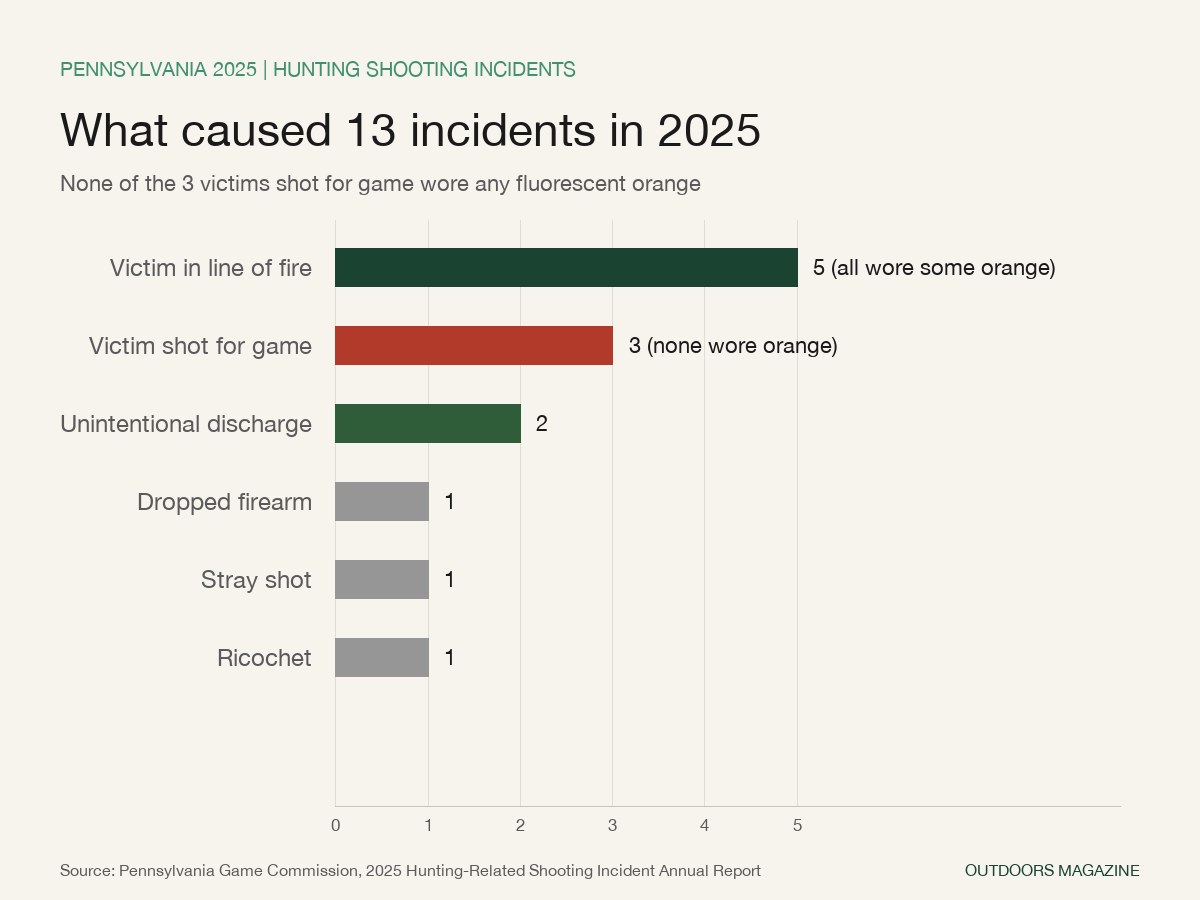
The case for orange is easiest to see in the incident reports state agencies publish every year. The Pennsylvania Game Commission's annual report on hunting-related shooting incidents is one of the most detailed. For 2025, it recorded 13 incidents among 831,203 licensed hunters, an incident rate of 1.56 per 100,000 participants, down from 2.25 in 2024. One of the 13 was fatal.
The breakdown by cause is the telling part. The most common cause was "victim in the line of fire," with five incidents, and all five victims were wearing some fluorescent orange. That is a muzzle-control and target-beyond problem that orange cannot fix. The second most common was "victim shot for game," with three incidents, and the report notes that none of those three victims was wearing any form of fluorescent orange. In other words, the incidents where a hunter was mistaken for an animal all involved people without orange. The Game Commission's report credits the long-term decline in incidents to its hunter-trapper education program and the mandatory use of hunter orange clothing.
New York's numbers point the same way. The DEC's 2025 hunting safety summary counts seven hunting-related shooting incidents, no fatalities and a total well below the 10-year average. Its list of primary hunter safety rules ends with a plain line: wear hunter orange.
The Michigan DNR adds a point that matters to hunters who resist orange because they fear it costs them deer. In its 2026 firearm season safety tips, the department states that hunter orange does not deter deer, and it recommends wearing as much orange as possible to increase your visibility to other hunters.
How do blaze orange rules differ by state?
The eight states below were checked against each agency's own regulations page, digest or official guide. They show the range of approaches; read your state's full text before you go.
Pennsylvania: 250 square inches, head, chest and back
According to the Game Commission digest, when orange is required, hunters must wear at least 250 square inches of daylight fluorescent orange on the head, chest and back combined, visible from 360 degrees. An orange hat and vest satisfies the rule. It applies in the deer, bear and elk firearms seasons regardless of the sporting arm carried, so archers hunting during a firearms season must comply. It also applies in the October muzzleloader antlerless season and the extended antlerless firearms seasons. The full amount must be worn while moving from one hour before legal hunting hours until one hour after they close.
Camouflage orange counts if its orange content totals at least 250 square inches. No orange is required during the archery deer seasons or the after-Christmas flintlock season, though the Commission strongly recommends it. Hunters in a blind or enclosed tree stand during the firearms deer, bear or elk seasons must also display at least 100 square inches of orange within 15 feet of the blind or stand, visible from 360 degrees. Pennsylvania also requires anyone on State Game Lands from Nov. 15 through Dec. 15 to wear 250 square inches of orange unless they are engaged in lawful hunting or trapping that does not require it, which covers hikers and birders too. These details come from the 2025-26 digest; confirm them against the 2026-27 edition.
New York: 250 square inches or a hat, orange or pink
The DEC deer and bear regulations require hunters using a firearm for deer or bear, and anyone accompanying them, to wear fluorescent orange or fluorescent pink. You can meet the rule three ways: at least 250 square inches of solid orange or pink worn above the waist and visible from all directions; at least 250 square inches of patterned material that is no less than 50 percent orange or pink, worn the same way; or a hat or cap with at least 50 percent of its exterior in solid orange or pink, visible from all directions.
Virginia: a blaze hat, blaze upper body or 100 square inches
The Virginia Department of Wildlife Resources requires every hunter, and anyone accompanying a hunter, to wear a solid blaze orange or blaze pink hat, or solid blaze upper-body clothing visible from 360 degrees, during the firearms deer season and the youth and apprentice deer hunting weekend. Alternatively, a hunter can display at least 100 square inches of solid blaze material at shoulder level within body reach. A hat's bill can be another color, but camo-style hats do not count. Hunters in an enclosed ground blind must also attach at least 100 square inches of blaze material, visible from 360 degrees, to or just above the blind. Waterfowl and dove hunters are exempt, as are archery hunters during a firearms season in areas where firearm discharge is prohibited. The page sets separate rules for the muzzleloader seasons, so muzzleloader hunters should read that section closely.
Tennessee: 500 square inches, head and upper body
Tennessee's 2026-27 big game regulations require hunters to wear at least 500 square inches of daylight fluorescent orange or pink on the upper body and head, visible front and back, while hunting big game, except on archery-only and turkey hunts. Where the archery-only deer season overlaps another big game gun season, such as bear, archers must wear the 500 square inches too. The guide notes that a hat combined with a vest fulfills the requirement.
Arkansas: 400 square inches plus a hat, with chartreuse allowed
The Arkansas Game and Fish Commission requires hunters, and those accompanying hunters, in areas where modern gun or alternative firearms deer, bear or elk seasons are open to wear at least 400 square inches of hunter orange, chartreuse or blaze camouflage above the waist, plus a head garment in those same safety colors. Migratory bird hunters are exempt. Arkansas is a useful reminder that "blaze orange" is shorthand: here the legal alternative color is chartreuse, not pink.
Minnesota: cap and outer clothing above the waist
The Minnesota DNR requires all hunters and trappers in the field during the firearms and muzzleloader deer seasons to display blaze orange or blaze pink on the visible portion of their cap and outer clothing above the waist, excluding sleeves and gloves. Blaze camouflage is allowed if it is at least 50 percent blaze orange or pink within each square foot. Exceptions include areas open only to archery hunting, migratory waterfowl hunting on the water or from a stationary location, and trapping on the water.
Wisconsin: at least 50 percent above the waist
Wisconsin DNR rules say that when and where a firearm deer season is in progress, it is illegal to hunt any game except waterfowl unless at least 50 percent of your outer clothing above the waist is blaze orange or fluorescent pink. A hat, if worn, must also be at least 50 percent orange or pink. Camo-blaze is legal at 50 percent or more, though the DNR recommends solid colors. The rule does not apply from 30 minutes after sunset to 30 minutes before sunrise, which matters for legal night hunters such as raccoon hunters.
Michigan: one orange garment, worn everywhere
The Michigan DNR says that during the Nov. 15 to 30 firearm deer season, deer hunters, including those using archery equipment, must wear a hunter orange cap, hat, vest, jacket or raincoat. It must be the outermost layer and visible from all directions, on private or public land, and even inside a blind. Camouflage orange counts if the pattern is at least 50 percent hunter orange.
Is blaze pink legal for deer hunting?
In a growing number of states, yes, but not everywhere. Among the states above, New York, Virginia, Minnesota and Wisconsin all name fluorescent or blaze pink as an accepted alternative to orange in their current rules, and Tennessee's guide writes its requirement as orange/pink. Virginia's DWR defines the pink as a solid blaze color, and its hat rule still bars camo-style hats. Arkansas takes a different path and accepts chartreuse.
The Pennsylvania digest and the Michigan DNR's 2026 season guidance describe their rules in terms of fluorescent or hunter orange only. If you hunt in more than one state, the safe default is solid blaze orange, which is accepted everywhere a safety color is required. Treat pink as legal only where your state's current regulations say so in plain words.
Do bowhunters have to wear blaze orange?
Usually not during an archery-only season, but often yes once a firearms season opens. That flip catches a lot of bowhunters. Pennsylvania requires no orange in its archery deer seasons, yet anyone hunting during a firearms deer season must wear the full 250 square inches regardless of the weapon carried. Michigan explicitly includes hunters using archery equipment in its Nov. 15 to 30 orange rule. Tennessee exempts archery-only hunts but requires archers to wear 500 square inches where archery deer season overlaps another big game gun season. Wisconsin's rule covers anyone hunting any game except waterfowl while a firearm deer season is in progress.
Some states carve out narrower exceptions. Minnesota exempts areas open only to archery hunting during its firearms deer seasons, and Virginia exempts archery hunters during a firearms season in areas where firearm discharge is prohibited. If you climb into a stand with a bow during gun season, assume you need orange unless your state's rules clearly say otherwise. While you are thinking about stand safety, review our guide to tree stand safety harnesses; falls from elevated stands are a separate and serious hazard that orange does nothing to prevent.
Do you need blaze orange in a ground blind or on private land?
Blinds hide hunters well, which is exactly why several states add a rule for them. Pennsylvania requires a 100-square-inch orange band within 15 feet of a blind or enclosed tree stand during the firearms deer, bear and elk seasons, in addition to the orange you wear inside. Virginia requires at least 100 square inches of blaze material attached to or just above an enclosed ground blind, also in addition to what you wear. Michigan says its orange rule applies even when hunting from within a blind.
Private land is not an automatic exemption either. Michigan's DNR states that its rule applies regardless of whether you hunt private or shared public land. Some states do treat landowners differently, so if you hunt your own ground, look for a specific landowner exception in your state's regulations rather than assuming one exists.
How do you choose blaze orange clothing that meets the rules?
Start with the strictest rule you will hunt under and work backward. A few practical points apply almost everywhere:
- Wear it on the outside. Michigan says the orange must be the outermost layer, and most states' visible-from-all-directions language means the same thing in practice. A heavy coat over an orange vest makes the vest worthless, legally and practically.
- Cover the head and the torso. Arkansas requires a head garment on top of 400 square inches above the waist, and a hat plus a vest meets Pennsylvania's and Tennessee's rules according to their own guidance. A hat also stays visible when brush or a blind hides your body.
- Be careful with camo orange. Pennsylvania counts only the orange content of a camouflage pattern toward its 250 square inches. Michigan, Minnesota and Wisconsin set 50 percent thresholds, and Virginia does not allow camo-style hats. Solid orange removes the guesswork.
- Fit it over your cold-weather layers. A vest that only fits over a T-shirt will not fit over a parka in December. Our guide on what to wear deer hunting in cold weather covers the layers that go underneath.
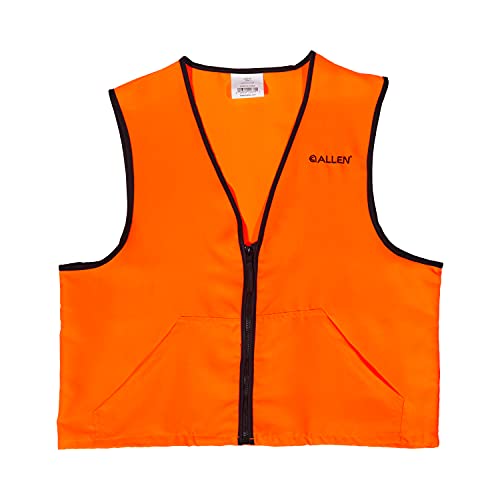
A simple blaze vest is the most flexible way to add orange over whatever you already wear. One example is the Allen Company Deluxe Blaze Orange Hunting Vest. Retailer OpticsPlanet lists it as a sleeveless polyester vest with a heavy-duty front zipper, two large pockets and over 600 square inches of blaze orange fabric, sold in sizes from medium (model 15765) through 2XL. A vest alone does not cover your head, so pair it with a solid orange hat wherever your state requires one, and measure against your state's placement rules rather than relying on a label.
Keep your orange on while tracking and dragging a deer, since other hunters may still be active. When you reach the deer, our guide on how to field dress a deer covers what comes next.
Check your state's 2026-27 regulations before you hunt
Everything above was checked against agency pages and digests available in late November 2026, but rules change by season and sometimes by management unit. Before each season:
- Read the safety-color section of your state's current regulations digest, not last year's printed copy.
- Check whether the rule changes by season (archery, muzzleloader, firearms, late or extended seasons), by zone, or on public land.
- If you hunt across state lines, meet the stricter state's rule, and do not count on pink or chartreuse being accepted.
- When the text is unclear, call your state wildlife agency. Its staff and conservation officers are the only people who can tell you how the rule applies to your situation.
The rules differ, but the reasoning does not. Orange worn on the outside and visible from every side is the cheapest safety gear in deer hunting.
Sources: Pennsylvania Game Commission: 2025-26 Hunting & Trapping Digest, Pennsylvania Game Commission: 2025 Hunting-Related Shooting Incident Annual Report, New York DEC: Deer and Bear Hunting Regulations, New York DEC: 2025 Hunting Safety Statistics, Virginia DWR: General Hunting Regulations, Tennessee 2026-27 Hunting Guide (TWRA): Big Game Regulations, Arkansas Game and Fish Commission: Deer Regulations, Minnesota DNR: Blaze Clothing Requirements, Wisconsin DNR: Highly Visible Clothing, Michigan DNR: 10 Tips for a Safe and Successful Firearm Deer Hunting Season (Nov. 2026), OpticsPlanet: Allen Deluxe Blaze Orange Hunting Vest listing; Amazon B076C8WX9Z.
Frequently asked questions
What are the blaze orange requirements for deer hunters?
Most states with a rule require deer hunters, and often anyone with them, to wear a minimum amount of fluorescent orange on the upper body during firearms seasons, visible from all directions. States define the minimum by square inches, by a share of outer clothing, or by a qualifying garment such as a hat or vest. Check your state's current digest for the exact rule.
Why does blaze orange matter for hunter safety?
It makes hunters visible to other hunters. In Pennsylvania's 2025 incident report, three hunters were shot after being mistaken for game, and none of them was wearing any fluorescent orange. The Game Commission credits mandatory hunter orange and hunter education for the long-term decline in incidents.
How do blaze orange rules differ by state?
The amounts and methods vary widely. Pennsylvania requires 250 square inches on the head, chest and back, Tennessee 500 square inches on the head and upper body, and Arkansas 400 square inches plus a hat, while Michigan accepts a single orange garment and Wisconsin requires at least 50 percent of outer clothing above the waist. Exceptions for archery, blinds and color choices also differ.
Is blaze pink legal for deer hunting?
In some states. New York, Virginia, Minnesota and Wisconsin accept fluorescent or blaze pink, and Tennessee writes its rule as orange or pink, while Arkansas accepts chartreuse instead. Pennsylvania and Michigan guidance refers to orange, so solid blaze orange is the safe choice if you hunt in more than one state.
Do bowhunters have to wear blaze orange?
Usually not during archery-only seasons, but often yes when a firearms season is open. Pennsylvania requires archers hunting during firearms seasons to wear 250 square inches, Michigan includes archery hunters in its Nov. 15 to 30 rule, and Tennessee requires archers to wear orange where archery and gun seasons overlap. Check your state's exceptions before you hunt.
Do you need blaze orange in a ground blind or on private land?
Often yes. Pennsylvania and Virginia require 100 square inches of orange displayed on or near a blind in addition to what you wear, and Michigan's rule applies inside blinds and on private land. Do not assume a landowner exception exists unless your state's regulations clearly state one.