
The Five Best-Selling Portable Electric Generators on Amazon
Written by John Wren|
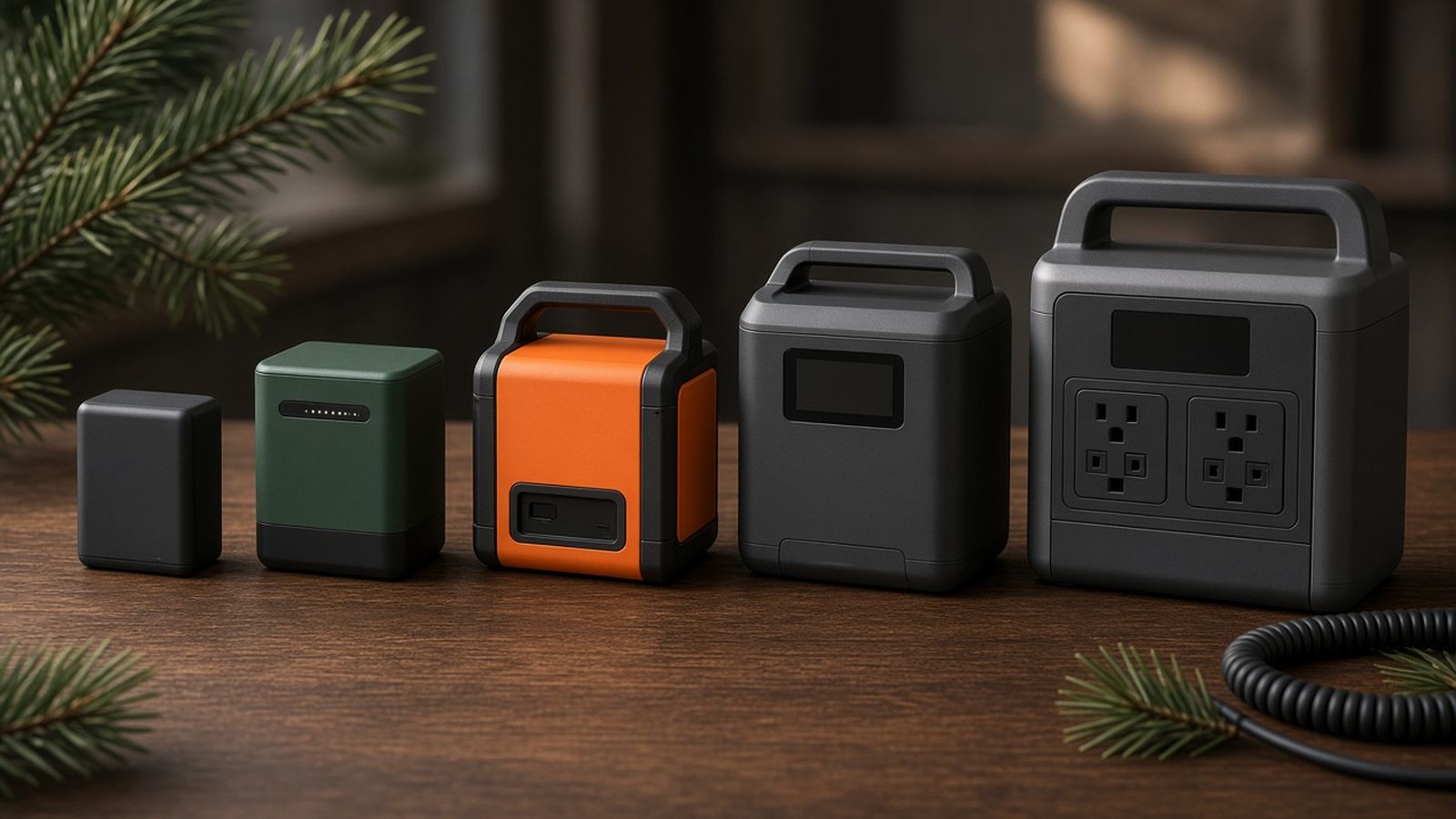
Buy the Jackery Explorer 1000 v2 for most car camps: 1,070 watt-hours, 1,500 watts, about 23.8 pounds. Buy the EcoFlow DELTA 3 Classic for 1,800 watts and a faster wall charge at 26.7 pounds. Buy the Explorer 300 when 300 watts is the job. The Daran and MARBERO M82 stay under 100 watts.
Key takeaways
- Outdoor Generators numbers one through five are batteries, not gas inverters.
- Explorer 1000 v2 is the usual camp pick: 1,500 watts, 1,070 watt-hours, about 23.8 pounds.
- DELTA 3 Classic is 1,800 watts and 26.7 pounds, with a listed charge to 80 percent in 45 minutes.
- Explorer 300 is 300 watts. Daran is 100 watts. MARBERO M82 is 80 watts.
Buy the Jackery Explorer 1000 v2 when a camp needs a quiet battery that can actually run a small appliance: 1,070 watt-hours, 1,500 watts continuous, a 3,000-watt starting figure, and about 23.8 pounds. Buy the EcoFlow DELTA 3 Classic when you want more continuous watts and a faster wall top-up: 1,024 watt-hours, 1,800 watts continuous, a 3,600-watt surge, and 26.7 pounds, with the listing’s X-Boost claim up to 2,600 watts. Buy the Jackery Explorer 300 when the job is a laptop, phones, and a light: 292 watt-hours, 300 watts continuous, 600 watts peak, and a case the description sizes at 9.06 by 6.02 by 7.83 inches. The Daran 89.6 watt-hour station and the MARBERO M82 are pocket chargers with a small AC outlet — 100 watts and 80 watts continuous — not a camp generator for a compressor fridge.
Short version. These five are the stations sitting at numbers one through five in Amazon’s Outdoor Generators list. All five are batteries. None of them is a gas inverter. If you already own a Honda-class inverter and you want the noise and runtime conversation, that lives on the quiet camping generator page and on the Honda generator note. This page is the battery class people are actually buying in that aisle right now. Pair it with what belongs in an overland camp and with quiet hours. Check live prices. Confirm the model on the listing before you trust a photo of a black box.
A best-seller rank is a sales fact, not a match for your cooler. The Explorer 300 is number one because a lot of people want a small orange-class brick. The Explorer 1000 v2 is number two because 1,500 watts is enough for a real Saturday and 23.8 pounds still comes out of a trunk. The Daran and the MARBERO sell because they are light and cheap to try. The DELTA 3 Classic is number five in this snapshot with the highest continuous watts of the five. Buy the rank that matches the label on the thing you will plug in.
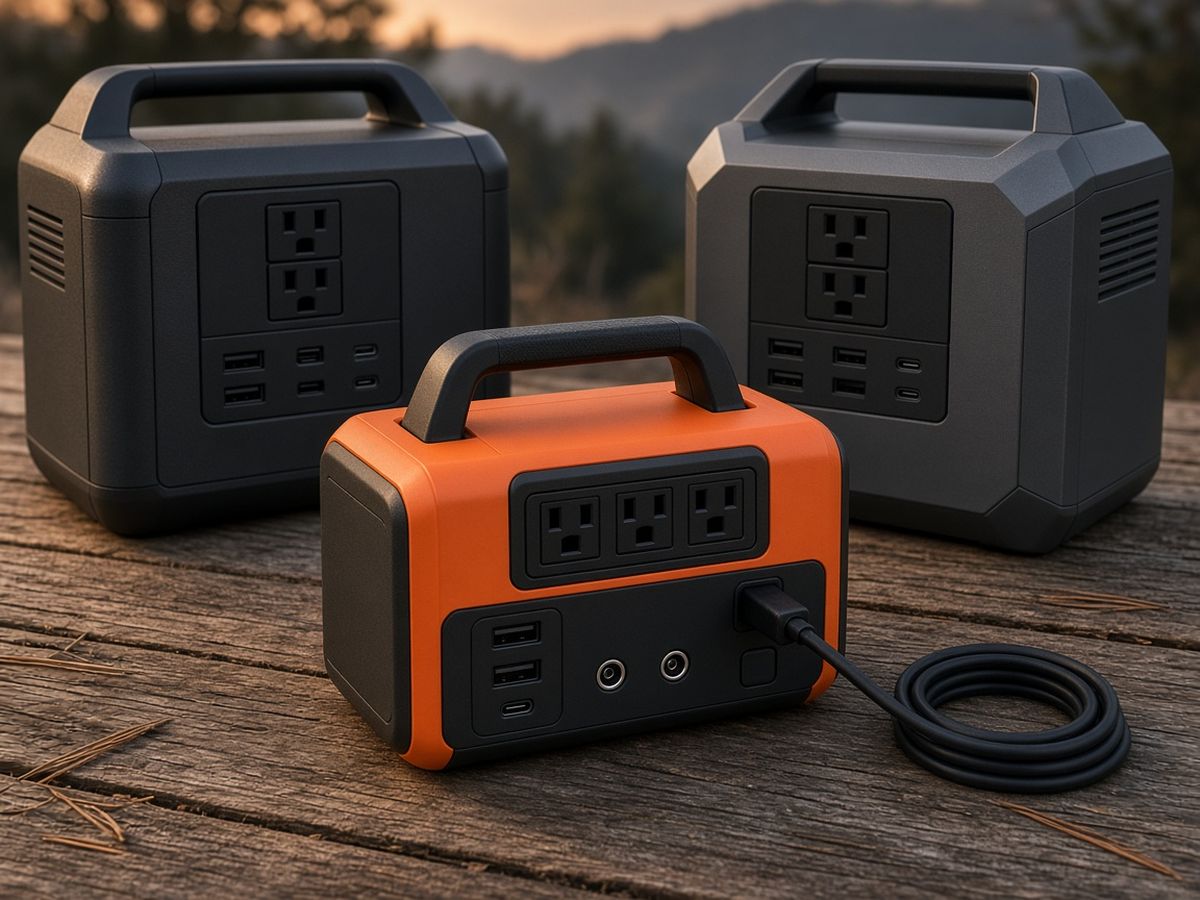
| Job | Station | Watts and watt-hours | Weight on the listing | Buy it if |
|---|---|---|---|---|
| Phones, a laptop, a lamp | Jackery Explorer 300 | 300W continuous, 600W peak, 292Wh | 7.1 lb in details; 7.5 lb in the description spec | The pack has to stay light |
| A weekend with a real AC load | Jackery Explorer 1000 v2 | 1,500W continuous, 3,000W starting, 1,070Wh | About 23.8 lb | This is the usual camp pick |
| A pocket AC outlet | Daran 89.6Wh, model R100 | 100W, 200W peak in the title, 89.6Wh | 2.5 lb item weight; 2.54 lb in the description | Every device stays under 100W |
| The smallest AC brick | MARBERO M82 | 80W continuous, 120W peak, 88.8Wh | 2.3 lb | Phones and a small laptop, not a cooler |
| More continuous watts | EcoFlow DELTA 3 Classic | 1,800W continuous, 3,600W surge, 1,024Wh | 26.7 lb | You want the faster wall charge and the extra watts |
Who each of these five is actually for
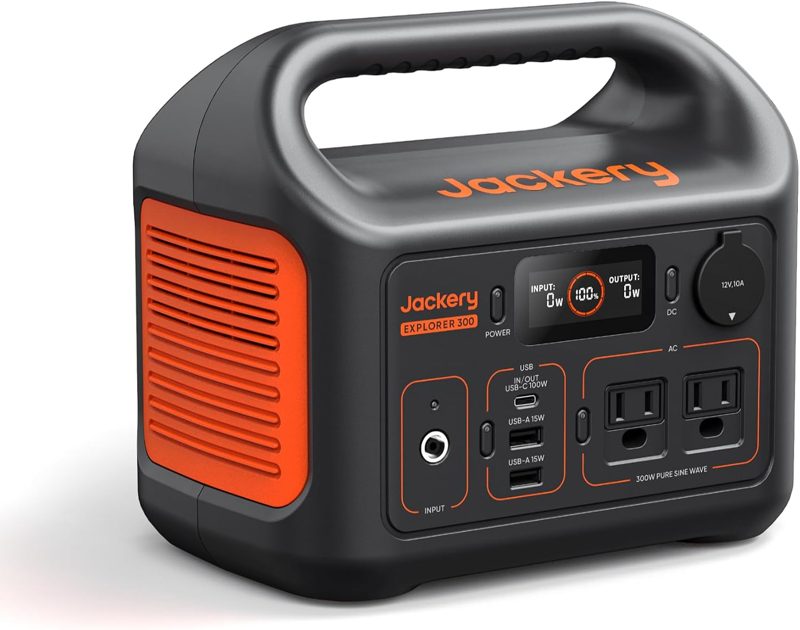
The Explorer 300 is for the person who hikes the station to the pad, or who keeps it in a day hatch for a phone, a camera, a laptop, and a 12-volt blanket a reviewer on that listing said they ran. Its own question-and-answer says it powers devices under 300 watts total and shuts off if you overload it. The same answer names toasters and coffee machines as the reason to step up to something like the Explorer 1000 v2. If your camp kitchen is a kettle and a toaster, this is the wrong brick.
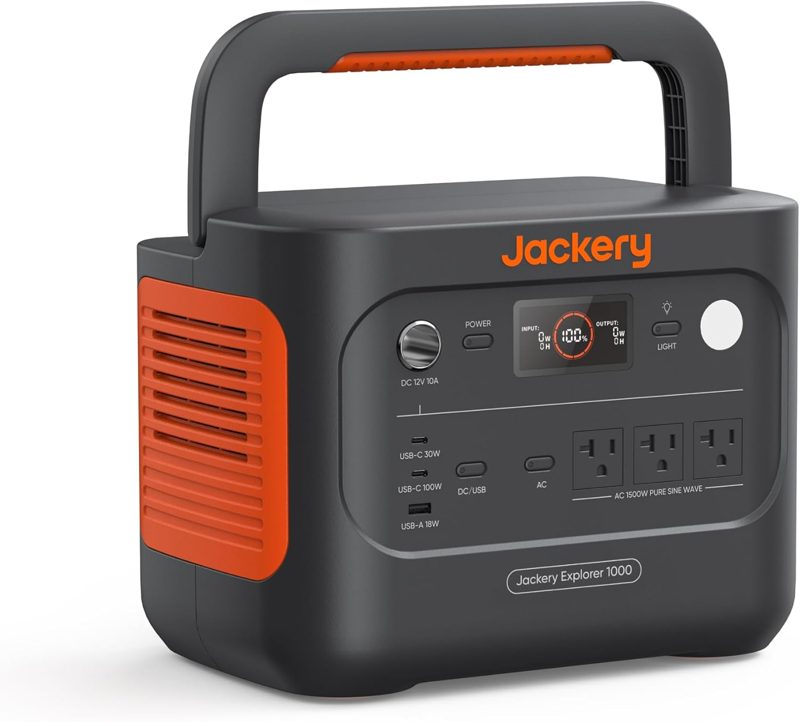
The Explorer 1000 v2 is for car camping, a truck bed, and an RV shore-power gap where you want three AC outlets and a fold handle. The listing gives it 1,500 watts continuous across those outlets, a 3,000-watt starting wattage, one USB-A port at 18 watts, two USB-C ports (30 watts and 100 watts), and a 12-volt car port at 10 amps. That is a camp box. It is not a backpacking box. Twenty-three point eight pounds is a lift you do once at the truck, not a lift you do at the switchback.
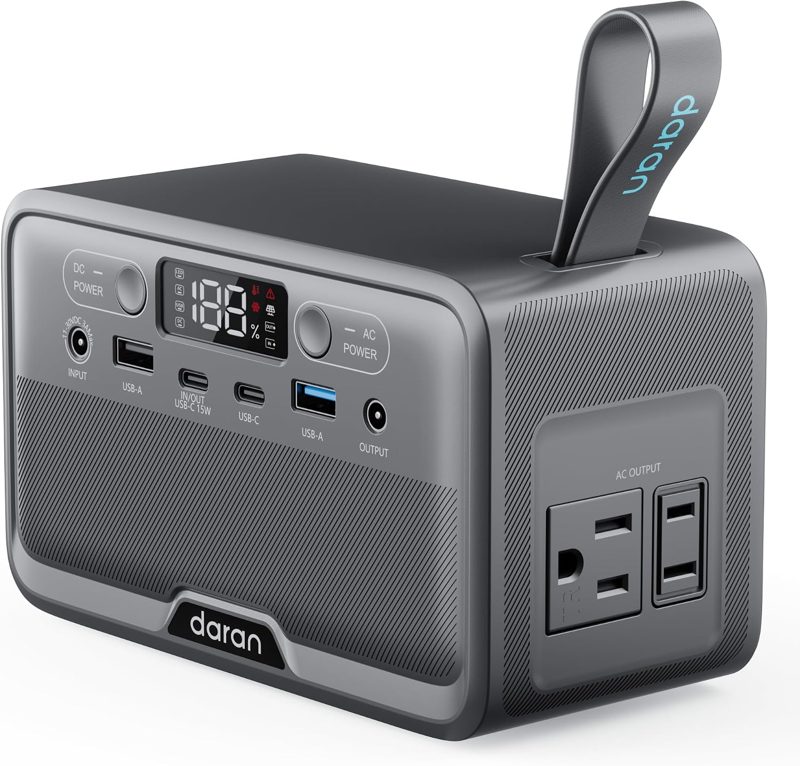
The Daran station, model YOUYO R100 on the product details, is for a pack. The description calls it about the size of a thick book: 6.5 by 3.3 by 4 inches. Seven ports: two AC sockets rated 100 watts, two USB-C ports at 45 watts and 15 watts, two USB-A ports at 18 watts and 15 watts, and a DC5521 port at 60 watts. The same bullets say it is only suitable for devices within 100 watts. Buy it when the heaviest thing you will run is a laptop on charge, a fan that stays under that ceiling, or a lamp. Do not buy it because the gift copy also says “mini-fridge.” A compressor that starts above 100 watts will trip it.
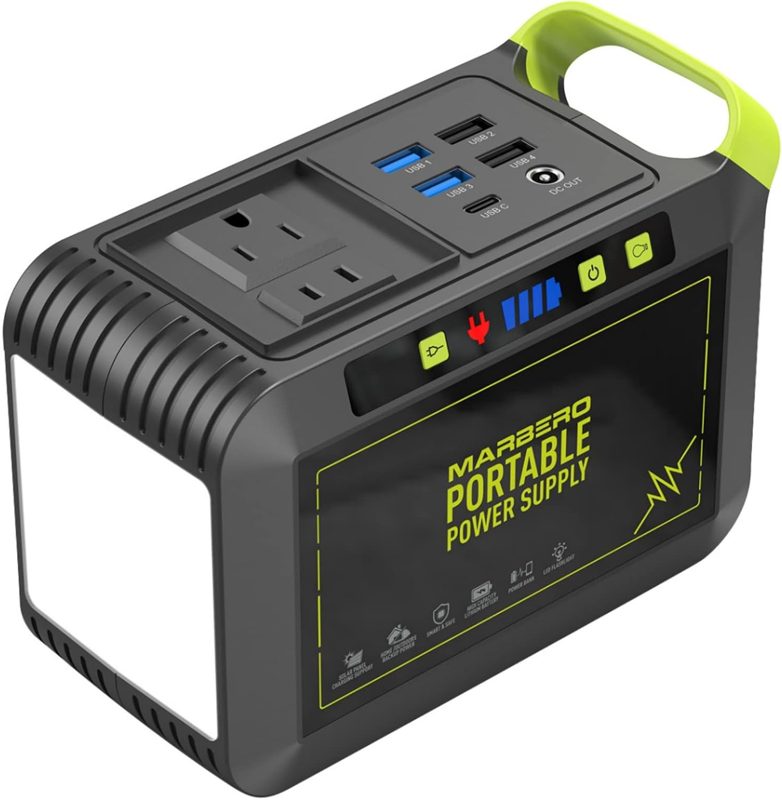
The MARBERO M82 is the other pocket brick, and it is a step down in AC power. Two AC outlets at 110 volts, 80 watts running, 120 watts peak. Eight ports in all: two plain USB-A, two Quick Charge USB-A, one USB-C at 18 watts, one DC car-style output, and those two AC sockets. The built-in battery on the comparison table is 88.8 watt-hours, which is the 24,000 milliamp-hour figure at 3.7 volts. The item-type line mentions CPAP backup. A CPAP whose label sits under 80 watts continuous can be a conversation. A CPAP or a heated hose that pulls more than that is a different station. The page does not call this battery LiFePO4. Treat it as the lithium pack the listing describes, not as the chemistry on the Jackery and EcoFlow cards.
The DELTA 3 Classic is for the outage and the RV pad where 1,800 watts matters: a fridge the listing names, a microwave the listing names, a laptop, and the X-Boost claim for heavier loads up to 2,600 watts. It is also the one with a stated UPS handoff under 10 milliseconds, which is a home-electronics feature more than a tent feature. It is not a tiny camp lantern battery. At 26.7 pounds it lives by the picnic table or in the RV bay. The listing says it is not compatible with a DELTA 2 Smart Extra Battery or a Delta 3 Series Smart Extra Battery. Do not plan an expansion that the page already refuses.
What the Jackery Explorer 300 will run
Three hundred watts continuous is a laptop charger, a camera battery, phones, a USB-C lamp, a small fan, and the kind of 12-volt blanket a buyer on that page said they ran. It is not a drip coffee maker, and the product page says so. Six hundred watts of peak is a short surge, not a license to run a 600-watt heater. The USB-C port is listed at 100 watts max. The USB-A port is listed at 15 watts max. AC output is 120 volts at 300 watts. Capacity is 292 watt-hours, also printed as 15.2 amp-hours at 19.2 volts DC. The battery line says LiFePO4.
Watt-hours are the tank. A 30-watt laptop is on the order of several hours of that 292, after the inverter takes a cut, not a three-day base camp. A 10-watt lamp is a long evening. A 100-watt draw is a short one. Do the division on the device label before you promise the group a movie. The product-details charge time is 4 hours. The feature copy says about 80 percent in 2.8 hours from a 100-watt Jackery solar panel, or about 80 percent in 7.5 hours from a 40-watt panel. The solar panel is not in the box. The title says optional.
Weight is the awkward line on this card. Product details list the item at 7.1 pounds. The description spec table lists 7.5 pounds and the case at 9.06 by 6.02 by 7.83 inches. Product details also print a larger set of dimensions, 15.43 by 9.92 by 11.89 inches, which reads like a carton more than the brick. Believe the smaller description size when you are packing a hatch, and believe that you should lift the box at delivery if the ounce count matters. Operating temperature on that spec table is 5°F to 113°F. Recharging temperature is 32°F to 113°F. A station that will run in a cold morning may still refuse to charge until it warms up. That is the line that strands people who leave it in the truck overnight and expect solar at dawn.
What the Jackery Explorer 1000 v2 will run
One thousand five hundred watts continuous is the camp station in this five. A small electric cooler whose running watts stay under that number, a laptop, a projector, phone chargers, and a low-draw cook tool can share the three AC outlets as long as the total stays inside 1,500 watts. The starting figure on the product details is 3,000 watts. A motor that spikes past what the inverter will pass will still fault even if the running watts look fine. Read the cooler’s label, not the marketing photo of a fridge.
The tank is 1,070 watt-hours. A 60-watt average draw is a long evening and a morning. A 400-watt draw is a couple of hours, not a week. The listing’s cycle line is 4,000 cycles, in a comparison table set next to other Jackery models that print 6,000. Buy this model for the watts and the weight, not because every Jackery card shares the same cycle count. The case is about 12.87 by 8.82 by 9.72 inches. Weight is about 23.8 pounds, also printed as 10.8 kilograms. Charge temperature is 32°F to 113°F. Discharge temperature is 14°F to 113°F. Same cold-truck lesson as the smaller Jackery: it may power a load in a chill it will not recharge in.
Wall charging is the part the title sells. Emergency charging in the Jackery app is listed as 0 to 100 percent in one hour. The default full charge, the same bullet says, is 1.7 hours, to go easier on the cells. The app line also names a 30 dB quiet overnight charging mode. That is a charging-mode claim, not a decibel rating for the inverter while a cooler is running. The listing does not publish a load-noise number. There is no gas engine, so there is no exhaust note. A fan, if it spins under a heavy load, is still a fan. Plan quiet hours as if your neighbors can hear a movie, because they can. The panel is optional. The page describes it as a solar generator and does not, on the spec block, give a solar-watt input you can budget. If the panel wattage is missing from the card you are looking at, do not guess it from a different Jackery.
What the Daran 89.6Wh station will run
This is a power bank that happens to have two AC sockets. One hundred watts continuous, with 200 watts of peak written into the title and into the port line (two AC sockets, 100 watts, 200 watts surge). Eighty-nine point six watt-hours is a phone weekend or a careful laptop afternoon. It is not a camp kitchen. The description says 0 to 80 percent in 1.5 hours and lists four charge paths: wall, two-way USB-C, car, and solar. Product details list a battery charge time of 1.2 hours. Both numbers are on the same listing. Use the slower one when you are planning a turnaround, and read which input you actually have.
Solar input is specific, and it is small. A question on the page says the package does not include a panel, and that the DC5521 input is 10 to 30 volts DC, 3 amps, 40 watts max. A huge folding array will not pour hundreds of watts into this brick. A small panel in that voltage window is the match. Discharge temperature in the description is 14°F to 113°F. Charging temperature is 32°F to 113°F. The chemistry line says LiFePO4, not NCM, and the bullets claim 3,500-plus cycles. That is the listing’s durability pitch. It does not make 89.6 watt-hours into 1,000.
Noise is the claim to read twice. One bullet says silent, fanless operation. A review title on the same page says “Loud fan.” Both cannot be your plan. If you are buying it to sleep next to, open the reviews for the fan note and assume a small fan may spin even when the headline says fanless. The flashlight is real on the listing: four levels plus SOS. That is a backup lamp, not a substitute for a headlamp you already walk with. A headlamp still belongs on your head. This brick can top the lamp’s cells up. It should not be the only light in the tent.
What the MARBERO M82 will run
Eighty watts continuous is a phone, a tablet, a camera, a USB lamp, and a laptop only if that laptop’s charger stays inside 80 watts. One hundred twenty watts is the peak, not the all-evening number. The USB-C port is 18 watts. That will charge a phone quickly and a modern laptop slowly, or not at the rate the laptop expects. The two Quick Charge USB-A ports are listed at up to 18 watts. The plain USB-A pair is 5 volts. The DC output is 12 to 16.8 volts at 10 amps, 13 amps max, which is the cigarette-lighter cable in the box, for a 12-volt accessory that respects that limit.
The battery table says 88.8 watt-hours. The title rounds that to 88. A full day of phones is plausible. A heated blanket is not. The product weight on the comparison table is 2.3 pounds. Item weight is also printed as 1.04 kilograms, which is the same neighborhood. The page you want is model M82. The comparison table on that same listing shows an M822 at 148 watt-hours and 200 watts. If the side of the box says M822, you bought a different station. Match M82 before you check out.
Recharge is less specific here than on the other four. The package is the station, a power adapter, a cigarette-lighter output cable, and a manual. Solar is in the title as optional. The page does not give a solar wattage or a hours-to-full figure you can pack against. Wall charging is the plan you can count, and you should time it at home once before a trip. The item-type line mentions an LED flashlight. Use it as a tent light in a pinch. Do not treat an 80-watt brick as the power half of an overnight kit. The kit still needs a light, a way to cook that is not this inverter, and a sleep system that does not depend on a heater this station cannot run.
What the EcoFlow DELTA 3 Classic will run
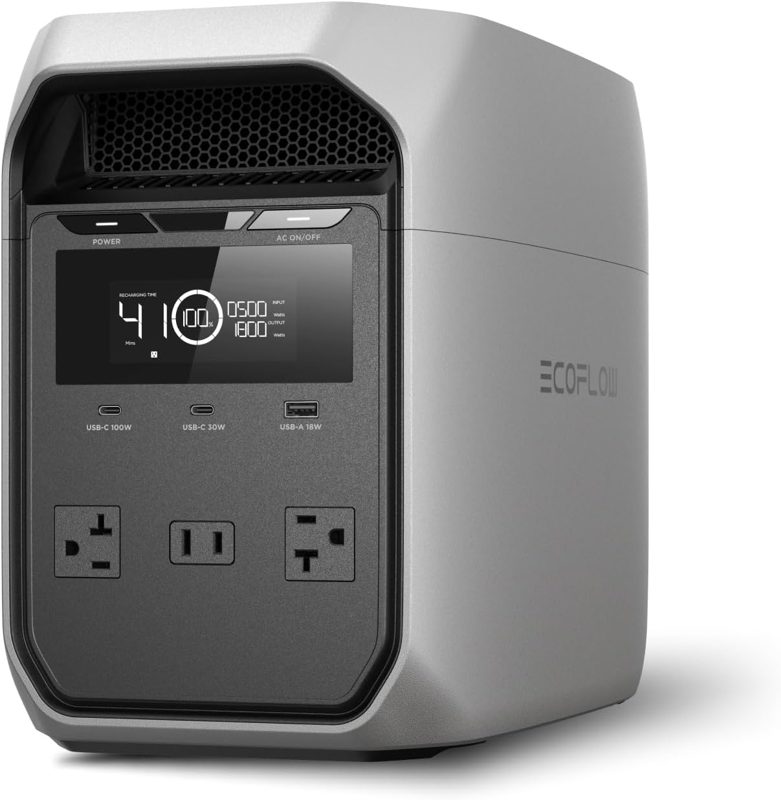
One thousand eight hundred watts continuous is the highest running figure in this five. The surge is 3,600 watts. X-Boost, the first bullet says, can support heavier loads up to 2,600 watts. The listing names refrigerators, microwaves, and laptops as the point of that output. A microwave and a fridge at the same time is a label problem: add the running watts, then ask what the start-up spike is. If the sum clears 1,800, you are in surge or X-Boost territory, and those are not the same as all-evening watts. Run one high draw at a time until you have watched the display.
The tank is 1,024 watt-hours, close to the Explorer 1000 v2’s 1,070, with more inverter headroom and a bit more weight. A hundred-watt average is a long day. A thousand-watt microwave is a short burst you can feel in the percentage. Item weight is 26.7 pounds. That is the number on the product details of this listing. Do not swap in a forum weight from a different Delta. USB-C at 100 watts is in the title, so a laptop can charge from the USB-C port without burning an AC outlet, the same way it can on the Explorer 1000 v2.
The wall charge is the practical advantage over the Jackery 1000 v2. The listing says 0 to 80 percent in 45 minutes with X-Stream AC charging. Solar, with a 500-watt panel that is not included, is listed at about 2.5 hours. That panel is a separate purchase and a separate carry. A 500-watt folding array is not a daypack item. If you will not own that panel, the 45-minute wall charge is the feature you came for, and you need a campground pedestal, a friend’s house, or the truck’s inverter to use it. The UPS line, under 10 milliseconds, matters if you are backing up a computer at home. In a tent it is mostly unused. App controls for a charge schedule are on the listing. They do not add watt-hours.
How weight decides which one leaves the truck
Line them up by what you will carry, not by the rank number. The MARBERO at 2.3 pounds and the Daran at about 2.5 pounds disappear into a pack next to a rain shell. The Explorer 300 at roughly 7 pounds is a deliberate choice: it rides in a hatch or a canoe dry bag, and you notice it on a portage. The Explorer 1000 v2 at 23.8 pounds and the DELTA 3 Classic at 26.7 pounds are tailgate tools. They belong beside the cooler, not inside the summit pack. If the walk from the truck to the pad is a hundred yards of sand, the 24-pound box still makes that walk. If the walk is three miles, it does not.
That split is the whole shopping decision for a lot of camps. The tools that earn a place in the box are the ones you will carry the last fifty feet. A station you leave in the locked truck is a driveway battery. A station you set where you sleep can run the lamp and the phone. Put the heavy two where the cooking table is, on a flat board, out of the rain, with the vents clear. Put the pocket two in the lid of the pack so you are not digging for a phone charge at dusk.
Handles matter on the two you lift. The Explorer 1000 v2 listing calls out a foldable handle. The Explorer 300 listing describes an integrated handle. The Daran description mentions a soft handle. None of that is a shoulder strap for a hike. If you need it on your back, it goes in a pack you already trust, and the pack’s hip belt takes the weight. Do not clip a 24-pound station to a daypack and call it ultralight.
What recharge and noise mean after quiet hours
None of these five has a gas engine. That is why they can sit closer to a tent than an inverter generator, and why many campgrounds that ban generators after a posted hour still tolerate a silent battery. Tolerate is not a promise. A safe camp is still a camp that does not blast a speaker off a 1,500-watt inverter at 10 p.m. The battery removed the exhaust. It did not remove your neighbors. If the host posts generator hours, read them. Some parks write the rule for any electric plant, engine or not. Ask before you build the weekend around a microwave at dusk.
Noise you can actually cite from these listings is thin, because the pages are selling silence. The Explorer 1000 v2 mentions a 30 dB quiet overnight charging mode in the app. That is the charger whispering, not a measured number for a cooler compressor. The Daran page says fanless and also carries a review that complains about a loud fan. The Explorer 300, the MARBERO, and the DELTA 3 Classic do not print a decibel rating for a running load on the pages behind these cards. If a fan starts under a heavy AC draw, you will hear it inside a small tent. Set the station outside the vestibule, on the table, not beside the pillow.
Recharge is the other half of quiet. A gas can is a plan you can pour. A battery is a plan you scheduled. The Explorer 300 wants about four hours on its listed charge time, or the solar hours above if you own the panel. The Explorer 1000 v2 wants 1.7 hours in the default, or one hour if you turn on the emergency mode and accept what that does to the cells. The Daran wants on the order of an hour and a half to 80 percent, with a 40-watt solar ceiling. The DELTA 3 Classic wants 45 minutes to 80 percent on AC, or about 2.5 hours on a 500-watt panel you do not own yet. The MARBERO wants a wall adapter and a test at home. On a week of dispersed camping, the station that cannot refill from the sun you actually carried is a Friday battery and a Sunday brick. Size the panel to the input the listing states, not to a wish.
Cold is the third half, and it is boring until it ruins a morning. Every Jackery and Daran charge range above starts at 32°F. Below that, the listing is telling you not to charge. Bring the station into the tent or the cab to warm before you ask it to take solar or a car charge. Running a load and charging a pack are different permissions. Read both temperatures on the card you bought, not on a sibling model.
What a watt-hour will not do for a weekend
People buy the rank and then discover the tank. One thousand watt-hours sounds like a house. It is a cooler and some lights if you are disciplined, and it is a space heater for less than an hour if you are not. A 1,500-watt heater on a 1,070 watt-hour Jackery is a short, expensive burst. Do not pack a heater as the plan for sleeping warm. A bag, a pad, and dry clothes still do that job. The station runs the lamp that lets you find the bag.
The same arithmetic kills the pocket pair faster. Eighty-nine watt-hours divided by a 60-watt laptop is about an hour and a half before conversion losses, and less after. That is a useful top-up on a travel day. It is a disappointment if you told someone it would run a mini-fridge overnight. The Daran page both names a mini-fridge and limits you to 100 watts. Believe the limit. If the fridge label is 40 watts running and 80 watts starting, you might be inside the Daran’s ceiling and you will still empty 89 watt-hours in a couple of hours. If the label is 65 watts running, the night is shorter than the sales photo.
Shared camps make this worse. Five phones, a tablet, a camera, and a string of USB lights are a polite load on the Explorer 1000 v2 and a selfish load on the MARBERO. Write the list on a card before you leave: what must run (a navigation phone, a headlamp charge, a medical device whose watts you measured) and what is a luxury (a speaker, a movie, a hot plate). The luxury comes off first when the percentage drops. RV gear that earns the cabinet follows the same rule. A station is one accessory. It does not replace water, a level, or a way to dump.
If the trip is a real outage at home, or a week off pavement with a fridge that must stay cold, these five are the start of a conversation, not the end. The DELTA 3 Classic and the Explorer 1000 v2 can cover a day of careful use. They will not cover a chest freezer and a well pump for three days. That is a bigger battery, a transfer setup, or the gas inverter on the other article, set downwind and inside the hours the host allows. Owning both is a reasonable camp: battery until the tank is low, engine only if the outage outlasts the watt-hours. This ranking simply tells you which batteries the Outdoor Generators aisle is selling first.
So which portable station should you buy?
Buy the Jackery Explorer 1000 v2 for most car-camping weekends. You get 1,500 watts, 1,070 watt-hours, three AC outlets, a 100-watt USB-C port, and a box around 24 pounds that one person can still lift. The one-hour emergency charge is there when you have a wall and you are willing to use the app mode. The default 1.7-hour charge is the kinder everyday path.
Buy the EcoFlow DELTA 3 Classic when the extra continuous watts are the point: 1,800 watts, a 3,600-watt surge, X-Boost claimed to 2,600, and a wall charge to 80 percent in 45 minutes. You pay for that in 26.7 pounds and in a battery that is 1,024 watt-hours, not a larger tank. Skip the extra-battery fantasy the listing already blocks.
Buy the Jackery Explorer 300 when 300 watts is honestly the whole job and you want the station people are buying most in this aisle. Keep toasters and coffee makers on a stove that is not this inverter. Carry the solar panel only if you will use the 100-watt or 40-watt hours the page prints.
Buy the Daran R100 or the MARBERO M82 only as a pocket charger with a small AC outlet. The Daran’s ceiling is 100 watts and 89.6 watt-hours, with a fanless claim you should reconcile with the fan complaint on the same page. The MARBERO’s ceiling is 80 watts and 88.8 watt-hours, model M82, not the bigger M822 on the same comparison table. Neither one is the generator a cooler needs.
Then do the boring Saturday test at home. Plug in the actual cooler, the actual laptop brick, and the actual lamp. Watch the watts on the display if it has one. Time the drain for an hour. Charge it the way you will charge it on the trip, including a cold garage if that is your dawn. If the percentage falls faster than the weekend you described to yourself, you bought the rank and not the tank. Return it while you still can, and step up to the station whose watts match the label. The aisle will still be there. The camp will not get colder because you waited one more afternoon to read the sticker.
Frequently asked questions
Which portable electric generator is selling best on Amazon right now?
The Jackery Explorer 300 is number one in Outdoor Generators. The Explorer 1000 v2 is number two, the Daran 89.6Wh station is number three, the MARBERO M82 is number four, and the EcoFlow DELTA 3 Classic is number five. All five are batteries. Rank is not the same as the right watts for your cooler.
Will any of these run a camping fridge?
Only if the fridge label stays inside the station’s continuous watts. The Explorer 300 is 300 watts, and its page says high-draw kitchen appliances need a larger model. The Daran page limits you to devices within 100 watts even though it also names a mini-fridge. The MARBERO M82 is 80 watts continuous and 120 watts peak. The Explorer 1000 v2 is 1,500 watts continuous with a 3,000-watt starting figure. The DELTA 3 Classic is 1,800 watts continuous and a 3,600-watt surge, with X-Boost claimed up to 2,600 watts. A label over the continuous rating is a no.
How much do these stations weigh?
Product details list the Explorer 300 at 7.1 pounds; the description spec table lists 7.5 pounds. The Explorer 1000 v2 is about 23.8 pounds. The Daran item weight is 2.5 pounds and the description says 2.54 pounds. The MARBERO M82 product weight is 2.3 pounds. The DELTA 3 Classic item weight is 26.7 pounds.
Are they quiet enough for campground quiet hours?
None of the five has a gas engine, so there is no exhaust note. The listings do not publish a decibel rating for running a load. The Explorer 1000 v2 mentions a 30 dB quiet overnight charging mode in the app, which is a charge setting, not a cooler-running measurement. The Daran listing says fanless, and a review on that page complains about a loud fan. Quiet hours still apply to speakers and voices.
How do you recharge them without a wall outlet?
The solar panel is optional on all five. The Explorer 300 listing says about 80 percent in 2.8 hours on a 100-watt panel, or 7.5 hours on a 40-watt panel. The Explorer 1000 v2 listing describes a one-hour full charge in an app emergency mode and a 1.7-hour default, and it does not print a solar-input wattage. The Daran solar input is stated as 40 watts max on DC5521. The DELTA 3 Classic listing says about 2.5 hours from a 500-watt panel. The MARBERO page does not state a solar recharge time. Charge temperatures on the Jackery and Daran cards start at 32°F.
Which one should you buy?
Buy the Explorer 1000 v2 for most car-camping weekends that need real AC watts in a box you can still lift. Buy the DELTA 3 Classic when 1,800 watts and a faster wall top-up matter more than the extra pounds. Buy the Explorer 300 when 300 watts is the whole job. Buy the Daran or the MARBERO M82 only when every device stays under 100 watts or 80 watts.