
Winter Hiking Daylight Hours: Plan Around Short Days
Written by Outdoors Magazine|
Outdoors Magazine is a participant in the Amazon Services LLC Associates Program. We may earn a commission if you buy through links on this page, at no extra cost to you. Affiliate disclosure.
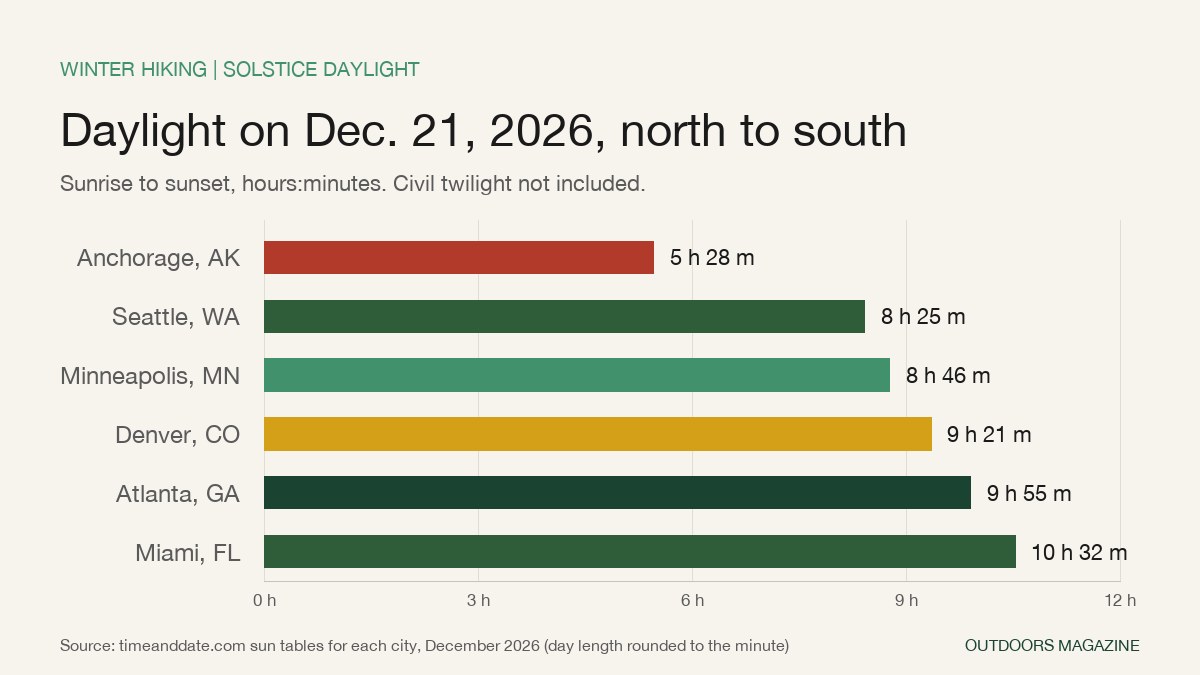
Winter hiking daylight hours near the December 21, 2026 solstice range from about 5 hours 28 minutes in Anchorage to 10 hours 32 minutes in Miami, with Seattle near 8 hours 25 minutes and Denver near 9 hours 21 minutes. Civil twilight adds roughly 26 to 62 minutes each evening. Finish by sunset, set a turnaround time, plan fewer miles in snow and carry a headlamp.
Key takeaways
- Solstice daylight runs from about 5.5 hours in Anchorage to 10.5 hours in Miami.
- Civil twilight adds a cushion, but treat it as spare light, not part of the plan.
- Set a turnaround time from sunset with at least an hour of buffer, and keep it.
- Carry a headlamp and spare power; cold can cut burn time by up to half.
Winter hiking daylight hours are short and depend on latitude. On the December 21, 2026 solstice, timeanddate.com gives Anchorage about 5 hours 28 minutes from sunrise to sunset, Seattle 8 hours 25 minutes, Denver 9 hours 21 minutes and Miami 10 hours 32 minutes. Finish before sunset, set a turnaround time and carry a headlamp.
Day length from sunrise to sunset on December 21, 2026 for six US cities, north to south, rounded to the minute. Civil twilight is not included. Source: timeanddate.com sun tables, December 2026.
The calendar says winter starts on December 21, but for hikers the problem starts weeks earlier. A trail you finished comfortably in October with an hour of light to spare can leave you on a dark, icy descent in December, even if you walk at the same speed and leave the car at the same time. The sun is the one part of the plan you cannot negotiate with, and in the weeks around the solstice it gives you the least room it will all year.
This guide puts numbers on that. It uses sun tables for six US cities to show how much daylight you actually get near the 2026 solstice, what civil twilight adds and what it doesn't, how to build a turnaround time from a sunset time, why snow slows you down, and what light to carry when the plan slips. The figures are for the cities themselves; your trailhead may sit in a valley or behind a ridge that hides the sun earlier, so treat them as a ceiling rather than a promise.
How many hours of daylight do you get for winter hiking?
Near the December 21, 2026 solstice, US hikers get roughly 5.5 to 10.5 hours of daylight, depending on latitude. Anchorage gets about 5 hours 28 minutes, Seattle 8 hours 25 minutes, Minneapolis 8 hours 46 minutes, Denver 9 hours 21 minutes, Atlanta 9 hours 55 minutes and Miami 10 hours 32 minutes.
Those numbers come from the December 2026 sun tables published by timeanddate.com for each city, and they measure the time from sunrise to sunset. Here is what the shortest day looks like on the clock, in local time:
- Anchorage, Alaska: sunrise 10:13 a.m., sunset 3:41 p.m., 5 hours 27 minutes 45 seconds of daylight.
- Seattle, Washington: sunrise 7:54 a.m., sunset 4:20 p.m., 8 hours 25 minutes 25 seconds.
- Minneapolis, Minnesota: sunrise 7:48 a.m., sunset 4:34 p.m., 8 hours 46 minutes 11 seconds.
- Denver, Colorado: sunrise 7:17 a.m., sunset 4:38 p.m., 9 hours 21 minutes 15 seconds.
- Atlanta, Georgia: sunrise 7:38 a.m., sunset 5:33 p.m., 9 hours 54 minutes 33 seconds.
- Miami, Florida: sunrise 7:03 a.m., sunset 5:34 p.m., 10 hours 31 minutes 48 seconds.
The spread is the point. A Miami hiker on the solstice has about five more hours of daylight than a hiker in Anchorage, and even between Seattle and Atlanta the gap is close to an hour and a half. Phoenix, for comparison, gets 9 hours 56 minutes, nearly the same as Atlanta. If you travel to hike, check the sun table for where you are going, not where you live.
Clock time matters as much as the total. Seattle and Minneapolis get similar amounts of daylight, but the sun sets before 4:35 p.m. in both. In Anchorage, the sun doesn't rise until after 10 a.m. and is down before 3:45 p.m., so an early start buys you nothing but cold, dark miles. In Atlanta and Miami, the light lasts past 5:30 p.m. and an afternoon hike is still realistic. The Appalachian Trail Conservancy's winter advice starts from the same fact: it gets dark early.
What does civil twilight add to a winter hike?
Civil twilight is the period when the sun is less than 6 degrees below the horizon, and the National Weather Service says that in many cases artificial light is not needed then. On December 21, 2026 it adds about 52 minutes in Miami, 52 to 72 minutes in the lower 48 cities here, and about two hours in Anchorage, split between morning and evening.
The National Weather Service defines morning civil twilight as starting when the geometric center of the sun is 6 degrees below the horizon and ending at sunrise; evening civil twilight runs from sunset until the sun is 6 degrees down again. During that window, the NWS notes, the horizon and objects on the ground can still be made out and the brightest stars and planets appear. Once the sun drops past 6 degrees, you are into nautical twilight, and the NWS says detailed outdoor activities are likely curtailed without artificial light. On a trail, that is the moment roots, ice and trail markers start to disappear.
Working from the same timeanddate.com tables, the evening share of civil twilight on the solstice is about 26 minutes in Miami, 27 in Atlanta, 31 in Denver, 34 in Minneapolis, 36 in Seattle and 62 in Anchorage. The morning share is nearly identical. That means a Seattle hiker has usable natural light from about 7:18 a.m. to 4:56 p.m., and a Denver hiker from about 6:47 a.m. to 5:09 p.m.
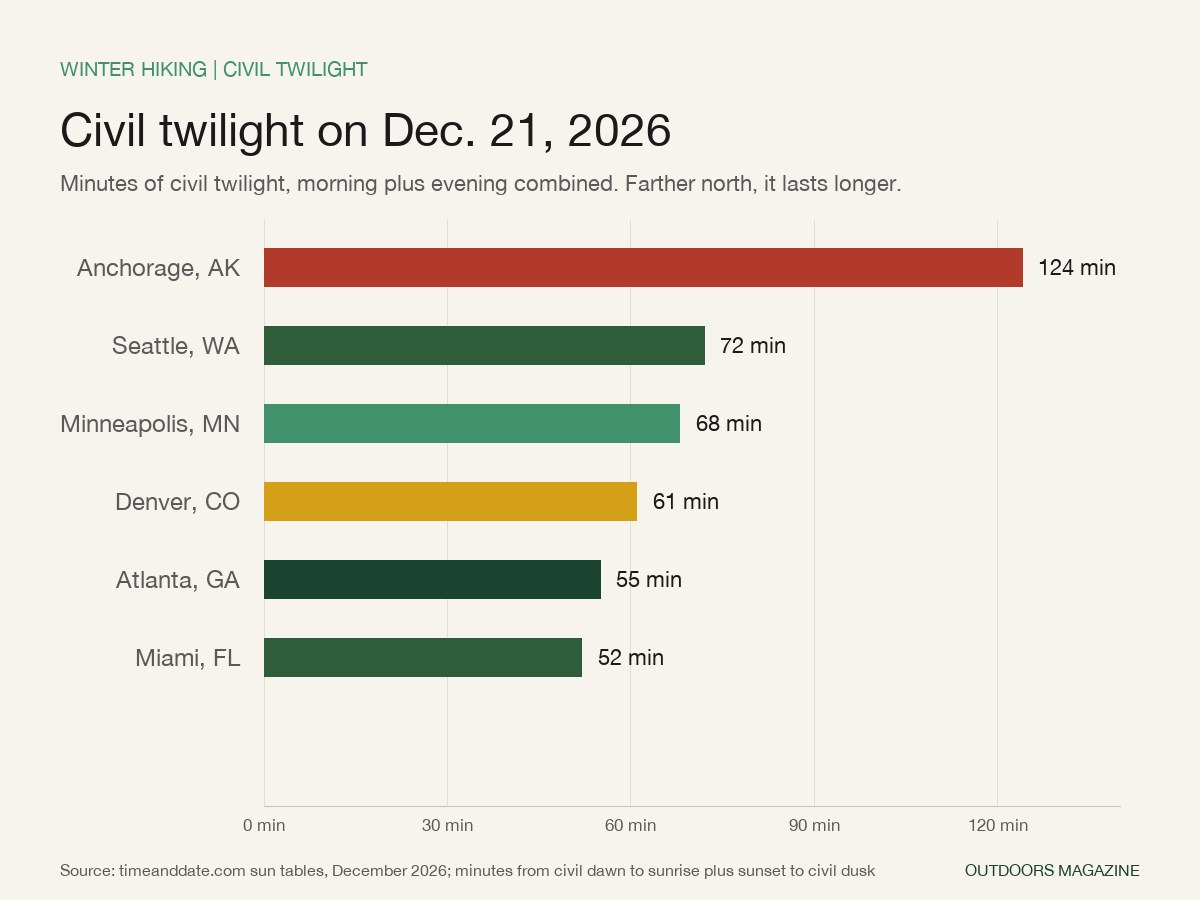
Treat evening twilight as a cushion, not as part of the plan. It shrinks fast under trees, in canyons and on overcast days, and a hiker who budgets to finish at the end of civil twilight has no margin left for a wrong turn, a slow partner or a stretch of ice. The more useful trick is the morning share: if the trailhead is safe and the approach is easy, starting in morning twilight gives you light to walk by while the sun is still coming up, and moves the whole day earlier.
Why do sunrise and sunset keep shifting around the solstice?
The shortest day is not the day with the earliest sunset or the latest sunrise. In the 2026 tables, sunsets are already getting slightly later by December 21 while sunrises keep getting later into the new year. That is why late-December afternoons feel a little longer even though the total daylight barely changes.
Seattle shows the pattern clearly. On December 1, 2026 the sun sets at 4:19 p.m. and rises at 7:36 a.m. On December 21 it sets at 4:20 p.m. and rises at 7:54 a.m. By December 31 the sunset has moved to 4:27 p.m., but the sunrise has slipped to 7:57 a.m. The day length on those three dates, 8 hours 42 minutes, 8 hours 25 minutes and 8 hours 29 minutes, changes far less than you might guess. Miami's table shows the same thing: its earliest sunset, 5:29 p.m., falls in the first week of December, while its latest sunrise of the month comes on December 31.
For planning, that has two practical effects. Early December hikes have the earliest dark of the season in many places, so don't assume you are safe because the solstice hasn't arrived. And holiday-week hikes gain a few minutes of evening light but lose them in the morning, so a dawn start in late December is a bit darker than it was on the first of the month. Look up the sunset for the exact date of your hike rather than relying on a number you remember from last week.
How do you set a turnaround time for a winter hike?
Start from the sunset time for your hike date, subtract a safety cushion, and work back to the latest time you can start the return leg. Write that turnaround time down before you leave and turn around at that time even if the summit or lake is close. The Washington Trails Association puts it simply: decide on a turnaround time and stick to it.
Here is the arithmetic with Seattle's solstice numbers. Say you reach the trailhead at 8:30 a.m. and want to be back at the car by sunset at 4:20 p.m. That is 7 hours 50 minutes. Take an hour off as a buffer for breaks, route-finding and the slower pace of a tired group, and you have 6 hours 50 minutes of walking. If the trail out and back is about the same difficulty, your turnaround is roughly halfway, which works out to about 11:55 a.m. In Denver, with a 4:38 p.m. sunset and the same 8:30 start, the same math gives a turnaround near 12:04 p.m. In Anchorage, a 10:30 a.m. start and a 3:41 p.m. sunset leave just over five hours in total, which is why winter day hikes there tend to be short.
Adjust the halfway point for the shape of the trail. If the outbound leg is a long climb, you will probably come back down faster, though not always in snow: steep, icy descents can be slower than the climb up, and the return is when everyone is most tired. If you are breaking trail on the way out, your own track may speed the return, but blowing snow can fill it in. When in doubt, turn earlier.
The Washington Trails Association also suggests starting earlier, picking a shorter backup hike nearby, and being willing to save a long hike for another day. The National Park Service adds one more piece that makes a turnaround time work: tell family, friends or park staff where you are going and when to expect you back. A return time is only useful if someone knows it.
How much slower is hiking in snow?
Slower than you think, and the amount varies too much for a single number. Snow, ice and mud all cut your pace, and snowshoeing takes more effort than hiking. The Appalachian Trail Conservancy says to plan fewer miles than you normally would, and the Washington Trails Association says to keep your mileage goals lower than usual.
The National Parks Conservation Association makes the same point from the daylight side: summer gives as much as 15 hours of daylight, and the mileage you can cover on a short winter day will be much lower. Combine a shorter day with a slower pace and a summer route that took six hours can easily stop fitting in daylight.
Rather than trusting a rule of thumb, measure your own winter pace. Pick a trail you know well, note your summer time between two landmarks, and time the same stretch in snow. Packed, popular trails with microspikes may feel close to normal. Unbroken snow, crusty drifts and steep icy grades can be dramatically slower, and a group always moves at the pace of its slowest member. Use the slowest number you have seen as your planning pace.
Gear choices change the math too. The National Park Service recommends traction devices whenever you walk on ice and snow, and the ATC suggests microspikes for icy trails and snowshoes for deeper snow. A binding that keeps slipping or a strap that has to be retied every half mile eats into your daylight, so practice at home first. Our guide on how to fit snowshoes walks through getting the size and bindings right before the first outing.
What light should you carry on a winter day hike?
Carry a headlamp on every winter hike, even a short one, plus spare power. The National Park Service lists illumination among the Ten Essentials and says headlamps are the recommended light source because they are hands-free; it also says to pack extra batteries. The ATC adds: always bring a headlamp, even on a short day hike.
Cold is the reason to think harder about power in winter. Petzl warns that both standard and rechargeable headlamp batteries are sensitive to cold below 0 degrees Celsius, and that between 0 and minus 20 degrees Celsius burn time can drop by up to 50 percent. Petzl's advice is to keep the lamp warm when you aren't using it, for example in a pocket. The Washington Trails Association also calls extra flashlight batteries and plenty of layers critical for short-day hikes, because temperatures drop quickly after sunset.
Brightness matters less than you might think on a trail you have to follow home. A light with a low, steady mode that runs for many hours is often more useful than a very bright mode that lasts two. Red light helps keep your night vision while you read a map or check a junction; our explainer on red vs. white headlamp light covers when each one makes sense.
One rechargeable option is the Black Diamond Storm 500-R. According to the specifications on NRS's product page, it puts out up to 500 lumens, runs on an integrated 2,400 mAh lithium-ion battery that charges by micro-USB in under two hours, and is rated IP67, tested to work at least 1 meter underwater for 30 minutes. NRS lists burn times of 350 hours on low, 19 hours on medium and 7 hours on high, a weight of 3.5 ounces with the battery, a red night-vision mode and a lock mode. NRS and REI both show the lamp as no longer available on their own sites, so confirm the details on the Amazon listing before you buy.
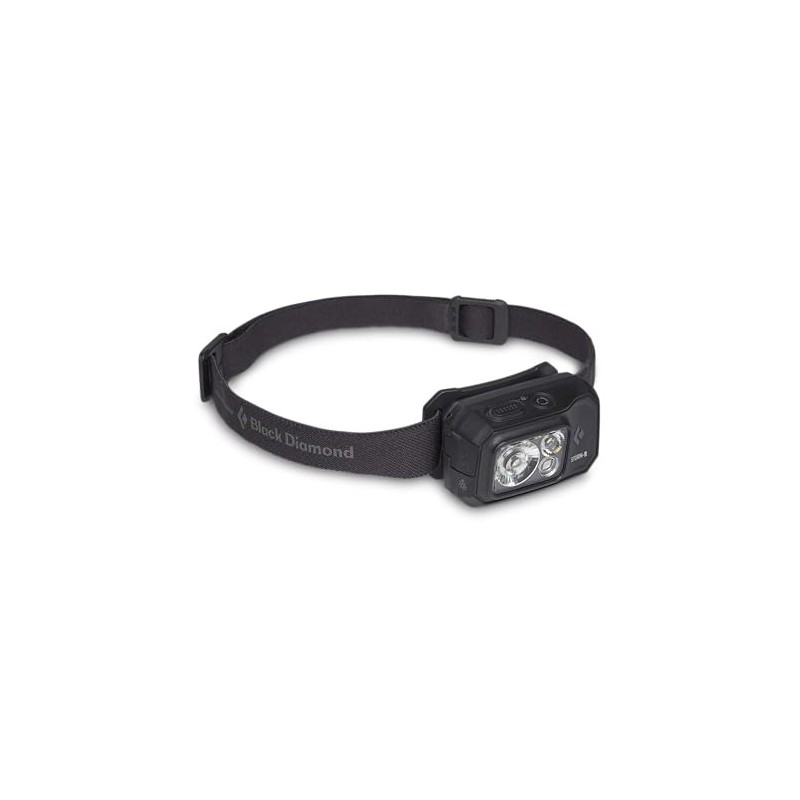
Because the Storm 500-R's battery is built in, you can't swap cells on the trail, so pair it with a second small light or carry a way to recharge it if you rely on it for long nights. If you would rather carry spare batteries, a hybrid lamp is an alternative: Petzl's ACTIK CORE runs on its CORE rechargeable battery (1,250 mAh) or on three AAA batteries, is rated at 625 lumens, weighs 88 grams and is IPX4 weather resistant, according to Petzl. Whatever you carry, check that it works and is charged the night before, and keep it near the top of your pack, not buried under layers.
A short-day hike plan, step by step
Pulling it together, a winter hike around short daylight comes down to a few habits you can repeat on any trail.
- Look up the sun for the date and place. Use a sun table for the nearest town to the trailhead and note sunrise, sunset and the end of civil twilight.
- Pick a route that fits. Use your slowest winter pace, not your summer time, and choose a shorter backup trail in case conditions are worse than expected.
- Set the turnaround time. Work back from sunset with at least an hour of cushion, write the time down and share it with the group.
- Tell someone. Leave your route and expected return time with a person who will act if you don't check in, as the National Park Service advises.
- Pack light and warmth. Carry a headlamp with spare power, extra layers and traction, and keep the lamp warm in a pocket.
- Navigate before dark. Snow-covered landscapes look different than in summer, the National Park Service notes, so carry a map and compass or GPS and know how to use them. Our guide on how to use a map and compass is a good refresher.
None of this makes winter hiking risk free, and local conditions such as avalanche terrain, closures and road access are outside the scope of a sun table. Check with the land manager for the area you plan to hike for current conditions and rules. But matching the route to the light you actually have is the single easiest way to keep a good winter day from turning into a long, cold night.
Sources: timeanddate.com: Anchorage sun table, December 2026, timeanddate.com: Seattle sun table, December 2026, timeanddate.com: Minneapolis sun table, December 2026, timeanddate.com: Denver sun table, December 2026, timeanddate.com: Atlanta sun table, December 2026, timeanddate.com: Phoenix sun table, December 2026, timeanddate.com: Miami sun table, December 2026, National Weather Service Louisville: Twilight types, National Weather Service Sioux Falls: Twilight definitions, National Park Service: The Ten Essentials, National Park Service: Winter hiking tips, Washington Trails Association: Staying safe when days are short, Washington Trails Association: Snowshoeing 101, Appalachian Trail Conservancy: Winter hiking, National Parks Conservation Association: 7 tips for winter hiking, Petzl: HYBRID CONCEPT and cold-weather battery use, Petzl: ACTIK CORE specifications, NRS: Black Diamond Storm 500-R Headlamp specs; Amazon B09NQKZ4BP.
Frequently asked questions
How many hours of daylight do you get for winter hiking?
Near the December 21, 2026 solstice, US hikers get roughly 5.5 to 10.5 hours of daylight from sunrise to sunset. Timeanddate.com tables give Anchorage about 5 hours 28 minutes, Seattle 8 hours 25 minutes, Denver 9 hours 21 minutes and Miami 10 hours 32 minutes. Check the table for your trailhead area, since valleys and forest make it dark sooner.
What does civil twilight add to a winter hike?
Civil twilight is when the sun is less than 6 degrees below the horizon, and the National Weather Service says artificial light is often not needed then. On the 2026 solstice it adds about 52 minutes in Miami, about an hour to 72 minutes in Denver, Minneapolis and Seattle, and about two hours in Anchorage, split between morning and evening. Treat the evening share as a cushion, not part of the plan.
Why do sunrise and sunset keep shifting around the solstice?
The shortest day is not the day with the earliest sunset or latest sunrise. In Seattle in 2026, sunset moves from 4:19 p.m. on December 1 to 4:27 p.m. on December 31, while sunrise slips from 7:36 a.m. to 7:57 a.m. Look up the sun times for the exact date of your hike.
How do you set a turnaround time for a winter hike?
Start from the sunset time for your hike date, subtract a cushion of at least an hour, and turn around at roughly the halfway point of the time that remains. Write the time down, share it with your group and someone at home, and stick to it even if the goal is close. Turn earlier if the return includes icy descents or tired hikers.
How much slower is hiking in snow?
Snow, ice and mud all slow you down, and the amount varies too much for one number. The Appalachian Trail Conservancy says to plan fewer miles than usual, and the Washington Trails Association says to set lower mileage goals when snowshoeing. Time a familiar stretch in snow and plan with your slowest pace.
What light should you carry on a winter day hike?
Carry a headlamp on every winter hike, even short ones, plus spare batteries or a backup light. The National Park Service lists illumination among the Ten Essentials and recommends hands-free headlamps. Petzl warns that cold can cut battery burn time by up to 50 percent between 0 and minus 20 degrees Celsius, so keep the lamp warm in a pocket.