
Rule 800 GPH vs Attwood Tsunami T800
Written by John Wren|
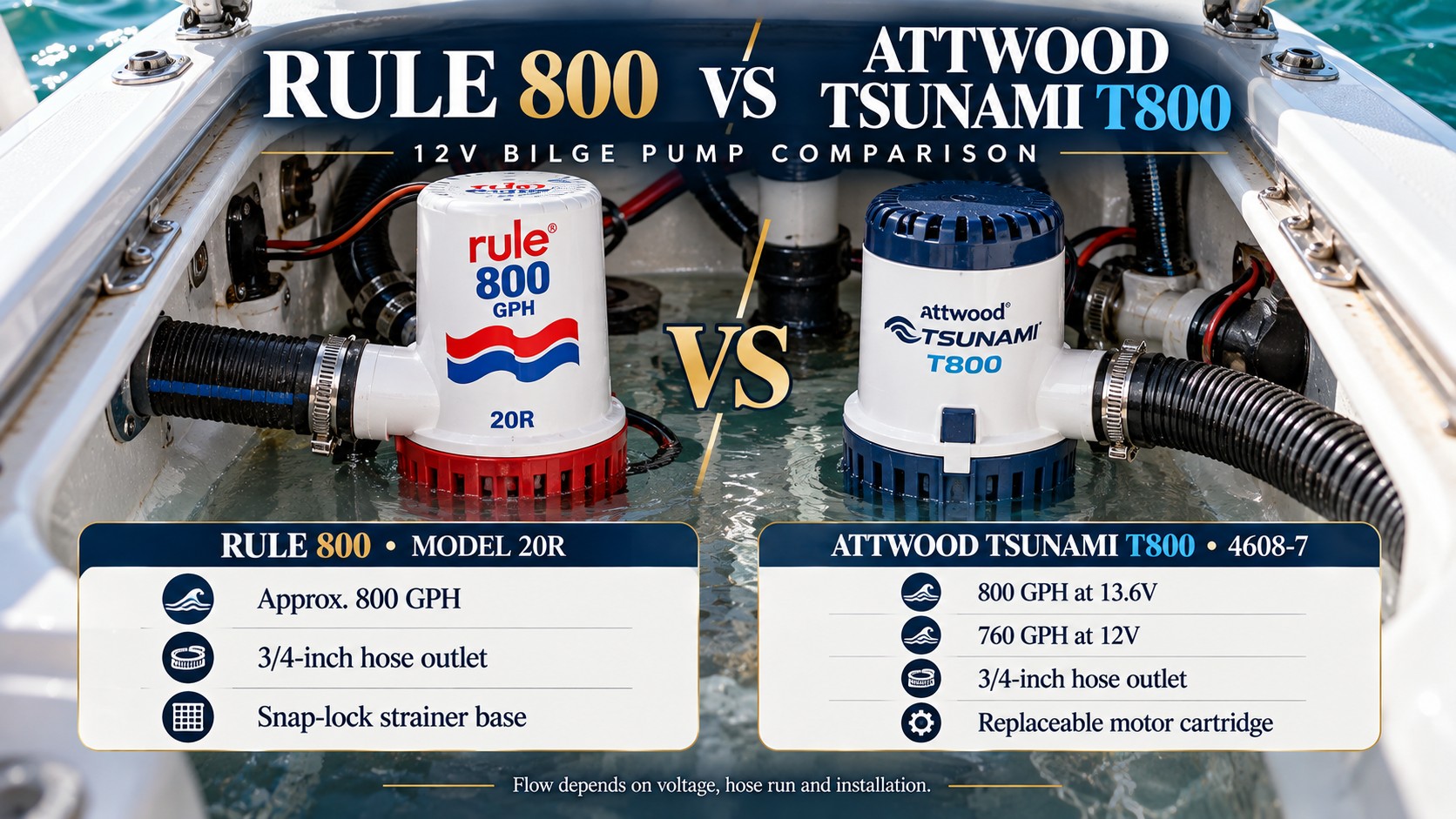
B000O8B854 if you want the Rule 800 round card with ~800 GPH and snap-lock strainer language. B001O0D6II if you want T800 with 800 GPH at 13.6 V / 760 GPH at 12 V and a replaceable cartridge.
Key takeaways
- Rule 800 on B000O8B854 prints ~800 GPH, 3/4-inch barb, run-dry-for-short-periods language, snap-lock strainer base.
- Attwood Tsunami T800 on B001O0D6II prints 800 GPH at 13.6 V / 760 GPH at 12 V, 3/4-inch outlet, replaceable cartridge motor core.
- A Sahara automatic bilge pump is a different Attwood fight.
- Neither card is a livewell pump comparison on this page.
Buy the Rule 800 GPH round submersible bilge pump, model 20R language, ASIN B000O8B854, when you want the bilge pump whose card prints high pumping capacity language at about 800 GPH, a 3/4-inch hose barb, ability to run dry for short periods, compact efficient long-life motor language, easy-clean snap-lock strainer bases, rust and corrosion protection language, and silent vibrationless operation language, for 12-volt DC unless a listing notes otherwise. Buy the Attwood Tsunami T800, model 4608-7, ASIN B001O0D6II, when you want the cartridge bilge pump whose features print 800 GPH output at design voltage 13.6 volts DC or 760 GPH at nominal 12 volts DC, premium bearings and brush language, a patented shaft seal, caulked and tinned wiring, a barbed 3/4-inch outlet, about 29-inch wire language, and a replaceable interchangeable motor core for service. Match the ASIN before you match a Rule square 20F body or an Attwood Sahara automatic pump.
Short version. An Attwood Sahara 4505-7 and a SEAFLO SFBP1-G500-01 are a different bilge fight. An Attwood 5550-24Z1 and a Perko 1311DP2CHR are not these cartridges. A SHURFLO 4008-101-E65 and a Jabsco 31395 are fresh-water pumps. A Standard Horizon HX890 and an Icom IC-M37 are handheld VHFs. A Uniden UM385BK and a Standard Horizon GX1400 are fixed-mount VHFs. This page is B000O8B854 and B001O0D6II.
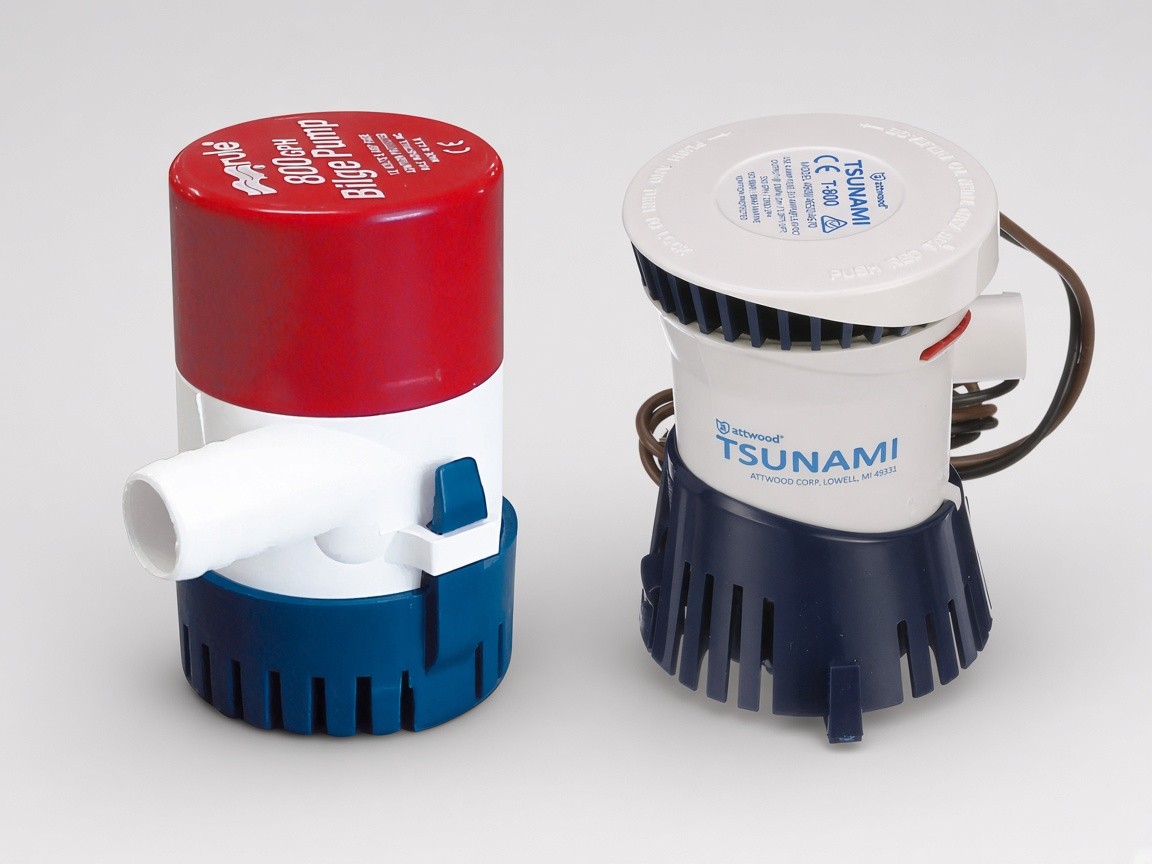
| Job | Rule 800 GPH | Attwood Tsunami T800 | Buy |
|---|---|---|---|
| What the card says | Rule 800 round, B000O8B854 | Tsunami T800 4608-7, B001O0D6II | Match ASIN before Sahara or other GPH. |
| Flow language | About 800 GPH | 800 GPH @ 13.6 V / 760 GPH @ 12 V | Quote both Attwood cells. |
| Outlet | 3/4-inch hose barb | 3/4-inch barbed outlet | Same hose class. |
| Service story | Snap-lock strainer base | Replaceable motor cartridge | Different service paths. |
| Extra language | Run dry for short periods | Shaft seal, tinned wiring | Neither is a seacock. |
| What this is not | Not Rule 1100, not square 20F by default | Not Sahara automatic | Buy the part on the card. |
Who should buy the Rule 800, and who should buy the Tsunami T800?
Buy B000O8B854 if you want the Rule 800 round card with about 800 GPH language, a 3/4-inch barb, run-dry-for-short-periods language, and a snap-lock strainer base story. Buy B001O0D6II if you want the Tsunami T800 with 800 GPH at 13.6 V / 760 GPH at 12 V, a replaceable motor cartridge, and the shaft-seal and tinned-wiring language on that card.
Buy neither if you wanted an automatic Sahara float-switch pump or a fresh-water pressure pump. Those ASINs are already compared elsewhere.
What is B000O8B854 actually for?
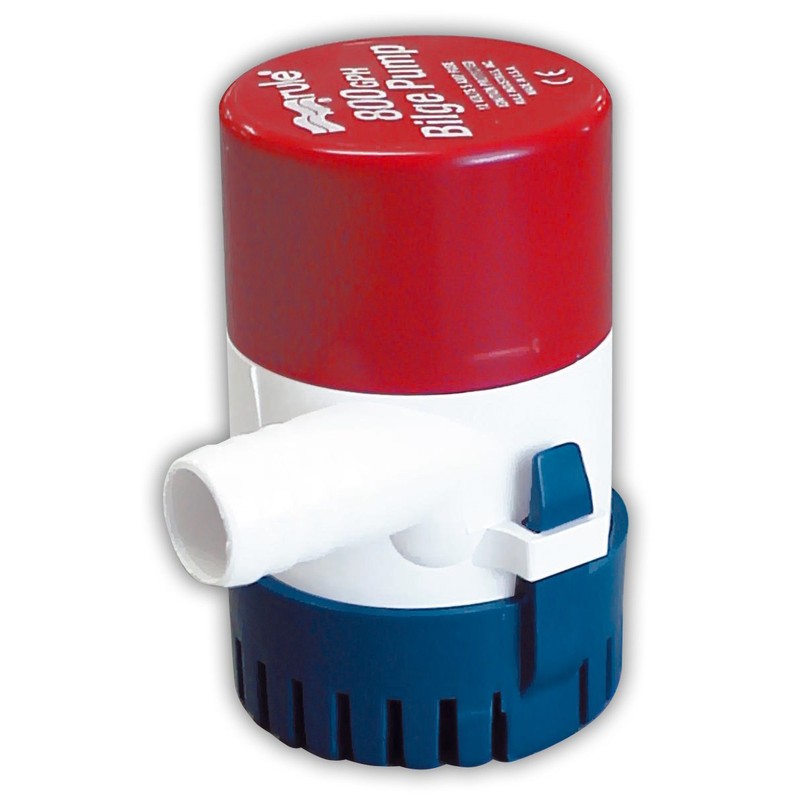
This card is a Rule 800 GPH round submersible bilge pump, model 20R language, ASIN B000O8B854. Features print about 800 GPH capacity language, a 3/4-inch hose barb, ability to run dry for short periods, compact efficient motor language, snap-lock strainer bases, corrosion protection language, and 12-volt DC unless noted.
Eight hundred GPH is the capacity class. It is not the Tsunami's dual 800/760 voltage split. Snap-lock strainer language is how this card says you clean the base. Run-dry-for-short-periods is a limited allowance, not a duty cycle.
Do not order a Rule 500 or 1100 because the brand matched. Do not treat a square Rule body as this round ASIN without checking the model cell.
What is B001O0D6II actually for?
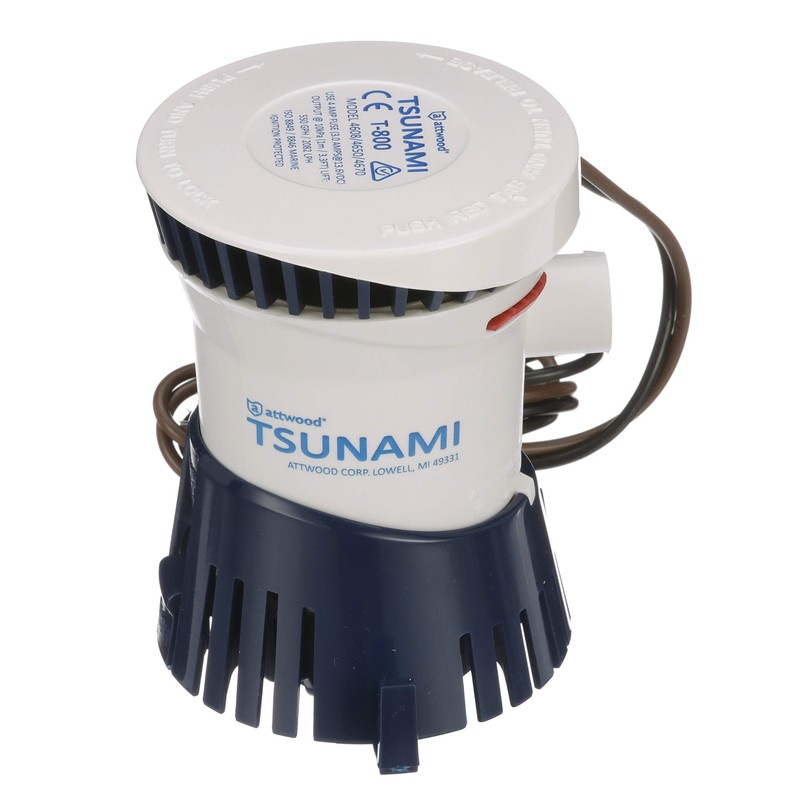
This card is an Attwood Tsunami T800 bilge pump, model 4608-7, ASIN B001O0D6II. Features print 800 GPH at 13.6 V DC or 760 GPH at 12 V DC, premium bearings and brushes language, a patented shaft seal, caulked and tinned wiring, a 3/4-inch barb, about 29-inch wire language, and a replaceable interchangeable motor core.
Cartridge service is the Tsunami story. It is not a Rule snap-lock strainer sentence. Quote both GPH cells when voltage at the pump is unknown.
Do not order Sahara 4505-7 because Attwood matched. That automatic fight is already written.
How do you read these two bilge cards without mixing the Sahara page?
Both cards are roughly 800 GPH-class submersible bilge pumps with 3/4-inch outlets. A Sahara automatic pump adds float-switch behavior this page is not selling. A SHURFLO or Jabsco fresh-water pump is a different plumbing job.
Rule run-dry-for-short-periods language is not permission to run dry as a habit. Attwood 800 GPH at 13.6 V versus 760 GPH at 12 V is a voltage-dependent flow split. Do not treat them as two different pump sizes.
Replaceable cartridge language on the Tsunami is a service story. Snap-lock strainer language on the Rule is a clean-out story. Neither sentence is a claim the pump replaces a through-hull seacock design decision on your hull.
VHF pages linked above are radios. Do not open those ASINs because the boating desk matched and the bilge cell was not checked.
What actually fails on these two cards?
The Rule card fails when 800 GPH is rewritten as a 500 GPH or 1100 GPH Rule without renaming the ASIN. It fails when run-dry language is sold as continuous dry running. It fails when a square 20F body is treated as B000O8B854 without checking.
The Tsunami card fails when 760 GPH at 12 V is ignored and only 800 GPH is quoted. It fails when Sahara automatic language is pasted onto 4608-7. It fails when a fresh-water pump ASIN is ordered because Attwood matched.
What is this comparison not?
This is not a livewell aerator comparison and not a VHF comparison. B000O8B854 and B001O0D6II are the cards. A Sahara automatic or a Rule of another GPH class is a different part if the ASIN changes. This is not a price quote.
This is also not a claim that one pump will empty a swamped cockpit faster in every install. Hose runs, voltage drop, and check valves change the job. Leave those on the boat.
So which bilge pump should you buy?
Buy the Rule if you want ASIN B000O8B854, about 800 GPH language, a 3/4-inch barb, and snap-lock strainer language. Buy the Attwood if you want ASIN B001O0D6II, 800 GPH at 13.6 V / 760 GPH at 12 V, and a replaceable cartridge motor core. Buy neither if you wanted an automatic Sahara or a fresh-water pump.
Keep both ASINs on the table when a seller gallery mixes generations. The shopping rule on this rule 800 vs attwood tsunami t800 page is still the ASIN printed on each product card above, not a colorway photograph alone, not a sibling size, and not a later year that borrowed the same hero image. If a cell is missing from the listing you opened, leave it missing instead of inventing a number from a review that never named this part. Internal links on this page point at real catalog fights on the same desk so you can leave when the job changes.
Read the compare table as a map of jobs, not as a score. A higher lumen peak, a lighter ounce cell, or a longer warranty sentence is still only the cell that listing printed. When two cards disagree on units, keep both units instead of converting them into a fake average. When a shop title adds adjectives the feature block never repeats, keep the feature block.
Carry and charging accessories in a bundle photograph are not automatic proof they ship in every fulfillment path. If the title says bundle and the ASIN is the bundle ASIN, shop that ASIN. If the title is the light alone, do not invent a holster from a lifestyle image. The same rule applies to reservoirs, flasks, harnesses, and stuff sacks named elsewhere on this site.
Answer-first shopping means you can stop after the opening paragraph if the ASIN match is already clear. The later sections exist for readers who need the failure modes, the not-this boundaries, and the FAQ answers that match the same cells. They are not a place to introduce a third product that is not on the cards.
Field language on this magazine stays tied to printed cells. A reviewer who loved one sample in salt fog is a reviewer. A manufacturer sentence about sealed oil, argon purge, USB-C, or a detachable waist belt is still only that sentence. Do not promote a blog metaphor into a waterproof rating, a cast distance, or a boil time this page did not measure.
When you leave this page for an outbound catalog link, you are changing the job on purpose. Spinning 3000 fights, red-dot fights, automatic bilge fights, and Farpoint-volume travel packs are already written so this comparison can stay narrow. Come back only if the ASIN you need is still one of the two named above.
Keep both ASINs on the table when a seller gallery mixes generations. The shopping rule on this rule 800 vs attwood tsunami t800 page is still the ASIN printed on each product card above, not a colorway photograph alone, not a sibling size, and not a later year that borrowed the same hero image. If a cell is missing from the listing you opened, leave it missing instead of inventing a number from a review that never named this part. Internal links on this page point at real catalog fights on the same desk so you can leave when the job changes.
Read the compare table as a map of jobs, not as a score. A higher lumen peak, a lighter ounce cell, or a longer warranty sentence is still only the cell that listing printed. When two cards disagree on units, keep both units instead of converting them into a fake average. When a shop title adds adjectives the feature block never repeats, keep the feature block.
Carry and charging accessories in a bundle photograph are not automatic proof they ship in every fulfillment path. If the title says bundle and the ASIN is the bundle ASIN, shop that ASIN. If the title is the light alone, do not invent a holster from a lifestyle image. The same rule applies to reservoirs, flasks, harnesses, and stuff sacks named elsewhere on this site.
Answer-first shopping means you can stop after the opening paragraph if the ASIN match is already clear. The later sections exist for readers who need the failure modes, the not-this boundaries, and the FAQ answers that match the same cells. They are not a place to introduce a third product that is not on the cards.
Field language on this magazine stays tied to printed cells. A reviewer who loved one sample in salt fog is a reviewer. A manufacturer sentence about sealed oil, argon purge, USB-C, or a detachable waist belt is still only that sentence. Do not promote a blog metaphor into a waterproof rating, a cast distance, or a boil time this page did not measure.
Frequently asked questions
Rule 800 or Attwood Tsunami T800?
B000O8B854 if you want the Rule 800 round card with ~800 GPH and snap-lock strainer language. B001O0D6II if you want T800 with 800 GPH at 13.6 V / 760 GPH at 12 V and a replaceable cartridge.
Is Tsunami T800 the same as Attwood Sahara?
No. Sahara automatic pumps are a different fight. This page is cartridge T800 on B001O0D6II.
Do both use a 3/4-inch outlet?
Yes. Both cards used here print 3/4-inch barb/outlet language.
Why does Attwood print two GPH numbers?
The T800 card prints 800 GPH at 13.6 V design voltage and 760 GPH at nominal 12 V. Quote both when you compare.
Is this a fresh-water pressure pump page?
No. SHURFLO and Jabsco fights are separate. These are bilge pumps.
Does Rule say it can run dry?
The Rule card prints ability to run dry for short periods. That is not continuous dry running.