
Duck Hunting From a Kayak: Cold-Water Safety Guide
Written by Outdoors Magazine|
Outdoors Magazine is a participant in the Amazon Services LLC Associates Program. We may earn a commission if you buy through links on this page, at no extra cost to you. Affiliate disclosure.
Duck hunting from a kayak in cold water is safe only if you plan to fall in. Wear a snug, Coast Guard-approved foam life jacket the whole time, dress for the water temperature, keep weight low and centered, keep the gun unloaded and cased while paddling, shoot seated and stopped, and leave a float plan.
Key takeaways
- Cold shock and muscle failure can kill in minutes, before hypothermia.
- Wear a snug foam life jacket at all times; you can't put one on after a capsize.
- Dress for immersion; waders can fill, so use a belt or skip them.
- Paddle with the gun unloaded and cased; shoot only seated and stopped.
Duck hunting from a kayak in late season is safe only if you plan for falling in: wear a snug, Coast Guard-approved foam life jacket the whole time, dress for the water temperature rather than the air, keep weight low, keep the gun unloaded and cased while paddling, shoot only seated and stopped, and leave a float plan.
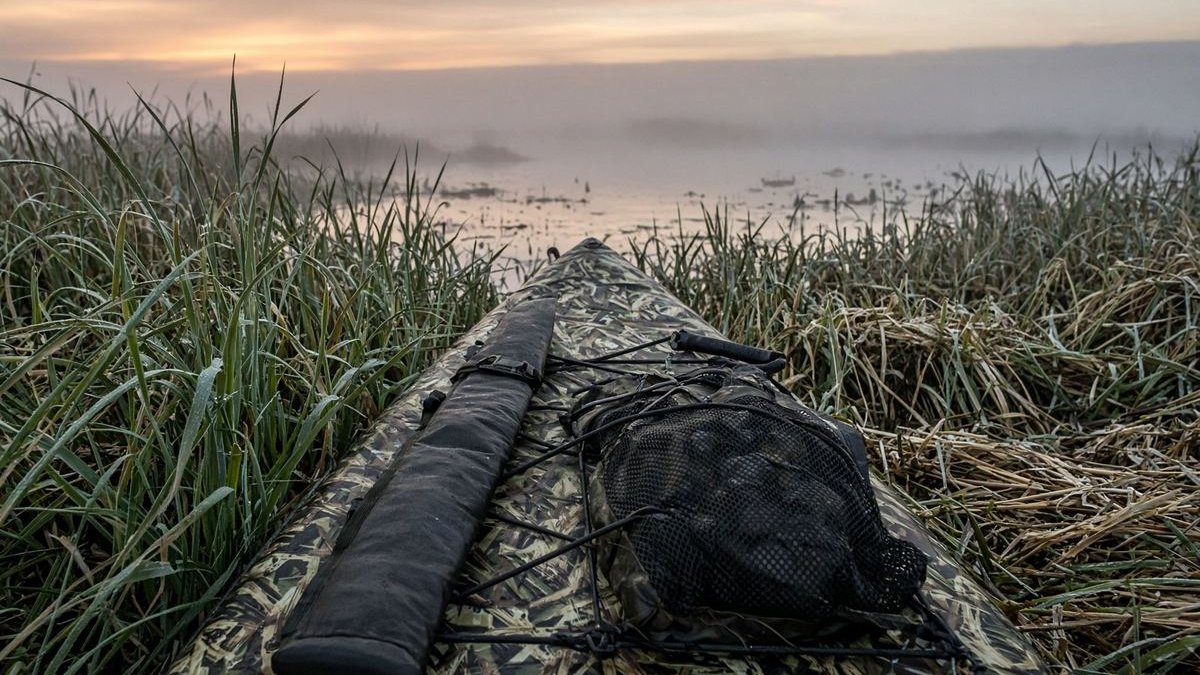
A small boat in a frozen marsh leaves very little margin for a mistake. AI-generated editorial image of the bow of a grass-camouflage kayak nosed into frosted marsh grass at a foggy dawn, a padded long case and a mesh decoy bag strapped to the deck.
A kayak is a quiet, cheap way to reach water that bigger duck boats can't. The trade-off is that it sits low, carries little, and can tip with one bad lean. In late season, with skim ice on the edges and water just above freezing, a capsize can be fatal within minutes. Idaho Fish and Game notes that with water just above freezing, boating accidents can end in a fatality, and the Minnesota DNR says more than 30 percent of the state's boating deaths involve cold water and a victim not wearing a life jacket.
This guide draws on the National Center for Cold Water Safety, the U.S. Coast Guard and state wildlife and boating agencies. Rules vary by state, so check your own state's boating and hunting regulations before the season.
Why is cold water the biggest danger when duck hunting from a kayak?
Because the first minute in cold water can kill you before hypothermia ever starts. Sudden immersion triggers cold shock, a gasp and loss of breathing control, followed within minutes by muscle failure that makes swimming and climbing back aboard nearly impossible. Hypothermia comes later, after you are already helpless.
The National Center for Cold Water Safety describes four stages of immersion. The first is cold shock, which hits the moment cold water covers a large area of skin such as the chest and back. It disrupts breathing control, strains the heart and impairs thinking. If you gasp with your head underwater, you inhale water. The second is incapacitation, sometimes called swimming failure: nerves and muscles in the arms and legs cool until they stop working, and the center says that in very cold water you can lose the use of your hands in about 60 seconds. The third is hypothermia, a drop in core temperature. The fourth is circum-rescue collapse, a sudden fall in blood pressure that can cause unconsciousness or heart failure, most often when a badly chilled person is pulled from the water.
Timelines vary. The Minnesota DNR describes cold shock lasting 2 to 3 minutes, swim failure within roughly 30 minutes and loss of useful consciousness after at least 30 minutes. The center's warning about hands is faster, so plan around it.
The water does not have to be icy to cause trouble. The center treats water at or below 70°F (21°C) with caution and calls 50 to 60°F and colder immediately life-threatening, with cold shock peaking for most unaccustomed people in the 50 to 60°F range. Late-season marshes are colder still. North Dakota Game and Fish gives an expected survival time of 30 to 90 minutes in water between 32.5 and 40°F, assuming you survive the first few minutes, and its rule is simple: dress for the water temperature, not the air temperature.
Do you have to wear a life jacket when duck hunting from a kayak?
Federal law requires a Coast Guard-approved wearable life jacket for each person aboard, but generally does not require adults in a kayak to wear it. In practice, you should. In cold water you will not have time to put one on after you capsize, and agencies such as the Missouri Department of Conservation tell duck hunters to wear one at all times.
The U.S. Coast Guard says a recreational vessel must carry a Coast Guard-approved wearable life jacket for each person on board, readily accessible. Kayaks and canoes are exempt from the throwable-device requirement, according to the Boat-Ed paddlesports course. Federal rules require children under 13 to wear one while underway, and states set their own ages: Oregon applies its rule to children 12 and under, North Dakota to children 10 and under.
Carrying one is not the same as wearing one. The Minnesota DNR says putting a life jacket on once you are in the water is extremely difficult, if not impossible, and calls wearing one the single most important factor in surviving cold-water immersion. Texas Parks and Wildlife's hunter education course says to wear one both underway and while stopped and hunting.
Foam or inflatable? For late-season paddling, the agencies lean toward foam. The Minnesota DNR says foam vests are better than inflatables during the cold-water season, and Oregon's State Marine Board calls inherently buoyant, foam-style jackets the best choice. Several limits on inflatables matter for kayak hunters:
- The Coast Guard does not approve inflatable life jackets for anyone under 16, according to Oregon's State Marine Board.
- The Coast Guard says inflatables are not appropriate for weak or non-swimmers, and many are approved only when worn.
- The Boat-Ed paddlesports course says inflatables should not be used when you expect to end up in the water, such as in whitewater paddling.
- An inflatable must have a full cylinder and all status indicators green to work, per the Coast Guard, and Oregon advises testing the inflation mechanism every year. The National Center for Cold Water Safety notes that manually activated models can fail to inflate if the wearer can't pull the cord.
Fit matters as much as type. The National Center for Cold Water Safety warns that a loose life jacket can ride up or slip off, that a typical recreational Type III vest won't turn an unconscious person face up, and that no life jacket prevents cold shock, incapacitation or hypothermia. In water below 40°F, North Dakota Game and Fish notes that a coat-style flotation jacket covers more of the body than a vest.
One example of a foam paddling vest built for kayaks is the Onyx MoveVent Dynamic. Sportsman's Warehouse lists it as a U.S. Coast Guard-approved Type III vest with soft foam flotation, a front zipper, adjustable side belts, an attached whistle, SOLAS-grade reflective material, a zippered pocket, and mesh in the lower back meant to fit high-back kayak seats. Its bright colors also help a rescuer find you.

What should you wear to hunt ducks from a kayak in cold water?
Dress for a swim, not for a sit. The National Center for Cold Water Safety says thermal protection such as a dry suit or wetsuit is required for cold-water immersion and warns against relying on waders. State agencies that accept waders say to wear a belt so they don't fill with water.
The National Center for Cold Water Safety treats immersion gear as survival equipment whenever water is below 70°F. A dry suit keeps water off your skin, which can blunt cold shock, but the warmth comes from insulating layers underneath. A snug wetsuit of adequate thickness is the other option. The center says raingear and paddling jackets are waterproof but not watertight, so they offer no real immersion protection, and it recommends neoprene for head, hands and feet. Its test: if you feel chilled on shore in your suit, you probably lack enough insulation for a swim.
Waders are where the sources part ways. The National Center for Cold Water Safety advises against waders as cold-water protection, citing two 2020 incidents, one fatal, in which waders filled after a capsize and kept paddlers from climbing back onto sit-on-top kayaks; it says compression straps are unlikely to keep water out. The Wisconsin DNR also warns that waders can fill and trap a hunter's legs. The Missouri Department of Conservation and Idaho Fish and Game tell hunters who wear chest waders to wear a belt over them, and Idaho notes that neoprene waders are warmer and float better than standard fishing waders. The conservative reading: a belt helps, but it is not a dry suit.
Idaho Fish and Game adds that alcohol makes people more susceptible to hypothermia and slows decision-making, so leave it at home.
How do you keep a hunting kayak stable with decoys, gear and a dog?
Stay within the kayak's rated capacity, keep weight low and centered, and secure gear so it can't shift. Bring a dog only if it is well trained, and keep it lying in the center of the boat. Sudden weight shifts from a dog or a hunter can capsize a small boat.
North Dakota Game and Fish tells hunters not to overload a boat, because sudden weight shifts can capsize it. The Missouri Department of Conservation says to keep decoys and gear low and evenly distributed, the Wisconsin DNR asks hunters to count passengers, dogs and gear together and keep the load low and centered, and the Boat-Ed course says never to exceed the vessel's capacity.
On a kayak, stow decoy bags and the gun case low and strapped down rather than stacked high, and rig lines so nothing can snag your legs if you go over. The Minnesota DNR advises staying seated while underway, wearing non-skid footwear and never reaching overboard for objects, including the decoy that drifted just out of reach. For more primary stability, a wider hull is the most reliable answer; our guide to the best duck hunting kayaks compares stable models.
Dogs. North Dakota Game and Fish recommends introducing your dog to boat hunting before the season. The Boat-Ed course says only well-trained dogs belong in small vessels, lying on the bottom in the center. Texas Parks and Wildlife says to treat a dog like another hunter for muzzle control and never shoot directly over one, and the Wisconsin DNR notes that dogs need life jackets too.
How should you handle a shotgun in a kayak?
Treat it exactly as you would on land, with extra care. Keep it unloaded, cased and secured so it can't go overboard while you paddle, load only after you are stopped and set up, keep the muzzle pointed safely, and shoot only while seated. With a partner, agree on a firing zone first.
The Minnesota DNR says hunters on the water should follow the same four firearm safety rules they use on land: treat every firearm as loaded, control the muzzle, be sure of your target and what is beyond it, and keep your finger off the trigger and outside the trigger guard until ready to shoot. The Wisconsin DNR teaches the same rules and adds that firearms carried by boat should be unloaded and secured so they won't go overboard.
State guidance on the specifics lines up closely:
- While paddling: The Missouri Department of Conservation says to transport firearms unloaded, in a case, with the action open, and Texas Parks and Wildlife says to keep them completely unloaded and cased with ammunition stored separately. The Boat-Ed boating course adds that firearms should be unloaded, with the safety on, and secured in a case while transported in a vessel.
- Before loading: Missouri says not to load until decoys are set, gear is deployed and you are in position, and to keep the safety on and your finger off the trigger until you are ready to shoot.
- When shooting: The Boat-Ed course says never to fire until the vessel is stopped and secured or anchored, and to always remain seated when shooting. Missouri asks hunters to make sure the shooting platform is stable and they can swing safely.
- With a partner: The Wisconsin DNR says to set and communicate a safe fire zone, and not to stand to shoot if your partner is shooting from a seated position. Texas Parks and Wildlife recommends sitting back to back for the safest zones of fire in a boat. Missouri warns against shooting over a partner's head.
In a kayak, standing raises your center of gravity, and a twisting swing is exactly the kind of sudden shift that rolls a hull. Unload and case the gun before you move the boat, pick up decoys or retrieve a bird. Your state's hunter education course covers these rules in more depth.
What should you do if your kayak capsizes in cold water?
Get your breathing under control first, stay with the boat, and try to get back aboard right away while your hands still work. Don't swim for shore unless help is very close. If you can't reboard, float still in a tucked position to save heat and signal for help.
The Minnesota DNR teaches the 1-10-1 principle for someone wearing a life jacket: about 1 minute to get breathing under control, about 10 minutes of meaningful movement to make a plan and try to self-rescue, and about 1 hour or more of useful consciousness to slow heat loss and signal. Given how fast hands can fail, make the reboarding attempt early.
The Minnesota DNR advises staying with the boat and trying to reboard, since most capsized craft still float and are easier for rescuers to find, and says not to swim except to a nearby boat or floating object. Keep clothes and boots on; most clothing floats for a long time. If you can't get out, use the H.E.L.P. position: cross your ankles, cross your arms over your chest, draw your knees up and lean back in your life jacket. The Missouri Department of Conservation adds: stuff decoys inside your jacket for extra flotation if they are within reach.
Practice before the season. NOLS says cold water can affect your ability to self-rescue, teaches the skills in calm water first, and recommends keeping a paddle float and bilge pump handy. The Minnesota DNR suggests practicing H.E.L.P. in a pool first. Practice reboarding your actual hunting kayak, in the clothing and life jacket you hunt in, in shallow water near shore with a partner, and take a paddling course if you have never done a deep-water reentry. If you plan to wear waders, the National Center for Cold Water Safety says to test them thoroughly near shore first.
Float plans, communication, ice and wind before you launch
Late-season marshes are lonely places. The Minnesota DNR points out that fewer boaters are on the water in fall, so cries for help may go unheard and rescues can take longer. That makes the steps you take on shore count for more.
Leave a float plan. The Minnesota DNR recommends leaving a float plan with a friend or relative that covers your boat and equipment, who is going, your destination and route, when you expect to return, and who to call if you are overdue. The Wisconsin, North Dakota and Missouri agencies give the same advice. Our kayak float plan checklist walks through what to include and how to agree on an overdue time.
Carry a way to call for help, on your body. North Dakota Game and Fish recommends a cell phone or emergency beacon and not hunting alone; the Minnesota DNR recommends a phone or radio but warns that service may be unavailable in remote areas. A phone in a dry bag strapped to an overturned kayak does no good, so keep it in a waterproof case attached to your life jacket. NOLS also recommends a whistle.
Read the wind and the weather. The Missouri Department of Conservation warns that high winds can be dangerous and says to head for shore at the first sign of a storm. The Wisconsin DNR lists fog, wind and sudden storms as the main concerns and asks hunters to carry proper lighting for low light. Decide your turnaround conditions before you launch.
Respect ice at the launch. Idaho Fish and Game warns that wet rocks glazed with ice are doubly slippery and can lead to an unexpected dip in frigid water. Launching and landing are when a kayak is least stable, so zip your life jacket before stepping aboard and avoid routes that would force you to push through ice or climb out onto it. For where birds hold late in the year, see our guide to late-season public-land ducks.
Sources: National Center for Cold Water Safety: Stages of Immersion, National Center for Cold Water Safety: Why It's Dangerous, National Center for Cold Water Safety: Water Temperature Safety Guide, National Center for Cold Water Safety: What PFDs Can and Can't Do, National Center for Cold Water Safety: Gear Guide, U.S. Coast Guard Boating Safety: Life Jacket Wear, Boat-Ed Paddlesports: Specific PFD Requirements, Boat-Ed: Hunters Who Use Boats to Hunt, Oregon State Marine Board: Life Jackets, Minnesota DNR: Cold Water Dangers, Minnesota DNR: Duck Boat Safety Tips, Minnesota DNR: Stay Safe When the Water Temperature Drops (2026), Wisconsin DNR: waterfowl boating safety release (2026), Wisconsin DNR: waterfowl hunting safety release (2025), Missouri Department of Conservation: Waterfowl Safety and Health, North Dakota Game and Fish: Boating Safety for Hunters, Texas Parks and Wildlife Hunter Education: Boats and Dogs, Idaho Fish and Game: Use Caution in Winter When Using Boats, NOLS: Sea Kayak Self-Rescue Techniques, Onyx MoveVent Dynamic listing at Sportsman's Warehouse; Amazon B00FI3F9XM.
Frequently asked questions
Why is cold water the biggest danger when duck hunting from a kayak?
Cold water can kill in the first minute through cold shock, a gasp reflex and loss of breathing control that can make you inhale water. Within minutes your arms and hands can stop working, so swimming or climbing back aboard becomes nearly impossible long before hypothermia sets in. Dress for the water temperature, not the air.
Do you have to wear a life jacket when duck hunting from a kayak?
Federal rules require a Coast Guard-approved wearable life jacket for every person aboard, and children must wear one under federal and state age rules. Adults generally aren't required to wear it, but you can't put one on after a cold-water capsize, so agencies such as the Missouri Department of Conservation tell duck hunters to wear one at all times. A snug foam vest is the preferred choice in the cold-water season.
What should you wear to hunt ducks from a kayak in cold water?
Dress for immersion: the National Center for Cold Water Safety says a dry suit with insulating layers or a snug wetsuit is the real protection in cold water, and that raingear is not. It advises against relying on waders, which can fill and prevent reboarding. If you do wear chest waders, state agencies say to wear a belt over them.
How do you keep a hunting kayak stable with decoys, gear and a dog?
Stay under the kayak's weight capacity, keep decoys and gear low, centered and strapped down, and stay seated. Bring only a well-trained dog and keep it lying in the center of the boat, because sudden weight shifts from a dog or hunter can capsize a small boat.
How should you handle a shotgun in a kayak?
Keep the gun unloaded, cased and secured while paddling, and load only after you are stopped and set up. Follow the four firearm safety rules, shoot only while seated, and agree on firing zones with any partner. Unload and case it again before moving the boat or retrieving birds.
What should you do if your kayak capsizes in cold water?
Get your breathing under control in the first minute, stay with the boat and try to reboard right away while your hands still work. Don't swim for shore unless help is very close. If you can't get out, float in the tucked H.E.L.P. position in your life jacket and signal for help.