
Black Diamond Distance Carbon Z 125 vs LEKI Journey Lite
Written by John Wren|
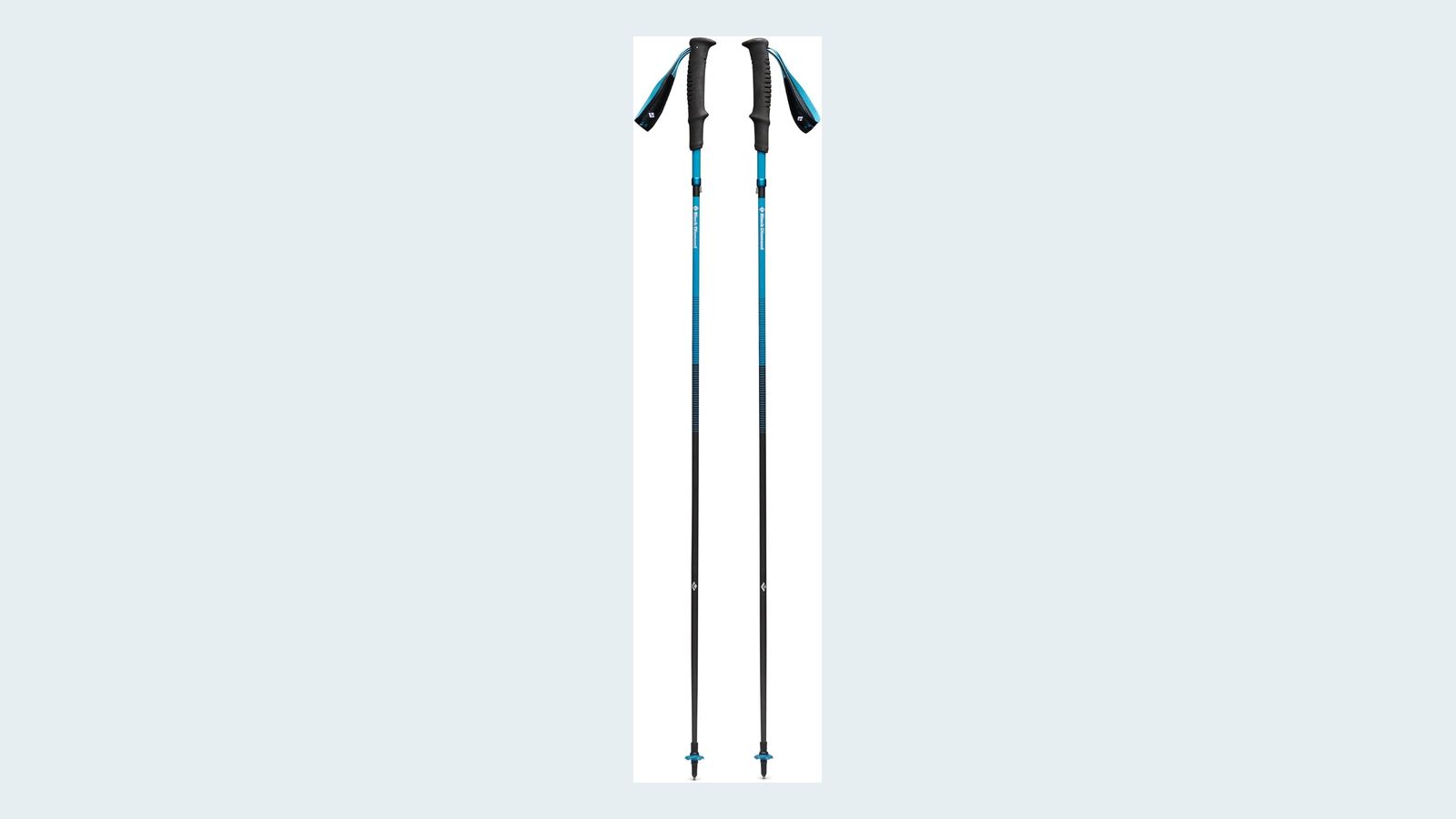
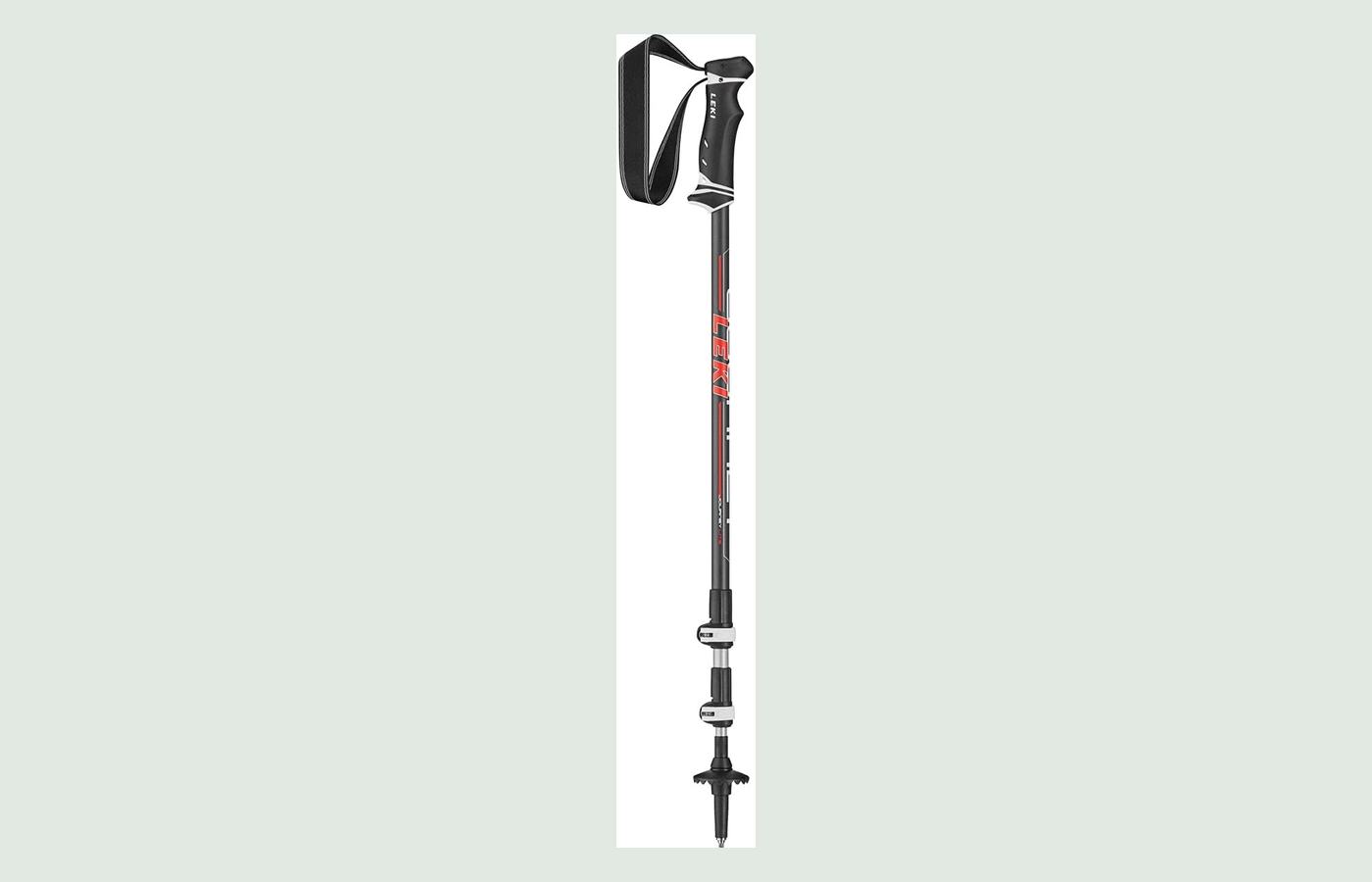
Choose the Black Diamond Distance Carbon Z, Ultra Blue, 125 cm, when that fixed length is the one you already use. Choose the LEKI Journey Lite pair marked 110–135 cm when you want to change length on the hill or you are still measuring.
Key takeaways
- Carbon Z on this card is fixed 125 cm, Z-fold, carbon.
- Journey Lite on this card is the 110–135 cm pair.
- A 110 cm or 130 cm Carbon Z is a different pole.
- Set the straps so you are not hiking with a fist.
Buy the Black Diamond Distance Carbon Z in 125 cm when you already know that length and you want a fixed carbon pole that folds. Buy the LEKI Journey Lite pair marked 110–135 cm when you want to shorten the pole on a climb and lengthen it on a descent. One is a fixed Z-fold. The other is an adjustable aluminum pair. A 110 cm or a 130 cm Carbon Z is a different pole. A Journey Lite marked 90–125 or 100–135 is a different card than the 110–135 pair.
Short version. A foam pad is what you sleep on. A headlamp is what you walk down with. The poles are what keep your knees honest on the way up and the way down. The stove can wait until camp. Poles are a fit problem first and a brand problem second. Check live prices. Read the centimeters on the shaft before you leave the listing.
This comparison is two pairs you can still buy for a trail, not for a ski touring race and not for a Nordic track. The Carbon Z on this card is Ultra Blue, 125 cm, Z-folding, with foam grips and carbide tips. The Journey Lite on this card is the pair whose title says 110–135. If the photo shows a single pole, or a length you did not measure, close it. The wrong length is a pole you will fight for the whole day and then blame for a sore wrist.
| Job | Distance Carbon Z 125 | Journey Lite 110–135 | Buy |
|---|---|---|---|
| One length you have already measured | Fixed 125 cm, carbon, Z-fold | You can set 125, and you can also leave it wrong | Carbon Z |
| Uphill short, downhill long | 125 cm the whole day | Adjustable through 110–135 cm | Journey Lite |
| A pack that has to swallow the poles | Three-section Z-fold | Collapses, longer packed than a Z | Carbon Z if the pack is small |
| A pole you will loan, or a first pair | Only if 125 cm is their length too | The range covers more people | Journey Lite |
| Rock, roots, and a long descent | Carbide tip, fixed | Carbide-style flextip, length you can add | Either, with baskets that match the dirt |
Carbon Z on this card is 125 cm, not an adjustable FLZ. Journey Lite on this card is the 110–135 pair, not a compact 90–125.
Who should buy the Carbon Z, and who should buy the Journey Lite?
Buy the Distance Carbon Z 125 cm if you have stood on flat ground, held a pole or a tape, and 125 cm is where your elbow sits near a right angle with the tip planted beside your boot. Fixed is a gift once you know that number. You stop fiddling with a lock at every switchback. Carbon is the reason the pair feels light in the hand after three hours, and the Z-fold is the reason the pair disappears into a small pack or straps to the side without a long tube sticking out. Foam grips and a strap you can snug are the parts your hand actually lives on. Carbide tips are for dirt and rock. A rubber tip belongs on pavement if you care about the carbide and about the trail surface you are not supposed to chip.
Buy the Journey Lite 110–135 if you do not know your length yet, or you do know it and it changes. Steep climbs want a shorter pole so your shoulder is not up by your ear. Steep descents want a longer pole so you are not bent over the grips. A partner who is taller or shorter than you can use the same pair on a different weekend if their number lives inside 110 to 135. Aluminum is the practical shaft for a first pair and for a pole that will be loaned, dropped in a parking lot, and leaned on while you put a boot back on. It is heavier in the hand than a carbon Z of the same job. It is also the shaft people stop worrying about.
Do not buy either pair as a substitute for a measured length. A 125 cm pole in the hands of a person who wants 115 cm is a pole that plants late and loads the wrist. A 110 cm setting on a tall frame is a pole that makes you stoop. A running vest and these poles can share a morning, but the vest does not size the pole. Set the length at home, on flat floor, before the trailhead parking lot becomes the fitting room.
What the Distance Carbon Z 125 is actually for
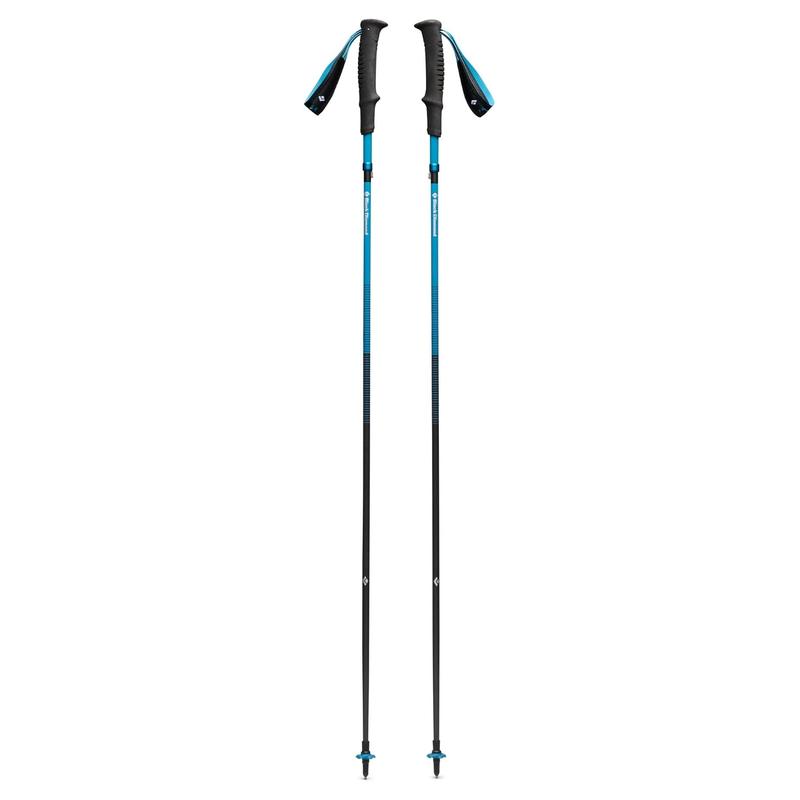
Black Diamond's Distance Carbon Z is a fixed-length carbon pole with a three-section Z-fold. The card here is Ultra Blue, 125 cm, with foam grips, an adjustable strap, and carbide tips. Fixed means the usable length does not slide. You pick 125 cm when you buy it. You do not discover a shorter setting on the hill. That is the feature and the limit. The fold is for packing, not for changing how tall the pole is while you walk.
Use it when your route is a steady grade and you already trust 125 cm, or when the pack is small and a long collapsed aluminum shaft will not fit the side pocket. Unfold it until the joints seat. A Z-pole that is almost clicked is a pole that folds under you on the one step you needed it. Baskets stay on for soft trail and come off, or swap smaller, when the tread is hard and a big basket trips you. The maker sells more than one length in this family. 105, 110, 115, 120, 130 cm boxes are real products. Only 125 cm is this card.
Do: plant the tip under your center, not out in front like a tightrope. Don't: store the pole collapsed while it is packed with grit in the joints. Rinse mud off the shafts before you fold them into the car. Don't: assume carbon shrugs off a full body lean against a rock. A carbon shaft can crack and then look fine until the next hard plant. If you heard a tick and the pole now feels soft, retire it. A soft pole is worse than no pole.
What the Journey Lite 110–135 is actually for
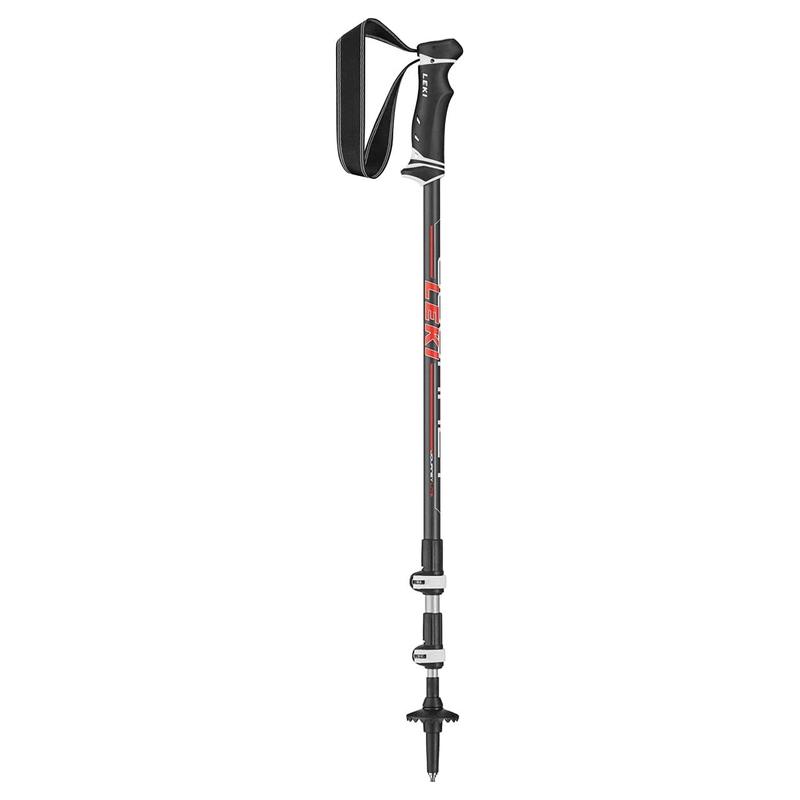
LEKI's Journey Lite on this card is a pair of adjustable poles whose listed range is 110–135 cm. That span is the reason to buy it. You set a length, you walk, and you change it when the grade changes. The pair matters. One pole is a cane. Two poles are a hiking system that shares the load between both arms and lets you brake on the way down without twisting one wrist all afternoon.
Adjustable aluminum is the pole you hand to a friend whose height you do not know, and the pole you keep if your own best length is still a guess. Set it at home. A common starting point is the grip in your hand, elbow near a right angle, tip on the floor beside your foot. Then shorten a few centimeters for a long climb and lengthen a few for a long drop, staying inside the marked range. Do not pull the shafts apart past the stop line printed on them. That line is the end of the overlap that keeps the lock honest. Past it, the pole is a tent pole you are about to lose in two pieces.
Do: set both poles to the same number unless you are traversing and you have a reason not to. Don't: hike an hour with a loose lock because you will tighten it at the top. The lock slips when you load it, which is the moment you wanted it fixed. Don't: treat 110–135 as if it included 100 or 140. If your floor measurement is outside that window, this card is the wrong pair. A compact Journey Lite with a lower range is a different listing.
How to plant a pole so it helps
Straps are part of the fit. A strap that is loose makes you grip harder, and a grip that is crushed makes the wrist do work the strap was built to share. Put your hand up through the strap, then down onto the grip, so the strap crosses the heel of the hand. Snug it until a light plant does not require a fist. On a long descent, that setup is the difference between a useful pole and a pair of sticks you are strangling.
Plant beside you, a little back, when you are climbing so the pole finishes its push as your foot steps up. Plant a little forward when you are descending so the pole is a brake before your knee takes the full drop. Alternate arms with your feet the way you already walk. Two poles planted together, every step, is a shuffle that tires you and catches a basket on a root. One pole is enough for a stream crossing if the other hand needs a rock. Two poles are better on a gravel descent.
Tips and baskets match the ground. A bare carbide tip bites dirt and slips on wet wood. A big basket floats in mud and snow and trips you on a paved approach. Carry the basket you need for the surface you will actually walk, and take it off if the trail is hard. The lamp still belongs in the pack if the descent can outlast the daylight. Poles do not make a dark trail shorter. They make a tired trail steadier.
What actually fails on a trekking pole
Locks fail when they are dirty or undertightened. Grit in a clamp or a twist section is the usual story. Rinse the shaft. Dry it. Tighten the lock until a firm tug does not collapse the section, and stop before you crush the tube. A lock you have to stomp on is a lock that is about to round off. If the pole collapses in your hand on a descent, stop and fix it. Walking on a collapsing pole is how wrists get bent.
Tips fail when the carbide snaps or the ferrule pulls out after a side load. A pole jammed in rocks and then used as a lever is the usual cause. Plant, don't pry. Baskets fail when the thread strips because they were forced on cross-threaded. Start them by hand. If a basket will not turn, it is the wrong basket or it is full of grit.
Carbon fails quietly. A crack at a joint can wait until you weight the pole on a drop-off. Look at the shafts at home under a good light, especially after a fall or a car door. Aluminum fails loudly: it bends. A bent aluminum shaft can sometimes be straightened enough to walk out, and it should then be retired. A bent carbon shaft should not be straightened. It should be replaced.
The other failure is the wrong box. Distance Carbon Z, Distance Carbon FLZ, and Distance aluminum Z share a family name and not a length system. FLZ adjusts. This Z does not. 125 cm is this carbon card. Journey Lite shares a name with other Leki pairs whose ranges start at 90 or 100. The title on this card says 110–135. Read it in the parking lot of the store, or on the listing, before you cut the tags off a different pair.
What this fight is not
It is not a ski pole, and it is not a tent stake. It is not a substitute for boots that fit or for a turnaround time. The pad you sleep on does not care which pole got you there. It is not a single replacement shaft if you only order one when the listing is a pair. Count the poles in the photo and in the box. A pair that arrives as one is a shipping problem, not a new technique.
It is not a reason to hike faster than your water. Poles let you keep a pace with less pounding. They also let you walk farther than your feet were ready for. Stop when the plan says stop. The lighter pole does not add daylight.
So which poles should you buy?
Buy the Black Diamond Distance Carbon Z, Ultra Blue, 125 cm, when that length is already yours and you want a fixed carbon Z-fold. Buy the LEKI Journey Lite pair marked 110–135 cm when you need to change length on the hill or you are still learning your number. Set the straps so your hands are not fists. Seat the joints or the locks before you trust them. Confirm the centimeters on the card you open, and leave the other lengths in the family on the shelf.
Frequently asked questions
Distance Carbon Z 125 or LEKI Journey Lite?
Carbon Z 125 cm if that fixed length is already yours and you want a carbon Z-fold. Journey Lite marked 110–135 cm if you need to shorten the pole uphill and lengthen it downhill.
Can I adjust the Carbon Z?
Not this card. The 125 cm Distance Carbon Z is a fixed length that folds for packing. The adjustable carbon model is the FLZ, which is a different pole.
What length is the Journey Lite on this card?
110–135 cm, sold as a pair. A Journey Lite marked 90–125 or 100–135 is a different range. Read the centimeters before you order.
How do I know if 125 cm fits?
On flat ground, plant the tip beside your boot and hold the grip. Your elbow should sit near a right angle. If you need several centimeters shorter on climbs, buy the adjustable pair.
What fails first on a folding pole?
A joint that is not fully seated, or a lock left loose. Carbon can crack after a hard side load and still look almost normal. Aluminum bends and should be retired after you walk out.
Are the poles a pair?
Yes. Both cards are pairs. Count two poles in the box. One pole is a cane, not the setup this comparison is about.