
How to Stake a Tent on Sand
Written by Outdoors Magazine|
Stake a tent on sand with long, broad sand stakes or compatible sand anchors instead of relying on the short pegs that came with the tent. Anchor the main corners, then use the tent's designated guylines to support the fly. If an anchor creeps when you pull along the line, reset it, switch to a suitable anchor, or move to a more sheltered legal campsite.
Key takeaways
- Carry broad sand stakes for the main corners and every needed guyline.
- Follow your tent and anchor instructions, then check each anchor for movement in the direction of pull.
- Use a buried anchor only where it is permitted; if anchors keep shifting, move or leave.
Stake a tent on sand with long, broad sand stakes or compatible sand anchors instead of relying on the short pegs that came with the tent. Anchor the main corners, then use the tent's designated guylines to support the fly. If an anchor creeps when you pull along the line, reset it, switch to a suitable anchor, or move to a more sheltered legal campsite.
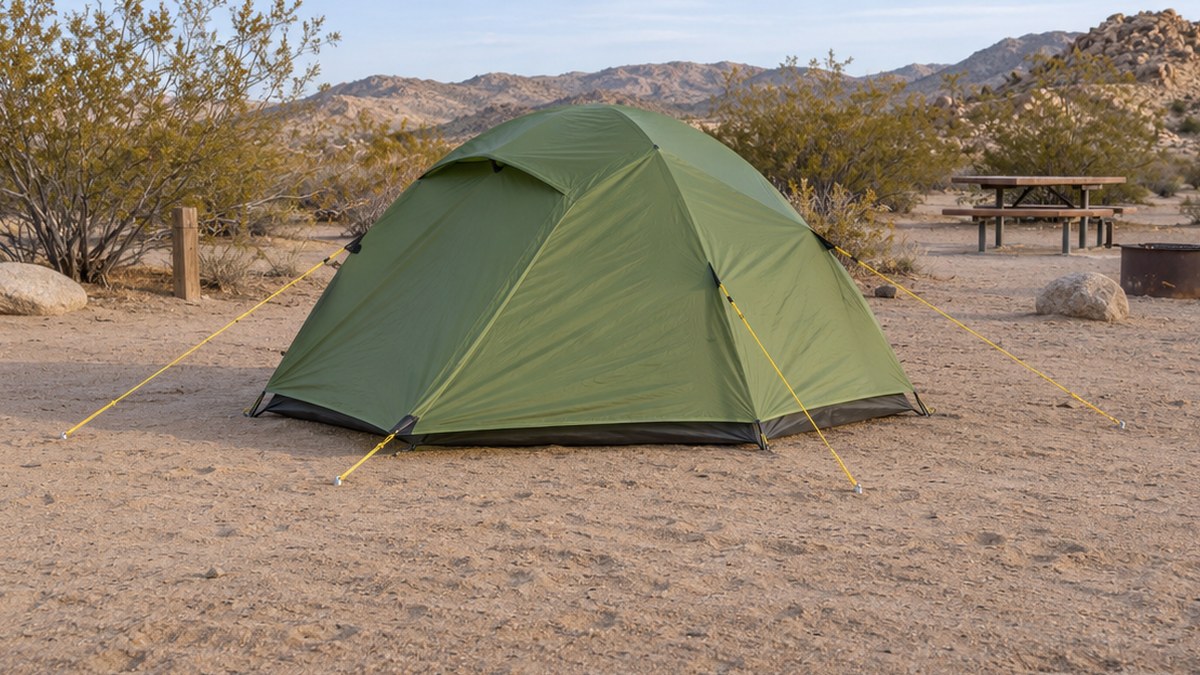
Generated editorial photograph of a tent anchored on a sandy inland campsite.
The pitch that looks neat in the afternoon isn't necessarily the one you want to sleep in. On sand, the most useful check is whether each anchor stays put under a steady pull in the direction the tent will load it. Look at the sand around the stake, not just the rope. A line can feel taut while the stake slowly moves toward the tent. Deal with that the first time you see it, rather than tightening the line again and hoping it holds.
What kind of stake holds better in sand?
Use a long, broad peg made for sand when the surface is loose. The extra area gives the anchor more sand to push against than a short, skinny peg. Carry enough for the corners and the guylines your tent needs, plus a spare or two; a stronger corner doesn't fix a weak fly anchor.
The National Park Service's Cape Lookout camping guide recommends stakes about a foot long for that exposed beach setting. That's a useful starting point, not a minimum for every campsite or a guarantee that a certain length will hold. A packed sandy campground pad behaves differently from deep, dry beach sand. Even within the same campsite, one corner can be firm and another little more than loose fill. Choose for the weakest part of the pitch, not just the spot where your first stake went in easily.
Shop by shape and attachment as well as length. A broad stake with a line attachment you can keep near the surface is usually a better match for loose sand than a long but narrow pin. A stake that can also be used sideways gives you another option, but verify that it's actually designed for that use. Bring a few conventional stakes if your trip takes you across mixed ground, where a broad sand stake may not go into a firm pad without bending or hitting rock.
Count the real anchor points at home. On a small tent, four corners may get the body standing, but the vestibule, fly and wind-support lines can need additional anchors. Take the tent out of the bag, lay out its lines and count. Our camping equipment inspection guide has a broader pre-trip check; for sand, add a look at each peg attachment and make sure the cord fits its hook or loop.
How do you pick a sandy campsite that won't make staking harder?
Start with a legal campsite on level, durable ground that drains well and has some wind protection. Leave room for the whole pitch, including guylines. On a beach, check official tide predictions, weather and local rules before committing. Skip sites in travel lanes, on protected vegetation or where rising water could cut off your exit.
Use the land manager's campsite-selection guidance and any site-specific instructions together. An empty patch of sand isn't necessarily available. At Great Sand Dunes National Park, for example, overnight backcountry camping requires a permit, with different location rules for the dunefield and designated Sand Ramp Trail sites. Cape Lookout's guidance allows beach camping in specified areas but lists excluded areas and instructs campers to leave room for traffic. Neither location's rules tell you what you can do at the next beach or park.
For inland sand, the easy mistake is choosing a hollow because it's out of the breeze without considering where water goes when it rains. Look around the site at ground level before unloading. If you can see a path by which water would reach the tent footprint, select a better pad rather than digging a ditch. On the coast, a visible high-water mark is a clue, not a forecast: check NOAA's tide predictions for the area and official weather or coastal hazard information. If conditions leave no room for a safe pitch and exit, don't camp there.
Think about other people, too. A sandy pad may look large until you set a vestibule and run three diagonal lines out from it. Orient the door so you can approach without stepping over a cord. Keep ropes off footpaths and beaches where vehicles may travel. If the only way to get a workable angle puts an anchor across someone else's route, choose a different position or a different campsite.
How do you install sand stakes and tension the guylines?
Use the tent and stake makers' instructions for placement and angle. Secure the main corners as you pitch, fit the fly, then stake the designated guylines with each cord pulling outward from its reinforced attachment. Bring the lines up to tension gradually so you're not dragging one corner or flattening a tent panel.
MSR's shelter manual calls for anchoring even freestanding tents and describes how tension at the guy-out points improves stability. A freestanding frame is a convenience when you're setting up, not a substitute for stakes. A nonfreestanding shelter may need a particular corner sequence to stand at all. Practice that sequence before the trip so you're not searching for a sleeve or reading a diagram while a fly is catching the wind.
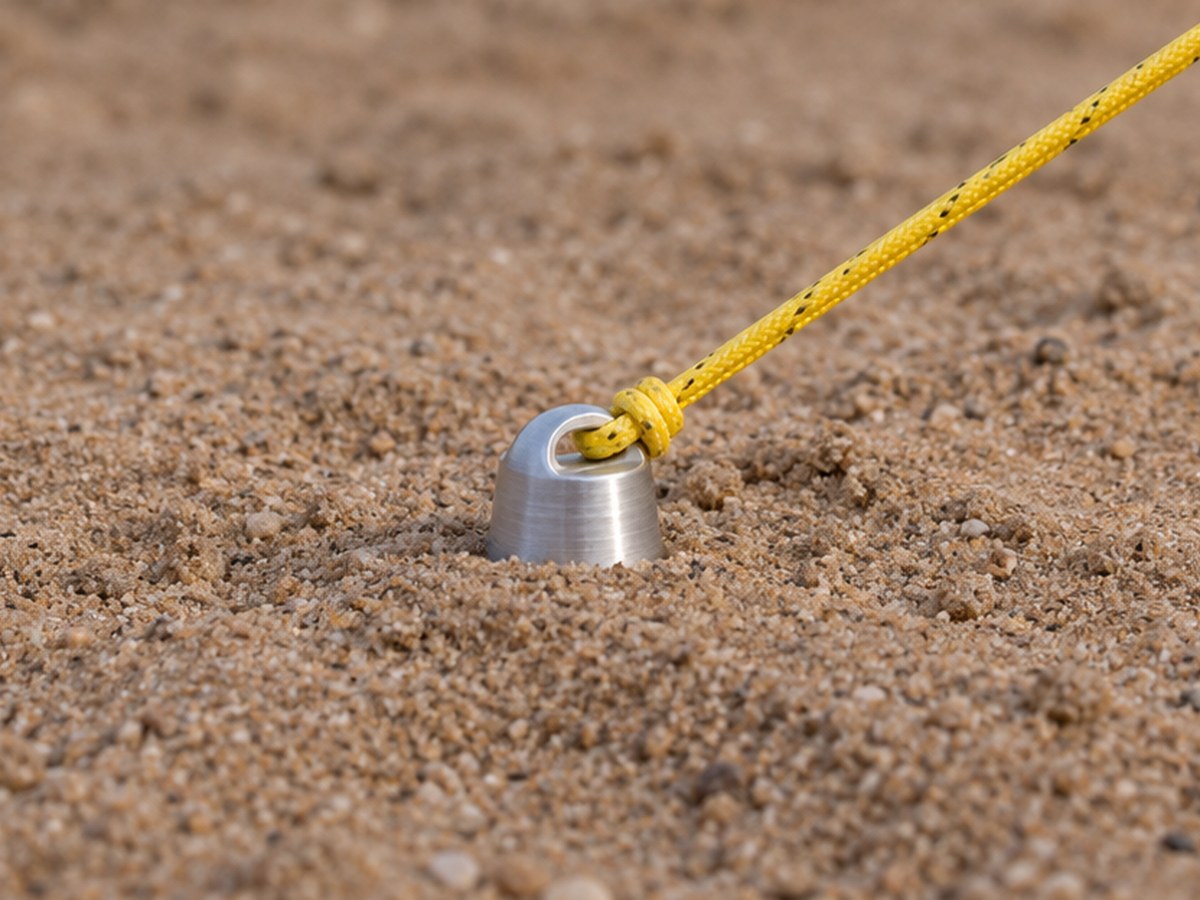
Look at the tent before you put a stake in. The line should lead from the reinforced attachment to an anchor that pulls in the intended direction. Keep the line attachment on an upright stake close to the sand, with enough of the head exposed to secure and remove it as intended. There's no single angle to apply to every peg shape and tent design. Follow the instructions for your gear rather than forcing a broad peg into the same angle you might use with a different stake.
Before moving to the next line, pull steadily along the cord in the direction the tent would pull. If the head tilts, sand bulges or the peg migrates, relieve tension and reset it in undisturbed sand or use a different anchor. Don't just reinstall it in the slot it made. Then work around the tent once more. You want the fly supported without pulling the door out of alignment or bowing the poles as you tighten. If a stake slips when you close a vestibule zipper, that's a clue to check anchor placement and fabric tension before adding more load.
When does a buried anchor make sense?
Use a buried anchor only where digging is allowed and when the tool and attachment are intended for that setup. A sideways anchor, often called a deadman, resists the pull across its broad face instead of depending on a narrow shaft. If you can't use that method without disturbing a protected surface, move or use a permitted alternative.
Hilleberg shows a sand peg designed for upright or sideways use. For a model made for sideways burial, attach its line as directed before covering it. Lay the peg across the pull, not pointing down the rope like an arrow. Route the line toward the shelter without running a channel wider than necessary, backfill and firm the cover by hand, then load the cord slowly. Don't adopt a fixed burial depth from another campsite or assume the same method applies to every model; if the anchor shifts or the cord starts cutting through loose sand, unload and reconsider the placement.
Sandbags can be an alternative where the land manager permits filling and using them. Great Sand Dunes' backcountry guidance, for example, recommends sand stakes or sandbags to secure tents, and separately prohibits trenching around tents at designated Sand Ramp Trail sites. Don't treat a general recommendation for sand anchors as blanket permission to dig wherever you camp. Check the rules for your exact site, especially around dunes, archaeological areas and vegetation. If a campground supplies tie-down points, use them as directed instead of modifying the pad.
Plan the retrieval before burial. Keep count of every anchor and never detach a buried stake or bag and walk away to pack the tent first. In daylight or with a headlamp, trace each line to its anchor, release tension, dig it out gently and restore the small depression as required. Bring home bags, stakes and cords, including any broken material.
What should you check when the wind picks up?
Check the anchors on the exposed side first, then go around the tent looking for movement, slack lines or fabric pulling unevenly. Reset drifting anchors rather than repeatedly shortening the cord. If the tent won't stay anchored or the weather is worsening, move to a more sheltered legal site or leave before taking it down becomes harder.
Do a second walk after you finish setting up and another before bed, while you can still see the campsite or work comfortably by headlamp. If the wind changes direction, don't assume the lines that were loaded at dinner are the ones that will matter overnight. Check the now-exposed side and confirm the anchors on the opposite side haven't loosened. A line that slackens once may simply need a small adjustment; slack that keeps returning warrants a look at the stake and surrounding sand.
Keep your decision separate from the gear. An anchor that stays put in a steady hand pull is a setup check, not a storm rating. Set a limit based on the forecast, the shelter instructions and whether you can safely get to a better site or leave. If thunderstorms develop, don't confuse a firmly anchored tent with a lightning shelter. Follow National Weather Service lightning safety guidance and go to a substantial building or enclosed hard-topped vehicle if available.
Don't trade a wind problem for a flooding or traffic problem when you relocate. Check the new slope, runoff, tide exposure if applicable and available space before moving the tent. If your options are an exposed pitch that keeps failing and a protected spot where camping isn't allowed, the right move is to find another legal site or end the overnight.
How do you take down a tent on sand without losing gear?
Keep the shelter tethered while you remove the fly and pack the loose pieces. Release each line before taking out its anchor, then count the pegs and bags against the number you brought. Smooth small disturbances according to local rules, gather every cord and check the pad before you leave.
Decide where each item goes before loosening anything. Put the empty stake bag somewhere it won't blow away. When gusts make packing awkward, have a partner hold the unsecured fabric while you deal with the poles or fly. If you're alone, follow your tent's teardown order while retaining an appropriate anchor until the fabric is under control. Pull upright stakes using the designated removal point after the load is off, without using the tent fabric as a handle. Uncover buried anchors rather than jerking the guyline.
Brush away dry grit before closing zippers or folding pole sections together. If a tent goes into its bag damp, unpack and dry it according to the maker's care directions when you get home. For salt exposure, MSR's manual calls for rinsing its poles in fresh water; check the cleaning guidance for your own tent and hardware. A last walk around the site catches a cord in the sand, a peg tucked behind a rock or a small bag you meant to collect on the way out. Next time, knowing exactly what's in the stake bag is a better start than remembering what you meant to pack.
Frequently asked questions
What kind of stake holds better in sand?
Use a long, broad peg made for sand when the surface is loose. The extra area gives the anchor more sand to push against than a short, skinny peg. Carry enough for the corners and the guylines your tent needs, plus a spare or two; a stronger corner doesn't fix a weak fly anchor.
How do you pick a sandy campsite that won't make staking harder?
Start with a legal campsite on level, durable ground that drains well and has some wind protection. Leave room for the whole pitch, including guylines. On a beach, check official tide predictions, weather and local rules before committing. Skip sites in travel lanes, on protected vegetation or where rising water could cut off your exit.
How do you install sand stakes and tension the guylines?
Use the tent and stake makers' instructions for placement and angle. Secure the main corners as you pitch, fit the fly, then stake the designated guylines with each cord pulling outward from its reinforced attachment. Bring the lines up to tension gradually so you're not dragging one corner or flattening a tent panel.
When does a buried anchor make sense?
Use a buried anchor only where digging is allowed and when the tool and attachment are intended for that setup. A sideways anchor, often called a deadman, resists the pull across its broad face instead of depending on a narrow shaft. If you can't use that method without disturbing a protected surface, move or use a permitted alternative.
What should you check when the wind picks up?
Check the anchors on the exposed side first, then go around the tent looking for movement, slack lines or fabric pulling unevenly. Reset drifting anchors rather than repeatedly shortening the cord. If the tent won't stay anchored or the weather is worsening, move to a more sheltered legal site or leave before taking it down becomes harder.
How do you take down a tent on sand without losing gear?
Keep the shelter tethered while you remove the fly and pack the loose pieces. Release each line before taking out its anchor, then count the pegs and bags against the number you brought. Smooth small disturbances according to local rules, gather every cord and check the pad before you leave.