
Rule 27SA vs Attwood Tsunami Mk2 500
Written by John Wren|
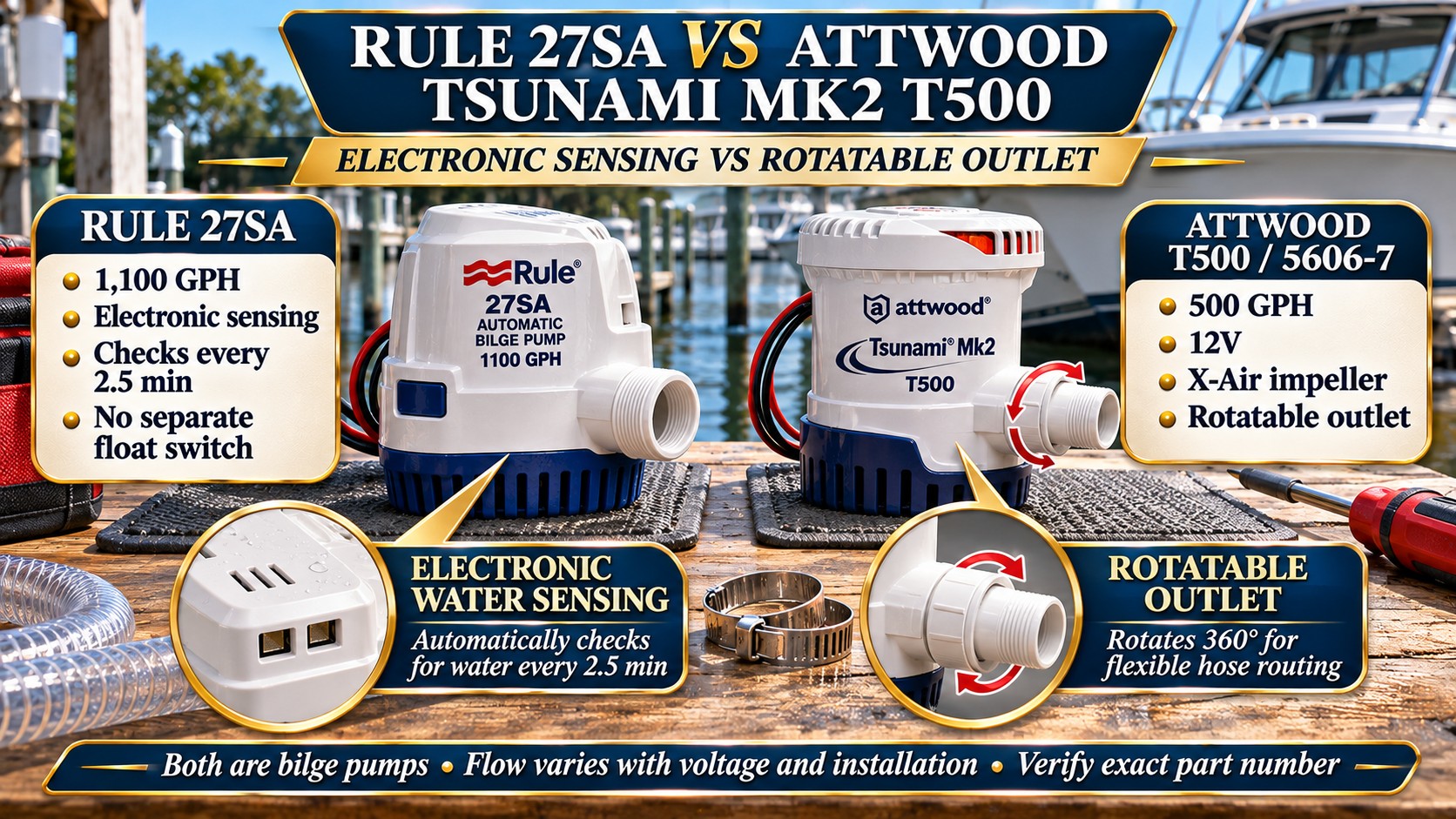
B01LZT149C if you want Rule 27SA electronic sensing 1100 GPH language. B09F29N9P7 if you want Attwood Tsunami Mk2 500 GPH cartridge language.
Key takeaways
- Rule 27SA on B01LZT149C is an electronic sensing 1100 GPH automatic bilge pump.
- Tsunami Mk2 500 on B09F29N9P7 prints 500 GPH, X-Air Impeller, and rotatable outlet language.
- An 800 GPH pump or a float switch is a different ASIN fight.
- Match hose size and amp draw before you wire either card.
Buy the Rule 27SA Electronic Sensing Bilge Pump 1100 GPH, ASIN B01LZT149C, when you want the electronic-sensing Rule pump whose feature line prints automatic checks every 2.5 minutes, about 0.20 amps daily, a threaded port, a built-in thermal cut-off, and language that no separate float switch is needed. Buy the Attwood Tsunami Mk2 500 GPH 5606-7, ASIN B09F29N9P7, when you want the 12V 500 GPH Tsunami Mk2 whose feature line prints quick install and service language, freshwater performance language, X-Air Impeller air-lock elimination language, and a 360° rotatable outlet that covers elbow and straight fittings. Both cards are bilge pumps. One is an electronic-sensing 1100 GPH Rule. The other is a 500 GPH Attwood with a rotatable outlet story. Match the ASIN before you match the word bilge.
Short version. A Rule 800 and an Attwood Tsunami T800 are a different pump pair on the same shelf family. A Rule 35A and an Attwood 4202-7 are float switches, not these pump bodies. An Attwood 4505-7 and a SEAFLO are another bilge pair with a different GPH story. A SHURFLO and a Jabsco are fresh-water pumps, not bilge discharge. An HX890 and an M37 are handheld VHF radios. B01LZT149C and B09F29N9P7 are the two bilge pump cards here.
| Job | Rule 27SA 1100 GPH | Attwood Tsunami Mk2 500 | Buy |
|---|---|---|---|
| What the card says you are holding | ASIN B01LZT149C, 27SA electronic sensing, 1100 GPH | ASIN B09F29N9P7, 5606-7, 12V 500 GPH Mk2 | Match the ASIN before a Rule 800 or a T800 photo. |
| Control story | Electronic sensing; checks every 2.5 min; no separate float needed | Pump body with quick install/service language | Rule if sensing without a float is the reason. |
| Flow class on the title | 1100 GPH | 500 GPH | Do not average the two GPH cells into one pump. |
| Standby / electrical language | ~0.20 amps daily sensing draw language | 12V Tsunami Mk2 | Quote each card’s own electrical sentence. |
| Port and outlet | Threaded port | 360° rotatable outlet, elbow and straight | Attwood if rotatable discharge is the pitch. |
| Protection / impeller language | Built-in thermal cut-off | X-Air Impeller air-lock elimination | Thermal cut-off is not X-Air language. |
| What this is not | Not a Rule 35A float, not Rule 800 | Not Tsunami T800, not a fresh-water pump | Buy the part on the card you opened. |
Rule 27SA Electronic Sensing Bilge Pump 1100 GPH is ASIN B01LZT149C. Attwood Tsunami Mk2 500 GPH 5606-7 is ASIN B09F29N9P7. A float switch, a fresh-water pump, and a VHF radio are different cards.
Who should buy the Rule 27SA, and who should buy the Attwood Tsunami Mk2 500?
Buy B01LZT149C if you want the Rule 27SA Electronic Sensing Bilge Pump 1100 GPH whose feature line prints automatic checks every 2.5 minutes, about 0.20 amps daily, a threaded port, a built-in thermal cut-off, and language that no separate float switch is needed. Buy it when electronic sensing is the install story you opened, when 1100 GPH is the flow class you named, and when you will keep 27SA attached to that ASIN instead of shopping a Rule 800 photograph alone.
Buy B09F29N9P7 if you want Attwood Tsunami Mk2 500 GPH part 5606-7, 12V, with quick install and service language, freshwater performance language, X-Air Impeller air-lock elimination language, and a 360° rotatable outlet that includes elbow and straight options. Buy it when 500 GPH and a rotatable discharge are the sentences you opened, not an 1100 GPH electronic-sensing Rule body.
Buy neither if you wanted a float switch. The Rule 35A versus Attwood 4202-7 fight already owns that seat. Buy neither if you wanted the Rule 800 versus Tsunami T800 pair. That is a different GPH conversation. Buy neither if you needed a fresh-water pump for a galley or washdown. A SHURFLO and a Jabsco live on that other shelf. Buy neither if the radio is quiet and you thought a bilge pump would call the Coast Guard. An HX890 or M37 is the handheld VHF shelf.
What is the Rule 27SA actually for?
This card is a Rule 27SA Electronic Sensing Bilge Pump rated 1100 GPH on the title, ASIN B01LZT149C. The Amazon feature block that travels with this part prints automatic checks every 2.5 minutes, about 0.20 amps daily, a threaded port, a built-in thermal cut-off, and language that no separate float switch is needed. Those cells belong to B01LZT149C. Do not paste a Rule 800 flow cell, a Rule 35A float story, or a different electronic-sensing sibling onto this ASIN.
Electronic sensing is the control sentence. Checks every 2.5 minutes is the interval sentence. About 0.20 amps daily is the standby-draw sentence. Threaded port is the hose connection sentence. Built-in thermal cut-off is the motor-protection sentence. No separate float switch needed is the install claim that removes a Rule-A-Matic from this particular cart. It is not a claim the bilge can stay packed with oil pads that never let water reach the sensor. It is not a claim 1100 GPH will empty a cracked hose faster than you can notice.
Eleven hundred GPH is the title flow class. It is not Attwood’s 500 GPH cell. Wire gauge, fuse size, and a battery that can still crank the engine after a sensing weekend are the electrical half. Kill the battery switch before you cut into a bilge circuit. Route the hose with as few high loops as the boat allows. Test after install: wet the bilge pocket, watch the pump take suction, confirm discharge overboard, then dry the pocket and confirm it stops. Automatic sensing is not unattended forever. A cracked fitting can still beat a small bank.
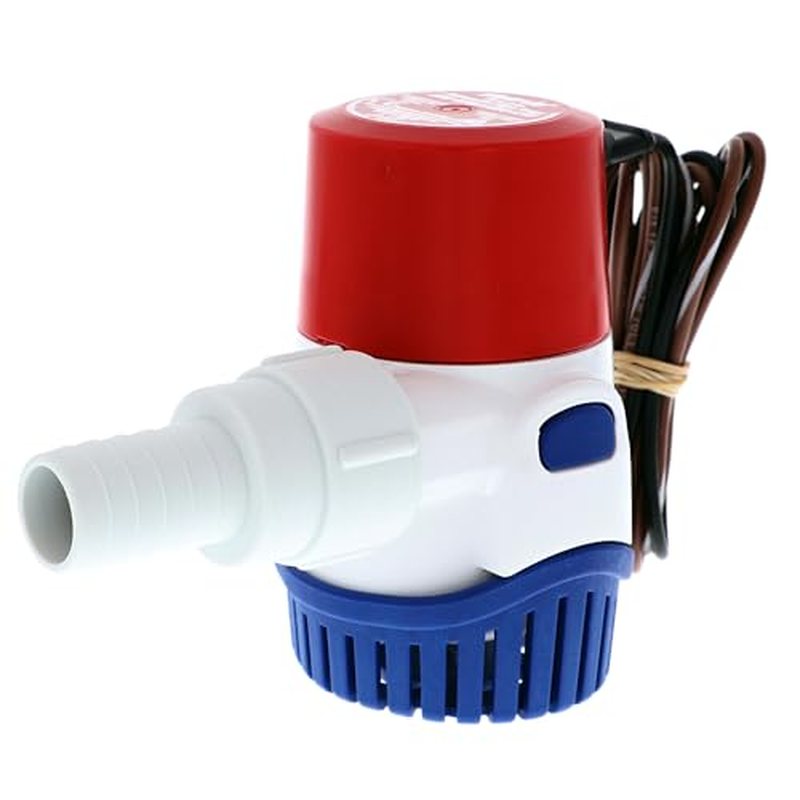
Do: match B01LZT149C, fuse the positive near the source, and keep the sensing area clear. Don’t: treat the 27SA as a float switch you still need to buy for this card’s “no separate float” language. Don’t: bury the pump under a oil pad. Don’t: ignore a pump that runs without water after the pocket is dry.
What is the Attwood Tsunami Mk2 500 actually for?
This card is an Attwood Tsunami Mk2 500 GPH bilge pump, part 5606-7, ASIN B09F29N9P7. The feature line that travels with this part prints 12V 500 GPH language, quick install and service language, freshwater performance language, X-Air Impeller air-lock elimination language, and a 360° rotatable outlet that covers elbow and straight fittings. Those cells belong to 5606-7 on B09F29N9P7. Do not paste a Tsunami T800 cell or a Rule 27SA sensing story onto this ASIN.
Twelve volt is the electrical sentence. Five hundred GPH is the flow sentence. Quick install and service is the mounting and maintenance sentence. Freshwater performance is the water-type sentence the card prints. X-Air Impeller air-lock elimination is the impeller sentence. A 360° rotatable outlet with elbow and straight options is the discharge sentence. Orient the outlet before you tighten the hose. A fixed wrong elbow is why people invent air locks the impeller language was meant to fight.
Five hundred GPH is not 1100 GPH. If the boat’s wet pocket and hose run want more flow class than this title prints, this Mk2 is the wrong card, not a Rule in disguise. Quick service language still needs access panels you can open without cutting a stringer. Freshwater performance language is not a reason to skip a strainer clean. Keep trash out of the impeller. Test the same way: wet, run, discharge, dry, stop. If the boat sits on a trailer with the bow high, water may collect away from the pump. Place it for the attitude that matters when the boat is in the water.
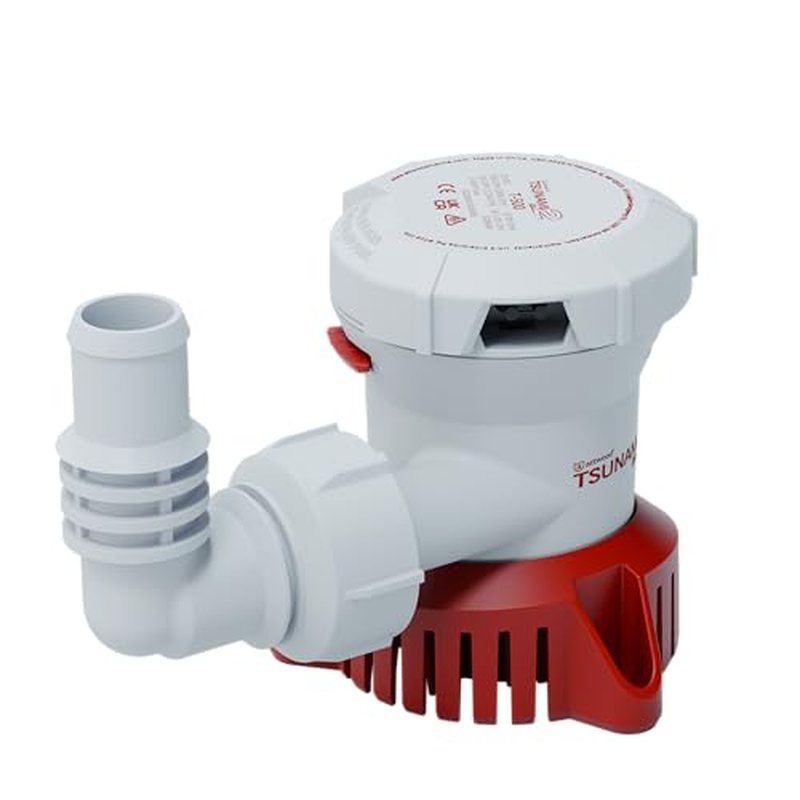
Do: set the 360° outlet to the hose path and fuse the 12V feed. Don’t: stretch a hard 90 that fights the rotatable claim. Don’t: treat X-Air Impeller language as a dry-run forever license. Don’t: order a T800 because the word Tsunami matched and the 500 GPH cell was not checked.
How do you read these two bilge pump cards without mixing the float-switch pages?
Both technique cells are bilge pumps that move water. A float switch will not replace either of them. The Rule 35A versus Attwood 4202-7 comparison elsewhere is a switch conversation. Put B01LZT149C or B09F29N9P7 in the wet pocket if a pump body is the job. The fresh-water pump articles tell you what feeds a galley. They do not rewrite a GPH cell. The handheld VHF articles tell you how you call after the bilge plan has already failed.
The Rule 27SA card gives you electronic sensing, checks every 2.5 minutes, about 0.20 amps daily, a threaded port, a built-in thermal cut-off, no-separate-float language, and an 1100 GPH title class. The Tsunami Mk2 500 card gives you 12V 500 GPH, quick install and service language, freshwater performance language, X-Air Impeller air-lock elimination language, and a 360° rotatable outlet with elbow and straight options. Those are the sentences this comparison will treat as belonging to these parts. A reviewer who timed a dry bilge to a different fuse is a reviewer. The feature still says what it says.
Eleven hundred GPH and 500 GPH are not the same cell. Electronic sensing without a separate float is not a rotatable-outlet story. About 0.20 amps daily is not a 12V title alone. Thermal cut-off is not X-Air Impeller language. Do not invent a float-switch ASIN for the 27SA from a neighbor Rule float page. Do not invent an 1100 GPH cell for the Mk2 from the Rule title. Do not invent a dollar figure for either listing. Use the buttons for the live cart.
What actually fails on these two cards?
The Rule 27SA card fails when 1100 GPH is rewritten as a Rule 800 without renaming the part. It fails when electronic sensing is sold as a Rule 35A float you still must buy for this card’s no-separate-float language. It fails when checks every 2.5 minutes are ignored and a dirty bilge is blamed on the brand. It fails when about 0.20 amps daily is read as a reason never to check the house bank. It fails when threaded port language is forced onto the wrong hose ID. It fails when built-in thermal cut-off is treated as a spare pump. It fails when a different Rule electronic-sensing sibling is ordered because the family name matched and the 27SA cell was not checked.
The Tsunami Mk2 500 card fails when B09F29N9P7, a T800, and a different Attwood GPH are treated as one ASIN. It fails when 500 GPH is rounded up to the Rule’s 1100 GPH cell because both say bilge. It fails when X-Air Impeller air-lock elimination language is ignored and a high hose loop is left as the only plan. It fails when the 360° rotatable outlet stays in the wrong orientation and the hose kinks. It fails when freshwater performance language is rewritten as a sealed dry-bag claim. It fails when quick install language is used as a reason to skip a fuse. It fails when a float-switch ASIN is opened because both conversations mention Attwood.
The shared failure is a dirty bilge and a skipped wet test. Oil, bags, and chips jam intakes. Clean before you blame the brand.
What is this comparison not?
This is not a float-switch comparison. Both cards are pumps, and the Rule 35A versus Attwood 4202-7 fight is elsewhere. This is not every Rule and every Tsunami. B01LZT149C and B09F29N9P7 / 5606-7 are the cards. A Rule 800, a Tsunami T800, or a SEAFLO neighbor is a different part if the ASIN changes. This is not a fresh-water pump review. This is not a handheld VHF review. This is not a price quote. The listing moves. Use the buttons if you want the live cart. Neither card prints a timed hull-empty chart for your stringers. The job is a boat bilge, not a house sump.
So which bilge pump should you buy?
Buy the Rule if you want ASIN B01LZT149C, the 27SA Electronic Sensing Bilge Pump 1100 GPH, automatic checks every 2.5 minutes, about 0.20 amps daily, a threaded port, a built-in thermal cut-off, and language that no separate float switch is needed. Buy the Attwood if you want ASIN B09F29N9P7, Tsunami Mk2 500 GPH 5606-7, 12V 500 GPH, quick install and service language, freshwater performance language, X-Air Impeller air-lock elimination language, and a 360° rotatable outlet with elbow and straight options. Buy neither if you wanted a float switch, a fresh-water pump, a VHF radio, or the Rule 800 / T800 fight the 27SA and Mk2 500 cards have already refused. Match the GPH class and the control story before you match the word bilge. Wet-test once at the dock. If the pocket never reaches the intake, the placement was wrong, not the weather.
Frequently asked questions
Rule 27SA or Attwood Tsunami Mk2 500?
B01LZT149C if you want electronic sensing 1100 GPH language. B09F29N9P7 if you want Tsunami Mk2 500 GPH cartridge language.
Is this the same as the Rule 800 versus Tsunami T800 page?
No. That fight is an 800 GPH pair. This comparison is 27SA sensing 1100 and Mk2 500.
Does Rule 27SA need a separate float switch?
The card language used here centers on electronic sensing and a threaded port without a separate float switch. Confirm the listing you open.
What does Attwood’s X-Air Impeller claim?
The Mk2 card prints air-lock elimination language for the X-Air Impeller. That is the cartridge story, not a GPH upgrade.
Will either pump replace a Rule-A-Matic float switch?
No. The Rule 35A versus Attwood 4202-7 fight is the float-switch page.
Do these include discharge hose?
No. Buy hose and clamps on their own. These cards are the pumps.