
How to Set a Tip-Up for Ice Fishing
Written by Outdoors Magazine|
Outdoors Magazine is a participant in the Amazon Services LLC Associates Program. We may earn a commission if you buy through links on this page, at no extra cost to you. Affiliate disclosure.
Here is how to set a tip-up: spool braided tip-up line, add a swivel, leader and hook, clip on a depth finder to find bottom, raise the bait to your depth and mark it, then set the frame over the hole and hook the flag under the trip so a running fish releases it.
Key takeaways
- Spool braided tip-up line, then a swivel, leader and hook or quick-strike rig.
- Find bottom with a clip-on depth finder and mark the bait depth on the line.
- Test the flag trip; use light settings for small baits, heavy for big ones.
- Line limits, distance and name-tag rules vary by state; check current regs.
Here is how to set a tip-up: spool braided tip-up line, add a swivel, leader and hook, clip on a depth finder to find bottom, raise the bait to your depth and mark it, then set the frame over the hole and hook the flag under the trip so a running fish releases it.
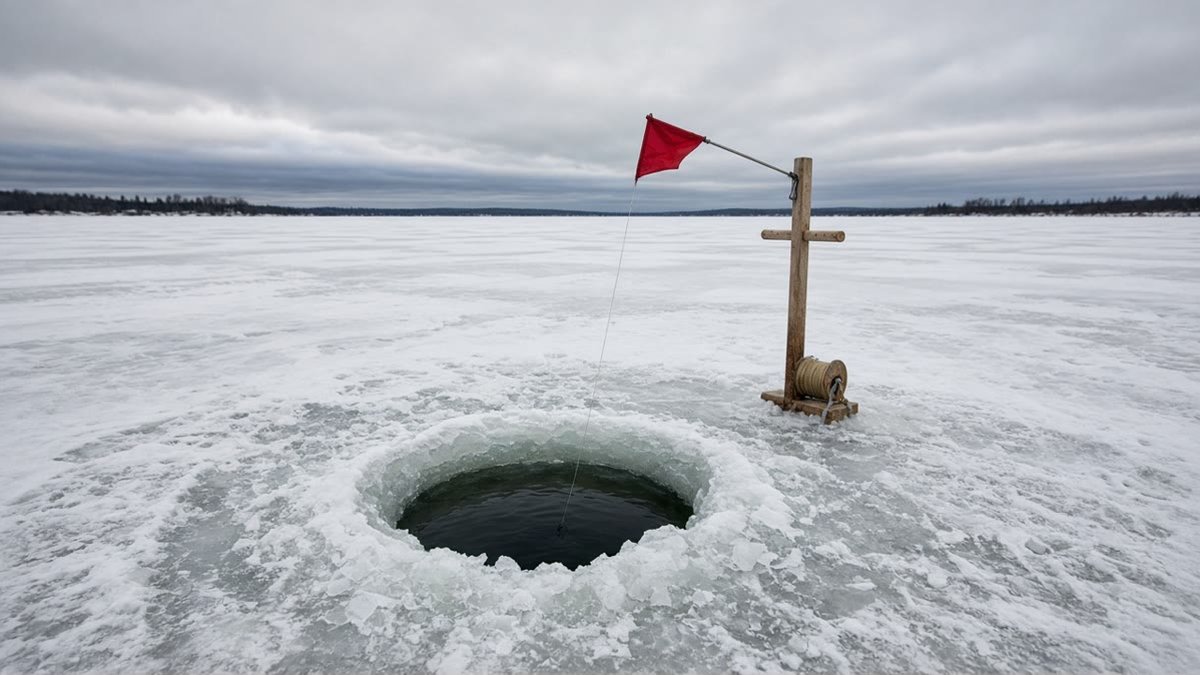
A raised flag means a fish is pulling line off the spool. AI-generated editorial image of a wooden-style tip-up with a red flag raised beside an open hole in white lake ice under a gray sky.
A tip-up is the simplest way to fish more than one hole at a time. It is a frame that sits on or over the ice, holds a spool of line that hangs straight down to a baited hook, and carries a spring flag that pops up when a fish takes line. North Dakota Game and Fish describes it plainly: a static line rigged with live or dead bait, and a small flag that trips when the line is tugged. You keep a rod in your hands at one hole while the tip-ups wait at the others.
Tip-ups are popular for northern pike and walleye, fish that cruise and will take a single bait held near bottom or over weeds. Because they hold one bait still at a set depth, almost everything about catching fish with them comes down to setup: the right line, a leader the fish won't refuse, a depth that puts the bait where the fish are, and a flag that trips when it should and not when the wind gusts.
None of that matters until you know the ice will hold you. Before drilling a single hole, read our guide on how to check ice thickness before walking out. Minnesota DNR guidance treats 4 inches of new, clear ice as the minimum for ice fishing on foot and says to double that on white ice. Measure it yourself, and keep measuring as you move.
What line and leader should you put on a tip-up?
Fill the spool with braided tip-up line, which is thick enough to grip with gloves and sheds water better than plain monofilament. Tie a small swivel to the end, then add a few feet of monofilament or fluorocarbon leader, or a wire leader or quick-strike rig for pike.
Tip-ups use a different kind of line than a rod and reel. Most anglers fill the spool with braided tip-up line, sometimes sold as Dacron or nylon tip-up line, which is thick, soft and easy to grab with cold fingers. A 2026 Outdoor News piece on tip-up details recommends 30-pound braided nylon tip-up line and points out that it is cheap, easy to hold and strong enough to pull loose if it freezes to the spool. A Clam Outdoors pro quoted by Bass Pro Shops runs 10- or 20-pound tip-up line on his walleye and pike rigs and replaces all of it every fall.
Coatings matter. Some tip-up lines carry a wax or Teflon-style coating that sheds water, and In-Fisherman notes that nylon and Teflon-coated Dacron ice line don't absorb water, which keeps them from freezing stiff. Plain monofilament as main line is harder to see and grip, and plastic line tends to tangle on a tip-up spool.
Below the main line, tie a small barrel swivel. It connects the main line to the leader and keeps a live or dead bait from twisting the line. Above the swivel, some anglers add a sliding sinker; the Bass Pro rigging article describes a half-ounce slide weight that holds the bait in the zone and lets it swim in a circle about twice the leader's length across.
Then the leader. For walleye and other fish that can't bite through line, a few feet of monofilament or fluorocarbon is standard. The Outdoor News article suggests about 8-pound fluorocarbon for walleye and 15- to 17-pound monofilament for pike, while the Bass Pro rigging piece describes fluorocarbon leaders of 3 to 8 feet. For pike, many anglers switch to wire or heavy fluorocarbon because of their teeth, though wire may make wary fish hesitate in clear water.
Hooks and quick-strike rigs. The Outdoor News author pairs pike leaders with a No. 2 or No. 4 treble and walleye leaders with a No. 6 Octopus hook or No. 6 treble. For big dead or live baits meant for pike, a quick-strike rig is the common alternative: a short length of wire, usually 20- to 40-pound test and 12 to 24 inches long according to Bass Pro's quick-strike primer, with two treble hooks. One hook goes as far forward on the bait as possible, near the nose or cheek, and the second a quarter to a half inch behind the dorsal fin. Because the hooks sit outside the bait, you can set the hook before the fish swallows it, which the same article ties to more lip-hooked, releasable fish. Hook rules vary by state and water, so confirm that treble hooks and multi-hook rigs are legal where you fish.
How do you set the depth on a tip-up?
Clip a weighted depth finder to the hook and lower it until it touches bottom, then pull up the amount you want the bait to sit off bottom. Mark that spot on the line with a small bobber or button so you can reset to the same depth after every fish.
Depth is where tip-ups win or lose. A bait set too high above cruising walleye, or buried in weeds where a pike can't see it, will sit untouched all day. Setting depth takes a minute per hole and is worth doing carefully.
The usual tool is a clip-on depth finder, a small weight with a clip that grabs the hook. MeatEater's step-by-step for a pike tip-up runs like this: clip the weight to the hook, lower it until it touches bottom, pull the line tight, then pull up enough line to leave the bait the distance you want off bottom. In that example the bait sits 3 feet off bottom. Thread or clip a marker onto the main line at the point where it meets the spool or the hole. MeatEater uses a small white shirt button; others clip on a tiny bobber. Then take off the depth finder, hook the bait, and let line back out until the marker returns to the same spot.
The marker earns its keep later. After you land a fish, you don't need the depth finder again; just let line out until the bobber or button is back where it was. On some setups, the button also tells you how much line a fish took before you got there.
Where should the bait sit? The Outdoor News article suggests about a foot off bottom for walleye minnows and perch fatheads, and setting pike suckers just above the weeds where they are easier for a pike to spot. Treat those as starting points. If you have a flasher or sonar, watch where fish show up on the screen and adjust. If one tip-up keeps getting flags and others don't, look at its depth and copy it.
When you hook the bait, hook it so it stays lively and swims naturally. MeatEater hooks a shiner just below the dorsal fin. A bait that dies quickly or spins on the line won't draw strikes, which is another reason the swivel and a correctly sized hook matter.
How do you set the flag on a tip-up?
Bend the flag down and lock its tip under the trip arm or catch on the spool shaft so that a turning spool releases it. Many tip-ups have a light and a heavy trip setting; use the light side for small baits and the heavier side for big, lively baits.
Every tip-up design has some version of the same trigger. The flag sits on a spring steel wire. You bend it down and hook its end under a catch, usually a small arm or T on the spool shaft. When a fish pulls line, the spool turns, the catch rotates out from under the flag, and the spring snaps the flag upright.
Before setting the tip-up in the hole, test it. MeatEater's walkthrough has you bend the flag down, clip it to the tripper, then pull some line the way a fish would and confirm the flag pops. A tip-up that won't trip because of ice, a bent wire or a dry spool shaft is just a hole with bait in it. On old wooden tip-ups especially, the Outdoor News article notes that a poorly set flag can let the spool turn without tripping at all.
Most modern tip-ups give you a choice of sensitivity. In-Fisherman describes the HT Polar trip bar as smooth on one end for small baits and notched on the other for heavier baits, and notes that raising the trip bar increases the pull needed to release the flag. The Frabill Pro-Thermal is listed with dual trip settings, light or heavy. The tradeoff is simple: a light trip catches timid bites but can fire on its own when a big, lively sucker swims hard; a heavy trip ignores a frisky bait but asks more of the fish. Start light for small baits and fussy fish, and go heavier for large baits or when you see false flags.
Finally, set the frame so the spool can turn freely. For a cross-style tip-up, MeatEater lowers it spool first, with the vertical upright resting against the edge of the ice and the spool clear of the hole's sides. For a round thermal model, the base simply sits over the hole with the spool under water. Either way, make sure nothing touches the spool or the line on its way down.
How do you keep a tip-up hole from freezing?
Skim ice and slush out of the hole, then cover it. Round insulated tip-ups sit over the hole like a lid, and packing snow or slush around the edge of the base seals out cold air and light. Tip-ups with the spool under water also keep the line itself from freezing.
A hole left open on a cold day skins over quickly, and line frozen into the ice can't run. The first step is mechanical: skim the hole clean with a scoop after drilling and again whenever you check it, so slush doesn't build up around the line.
The second step is to cover it. In-Fisherman notes that foam or plastic hole covers can keep holes ice-free for hours in below-zero temperatures, and that insulated tip-ups use a frame that covers holes of roughly 6 to 10 inches. Piling snow or slush around the edge of the frame helps seal it and also blocks light that can spook fish in shallow water. Because the spool on these designs hangs under the surface, the line stays in liquid water rather than freezing to a reel up in the wind.
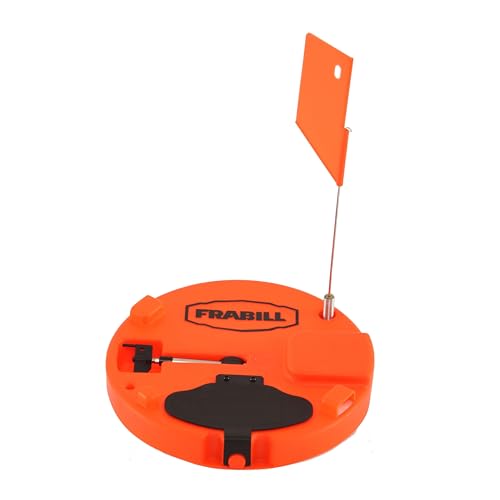
Round thermal tip-ups are built around this idea. The Frabill Pro-Thermal, model 1660, is a 10-inch orange disk that sits over a hole up to 10 inches across. Retailer listings describe a foam-insulated underside meant to reduce freeze-up, a removable spool shaft pre-lubricated with low-temperature grease, dual light and heavy trip settings, and a body that fits in a 5- to 6-gallon bucket for carrying. A Bass Pro Shops review adds that the low, round shape keeps out snow and slush and has a built-in tackle compartment for a clip-on depth finder or spare weights.
Check hole-size rules before you choose an auger. Wisconsin's administrative code, for example, prohibits cutting or using a hole larger than 12 inches across for taking fish, with exceptions such as sturgeon spearing. North Dakota requires holes wider than 10 inches to be marked before you leave them. Rules like these differ from state to state.
What should you do when the tip-up flag goes up?
Walk to it calmly and watch the spool before you touch anything. If line is still going out, let the fish run, then pick up the line, pull it in hand over hand until it is tight and set the hook with a sweep. With a quick-strike rig, set the hook right away.
A flag in the air is the moment the whole setup is built for, and it is easy to rush. Walk, don't run; ice is slick and holes are hard to see under fresh snow. As you get close, look at the spool or the spinning indicator above it. Outdoor News points out that modern above-water indicators show whether a fish is still taking line, so you don't have to stand directly over the hole to tell.
With a single hook and a pike, the traditional approach is patience. The Outdoor News author describes letting the fish run, stop to turn the bait, and setting on the second run, while MeatEater's walkthrough waits a few minutes after the trip so the fish can take the bait. With a quick-strike rig, or for walleye and perch, set right away; waiting only increases the chance of a deeply hooked fish.
To set the hook, lift the tip-up out of the hole and lay it on the ice where the line can still come off the spool freely. Take the line in your fingers, pull it in hand over hand until you feel weight, and set with a smooth upward sweep. North Dakota Game and Fish puts it simply: set the hook by hand, then pull in the line and the fish. Keep the slack line coiled on the ice beside you, not tangled around your boots, in case the fish makes another run. With a big fish, MeatEater suggests one person fights the fish while a partner keeps the loose line clear.
If you plan to release the fish, keep it in the water as much as you can, unhook it quickly and let it go. Then re-bait, reset to your depth marker, re-cock the flag and skim the hole before the tip-up goes back in. After a long day, MeatEater recommends winding line back on with the spool rather than by hand, to avoid kinks and tangles.
How many tip-ups can you use, and how far away can you be?
It depends on the state, and sometimes on the lake. Minnesota allows two lines through the ice and requires you to stay within 200 feet of a tip-up, Michigan allows up to three lines and requires your name and address on each tip-up, and North Dakota counts each tip-up as one of four poles within 150 feet.
Tip-up rules vary more than most anglers expect, and they change. Here are a few examples from statutes and agency pages, to show how different the rules can be, not to replace the current regulations for your water.
Minnesota. State statute allows two lines when taking fish through the ice. An unattended line is legal only if you are within sight of it, or if a tip-up is attached and you are within 200 feet of the tip-up.
Michigan. State law caps anglers at three lines, with no more than six hooks on all lines combined, and says you may not set or use a tip-up unless the owner's name and address are marked on it in legible English or fastened to it on a plate or tag.
North Dakota. Game and Fish says anglers may use four poles through the ice and each tip-up counts as one. Tip-ups must be within sight and within 150 feet of the angler, and a line left unattended or unchecked for more than an hour is treated as an illegal setline.
Boundary waters shared by two states, special regulation lakes and trout waters can have their own limits. Check the current regulations from the state agency that manages the water before you set out, and write your name and address on every tip-up even where it isn't required; it is a cheap way to get lost gear back.
Setting up a spread that works
A good tip-up day usually starts with fewer holes set well rather than many set carelessly. Rig everything at home: fresh line on the spools, swivels and leaders tied, hooks in their holders, flags tested. On the ice, set your legal number of tip-ups across different depths or along a weed edge, mark each depth, and test each flag before you walk away.
Then keep an eye on the spread. Skim holes when you check them, look for frozen line or a flag stuck under drifted snow, and move a tip-up that hasn't produced. If you are just getting started, our beginner's guide to ice fishing gear covers the rest of the kit, and how to catch your first walleye through the ice pairs well with a couple of tip-ups set near bottom.
Sources: Minnesota Statutes 97C.315 (lines allowed), Minnesota Statutes 97C.321 (unattended lines and tip-ups), Michigan Compiled Laws 324.48703, Wisconsin Administrative Code NR 20.11, North Dakota Game and Fish: Tip-up, North Dakota Game and Fish: Ice fishing regulation reminders, Minnesota DNR: Ice thickness guidelines, MeatEater: Hardwater basics, a guide to tip-up fishing, Bass Pro Shops: How to rig tip-ups, Bass Pro Shops: Basics of the quick-strike rig, Outdoor News: Examining the finer details of tip-up fishing, In-Fisherman: Ice fishing tip-ups, Bass Pro Shops: Frabill Pro-Thermal tip-up review, Sportsman's Warehouse: Frabill Pro Thermal Round Tip-Up 1660, FishUSA: Frabill Pro-Thermal Tip-Up; Amazon B0000ATIYB.
Frequently asked questions
What line and leader should you put on a tip-up?
Fill the spool with braided tip-up line, which is thick enough to grip with gloves and sheds water better than plain monofilament. Tie a small swivel to the end, then add a few feet of monofilament or fluorocarbon leader, or a wire leader or quick-strike rig for pike.
How do you set the depth on a tip-up?
Clip a weighted depth finder to the hook and lower it until it touches bottom, then pull up the amount you want the bait to sit off bottom. Mark that spot on the line with a small bobber or button so you can reset to the same depth after every fish.
How do you set the flag on a tip-up?
Bend the flag down and lock its tip under the trip arm or catch on the spool shaft so that a turning spool releases it. Many tip-ups have a light and a heavy trip setting; use the light side for small baits and the heavier side for big, lively baits.
How do you keep a tip-up hole from freezing?
Skim ice and slush out of the hole, then cover it. Round insulated tip-ups sit over the hole like a lid, and packing snow or slush around the edge of the base seals out cold air and light. Tip-ups with the spool under water also keep the line itself from freezing.
What should you do when the tip-up flag goes up?
Walk to it calmly and watch the spool before you touch anything. If line is still going out, let the fish run, then pick up the line, pull it in hand over hand until it is tight and set the hook with a sweep. With a quick-strike rig, set the hook right away.
How many tip-ups can you use, and how far away can you be?
It depends on the state, and sometimes on the lake. Minnesota allows two lines through the ice and requires you to stay within 200 feet of a tip-up, Michigan allows up to three lines and requires your name and address on each tip-up, and North Dakota counts each tip-up as one of four poles within 150 feet.