
Epicka 3 USB-C Adapter vs TESSAN 633F
Written by John Wren|
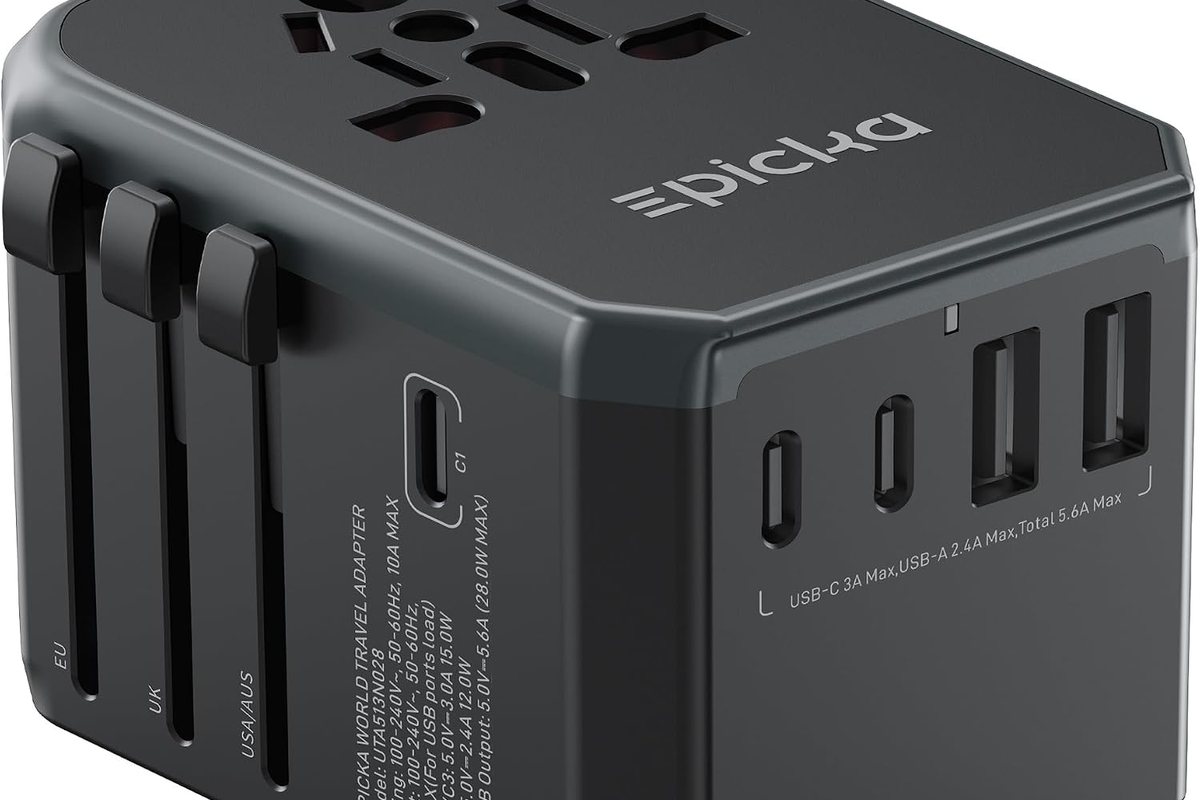
Choose the Epicka adapter whose title prints 1 AC, 3 USB-C, and 2 USB-A for that port layout, a 10A fuse with a spare, and the bullet that says it is not a voltage converter, with 1100W at 110V and 2400W at 240V. Choose TESSAN model 633F for 3 USB-C and 1 USB-A, 5.9 ounces, and 3.1 by 2.3 by 2.7 inches. The TESSAN feature bullet does not print a converter warning, so read the leaflet and treat the AC outlet as pass-through until it does.
Key takeaways
- The Epicka title is 1 AC, 3 USB-C, and 2 USB-A.
- The Epicka bullets say it is not a voltage converter.
- A four-USB-A face is the older layout, even if a model cell says TA-105.
- TESSAN 633F is 3 USB-C and 1 USB-A, 5.9 ounces, 3.1 by 2.3 by 2.7 inches.
Buy the Epicka adapter whose title prints 1 AC, 3 USB-C, and 2 USB-A when you want that port layout, the bullet that says it is not a voltage converter, a 10A fuse with a spare, and the power line that says 1100W at 110V and 2400W at 240V. Buy the TESSAN model 633F, the brick whose detail block prints 3.1 by 2.3 by 2.7 inches and 5.9 ounces, when you want the title that says 4 USB with 3 USB-C and 1 USB-A, plus Type C, G, A, and I plugs. One card states it does not convert voltage. The other card's own feature bullet does not print that warning. Read the leaflet before you plug in a hair dryer either way.
Short version. A luggage scale tells you the bag is heavy. It does not change the wall voltage. A power bank is the backup when the adapter's AC outlet is the wrong idea. A carry-on pack is where the brick has to fit. A packing cube is not a fuse. Count the USB-C ports on the face you unpack. The title is the count that matters.
The Epicka title on the live listing is a universal travel adapter with 1 AC, 3 USB-C, and 2 USB-A ports. The bullets say four plug types and 200 or more countries, and they exclude South Africa and India. The country examples they do list include the USA, Canada, Japan, the UK, Ireland, Scotland, France, Germany, Italy, Spain, China, Australia, Argentina, and New Zealand. The device count is six: two USB-A ports the bullet rates at 2.4A, three USB-C ports the bullet rates at 3A, and one AC outlet. A replaceable 10A fuse is included, plus one spare. The same bullets say this is not a voltage converter. Maximum power is printed as 1100W at 110V and 2400W at 240V. A satisfaction bullet mentions a 2-year limited warranty. The package line is the adapter and a manual.
Do not trust an older snippet that described this family as four USB-A ports and one USB-C, or a sibling listing's weight, color, and UPC. A detail table on the live page has pointed at a different ASIN. The title in front of you is 2 USB-A and 3 USB-C plus one AC. If a model cell says TA-105 or TA-105+, count the ports before you believe the model string. Four USB-A ports and a single USB-C port is the older layout, and it is not the title we are using. The brick in your hand is the specification. A model code that survived a redesign is how people reorder the wrong face.
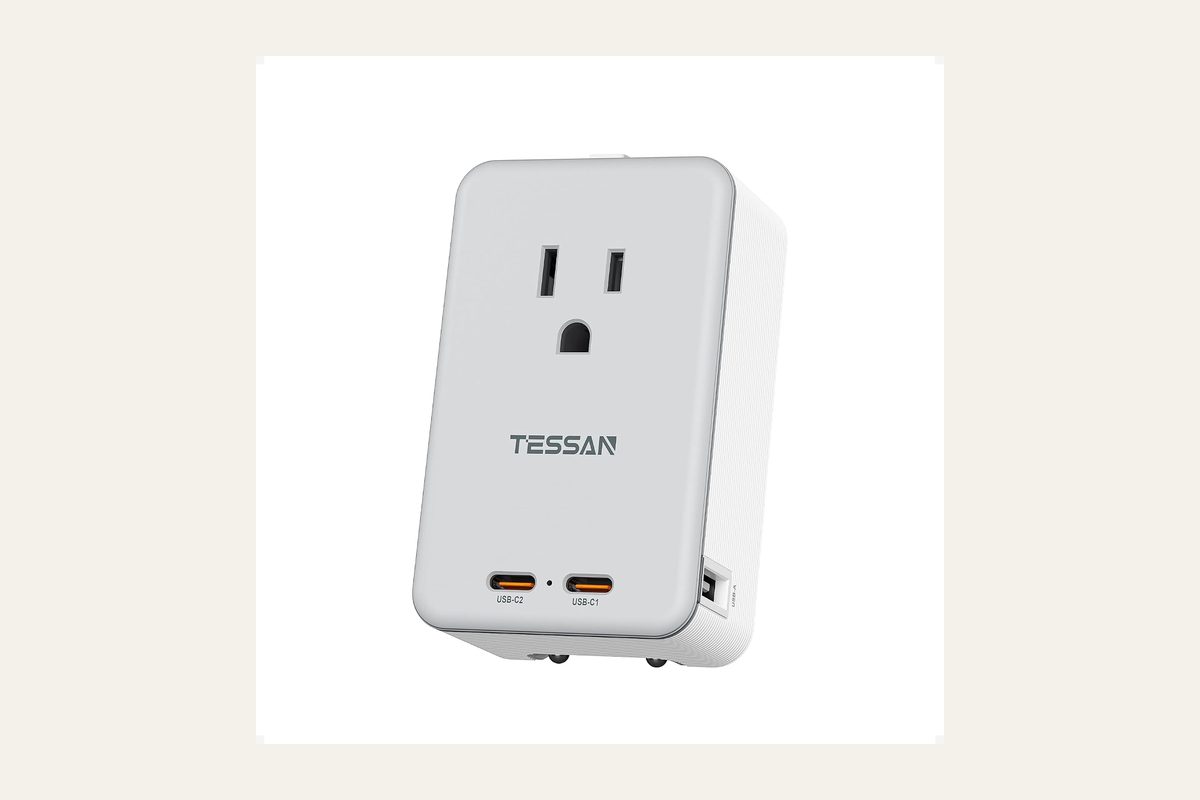
The TESSAN title includes 4 USB, written as 3 USB-C and 1 USB-A, and Type C, G, A, and I, with a US-to-Europe, UK, Spain, Italy, England, and New Zealand line. A feature bullet says 6-in-1, one AC, four USB, and charging five devices. The description says 150 or more countries. It assigns Type C to most of Europe, including Spain, France, and Germany. It assigns Type G to the UK and Ireland. It assigns Type I to Argentina, Australia, Fiji, and China. It assigns Type A to Japan, the USA, and Mexico. The detail block that matches this ASIN prints dimensions 3.1 by 2.3 by 2.7 inches, item weight 5.9 ounces, and model 633F. That model number is the reorder. A different TESSAN brick with a different model is a different port map even when the brand matches.
| Job | Epicka 1 AC / 3 USB-C / 2 USB-A | TESSAN 633F | Buy |
|---|---|---|---|
| USB-C ports on the title | 3 USB-C, plus 2 USB-A | 3 USB-C, plus 1 USB-A | Epicka if you still need two USB-A plugs |
| A printed "not a converter" line | The bullets say it | This feature bullet does not | Read the leaflet on the TESSAN before a heating appliance |
| A printed watt ceiling | 1100W at 110V, 2400W at 240V | Not printed on the bullets we are using | Do not invent a watt number for 633F |
| Country-count sentence | 200 or more, excluding South Africa and India | 150 or more in the description | Check the wall you will actually use |
| A model you can match | Count ports. A TA-105 cell can be a sibling layout | 633F, 5.9 oz, 3.1 x 2.3 x 2.7 in | The face and the model, not the brand |
Epicka title: 1 AC, 3 USB-C, 2 USB-A. TESSAN model 633F. A four-USB-A Epicka and a different TESSAN model are different bricks.
Who should buy the Epicka layout, and who should buy 633F?
Buy the Epicka brick if you can count three USB-C ports and two USB-A ports on the face, you want the spare 10A fuse, and you want the sentence that says this is not a voltage converter written on the same card as the watt lines. Six devices is the bullet's count: five USB ports plus the AC outlet. Two USB-A ports at 2.4A and three USB-C ports at 3A are the current figures printed. They are per-port claims on the card, not a promise that every port runs at that current at the same instant while a kettle is in the AC outlet. The 1100W at 110V and 2400W at 240V lines are the ceilings for the AC side as printed. A hair dryer that exceeds the ceiling for the voltage you are on does not become safe because the plug fits.
Buy TESSAN 633F if you want three USB-C ports and one USB-A port, the 5.9-ounce weight, and the 3.1 by 2.3 by 2.7 inch block, and your trip is in the Type C, G, A, or I list the description names. The 6-in-1 bullet and the "charge five devices" bullet are one AC plus four USB ports. That is five things drawing power, which matches "five devices" better than it matches a careless reading of 6-in-1 as six gadgets. The sixth item in 6-in-1 is the plug set, not a sixth cable. The description's 150-country line is a smaller number than the Epicka's 200-country line, and the country lists are examples, not a treaty. Scotland on the Epicka list is the UK plug. Fiji on the TESSAN list is Type I. Your hotel wall is the test.
Do not buy either brick to turn 220 volts into 110. The Epicka card says it is not a voltage converter. The TESSAN feature bullet we are using does not print that warning, and it also does not print a watt rating you can borrow from a different adapter. Treat the TESSAN AC outlet as pass-through until the leaflet in the box says otherwise. Do not copy a 25-watt USB figure or a 2500-watt ceiling from a different product onto 633F. Those numbers are not on this card.
What the Epicka 3 USB-C brick is actually for
Phone, tablet, and camera batteries are the USB job. Two USB-A ports at 2.4A cover older cables. Three USB-C ports at 3A cover the cables you actually travel with now. One AC outlet is for a device that has its own dual-voltage power supply, a laptop brick that already says 100 to 240V on its label, or a charger that is happy on the local mains. The adapter does not change the voltage. The bullet says so. If your curling iron says 120V only, leave it at home or buy a converter that is a converter, which this is not. The 1100W and 2400W lines tell you the ceiling at two voltages. They do not make a single-voltage appliance dual-voltage.
The fuse is the part people lose. A 10A fuse plus a spare is in the bullets. When the spare is gone, the brick is a paperweight the next time a fault opens the first fuse. Put the spare in a labeled bag, not loose in a dopp kit. The manual is the other item in the package line. Read the country exclusions before you fly. South Africa and India are named as exclusions on the 200-country bullet. A trip that is only those two countries is outside the sentence. A trip through France, Japan, or Australia is inside the examples. The 2-year limited line is a warranty mention in a satisfaction bullet, not a promise that a melted outlet will be replaced without the terms.
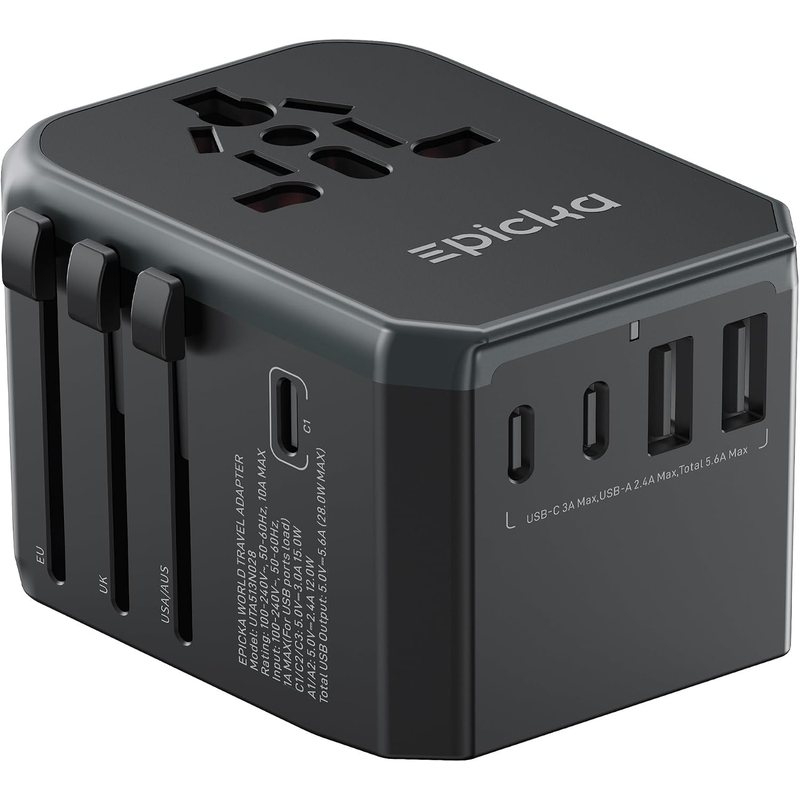
Do: count the ports on the face against the title before you pack it. Two USB-A and three USB-C is this buy. Don't: accept a TA-105 or TA-105+ label as proof if the face shows four USB-A ports and one USB-C. That is the older layout. Don't: pull the fuse and replace it with a higher-amp fuse you found in a drawer. The bullet says 10A. A larger fuse is how a fault becomes a fire. Don't: run the AC outlet at the printed ceiling for an hour in a closed bag. The watt line is a maximum, not a comfort rating. If the brick is too hot to hold, unplug it.
What the TESSAN 633F is actually for
Model 633F is the identity. Dimensions 3.1 by 2.3 by 2.7 inches and 5.9 ounces are the size and weight on the detail block for this ASIN. The title's USB split is 3 USB-C and 1 USB-A, which is four USB ports, and one AC outlet. Five devices is the charge bullet. The plug types in the description are C, G, A, and I, with the country examples above. A US traveler using it in a US hotel is on Type A, which the description includes. The same brick in London is Type G. The same brick in Sydney is Type I. Slide the right plug out. Forcing the wrong plug is how the slider breaks.
The feature bullet does not say "not a voltage converter." A different sponsored adapter on a shopping page said that. It is not this model. Because the warning is absent, do not invent a conversion feature, and do not invent peace of mind. Open the leaflet. If the leaflet says pass-through, believe it. If the leaflet is silent, treat the AC outlet as pass-through anyway until you can read a rating printed on the brick itself. Dual-voltage laptop bricks are the safe AC load. Heating appliances are the load that starts fires when the voltage is wrong. No watt ceiling is printed in the bullets we are using. Do not paste the Epicka's 1100W and 2400W lines onto 633F. They are a different card.
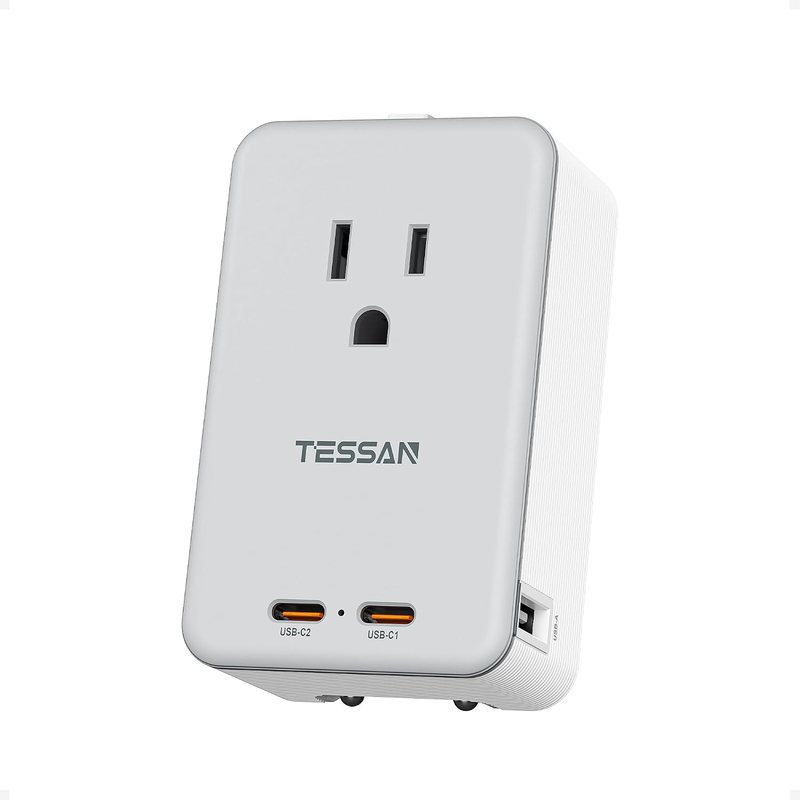
Do: match 633F on the brick or the box, and match 5.9 ounces if you bother to weigh it. Don't: assume 150 countries includes a wall the description did not name. South Africa is not in the TESSAN examples we are using, and the Epicka card excludes it outright. Don't: cover the brick with a sweater while five cables are plugged in. Heat needs a path out of a 3.1-inch block. Don't: use the single USB-A port as a reason to carry a fistful of old cables you could have replaced. One USB-A is a spare shape, not a hub for a family of cameras from 2014.
How to pack either adapter for a real trip
Start with the bag you already carry. A 35- or 40-liter carry-on has a pocket that will hide a brick until the security bin. Put the adapter in the pocket you open at the hotel, not under a duffel of dirty clothes. The Epicka spare fuse rides in the same pocket, in a small bag, so it does not look like a screw. The TESSAN has no spare-fuse sentence on the card we are using. If the leaflet includes a fuse, keep that fuse. If it does not, you do not have a spare just because the other brand shipped one.
Charge from USB first. Phones, earbuds, and cameras are USB loads. The AC outlet is for the laptop power supply that already reads 100–240V on its own label. A power bank covers the train, the airport, and the hotel where the only socket is behind the bed. The adapter covers the wall. They are not substitutes. A bank does not create a European plug. An adapter does not store energy overnight.
At the wall, seat the plug fully. A half-seated Type G plug in a UK socket arcs. A Type C plug in a recessed European socket needs the face of the brick close to the wall, which is why the 2.7-inch dimension on the TESSAN matters in a crowded strip. If the hotel has a loose socket, do not solve it by hanging the brick from the prongs. Move to another outlet. Then weigh the bag before the flight home so the brick, the bank, and the cables are in the number you tell the airline, not in a pocket you forgot.
What actually fails on these two adapters
The port count fails first. The Epicka title is 3 USB-C and 2 USB-A. A face with 4 USB-A and 1 USB-C is the older layout, even if a model cell still says TA-105 or TA-105+. The TESSAN title is 3 USB-C and 1 USB-A, model 633F. A different model with a different USB split is not this weight and not this block. The voltage story fails next. Epicka prints "not a voltage converter" and prints 1100W at 110V and 2400W at 240V. TESSAN's feature bullet does not print the warning and does not print those watts. Using the Epicka ceiling on the TESSAN is a made-up spec. Using either brick as a converter is how a 120V dryer dies, or worse.
The country list fails when you treat 200 and 150 as the same sentence. Epicka says 200 or more and names South Africa and India as exclusions. TESSAN's description says 150 or more and gives Type C, G, A, and I examples. Overlap is large. It is not identity. The fuse fails when you lose the Epicka spare or replace a 10A fuse with a nail. The heat fails when five cables and a laptop supply run under a pillow. The slider fails when you open two plug types at once or force Type I into a Type G wall.
The other failure is a sibling ASIN. A detail table that shows a different Epicka ASIN can carry a weight, a color, and a UPC from that sibling. We are not using those figures. Identify the Epicka brick by the port layout in the title. Identify the TESSAN brick by model 633F, 5.9 ounces, and 3.1 by 2.3 by 2.7 inches.
What this comparison is not
It is not a voltage converter, a power bank, or a USB hub for a desk. It is not a promise that 200 countries and 150 countries are the same map. It is not a promise that a TA-105 marking equals three USB-C ports. It is not a watt rating for the TESSAN that the TESSAN bullets did not print. It is not a hair-dryer solution. It is not the excluded countries on the Epicka card.
It is not a reason to carry two bricks and read neither leaflet. Pick the port layout you will actually fill, read the converter sentence that is there or the leaflet where it is missing, and pack the spare fuse if the box included one. The brick that matches the title is the one that charges the phone.
So which travel adapter should you buy?
Buy the Epicka adapter with 1 AC, 3 USB-C, and 2 USB-A when you want that face, the 10A fuse and spare, the "not a voltage converter" bullet, and the printed ceilings of 1100W at 110V and 2400W at 240V. Count the ports. A four-USB-A face is a different layout. Buy TESSAN model 633F when you want 3 USB-C and 1 USB-A, the 5.9-ounce and 3.1 by 2.3 by 2.7 inch detail block, and the Type C, G, A, and I description. Its feature bullet does not print a converter warning or a watt ceiling, so read the leaflet and treat the AC outlet as pass-through until that leaflet says otherwise. Neither brick turns the wall into a different voltage.
Frequently asked questions
Epicka or TESSAN 633F for a trip?
The Epicka title if you need two USB-A ports plus three USB-C and you want the not-a-converter sentence. 633F if you want three USB-C, one USB-A, and the 5.9-ounce block.
Does the Epicka convert voltage?
No. The bullets say it is not a voltage converter. The printed ceilings are 1100W at 110V and 2400W at 240V. A 120V-only dryer still does not belong on a 220V wall.
Does the TESSAN bullet say it is not a converter?
This model's feature bullet does not. Read the leaflet. Treat the AC outlet as pass-through until that leaflet says otherwise. Do not copy the Epicka watt lines onto 633F.
How many USB-C ports does each title print?
Both titles print three USB-C ports. Epicka adds two USB-A ports. TESSAN 633F adds one USB-A port. Count the face. Four USB-A and one USB-C is a different Epicka layout.
What countries does the Epicka card exclude?
The 200-country bullet names South Africa and India as exclusions. The TESSAN description says 150 or more countries and lists Type C, G, A, and I examples. Check the wall you will use.
What size is model 633F?
The detail block says 3.1 by 2.3 by 2.7 inches and 5.9 ounces. Match 633F. A different TESSAN model is a different brick.