
Blue Sea 6006 vs Perko 8501DP
Written by John Wren|
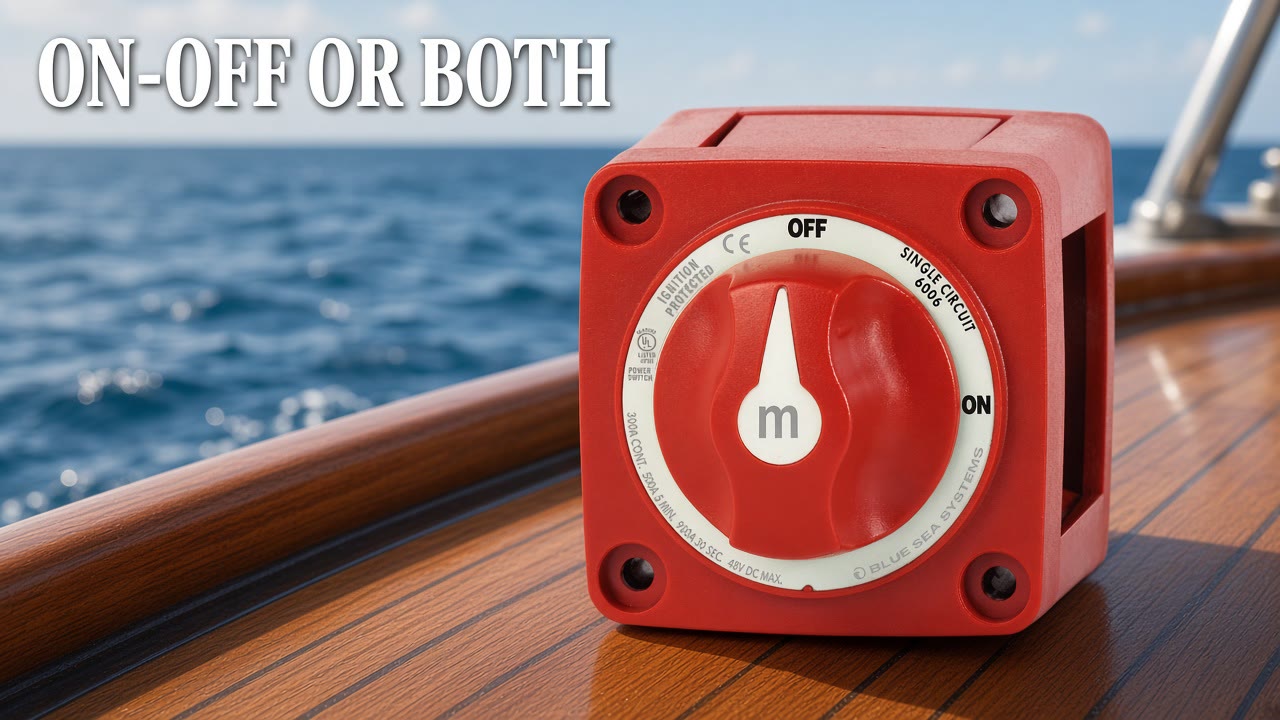
Choose Blue Sea model 6006, UPC 632085060060, for one circuit, OFF and ON. The cells say 300 amps and 48 volts. The label adds 500 amps for 5 minutes and 900 amps for 30 seconds. The actuator cell says push button. Choose Perko model 8501DP, UPC 085226559471, for a selector. The cells say 250 amps and 32 volts. The positions cell says 6. The mode cell says OFF-NONE-ON-ON.
Key takeaways
- 6006 is a single-circuit on-off switch. The cells say 300 amps and 48 volts.
- The actuator cell says push button. The knob is rotary. The wattage cell is 300 times 48.
- 8501DP is a selector. The cells say 250 amps and 32 volts. The positions cell says 6.
- The Perko wattage cell says 18000. That is not 250 times 32. Both cards say X-10.
Buy the Blue Sea m-Series battery switch, model 6006, UPC 632085060060, when you want the red single-circuit on-off switch the label marks 300 amps continuous and 48 volts DC maximum, and when you will ignore an actuator cell that says Push Button on a rotary knob. Buy the Perko battery selector, model 8501DP, UPC 085226559471, when you want a selector that can choose between banks, and when you will ignore a positions cell that says 6 and an operation-mode cell that says OFF-NONE-ON-ON. These are battery switches. They are not the same switch. One is on and off for a single circuit. The other is a selector.
Short version. A navigation light and a different Perko are a lamp and a horn, not a battery switch. Two compasses tell you a heading. Two hand pumps move water. Two electric bilge pumps move more water. Model 6006 and model 8501DP decide which battery those loads can see. Match the model before you match the words battery switch.
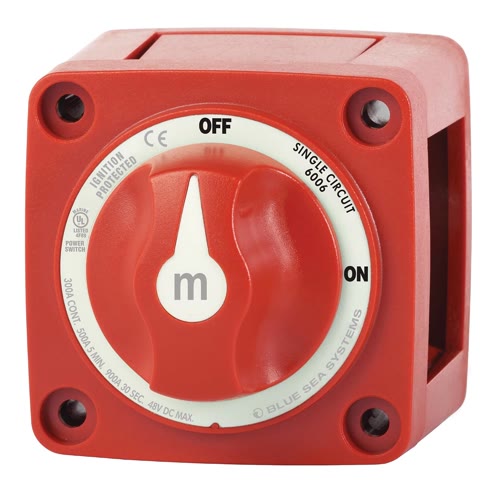
The Blue Sea title on this card is an m-Series on/off battery switch in red, model 6006. The UPC is 632085060060. The GTIN is 00632085060060. The current-rating cell says 300 amps. The operating-voltage cell says 48 volts. The switch-type cell says Rotary. The number-of-positions cell says 2. The control-type cell says ON/OFF. The color cell says Red. The contact-material cell says Tin Plated Copper. The material cell says Marine Grade Metals and Polycarbonate. The item-weight cell says 10.4 ounces. The included-components cell says Battery Switch. The warranty cell says Lifetime. The compatible-vehicle cell says Boat. Those cells describe one red rotary on-off switch for a boat, rated 300 amps and 48 volts, with tinned copper contacts and a lifetime warranty cell.
The hardware label in the product photo is the check on those two electrical cells. It reads 300A continuous, 500A for 5 minutes, 900A for 30 seconds, 48V DC maximum, single circuit, 6006, OFF and ON, and ignition protected. The 300-amp cell matches the continuous line on that label. The 48-volt cell matches the 48V DC maximum line. The two-position cell matches OFF and ON. The card does not also print 500 amps and 900 amps in specification cells. Those duty cycles live on the label in the photo. Do not drop them. Do not replace them with a 32-volt story or a 375-amp story this card's specification cells do not print. The label you can see says 48 volts and 300 continuous. The cells agree with that label. A feature sentence about a different voltage, if a seller page mixes related products into the same text, is not this specification block.
The actuator-type cell says Push Button. The photo is a rotary knob. The switch-type cell says Rotary. A push button and a rotary knob are different actuators. This conflict is real. You turn the red knob. You do not press it like a horn. The connectivity-protocol cell says X-10. X-10 is a household automation protocol. A battery switch does not speak X-10. The control-method cell says Touch. The controller-type cell says Ring. The contact-type cell says Normally Open. The circuit-type cell says 2-way. Touch, ring, normally open, and 2-way are a pile of generic switch words. The control-type cell already said ON/OFF, and the positions cell already said 2. Use those. Ignore X-10 and Touch. The wattage cell says 14400 watts. Three hundred amps times 48 volts is 14,400. The wattage cell is the product of the two electrical cells, not a separate measurement of a motor. Do not shop a 14,400-watt inverter because this cell multiplied the rating by the voltage.
The item-dimensions cell says 3 by 4 by 6 inches. The IP rating cell says IP66. The upper-temperature cell says 85 °C. The specification-met cell says Bss. Bss is not a spelled-out standard in the cell. IP66 is a dust and water claim the cell prints. The card does not print a mounting-hole template in inches you can machine from. Six by four by three is a box size, not a panel cutout. Confirm the cutout against the switch in your hand before you drill a bulkhead. Ignition protected is on the photo label. It is the phrase that matters in a gasoline engine compartment. The card's specification cells do not repeat those two words in their own row. Cite the label for ignition protection. Cite the cells for 300 amps, 48 volts, rotary, two positions, and ON/OFF. The lifetime warranty cell does not list what a lifetime covers. A burned contact and a broken knob are different claims. The card does not separate them.
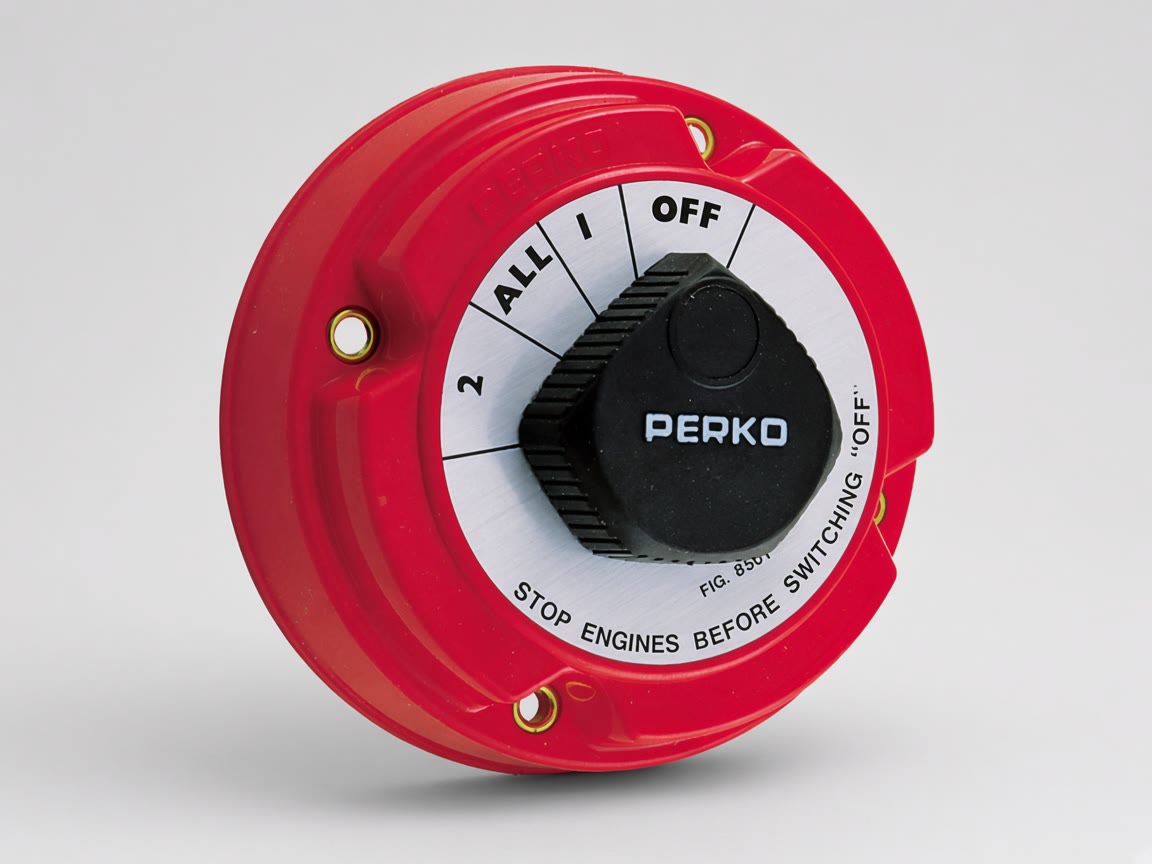
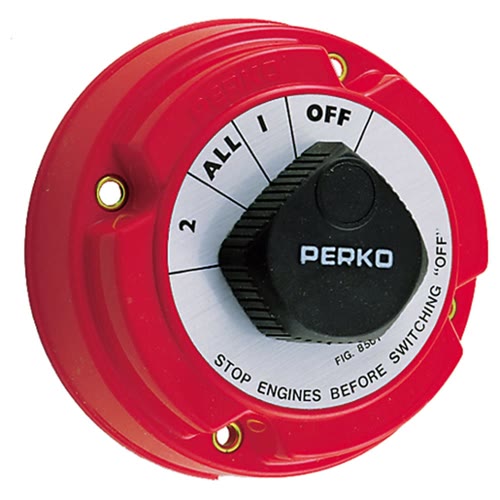
The Perko card is model 8501DP, a battery selector, UPC 085226559471, GTIN 00085226559471. The color cell says Red. The current cell says 250 amps. The voltage cell says 32 volts. The operation-mode cell says OFF-NONE-ON-ON. The number-of-positions cell says 6. The actuator cell says Rotary. The switch-type cell says Rotary. The connector-type cell says Clamp. The contact-material cell says Alloy Steel. The material cell says Plastic. The item-dimensions cell says 8 by 6 by 3 inches. The item-weight cell says 6.24 ounces. The IP cell says IP54. The upper-temperature cell says 185 °C. The connectivity-protocol cell says X-10. The control-method cell says Touch. The wattage cell says 18000 watts. A selector and an on-off switch are different products. Model 6006 is single circuit, OFF and ON. Model 8501DP is the selector a two-bank boat uses to pick battery 1, battery 2, both, or off. Do not replace one with the other because both are red and both say battery.
Six positions do not match a four-stop selector. A Perko selector face is typically OFF, 1, BOTH, and 2. That is four stops, not six. OFF-NONE-ON-ON is not the face labeling either. NONE and a repeated ON are generic mode words. The photo of this kind of switch is labeled with numbers and the word ALL or BOTH, not with NONE. Treat 6 and OFF-NONE-ON-ON as the broken cells. Treat the selector job as the reason you bought 8501DP. The feature bullets say 12, 24, and 32 volts, and they say 250 amps continuous and 360 amps intermittent, and they say ignition protected. The 250-amp cell matches the continuous bullet. The 32-volt cell matches the top of the 12/24/32 bullet. The 360-amp intermittent figure is in the bullets, not in a separate intermittent-current cell. Use it as a bullet. Do not pretend the specification table printed a second amp number if the only amp cell says 250.
The description talks about systems under 50 volts. The voltage cell says 32. Fifty and 32 are not the same ceiling. A search snippet of this listing also gives a diameter of 5-1/2 inches and a depth of 2-5/8 inches. The dimensions cell says 8 by 6 by 3 inches. A 5-1/2-inch diameter and an 8-by-6-by-3 box cannot both be the face of the switch without one of them being the mailer. The Perko catalog, which is not this Amazon cell, lists 6 to 32 volts DC, 250 amps continuous, 360 amps for 5 minutes intermittent, a diameter line that reads "5-1/4 square inches," and it separates 8501DP as a dealer pack from 8501 as an OEM bulk pack. "5-1/4 square inches" is an area-shaped phrase for a diameter, which is its own catalog problem. Do not paste it into the Amazon dimensions cell. Use the Amazon 8-by-6-by-3 cell as the cell, the 5-1/2-inch description figure as the description, and the catalog's 5-1/4 wording as the maker sheet. Measure the switch before you cut the panel.
The same Perko catalog table marks Alternator Field Disconnect as No, while the catalog paragraph says non-unitized alternators interrupt field current when the switch is turned. The Amazon description repeats the interrupt sentence. A table column that says No and a paragraph that says the field is interrupted are a maker-sheet conflict, not an Amazon specification cell. If your alternator is not unitized, read that paragraph before you turn the selector through OFF with the engine running, and do not let the word No in a catalog column be the only thing you read. This Amazon card's own electrical cells remain 250 amps and 32 volts. Eighteen thousand watts is a marketplace wattage cell. Two hundred fifty amps times 32 volts is 8,000 watts, not 18,000. Unlike the Blue Sea wattage cell, this one is not the product of the printed current and the printed voltage. Ignore 18000 watts. Ignore X-10. Ignore Touch. Alloy steel contacts versus the Blue Sea's tin-plated copper is a real material difference between the two cards. Plastic versus marine-grade metals and polycarbonate is the housing difference. IP54 versus IP66 is the ingress difference the cells print. Six point two four ounces versus 10.4 ounces is the weight difference. One hundred eighty-five degrees Celsius versus 85 degrees Celsius is the upper-temperature difference, and 185 °C is a very hot cell for a plastic battery switch. Do not mount either switch against an engine manifold because a temperature cell went that high.
| Job | Blue Sea 6006 | Perko 8501DP | Buy |
|---|---|---|---|
| What it switches | Single circuit, OFF and ON, two positions | A battery selector. Mode cell says OFF-NONE-ON-ON. Positions cell says 6 | 6006 for one bank on or off. 8501DP if you must choose banks. Do not swap them. |
| Current and voltage cells | 300 A, 48 V. Label adds 500 A for 5 min and 900 A for 30 sec | 250 A, 32 V. Bullets add 360 A intermittent and 12/24/32 V | Use the cells. Keep the duty cycles in the label or the bullets. |
| Actuator | Switch type rotary. Actuator cell says push button | Rotary in both the actuator cell and the switch-type cell | Both are knobs. Ignore push button. |
| Size and ingress | 3 x 4 x 6 in, 10.4 oz, IP66, 85 °C | 8 x 6 x 3 in, 6.24 oz, IP54, 185 °C. Description also says 5-1/2 in diameter | Measure before you drill. Ignore X-10 on both cards. |
| Contacts | Tin plated copper | Alloy steel | Different contact cells. Do not merge them. |
Who should buy the Blue Sea, and who should buy the Perko?
Buy model 6006 if you have one battery circuit to turn on and off and you want the red m-Series switch whose cells say 300 amps and 48 volts and whose label says single circuit, ignition protected, 500 amps for five minutes, and 900 amps for 30 seconds. Buy it if you will ignore push button, X-10, Touch, Ring, and a 14,400-watt cell that is only the multiplication of 300 and 48. Buy model 8501DP if you have two banks and you need a selector, and if you will ignore six positions, OFF-NONE-ON-ON, X-10, Touch, and an 18,000-watt cell that does not equal 250 times 32. Buy it if 250 amps and 32 volts, clamp connectors, and a selector face are the job, and if you have read the alternator-field sentence before you turn the knob with an engine running.
Do not buy the Blue Sea to combine two banks. The label says single circuit. Do not buy the Perko as a simple on-off for one battery and then wonder where BOTH is. Do not buy either switch from the X-10 protocol cell. Do not buy either one as a bilge pump, a compass, or a horn. Those are the other cards. A battery switch is upstream of those loads.
What model 6006 is actually for
This card is one red rotary on-off battery switch. The useful identity is model 6006, UPC 632085060060, 300 amps, 48 volts, two positions, ON/OFF, tin-plated copper, 10.4 ounces, lifetime warranty cell, boat, and the label lines for 500 amps at five minutes, 900 amps at 30 seconds, and ignition protected. The push-button actuator cell is the warning. X-10, Touch, and Ring are the warnings. The 3-by-4-by-6 dimension cell is a size you test, not a cutout drawing. IP66 and 85 °C are the environmental cells. Bss is an unexplained specification-met cell. Single circuit means one path. OFF opens it. ON closes it. There is no BOTH position because there is no second bank in the function. If your panel label says 1 / BOTH / 2, this is the wrong switch even if the amperage would have been enough.
Tin-plated copper is the contact cell. It is a reason to keep the contacts dry and tight, not a reason to sand them bright every season. The card does not print a torque for the studs. Clamp-style connections are the Perko's connector cell, not this one. Look at the studs on the back of the 6006 before you buy cable lugs. The included line says battery switch, singular. A spare knob, a label set, and a rubber boot are not promised. Ignition protected, from the label, is what lets you discuss a gasoline bilge. It is not a substitute for a fuse. The card does not print a fuse rating. The current rating is the switch, not the wire.
What model 8501DP is actually for
This card is a red Perko selector. The useful identity is model 8501DP, UPC 085226559471, 250 amps, 32 volts, rotary, clamp connectors, alloy steel contacts, plastic, 6.24 ounces, IP54, and the bullets for 12/24/32 volts, 360 amps intermittent, and ignition protected. The warnings are six positions, OFF-NONE-ON-ON, X-10, Touch, 18000 watts, an 8-by-6-by-3 dimension cell that fights a 5-1/2-inch description, and a 185 °C upper temperature. The dealer-pack distinction lives on the maker sheet: 8501DP versus bulk 8501. Order the DP model this card names if you want the dealer pack. The card does not print a count of switches inside the dealer pack in the cells above. Open the box and count before you assume a spare.
A selector exists so a two-battery boat can start on one bank, charge, or isolate. BOTH, or ALL on some faces, ties the banks. OFF isolates both. The operation-mode cell's NONE is not a position you can point to on the face. The interrupt sentence for non-unitized alternators is the operational warning. Turning a selector to OFF while an engine is running is how a diode, or the alternator itself, gets asked to absorb a load the field wire was supposed to shed. The catalog column that says the field disconnect feature is No does not erase the paragraph. Read the paragraph that the Amazon description repeats. If you do not know whether your alternator is unitized, do not use this switch as the only way you shut the engine down.
How to install them without mixing the two jobs
Mount the 6006 where a single battery's positive cable can be opened. Mount the 8501DP where two batteries and a load can land on the studs a selector expects. Do not land two battery positives on the 6006 and call it BOTH. The label says single circuit. Do not land one battery on the 8501DP and ignore the second stud, then expect the positions to mean something. Cable size is not on either card. The amp rating is the switch rating. The wire has its own rating. A 300-amp switch on a wire that cannot carry the starter is not a 300-amp system. Neither card prints a wire gauge.
Drill from a template you measured, not from 3 by 4 by 6 or from 8 by 6 by 3. Those cells disagree with the round face you can see, and the Perko description's 5-1/2-inch diameter disagrees with both. IP66 and IP54 are not a reason to submerge the switch. They are the cells. A battery switch still wants to be above the slosh. Ignition protected is about sparks in a gasoline compartment. It is printed on the 6006 label and in the 8501DP bullets. It is not printed as a shared test report. Keep the X-10 cell out of the installation notes. There is no home-automation controller hiding behind the knob.
What actually fails on these two cards
The Blue Sea card fails when push button is copied onto a work order and a yard looks for a button. It fails when 14400 watts is copied as an inverter size. It fails when X-10 sends the switch to a smart-home cart. It fails when 500 amps for five minutes and 900 amps for 30 seconds are dropped, or when they are replaced with numbers this card does not print. It fails when single circuit is ignored and two banks are forced onto one knob. It fails when the dimension cell is used as a cutout.
The Perko card fails when six positions is used to claim two extra stops the face does not have. It fails when OFF-NONE-ON-ON is printed on a panel placard. It fails when 18000 watts is treated as 250 times 32. It fails when 50 volts in the description replaces the 32-volt cell, or the 32-volt cell is used to reject a 12-volt boat the bullets include. It fails when 8 by 6 by 3 is drilled and the face is 5-1/2 inches. It fails when the field-interrupt paragraph is skipped because a catalog column said No. It fails when 8501DP is swapped with an on-off switch because both are red.
What this comparison is not
This is not a claim that one switch starts an engine the other cannot. Neither card prints a starter test. This is not a 32-volt versus 48-volt argument about the same function. One is an on-off switch. The other is a selector. This is not a price quote. Use the buttons for the live listing. This is not a bilge-pump, compass, light, or horn review. This is not a wiring diagram. The cards do not print wire gauge, fuse size, or a panel template. This is not the Perko horn on the other article. Model 8501DP is the selector. A different Perko number is a different product.
So which battery switch should you buy?
Buy the Blue Sea if you want model 6006, one circuit, OFF and ON, 300 amps, 48 volts, and the label's intermittent numbers, and if you will throw out push button, X-10, and the wattage multiplication. Buy the Perko if you want model 8501DP, a selector, 250 amps, 32 volts, and the 360-amp intermittent bullet, and if you will throw out six positions, OFF-NONE-ON-ON, X-10, and 18000 watts. Buy neither if you wanted one switch to be both an on-off and a combiner without reading the label. The model stamp is the decision. The cells are the warnings.
The Asobolife film, "Product Review - Blue Sea Systems Battery Switch (6006)," shows the 6006. It does not show the Perko 8501DP. Use it for the red knob and the single-circuit layout. Do not use it as a reading of the Perko positions cell or of the selector face.
Frequently asked questions
Blue Sea 6006 or Perko 8501DP for a boat battery?
6006 if you need a single-circuit on-off switch. 8501DP if you need a selector between banks. They are not the same switch.
Is the Blue Sea 6006 a push button?
The actuator cell says push button. The switch-type cell says rotary. The photo is a knob marked OFF and ON. Turn it. Do not shop for a button.
What do the 6006 current and voltage cells say?
The current cell says 300 amps. The voltage cell says 48 volts. The hardware label adds 500 amps for 5 minutes, 900 amps for 30 seconds, and 48V DC maximum.
Why does the Perko card say 6 positions?
The positions cell says 6 and the operation-mode cell says OFF-NONE-ON-ON. A selector face is four stops. Treat both cells as the broken fields.
Does 18,000 watts match 250 amps at 32 volts?
No. Two hundred fifty times 32 is 8,000, not 18,000. The Blue Sea wattage cell of 14400 is 300 times 48. The Perko wattage cell is not that kind of product.
Does the video show both switches?
No. The Asobolife clip reviews the Blue Sea 6006. It does not show the Perko 8501DP.