
Best Tactical Flashlights (2026): SureFire, Streamlight, and What to Skip
Written by John Wren|
Buy a Streamlight ProTac 1L-1AA for dual-fuel EDC or a SureFire G2X if you want a duty-shaped light that lasts. 300–800 usable lumens beat a 3,000-lumen zoom toy. Carry a spare cell.
Key takeaways
- Switch, body, and battery plan beat a lumen sticker.
- SureFire G2X for buy-it-once; Streamlight ProTac for dual-fuel EDC.
- Zoomable checkout-aisle lights are utility toys, not duty lights.
- Practice momentary-on and carry a spare cell.
A tactical flashlight is not a camping lantern and it is not a novelty zoom toy from a checkout aisle. It is a small, durable light you can run with one hand, clip in a pocket, and trust when the power is out, the trail goes black, or you need a bright, ugly burst of photons in someone’s eyes long enough to leave. The features that matter are output you can actually use, a switch you will not fumble, a body that survives drops, and a battery plan that does not strand you.
Our 2026 short list keeps the names that have earned law-enforcement and EDC reputations — SureFire and Streamlight — and one value kit light if the budget is the constraint. We would rather send you a 600-lumen SureFire that still works in five years than a 3,000-lumen mystery light that dies when you drop it off a tailgate. Lumens are not the whole spec. Candela (throw), runtime, and switch design are how you tell a tool from a toy.
What does “tactical” actually mean on a flashlight?
It means the light was designed to be used under stress: tail-cap switch, momentary-on, a grip you can keep with gloves, and a bezel that will not shatter the first time it hits concrete. Some bezels are crenelated so the light can be used as a striking aid. That is a last-ditch option, not a personality. If self-defense is the job, training matters more than a crown. If camping is the job, a strobe you cannot find in the UI is a liability.
EDC (every day carry) lights live in a pocket. Belt lights live next to a multi-tool. Nightstand lights can be bigger. Do not buy a 10-inch “tactical” club and then complain it will not clip in jeans. Size is a feature. So is a pocket clip that is actually reversible and does not chew your pocket to death in a week.
For the walk-in-the-woods version of this conversation, pair a handheld with a headlamp so you are not tying up a hand on a trail. For the “I also carry a pen” crowd, the tactical pen guide is the sibling page. Brightness bragging lives on best brightest flashlight if you insist on the lumen war.
How should you choose lumens, batteries, and switches?
Lumens describe total light. Candela describes how intense the hotspot is and how far it throws. A floody 1,000-lumen light can be worse on a trail than a 350-lumen light with a tight reflector. For property, power outages, and around the truck, 300–800 lumens on high is plenty. For spotting eyes at the tree line, you want throw, which is candela, not a bigger lumen sticker.
Batteries: USB-C 18650 or proprietary rechargeable cells are the 2026 default. AA and CR123A still win when you want a light that eats gas-station batteries at 11 p.m. Streamlight’s dual-fuel ProTac idea — 18650 or CR123, sometimes AA — is why those lights stay in duty bags. Mystery zoom lights that only take a no-name 18650 with a barrel charger are how you end up with a brick.
Switches: a tail cap you can find in the dark is the tactical standard. Side switches are fine for camping. Mode memory that boots into strobe is hostile. You want high, low, and maybe strobe in a sequence you can learn in one evening. If you have to click seven times to get moonlight, you will not use moonlight.
| Light | Best for | Power | Why it is here |
|---|---|---|---|
| SureFire G2X | Duty / “buy it once” | CR123 | Body and switch you can trust |
| Streamlight ProTac 1L-1AA | EDC / dual fuel | AA or CR123 | Small, programmable, cheap to feed |
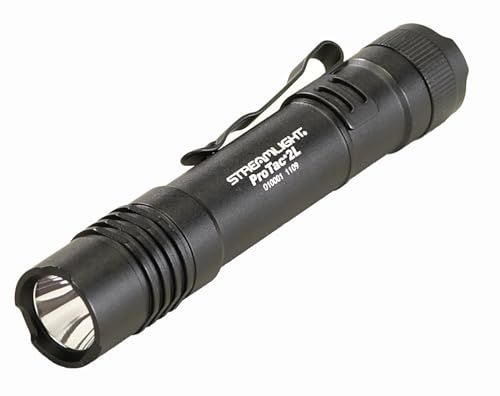
| Streamlight ProTac (88031 class) | Belt / kit light | CR123 / 18650 options | Parts, clips, holsters exist |
| EcoGear FX kit | Budget kit in a box | 18650 + charger | Complete kit, not a duty light |
SureFire G2X — buy-it-once tactical
SureFire earned the word tactical by selling lights to people who get paid to work in the dark. The G2X series uses a Nitrolon polymer body with an aluminum bezel, a tail-cap that can momentary or click, and an LED that is not trying to win a lumen contest on a product page. Six hundred lumens on high with a useful spill is more honest than a 2,000-lumen claim from a brand you will not find a spare clip for.
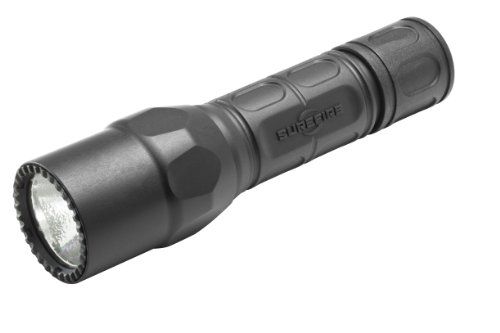
It runs CR123s, which cost more than AA and store longer than cheap 18650s you bought in a three-pack. That is a feature for a glove-box or duty light you might not touch for six months. The polymer body is lighter than full aluminum and does not weld itself to your skin in January. If you want aluminum and USB-C, look at Streamlight’s newer ProTac 2.0 class or a Fenix — but the G2X is still the light we would throw in a door pocket and forget until we needed it.
Streamlight ProTac 1L-1AA — best dual-fuel EDC
This is the pocket light. Anodized aluminum, TEN-TAP programming so you can set high/low/strobe the way you think, and the ability to run a CR123 or an AA. That last part is the whole review. When the rechargeable is dead, any gas station can feed it. Output on the CR123 is the useful one. AA is the backup personality.
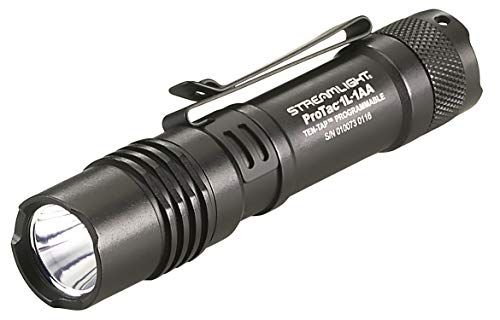
The clip is actually a clip. The anti-roll head is not a joke if you set it on a truck roof. Waterproofing is IPX7, which means rain and a dropped-in-the-creek moment, not a dive light. If you want a slightly different ProTac body in the same family, the 88031-class light is the holster version that lives on a belt.
EcoGear FX — complete kit, known limits
Budget tactical kits survive because they include two 18650s, a charger, and a zoomable CREE-style LED for the price of a SureFire tail cap. The EcoGear FX is that kit. It will light a backyard. It will zoom into a square hotspot. It will not be the light we trust as a duty primary. Buy it as a glove-box spare and a charger that already lives in the bag, not as your only light.
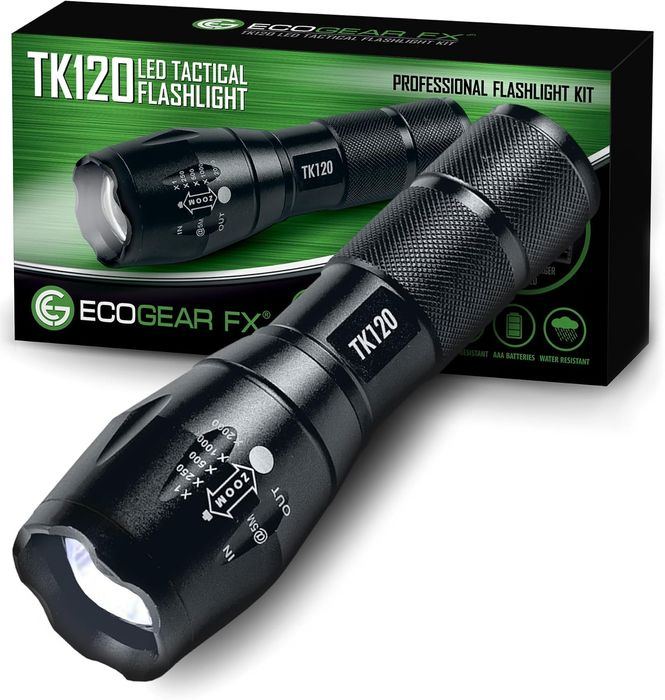
Zoomable heads are a tell. Duty lights are usually fixed-focus for a reason: a zoom that slides also leaks, eats drop tests, and gives you a square beam that looks impressive on a wall and messy on a trail. If you like zoom, admit you bought a utility light. That is fine. Do not call it a SureFire.
How should you carry and use it?
Clip it bezel-down or bezel-up based on whether you want to draw and click without thinking. Practice the click with the hand you actually carry on. Momentary-on is how you check a yard without advertising a lighthouse. High is for “I need to see now.” Low is for map, engine bay, and not wrecking night vision. Strobe is for signaling and for making a problem blink. It is not a personality.
Around firearms, a handheld is not a weapon light. If you need a light on a gun, that is a different mounting, switch, and training problem — see the optics and ear-pro pages if that is your lane. Around dogs and kids, do not strobe people in the face as a joke. Around the woods, a red or low mode keeps you from destroying your own night vision every time you check a knot. Our how to use a tactical flashlight piece is the technique companion to this buying guide.
Runtime claims assume a new cell at room temperature. Cold eats lithium. High mode eats minutes. Carry a spare cell or a dual-fuel light. Mark the tail cap with a bit of paint if you own more than one light so you can find it in a bag without turning it on.
What should you actually buy?
Most people should buy the Streamlight ProTac 1L-1AA and a spare AA pack, or the SureFire G2X if they want the duty-shaped light and will pay for CR123s. Buy the EcoGear kit only as a spare. If your use is hunting, add a headlamp. If your use is a night walk on a county road, add reflective something that is not the light itself. If your use is “I saw a 4,000-lumen ad,” close the tab and look at candela and switch quality instead.
We will keep these ASINs live. When a light disappears, we replace it with the closest current Streamlight or SureFire equivalent — same job, our tag, no empty box. That is the deal on this URL.
What is candela, in plain language?
If lumens are the size of the bucket of light, candela is how hard you squeeze it into a beam. A living-room flood can be high lumens and still fail to show you a fence line. A thrower can look modest on a lumen chart and still pick up a reflective marker at two hundred yards. Manufacturers mix the two on purpose. Read both, or look at beam photos from reviewers who are not selling the light.
For a house, a truck, and a campsite, flood is friendlier. For a long driveway, a pasture, or “what was that in the tree line,” throw is the feature. The Streamlight ProTacs in this list are a compromise: enough flood to walk, enough hotspot to point. The no-name 3,000-lumen zoom light is usually a flood that you squeeze into an ugly square. It photographs well. It walks poorly.
Charging, water, and boats
Do not charge swollen cells. Do not leave a barrel charger on a dashboard in July. USB-C lights with quality cells are less drama than 2016’s mystery 18650 kits, but physics still applies. On a boat, IPX7 is rain and a drop in the bilge, not an invitation to find the light with your foot in four feet of water. Tie a lanyard if the light lives near a gunwale. Aluminum sinks. So do excuses.
Holsters make belt carry sane. Clips make pocket carry sane. A light that only lives in the bottom of a backpack is a camping light you will not have when the breaker trips. Pick a home for it: door pocket, nightstand, weak-side pocket, or kit bag, and put it back there. The best tactical flashlight is the one you can find in the dark without a flashlight.
What we skipped on purpose
Olight, Fenix, Cloud Defensive, and Modlite all make serious lights. Some of them are better than what is on this page for a given job. They are not all easy Amazon-tag buys in the way Streamlight and SureFire still are, and this URL has always been a buying page, not a collector catalog. If a current ProTac 2.0 or Stiletto-class listing is a cleaner dual-fuel USB-C option when you click through, take it — same family, same job. We would rather you leave with a light that ships this week than a perfect spec sheet that is out of stock until next quarter.
Frequently asked questions
What is the best tactical flashlight for most people?
A Streamlight ProTac 1L-1AA if you want dual-fuel EDC, or a SureFire G2X if you want a duty-shaped light that will still work in five years. Ignore giant lumen claims from no-name zoom lights.
How many lumens do I need?
300–800 on high is plenty for property, outages, and around a truck. For throw to the tree line, look at candela, not just lumens. A floody 1,000-lumen light can be worse on a trail than a tighter 350.
Are rechargeable tactical flashlights better?
USB-C 18650 lights are convenient. Dual-fuel lights (AA or CR123 plus rechargeable) are more reliable when you travel. A light that only takes a no-name cell is a future brick.
Should I buy a zoomable flashlight?
Zoom is fine on a utility light. Duty and EDC lights are usually fixed-focus because zoom heads leak, fail drop tests, and throw ugly square beams.
Can a tactical flashlight be used for self-defense?
A bright momentary burst can buy you time. A crenelated bezel is a last-ditch striking aid. Neither replaces awareness or training. Do not strobe people as a joke.